
Homework Answers

Add Answer to:
Please show all work
The de-de converter shown in Fig. 1 operates in continuous conduction mode....
conversion ratio analysis of the SEPIC of Fig. 4 a) Suppose that the converter operates at...
 conversion ratio analysis of the SEPIC of Fig. 4 a) Suppose that the converter operates at the boundary between CCM and DCM DCM, with the following element and parameter values D 0.225 f-100 kHz V120 V C2 200 μF Sketch the diode current ID(t) waveform and the inductor current waveforms and I(t) and 12(t) Label the magnitudes of the ripples and de components of these waveforms. b) Suppose next that the converter operates in the discontinuous conduction mode, with a...
5. Consider the the SEPIC converter shown in of Fig. 4 о, 01 Figure 4: Sepic...
 5. Consider the the SEPIC converter shown in of Fig. 4 о, 01 Figure 4: Sepic Converter a) Sketch the diode current waveform for CCM operation. Find its peak value, in terms of the ripple magnitudes ΔΙ.and Δ1L2 and the dc components li and 12 of the two inductor currents Ii(t) and I2(t) respectively b) Derive an expression for the conditions under which the SEPIC operates in the discontinuous conduction mode. Express your result in the form K< Keni(D) and...
Buck Converter Question Q3. A Buck converter is used to produce a regulated 10V, 5A DC...
 Buck Converter Question
Q3. A Buck converter is used to produce a regulated 10V, 5A DC power supply from a variable DC source with an nominal input voltage of Vin = 20V±5V. The Buck converter switches at 250kHz, and operates entirely in the continuous conduction mode. The output filter capacitance is C1.0uF 3.a. Draw the circuit topology for the Buck converter. Ensure that your circuit includes the input DC source, the output load resistance, the switching devices (i.e. MOSFET and...
Buck Converter Question
Q3. A Buck converter is used to produce a regulated 10V, 5A DC power supply from a variable DC source with an nominal input voltage of Vin = 20V±5V. The Buck converter switches at 250kHz, and operates entirely in the continuous conduction mode. The output filter capacitance is C1.0uF 3.a. Draw the circuit topology for the Buck converter. Ensure that your circuit includes the input DC source, the output load resistance, the switching devices (i.e. MOSFET and...
P8.8 A forward converter supplied from a 25-V de source operates with the switch- ing frequency...
 P8.8 A forward converter supplied from a 25-V de source operates with the switch- ing frequency of 50 kHz and duty ratio of 0.5. The turn ratio of the trans- former is 1:1, the output capacitance is 150 uF, and the load draws a current of 2.5 A. Select the minimum inductance for continuous conduction mode and determine the average value and ripple amplitude of the output voltage.
QUESTION 3 In the DC-DC buck-boost converter shown in next page assume that all the components...
 QUESTION 3 In the DC-DC buck-boost converter shown in next page assume that all the components are ideal and the converter is operating in continuous conduction mode and is in steady-state (a) Derive the conversion ratio of WI - Draw the circuit diagram when the switch is in on and off states. Use small ripple approximation for your analysis Sketch the current through and the voltage across the inductor when the switch is in on and off states. Include all...
3. For the non-ideal buck converter in Fig. 3, 1) Derive the state space model with state variable vector X as (it, vc), input variable vector U as (vi, io), output variable vector Y as vo. Deriv...
 3. For the non-ideal buck converter in Fig. 3, 1) Derive the state space model with state variable vector X as (it, vc), input variable vector U as (vi, io), output variable vector Y as vo. Derive the coefficient matrices in the model below. Note that duty cycle should be considered and included. dt ) di di dt 2)Select the line of a L, ie., a L-4-i, +A2Mz + Bı'y4B12%.and use perturbation-and- dt linearization approach to derive its small-signal representation....
MOSFET Diode 0 Fig. 1. Buck converter with non-ideal switches 2. Based on the small-signal model...
 MOSFET Diode 0 Fig. 1. Buck converter with non-ideal switches 2. Based on the small-signal model derived in Problem 1, assume Vin and io are ideal with no variations (i.e., the perturbations of vin and io equal zero), rewrite the state space equations. Note that in the updated state space equations, only the perturbation of duty cycle d is considered in the vector of input variables 3. Understand the function of the MATLAB commands 'ss' and 'bode'1. Use the command...
5. s a de current and In the circuit shown in Fig. P e, is a...
 5. s a de current and In the circuit shown in Fig. P e, is a sinusoidal signal. Capacitors C, and C, are very large; their function is to couple the signal to and from the diode but block the de current from flowing into the signal source or the load (not shown). Use the diode small-signal model to show that the signal component of the output voltage is V, If v, = 10mV, find v, for 1 = 1...
Question 1 For the flyback converter shown in Fig. 1, Vin is 30 V, Vout is 8 V, the output power is 30 w, 30 turns are...
 Question 1 For the flyback converter shown in Fig. 1, Vin is 30 V, Vout is 8 V, the output power is 30 w, 30 turns are fitted to winding Ww1, 15 turns are fitted to winding W2, the inductance of W1, L1, is 50 uH and the switching frequency is 200 kHz. The flyback converter operates in continuous conduction mode. Calculate the time for which S1 is switched on a. b. Calculate Aisı during the time S1 is switched...
1. In the converter of Fig. 1, the inductor has winding resistance RL. All other losses...
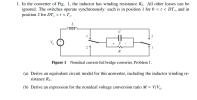 1. In the converter of Fig. 1, the inductor has winding resistance RL. All other losses can be ignored. The switches operate synchronously: each is in position 1 for 0 < t < DTs, and in position 2 for DT< T Figure 1 Nonideal current-fed bridge converter, Problem 1 (a) Derive an equivalent circuit model for this converter, including the inductor winding re- sistance R (b) Derive an expression for the nonideal voltage conversion ratio M
 conversion ratio analysis of the SEPIC of Fig. 4 a) Suppose that the converter operates at the boundary between CCM and DCM DCM, with the following element and parameter values D 0.225 f-100 kHz V120 V C2 200 μF Sketch the diode current ID(t) waveform and the inductor current waveforms and I(t) and 12(t) Label the magnitudes of the ripples and de components of these waveforms. b) Suppose next that the converter operates in the discontinuous conduction mode, with a...
 5. Consider the the SEPIC converter shown in of Fig. 4 о, 01 Figure 4: Sepic Converter a) Sketch the diode current waveform for CCM operation. Find its peak value, in terms of the ripple magnitudes ΔΙ.and Δ1L2 and the dc components li and 12 of the two inductor currents Ii(t) and I2(t) respectively b) Derive an expression for the conditions under which the SEPIC operates in the discontinuous conduction mode. Express your result in the form K< Keni(D) and...
 Buck Converter Question
Q3. A Buck converter is used to produce a regulated 10V, 5A DC power supply from a variable DC source with an nominal input voltage of Vin = 20V±5V. The Buck converter switches at 250kHz, and operates entirely in the continuous conduction mode. The output filter capacitance is C1.0uF 3.a. Draw the circuit topology for the Buck converter. Ensure that your circuit includes the input DC source, the output load resistance, the switching devices (i.e. MOSFET and...
Buck Converter Question
Q3. A Buck converter is used to produce a regulated 10V, 5A DC power supply from a variable DC source with an nominal input voltage of Vin = 20V±5V. The Buck converter switches at 250kHz, and operates entirely in the continuous conduction mode. The output filter capacitance is C1.0uF 3.a. Draw the circuit topology for the Buck converter. Ensure that your circuit includes the input DC source, the output load resistance, the switching devices (i.e. MOSFET and...
 P8.8 A forward converter supplied from a 25-V de source operates with the switch- ing frequency of 50 kHz and duty ratio of 0.5. The turn ratio of the trans- former is 1:1, the output capacitance is 150 uF, and the load draws a current of 2.5 A. Select the minimum inductance for continuous conduction mode and determine the average value and ripple amplitude of the output voltage.
 QUESTION 3 In the DC-DC buck-boost converter shown in next page assume that all the components are ideal and the converter is operating in continuous conduction mode and is in steady-state (a) Derive the conversion ratio of WI - Draw the circuit diagram when the switch is in on and off states. Use small ripple approximation for your analysis Sketch the current through and the voltage across the inductor when the switch is in on and off states. Include all...
 3. For the non-ideal buck converter in Fig. 3, 1) Derive the state space model with state variable vector X as (it, vc), input variable vector U as (vi, io), output variable vector Y as vo. Derive the coefficient matrices in the model below. Note that duty cycle should be considered and included. dt ) di di dt 2)Select the line of a L, ie., a L-4-i, +A2Mz + Bı'y4B12%.and use perturbation-and- dt linearization approach to derive its small-signal representation....
 MOSFET Diode 0 Fig. 1. Buck converter with non-ideal switches 2. Based on the small-signal model derived in Problem 1, assume Vin and io are ideal with no variations (i.e., the perturbations of vin and io equal zero), rewrite the state space equations. Note that in the updated state space equations, only the perturbation of duty cycle d is considered in the vector of input variables 3. Understand the function of the MATLAB commands 'ss' and 'bode'1. Use the command...
 5. s a de current and In the circuit shown in Fig. P e, is a sinusoidal signal. Capacitors C, and C, are very large; their function is to couple the signal to and from the diode but block the de current from flowing into the signal source or the load (not shown). Use the diode small-signal model to show that the signal component of the output voltage is V, If v, = 10mV, find v, for 1 = 1...
 Question 1 For the flyback converter shown in Fig. 1, Vin is 30 V, Vout is 8 V, the output power is 30 w, 30 turns are fitted to winding Ww1, 15 turns are fitted to winding W2, the inductance of W1, L1, is 50 uH and the switching frequency is 200 kHz. The flyback converter operates in continuous conduction mode. Calculate the time for which S1 is switched on a. b. Calculate Aisı during the time S1 is switched...
 1. In the converter of Fig. 1, the inductor has winding resistance RL. All other losses can be ignored. The switches operate synchronously: each is in position 1 for 0 < t < DTs, and in position 2 for DT< T Figure 1 Nonideal current-fed bridge converter, Problem 1 (a) Derive an equivalent circuit model for this converter, including the inductor winding re- sistance R (b) Derive an expression for the nonideal voltage conversion ratio M
Most questions answered within 3 hours.
-
Where is the error in this code sequence?
String s1 = "Hello";
String s2 = "ello";...
asked 10 months ago -
Financial data for Joel de Paris, Inc., for last year
follow:
Joel de Paris, Inc.
Balance...
asked 10 months ago -
Consider this reaction:
Al2(SO4)3 (aq)+ BaCl3
(aq) Al2Cl6 (aq)- +
3BaSO4(s) . What is the...
asked 10 months ago -
Suppose that Savneet is considering increasing her
recent random sample from 20 car rentals to 40...
asked 10 months ago -
Trucks arrive at an unloading terminal at an average rate of 120
per hour.
Trucks arrive...
asked 10 months ago -
Why are methanol and ethanol completely soluble in water while
octanol is not very little soluble....
asked 10 months ago -
A facilities manager at a university reads in a research report
that the mean amount of...
asked 10 months ago -
When the CuSO4 is rehydrated by adding water to the anhydrous
compound, is this an endothermic...
asked 10 months ago -
A ray of sunlight is passing from diamond into crown glass; the
angle of incidence is...
asked 10 months ago -
A block of mass 0.249 kg is placed on top of a light, vertical
spring of...
asked 10 months ago -
how do the kidneys compensate in the presences of acidosis
a) trigger hyperventilate
b) reserve acid...
asked 10 months ago -
Question 501 pts
The rental rate of capital to the firm increases. Which of the
following...
asked 10 months ago