
Homework Answers
Add Answer to:
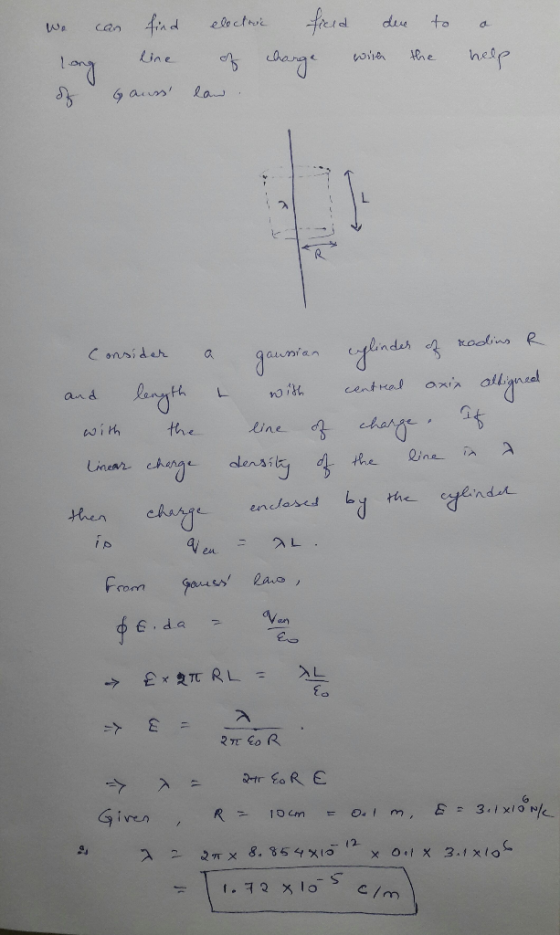
Consider a charged conductor as a long line of charge uniformly
distributed along its length. the...
A.) charge +Q is distributed uniformly along a straight line of length L. Find the Electric...
A.) charge +Q is distributed uniformly along a straight line of length L. Find the Electric field at a point P along the direction of the line a distance d from it. Calculate the electric field strength if Q = + 6 μC , L= 0.10m and d = 0.05m. B.) With the same charge distribution, calculate the electric field strength at a point a distance d = 0.05m above or below the mid-point of the charged line.
In the figure a nonconducting rod of length L = 8.41 cm has charge -q = -4.27 fC uniformly distributed along its length.
In the figure a nonconducting rod of length L = 8.41 cm has charge -q = -4.27 fC uniformly distributed along its length. (a) What is the linear charge density of the rod? What are the (b) magnitude and(c) direction (positive angle relative to the positive direction of the x axis) of the electric field produced at point P, at distance a = 12.3 cm from the rod? What is the electric field magnitude produced at distancea = 70 m...
A long cylindrical shell (radius = 4cm ) has a charge uniformly distributed on its surface.
A long cylindrical shell (radius = 4cm ) has a charge uniformly distributed on its surface. If the magnitude of the electric field at a point 8.0 cm radially outward from the axis of the shell is 85 N/C, how much charge is distributed on a 2.0-m length of the charged cylindrical surface?
+3.20 nC of charge is uniformly distributed along the top half of a thin rod of total length L = 3.40 cm, while -3.20 nC of charge is uniformly distributed along the bottom half of the rod
 +3.20 nC of charge is uniformly distributed along the top half of a thin rod of total length L = 3.40 cm, while -3.20 nC of charge is uniformly distributed along the bottom half of the rod, as shown in the figure, what is the magnitude of the electric field at the dot, a distance r= 20.0 cm from the centre of the rod?
A long uniformly charged thread (linear charge density A -2.1 C/m) lies along the z axis in the figure.
 A long uniformly charged thread (linear charge density A -2.1 C/m) lies along the z axis in the figure.(Figure 1) A small charged sphere (Q =-2.4 C ) is at the point x=0 cm, y = -5.0 cm.Part AWhat is the direction of the electric field at the point x = 7.0 cm, y =7.0 cm? Ethread and EQ represent fields due to the long thread and the charge Q, respectively.Part B What is the magnitude of the electric field at...
A straight, nonconducting plastic wire 8.50 cm long carries a charge density of +175 nC/m distributed uniformly along its length.
A straight, nonconducting plastic wire 8.50 cm long carries a charge density of +175 nC/m distributed uniformly along its length. It is lying on a horizontal tabletop. (a) Find the magnitude and direction of the electric field this wire produces at a point 6.00 cm directly above its midpoint (b) If the wire is now bent into a circle lying flat on the table, find the magnitude and direction of the electric field it produces at a point 6.00 cm...
Problem 2 Electric charge is distributed uniformly along a thin rod of length a. with total...
 Problem 2 Electric charge is distributed uniformly along a thin rod of length a. with total charge Q. Find the E field at P a) If Q is concentrated at the center of the rod. b) If Q uniformly distributed along the road. c)Suppose that the road is infinity long and point P is at the middle of the road at distance b above the road, what will be the E field at point P?
Problem 2 Electric charge is distributed uniformly along a thin rod of length a, with total...
 Problem 2 Electric charge is distributed uniformly along a thin rod of length a, with total charge Q. Find the E field at P. a) If Q is concentrated at the center of the rod. b) If Q uniformly distributed along the road. c)Suppose that the road is infinity long and point P is at the middle of the road at distance b above the road, what will be the E field at point P? 0
A straight, nonconducting plastic wire 8.50 cm long carries a charge density of 100 nC/m distributed uniformly along its length. It is lying on a horizontal tabletop.
A straight, nonconducting plastic wire 8.50 cm long carries a charge density of 100 nC/m distributed uniformly along its length. It is lying on a horizontal tabletop. Part C If the wire is now bent into a circle lying flat on the table, find the magnitude and direction of the electric field it produces at a point 4.50 cm directly above its center.
For Problems 4-5: Consider a uniformly-charged rod of length L 12.0 cm and total charge (which...
 For Problems 4-5: Consider a uniformly-charged rod of length L 12.0 cm and total charge (which is not known) P4. The electric field on the perpendicular bisector of this rod, 5.00 cm from it, is be 3.2 × 10⁴ N/C. Calculate。 measured to 5.00 cm P5. What is the electric field created by this rod at a point 5.00 cm from the rod, along a line perpendicular to the end of the rod?
 Problem 2 Electric charge is distributed uniformly along a thin rod of length a. with total charge Q. Find the E field at P a) If Q is concentrated at the center of the rod. b) If Q uniformly distributed along the road. c)Suppose that the road is infinity long and point P is at the middle of the road at distance b above the road, what will be the E field at point P?
 Problem 2 Electric charge is distributed uniformly along a thin rod of length a, with total charge Q. Find the E field at P. a) If Q is concentrated at the center of the rod. b) If Q uniformly distributed along the road. c)Suppose that the road is infinity long and point P is at the middle of the road at distance b above the road, what will be the E field at point P? 0
 For Problems 4-5: Consider a uniformly-charged rod of length L 12.0 cm and total charge (which is not known) P4. The electric field on the perpendicular bisector of this rod, 5.00 cm from it, is be 3.2 × 10⁴ N/C. Calculate。 measured to 5.00 cm P5. What is the electric field created by this rod at a point 5.00 cm from the rod, along a line perpendicular to the end of the rod?
Most questions answered within 3 hours.
-
Where is the error in this code sequence?
String s1 = "Hello";
String s2 = "ello";...
asked 10 months ago -
Financial data for Joel de Paris, Inc., for last year
follow:
Joel de Paris, Inc.
Balance...
asked 10 months ago -
Consider this reaction:
Al2(SO4)3 (aq)+ BaCl3
(aq) Al2Cl6 (aq)- +
3BaSO4(s) . What is the...
asked 10 months ago -
Suppose that Savneet is considering increasing her
recent random sample from 20 car rentals to 40...
asked 10 months ago -
Trucks arrive at an unloading terminal at an average rate of 120
per hour.
Trucks arrive...
asked 10 months ago -
Why are methanol and ethanol completely soluble in water while
octanol is not very little soluble....
asked 10 months ago -
A facilities manager at a university reads in a research report
that the mean amount of...
asked 10 months ago -
When the CuSO4 is rehydrated by adding water to the anhydrous
compound, is this an endothermic...
asked 10 months ago -
A ray of sunlight is passing from diamond into crown glass; the
angle of incidence is...
asked 10 months ago -
A block of mass 0.249 kg is placed on top of a light, vertical
spring of...
asked 10 months ago -
how do the kidneys compensate in the presences of acidosis
a) trigger hyperventilate
b) reserve acid...
asked 10 months ago -
Question 501 pts
The rental rate of capital to the firm increases. Which of the
following...
asked 10 months ago