
Homework Answers
Q.(a)
Ans.- Graph of x(t)
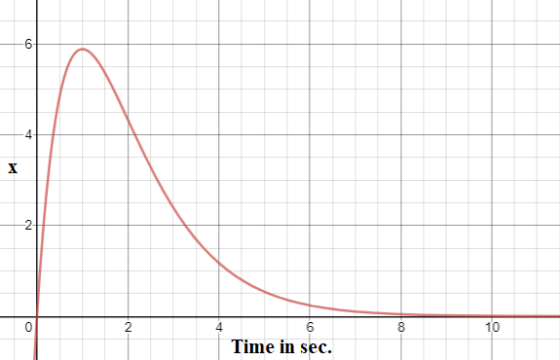
(b)
Ans.-  (c)
(c)
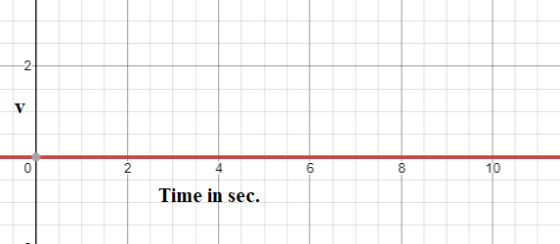
Ans.-
Add Answer to:
ection 2.2 4. An electron moving along the x axis has a position given by x...
An electron moving along the x axis has a position given by x = 16 te-t...
An electron moving along the x axis has a position given by x = 16 te-t m, where t is in seconds. How far is the electron from the origin when it momentarily stops?
An electron moving along the x axis has a position given by x = 10te^minus3t m,...
 An electron moving along the x axis has a position given by x = 10te^minus3t m, where t is in seconds. How far is the electron from the origin when it momentarily stops? m A car traveling 56.0 km/h is 20.0 m from a barrier when the driver slams on the brakes. The car hits the barrier 2.39 s later. What is the magnitude of the car's constant acceleration before impact? m/s^2 How fast is the car traveling at impact?...
Pg.3 51. The position function of a particle moving along an x- axis is given by...
 Pg.3 51. The position function of a particle moving along an x- axis is given by )4.Se+10+2: where x is measured in meters and t in seconds. a) Where is the particle located at exactly 1s? 5) What is the magnitude of the velocity at 1.5s? ) At what time, if ever, does the particle (momentarily) stop? d) Where is the particle at the time it stops? e) When, if ever, is its acceleration zero? 6] An Airplane whose ground...
Question 2.14: An eletron moving along the x-axis has a position given by x=16te^(-t)m where t...
 Question 2.14: An eletron moving along the x-axis has a position
given by x=16te^(-t)m where t is in seconds. How far is the
electron from the origin when it stops?
Question 2.14: An eletron moving along the x-axis has a position
given by x=16te^(-t)m where t is in seconds. How far is the
electron from the origin when it stops?
The velocity of a particle moving along x-axis is given by v(t) = 4 alpha middot...
 The velocity of a particle moving along x-axis is given by v(t) = 4 alpha middot t^2 - beta middot t in m/s. (a) Find the units of measurement of the known constants alpha and beta. (b) Find the average acceleration of the particle during its first 5 s of its motion. (c) When does the particle stop momentarily? (d) How far is the particle from the origin at that instant, if x(t = 0) = 0? (e) Find the...
. The position of a partide moving along the x-axis isgiven, as a function of time,...
 . The position of a partide moving along the x-axis isgiven, as a function of time, by at) 3eft. aFind b)Sketch graphs of vst, vstand a{t)vst. c Use the graph of vit) vs t to estimate the distance travelled by the particle in the first 5 s of motion.Show your work ] Compare the result found in (c above to ds 5)-x(0) and to the result found from
1. Consider an electron initially moving in the positive x-direction along the negative x-axis wi...
1. Consider an electron initially moving in the positive x-direction along the negative x-axis with an energy E. At the origin the potential energy U (x) changes abruptly, from U(x) = 0 for x < 0, to U(x) = 1.00 eV for x > 0. If E=1.02 eV, just higher than the barrier by 2%, what is the barrier penetration length? What is the reflectance? What is the transmittance? 2. Consider an electron initially moving in the positive x-direction along...
1. A particle is moving along a (horizontal) x-axis. Its position as a function of time...
 1. A particle is moving along a (horizontal) x-axis. Its position as a function of time is given by the equationAt2 B where A-2.10 and B-2.80 and t is in seconds. (i) What are the proper units for A and B in SI units (show your work) (ii) Determine the displacement of the particle during the time interval from -3.00 s to 12 5.00 s. iii) Determine the average velocity (think secant line!) during this time interval (iv) Determine the...
 An electron moving along the x axis has a position given by x = 10te^minus3t m, where t is in seconds. How far is the electron from the origin when it momentarily stops? m A car traveling 56.0 km/h is 20.0 m from a barrier when the driver slams on the brakes. The car hits the barrier 2.39 s later. What is the magnitude of the car's constant acceleration before impact? m/s^2 How fast is the car traveling at impact?...
 Pg.3 51. The position function of a particle moving along an x- axis is given by )4.Se+10+2: where x is measured in meters and t in seconds. a) Where is the particle located at exactly 1s? 5) What is the magnitude of the velocity at 1.5s? ) At what time, if ever, does the particle (momentarily) stop? d) Where is the particle at the time it stops? e) When, if ever, is its acceleration zero? 6] An Airplane whose ground...
 Question 2.14: An eletron moving along the x-axis has a position
given by x=16te^(-t)m where t is in seconds. How far is the
electron from the origin when it stops?
Question 2.14: An eletron moving along the x-axis has a position
given by x=16te^(-t)m where t is in seconds. How far is the
electron from the origin when it stops?
 The velocity of a particle moving along x-axis is given by v(t) = 4 alpha middot t^2 - beta middot t in m/s. (a) Find the units of measurement of the known constants alpha and beta. (b) Find the average acceleration of the particle during its first 5 s of its motion. (c) When does the particle stop momentarily? (d) How far is the particle from the origin at that instant, if x(t = 0) = 0? (e) Find the...
 . The position of a partide moving along the x-axis isgiven, as a function of time, by at) 3eft. aFind b)Sketch graphs of vst, vstand a{t)vst. c Use the graph of vit) vs t to estimate the distance travelled by the particle in the first 5 s of motion.Show your work ] Compare the result found in (c above to ds 5)-x(0) and to the result found from
 1. A particle is moving along a (horizontal) x-axis. Its position as a function of time is given by the equationAt2 B where A-2.10 and B-2.80 and t is in seconds. (i) What are the proper units for A and B in SI units (show your work) (ii) Determine the displacement of the particle during the time interval from -3.00 s to 12 5.00 s. iii) Determine the average velocity (think secant line!) during this time interval (iv) Determine the...
Most questions answered within 3 hours.
-
Where is the error in this code sequence?
String s1 = "Hello";
String s2 = "ello";...
asked 10 months ago -
Financial data for Joel de Paris, Inc., for last year
follow:
Joel de Paris, Inc.
Balance...
asked 10 months ago -
Consider this reaction:
Al2(SO4)3 (aq)+ BaCl3
(aq) Al2Cl6 (aq)- +
3BaSO4(s) . What is the...
asked 10 months ago -
Suppose that Savneet is considering increasing her
recent random sample from 20 car rentals to 40...
asked 10 months ago -
Trucks arrive at an unloading terminal at an average rate of 120
per hour.
Trucks arrive...
asked 10 months ago -
Why are methanol and ethanol completely soluble in water while
octanol is not very little soluble....
asked 10 months ago -
A facilities manager at a university reads in a research report
that the mean amount of...
asked 10 months ago -
When the CuSO4 is rehydrated by adding water to the anhydrous
compound, is this an endothermic...
asked 10 months ago -
A ray of sunlight is passing from diamond into crown glass; the
angle of incidence is...
asked 10 months ago -
A block of mass 0.249 kg is placed on top of a light, vertical
spring of...
asked 10 months ago -
how do the kidneys compensate in the presences of acidosis
a) trigger hyperventilate
b) reserve acid...
asked 10 months ago -
Question 501 pts
The rental rate of capital to the firm increases. Which of the
following...
asked 10 months ago