1. The hydration of carbon dioxide CO2 in red blood cells takes place due to an...
1. The hydration of carbon dioxide CO2 in red blood cells takes place due to an enzyme catalytic process, where bicarbonate ions are formed:
CO2(g) + H2O(l) ® HCO3¯ (aq) + H+(aq)
At the enzyme concentration of [E]0 = 2.3´10-6 mol/L, the following kinetic data for initial reaction rate vs. initial concentration of carbon dioxide were obtained:
|
[CO2], mol/L |
1.25 |
2.50 |
5.00 |
20.00 |
|
Rate, (mol/L)s-1 |
2.78´10-2 |
5.01´10-2 |
8.32´10-2 |
1.67´10-1 |
Determine the Michaelis constant and the turnover number of the catalytic process.
2. The enzyme a-chymotrypsin is secreted in the pancreas of mammals and cleaves peptide bonds made between certain amino acids. Several solutions containing the small peptide N-glutaryl-1-phenylalanine-p-nitroanilide (a substrate) at different concentrations were prepared and the same amount of a-chymotrypsin was added to each one. The following data were obtained on the initial rates of the formation of product:
|
[S]0, mol/L |
0.334 |
0.450 |
0.667 |
1.00 |
1.33 |
1.67 |
|
Rate, (mol/L)s-1 |
0.152 |
0.201 |
0.269 |
0.417 |
0.505 |
0.667 |
Determine the maximum reaction rate and the Michaelis constant for the enzyme reaction.
Homework Answers
1.
The plot of 1/ rate vs 1/ [CO2] is as shown
![Rate CO21/[rate] 1/[CO2] 0.0278 0.0501 0.0832 0.167 40 35.971223 19.9600798 0.4 12.0192308 0.2 5.988023950.05 0.8 35 2.5 30 y](http://img.homeworklib.com/questions/5ad562e0-bf48-11eb-b4d5-07501aded89b.png?x-oss-process=image/resize,w_560)
Y intercept 
Hence, the maximum reaction rate

Slope 
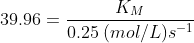
Hence, the Michaelis constant

![K_{cat} = \dfrac {V_{max}}{[E]_0}= \dfrac {0.25 \: (mol/L)s^{-1}}{2.3 \times 10^{-6 } \: mol/L}](http://img.homeworklib.com/questions/5d9cb200-bf48-11eb-9f20-0f230665cf6e.png?x-oss-process=image/resize,w_560)

Add Answer to:
1. The hydration of carbon dioxide CO2 in red blood
cells takes place due to an...
The enzyme carbonic anhydrase catalyzes the hydration of CO2 gas in red blood cells: &
The enzyme carbonic anhydrase catalyzes the hydration of CO2 gas in red blood cells: CO2 (g) + H2O (L) →H2CO3 (aq) Determine the ∆Ssys of this reaction at 37 °C (body temperature), and justify the sign. *Thermodynamic parameters at T=298K and 1 bar Sm (JK-1 mol-1) Cp (JK-1 MOL-1) CO2 (g) 213.7 36.8 H2O (L) 69.9 78.2 H2CO3 (aq) 187.4 19.4
Carbonic acid present in the blood comes mainly from dissolved carbon dioxide (CO2). Dissolved carbon dioxide,...
Carbonic acid present in the blood comes mainly from dissolved carbon dioxide (CO2). Dissolved carbon dioxide, CO2(aq), reacts with water to produce H2CO3. a) Write the equilibrium expression for this process. b) The equilibrium constant for this reaction is the hydration constant for CO2, Kh = [H2CO3]/[CO2(aq)] = 3.0 x 10⁻³ . Combine this equation with the expression you derived in 1.a) for the equilibrium expressions for the first ionization (controlled by Ka1) and rearrange to obtain the apparent equilibrium...
carbon monoxide reacts with nitrogen dioxide to produce carbon dioxide and nitric oxide as given by...
carbon monoxide reacts with nitrogen dioxide to produce carbon dioxide and nitric oxide as given by the following reaction. CO (g) + NO2 (g) → CO2 (g) + NO (g) The reaction is zeroth order in CO and second order in NO2, and second order overall. The rate constant for this reaction at 175ºC is 7.58 × 10⁻⁴ L mol-1 s-1. If the initial concentration of NO2 was 0.565 M, what is the molar concentration of NO2 after 5.8 minutes?...
3. The carbon dioxide produce in animal cells is transported to the lungs mostly dissolved in blood plasma. Essential t...
 3. The carbon dioxide produce in animal cells is transported to the lungs mostly dissolved in blood plasma. Essential to this process is the reaction of CO2 with water. Given the AHE= -612.96 kJ/mol for carbonic acid, calculate the AHreaction at 298.15 K. H2O(l) + CO2(g) 2 H2CO3(aq)
Complete the following sentences describing the reactions of CO2 in plasma. red blood cells carbonic anhydrase...
 Complete the following sentences describing the reactions of CO2 in plasma. red blood cells carbonic anhydrase low left reversible acidic right cytoplasm basic arrow The concentration of carbon dioxide determines the following reaction: H2O + CO2 + H2CO3 The above reaction is catalyzed by the enzyme carbonic anhydrase found in In the tissues, where CO is high, the reaction will move to the making the blood more making In the lungs where CO2 is low and H2CO3 is high, the...
2. What is the percent yield of CO2 (44.01 g/mol) if 0.275 g of carbon dioxide...
 2. What is the percent yield of CO2 (44.01 g/mol) if 0.275 g of carbon dioxide is obtained by heating 1.75 g of calcium carbonate, CaCO3 (100.09 g/mol)? (10 points) show all setup & work CaCO3) + CaO) + CO2Q Answer: % yield = A MULA needed to react with excess CaCO3 to produce 32.0 L of CO2 at S
The following data were obtained for the reaction of methane with oxygen: CH4(g) + 202(g) CO2(g)...
 The following data were obtained for the reaction of methane with oxygen: CH4(g) + 202(g) CO2(g) + 2H20(1) → time(min)[CH4l (mol/L) 0 10 20 30 0.050 0.030 0.020 0.015 0.020 a) How many moles of CO2 are produced for each mole of CH4 that is used up? b) What concentration of CH4 is used up after 10 minutes? c) What is the concentration of carbon dioxide produced after 20 minutes? d) Write an equation for reaction rate in terms of...
Nitrogen dioxide reacts with carbon monoxide to produce nitric oxide as follows: NO2 (9) + CO...
 Nitrogen dioxide reacts with carbon monoxide to produce nitric oxide as follows: NO2 (9) + CO (9) ► NO (9) + CO2 (g) The reaction is second order in NO2, zeroth order in CO and second order overall. How long (in hours) will it take for NO2 to decompose by 35.8% given the initial concentration was 0.43 M NO2 and CO was in excess. The rate constant for this reaction at 225°C is 2.08 x 10⁻⁴ L/mol/s. Report your answer...
Acetoacetic acid, CH3COCH2COOH, decomposes in aqueous acidic solution to form acetone and carbon dioxide: CH3COCH2COOH(aq) -->...
Acetoacetic acid, CH3COCH2COOH, decomposes in aqueous acidic solution to form acetone and carbon dioxide: CH3COCH2COOH(aq) --> CH3COCH3(aq) + CO2(g) The reaction is first order. At room temperature, the half-life of the reactant is 139 min. a. What is the rate constant of the decomposition reaction ? b. If the initial concentration of acetoacetic acid is 2.75 M, what is its concentration after 5 hours ?
1. The following chemical reaction: A → products shows first order kinetics with respect to A;...
1. The following chemical reaction: A → products shows first order kinetics with respect to A; rate = k[A]. Assume k = 10.09 x 10⁻⁴ s-1 . If the initial concentration of A was 0.82 mol L-1 and then decreased to 0.11 mol L-1 , how much time elapsed in minutes? 2. Consider the following balanced chemical equation: H2O2 (aq) + 3 I-(aq) + 2 H+(aq) → I3- (aq) + 2 H2O (l) In the first 62.9 seconds of the...
 3. The carbon dioxide produce in animal cells is transported to the lungs mostly dissolved in blood plasma. Essential to this process is the reaction of CO2 with water. Given the AHE= -612.96 kJ/mol for carbonic acid, calculate the AHreaction at 298.15 K. H2O(l) + CO2(g) 2 H2CO3(aq)
 Complete the following sentences describing the reactions of CO2 in plasma. red blood cells carbonic anhydrase low left reversible acidic right cytoplasm basic arrow The concentration of carbon dioxide determines the following reaction: H2O + CO2 + H2CO3 The above reaction is catalyzed by the enzyme carbonic anhydrase found in In the tissues, where CO is high, the reaction will move to the making the blood more making In the lungs where CO2 is low and H2CO3 is high, the...
 2. What is the percent yield of CO2 (44.01 g/mol) if 0.275 g of carbon dioxide is obtained by heating 1.75 g of calcium carbonate, CaCO3 (100.09 g/mol)? (10 points) show all setup & work CaCO3) + CaO) + CO2Q Answer: % yield = A MULA needed to react with excess CaCO3 to produce 32.0 L of CO2 at S
 The following data were obtained for the reaction of methane with oxygen: CH4(g) + 202(g) CO2(g) + 2H20(1) → time(min)[CH4l (mol/L) 0 10 20 30 0.050 0.030 0.020 0.015 0.020 a) How many moles of CO2 are produced for each mole of CH4 that is used up? b) What concentration of CH4 is used up after 10 minutes? c) What is the concentration of carbon dioxide produced after 20 minutes? d) Write an equation for reaction rate in terms of...
 Nitrogen dioxide reacts with carbon monoxide to produce nitric oxide as follows: NO2 (9) + CO (9) ► NO (9) + CO2 (g) The reaction is second order in NO2, zeroth order in CO and second order overall. How long (in hours) will it take for NO2 to decompose by 35.8% given the initial concentration was 0.43 M NO2 and CO was in excess. The rate constant for this reaction at 225°C is 2.08 x 10⁻⁴ L/mol/s. Report your answer...
Most questions answered within 3 hours.
-
Where is the error in this code sequence?
String s1 = "Hello";
String s2 = "ello";...
asked 11 months ago -
Financial data for Joel de Paris, Inc., for last year
follow:
Joel de Paris, Inc.
Balance...
asked 11 months ago -
Consider this reaction:
Al2(SO4)3 (aq)+ BaCl3
(aq) Al2Cl6 (aq)- +
3BaSO4(s) . What is the...
asked 11 months ago -
Suppose that Savneet is considering increasing her
recent random sample from 20 car rentals to 40...
asked 11 months ago -
Trucks arrive at an unloading terminal at an average rate of 120
per hour.
Trucks arrive...
asked 11 months ago -
Why are methanol and ethanol completely soluble in water while
octanol is not very little soluble....
asked 11 months ago -
A facilities manager at a university reads in a research report
that the mean amount of...
asked 11 months ago -
When the CuSO4 is rehydrated by adding water to the anhydrous
compound, is this an endothermic...
asked 11 months ago -
A ray of sunlight is passing from diamond into crown glass; the
angle of incidence is...
asked 11 months ago -
A block of mass 0.249 kg is placed on top of a light, vertical
spring of...
asked 11 months ago -
how do the kidneys compensate in the presences of acidosis
a) trigger hyperventilate
b) reserve acid...
asked 11 months ago -
Question 501 pts
The rental rate of capital to the firm increases. Which of the
following...
asked 11 months ago