
Homework Answers
Add Answer to:
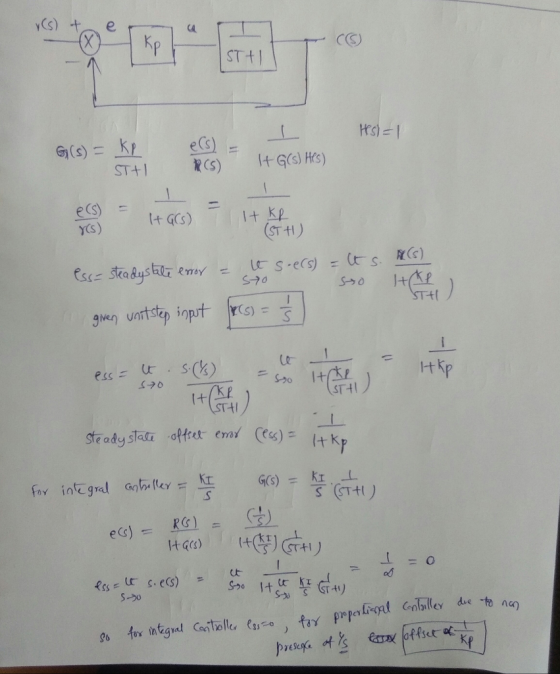
Problem 3 Explain why a proportional control of a plant that does not possess an integrating...
Problem 4. Consider the control system shown below with plant G(s) that has time con- stants...
 Problem 4. Consider the control system shown below with plant G(s) that has time con- stants T1 = 2, T2 = 10, and gain k = 0.1. 4 673 +1679+1) (1.) Sketch the pole-zero plot for G(s). Is one of the poles more dominant? Using MATLAB, simulate the step response of the plant itself, along with G1(s) and G2(s) as defined by Gl(s) = and G2(s) = sti + 1 ST2+1 (2.) Design a proportional gain C(s) = K so...
Problem 6.2 To avoid steady-state error for the thermal plant of Problem 6.1, a PI control is con...
 PROBLEM 6.3 ONLY
Problem 6.2 To avoid steady-state error for the thermal plant of Problem 6.1, a PI control is considered by using a compensator having the transfer function s+ e (a) For c-2 as in Problem 5.1, find the value of K which provides a damping factor(-.7. Using this value of K determine the closed-loop step response. (b) Using the "dominant pole" concept, and the standard response curves for second-order systems, (Unit 6 notes) estimate the overshoot and the...
PROBLEM 6.3 ONLY
Problem 6.2 To avoid steady-state error for the thermal plant of Problem 6.1, a PI control is considered by using a compensator having the transfer function s+ e (a) For c-2 as in Problem 5.1, find the value of K which provides a damping factor(-.7. Using this value of K determine the closed-loop step response. (b) Using the "dominant pole" concept, and the standard response curves for second-order systems, (Unit 6 notes) estimate the overshoot and the...
SOLVE USING MATLAB A servomechanism position control has the plant transfer function 10 s(s +1) (s 10) You are to desig...
 SOLVE USING MATLAB
A servomechanism position control has the plant transfer function 10 s(s +1) (s 10) You are to design a series compensation transfer function D(s) in the unity feedback configuration to meet the following closed-loop specifications: . The response to a reference step input is to have no more than 16% overshoot. . The response to a reference step input is to have a rise time of no more than 0.4 sec. The steady-state error to a unit...
SOLVE USING MATLAB
A servomechanism position control has the plant transfer function 10 s(s +1) (s 10) You are to design a series compensation transfer function D(s) in the unity feedback configuration to meet the following closed-loop specifications: . The response to a reference step input is to have no more than 16% overshoot. . The response to a reference step input is to have a rise time of no more than 0.4 sec. The steady-state error to a unit...
PLEASE DO IN MATLAB Problem 8 (PID feedback control). This problem is about Proportional-Integral-Derivative feedback control...
 PLEASE DO IN MATLAB
Problem 8 (PID feedback control). This problem is about Proportional-Integral-Derivative feedback control systems. The general setup of the system we are going to look at is given below: e(t) u(t) |C(s) y(t) P(s) r(t) Here the various signals are: signal/system r(t) y(t) e(t) P(s) C(s) и(t) meaning desired output signal actual output signal error signal r(t) y(t) Laplace transform of the (unstable) plant controller to be designed control signal Our goal is to design a controller...
PLEASE DO IN MATLAB
Problem 8 (PID feedback control). This problem is about Proportional-Integral-Derivative feedback control systems. The general setup of the system we are going to look at is given below: e(t) u(t) |C(s) y(t) P(s) r(t) Here the various signals are: signal/system r(t) y(t) e(t) P(s) C(s) и(t) meaning desired output signal actual output signal error signal r(t) y(t) Laplace transform of the (unstable) plant controller to be designed control signal Our goal is to design a controller...
Problem 7.2 The differential equations for a second-order thermal system are y=x2 where u is the control input. (a) Show that the plant is type zero. As a consequence, the steady-state error using pr...
 Problem 7.2 The differential equations for a second-order thermal system are y=x2 where u is the control input. (a) Show that the plant is type zero. As a consequence, the steady-state error using proportional control is non-zero. Find the steady-state error as a function of G (b) To achieve zero steady-state error, integral control will be used, by adding the state variable zo with which is appended to the original equations, making the system third-order. For the resulting third-order system,...
A servomechanism position control has the plant transfer function G(s) =10/s(s + I )(s + 10)...
A servomechanism position control has the plant transfer function G(s) =10/s(s + I )(s + 10) You are to design a series of compensation transfer function Dc(s) in the unity feedback configuration to meet the following closed-loop specifications: -The response to a reference step input is to have no more than 16%overshoot. -The response to a ref ere nee step input is to have a rise time of no more than 0.4 sec. -The steady-state error to a unit ramp...
Consider a unity-feedback control system with a PI controller Gpr(s) and a plant G(s) in cascade. In particular, the plant transfer function is given as 2. G(s) = s+4, and the PI controller trans...
 Consider a unity-feedback control system with a PI controller Gpr(s) and a plant G(s) in cascade. In particular, the plant transfer function is given as 2. G(s) = s+4, and the PI controller transfer function is of the forrm KI p and Ki are the proportional and integral controller gains, respectively where K Design numerical values for Kp and Ki such that the closed-loop control system has a step- response settling time T, 0.5 seconds with a damping ratio of...
5, (29%) Consider the feedback control system in Figure-5 in block diagram form. The reference input...
 5, (29%) Consider the feedback control system in Figure-5 in block diagram form. The reference input R(s), system output Y(s), and disturbance D(s) are denoted along with the error E(s) and control effort F(s). You will design the control law Gc(s) to achieve certain performance criteria. Answer the following questions (assume D(s)0 in all parts except part(ü) (a) [396] Show that the transfer function relating the reference R(s) to the output Y(s) is given by (b) [3%) Assuming a proportional...
PROBLEM: A unity feedback system with the forward transfer function K G(s) s(s+7) is operating with...
 PROBLEM: A unity feedback system with the forward transfer function K G(s) s(s+7) is operating with a closed-loop step response that has 15% overshoot. Do the following: a. Evaluate the steady-state error for a unit ramp input. b. Design a lag compensator to improve the steady-state error by a factor of 20. c. Evaluate the steady-state error for a unit ramp input to your compensated system. d. Evaluate how much improvement in steady-state error was realized.
A unity feedback system with the forward transfer function G(s)=K/(s+1)(s+3)(s+6) is operating wi...
 A unity feedback system with the forward transfer function
G(s)=K/(s+1)(s+3)(s+6) is operating with a closed-loop step
response that has 15% overshoot. Do the following:
a) Evaluate the steady-state error for a unit step input
b) Design a PI control to reduce the steady-state error to zero
without affecting its transient response
c) Evaluate the steady-state error and overshoot for a unit step
input to your compensated system
A unity feedback system with the forward transfer function G(s) is operating with...
A unity feedback system with the forward transfer function
G(s)=K/(s+1)(s+3)(s+6) is operating with a closed-loop step
response that has 15% overshoot. Do the following:
a) Evaluate the steady-state error for a unit step input
b) Design a PI control to reduce the steady-state error to zero
without affecting its transient response
c) Evaluate the steady-state error and overshoot for a unit step
input to your compensated system
A unity feedback system with the forward transfer function G(s) is operating with...
 Problem 4. Consider the control system shown below with plant G(s) that has time con- stants T1 = 2, T2 = 10, and gain k = 0.1. 4 673 +1679+1) (1.) Sketch the pole-zero plot for G(s). Is one of the poles more dominant? Using MATLAB, simulate the step response of the plant itself, along with G1(s) and G2(s) as defined by Gl(s) = and G2(s) = sti + 1 ST2+1 (2.) Design a proportional gain C(s) = K so...
 PROBLEM 6.3 ONLY
Problem 6.2 To avoid steady-state error for the thermal plant of Problem 6.1, a PI control is considered by using a compensator having the transfer function s+ e (a) For c-2 as in Problem 5.1, find the value of K which provides a damping factor(-.7. Using this value of K determine the closed-loop step response. (b) Using the "dominant pole" concept, and the standard response curves for second-order systems, (Unit 6 notes) estimate the overshoot and the...
PROBLEM 6.3 ONLY
Problem 6.2 To avoid steady-state error for the thermal plant of Problem 6.1, a PI control is considered by using a compensator having the transfer function s+ e (a) For c-2 as in Problem 5.1, find the value of K which provides a damping factor(-.7. Using this value of K determine the closed-loop step response. (b) Using the "dominant pole" concept, and the standard response curves for second-order systems, (Unit 6 notes) estimate the overshoot and the...
 SOLVE USING MATLAB
A servomechanism position control has the plant transfer function 10 s(s +1) (s 10) You are to design a series compensation transfer function D(s) in the unity feedback configuration to meet the following closed-loop specifications: . The response to a reference step input is to have no more than 16% overshoot. . The response to a reference step input is to have a rise time of no more than 0.4 sec. The steady-state error to a unit...
SOLVE USING MATLAB
A servomechanism position control has the plant transfer function 10 s(s +1) (s 10) You are to design a series compensation transfer function D(s) in the unity feedback configuration to meet the following closed-loop specifications: . The response to a reference step input is to have no more than 16% overshoot. . The response to a reference step input is to have a rise time of no more than 0.4 sec. The steady-state error to a unit...
 PLEASE DO IN MATLAB
Problem 8 (PID feedback control). This problem is about Proportional-Integral-Derivative feedback control systems. The general setup of the system we are going to look at is given below: e(t) u(t) |C(s) y(t) P(s) r(t) Here the various signals are: signal/system r(t) y(t) e(t) P(s) C(s) и(t) meaning desired output signal actual output signal error signal r(t) y(t) Laplace transform of the (unstable) plant controller to be designed control signal Our goal is to design a controller...
PLEASE DO IN MATLAB
Problem 8 (PID feedback control). This problem is about Proportional-Integral-Derivative feedback control systems. The general setup of the system we are going to look at is given below: e(t) u(t) |C(s) y(t) P(s) r(t) Here the various signals are: signal/system r(t) y(t) e(t) P(s) C(s) и(t) meaning desired output signal actual output signal error signal r(t) y(t) Laplace transform of the (unstable) plant controller to be designed control signal Our goal is to design a controller...
 Problem 7.2 The differential equations for a second-order thermal system are y=x2 where u is the control input. (a) Show that the plant is type zero. As a consequence, the steady-state error using proportional control is non-zero. Find the steady-state error as a function of G (b) To achieve zero steady-state error, integral control will be used, by adding the state variable zo with which is appended to the original equations, making the system third-order. For the resulting third-order system,...
 Consider a unity-feedback control system with a PI controller Gpr(s) and a plant G(s) in cascade. In particular, the plant transfer function is given as 2. G(s) = s+4, and the PI controller transfer function is of the forrm KI p and Ki are the proportional and integral controller gains, respectively where K Design numerical values for Kp and Ki such that the closed-loop control system has a step- response settling time T, 0.5 seconds with a damping ratio of...
 5, (29%) Consider the feedback control system in Figure-5 in block diagram form. The reference input R(s), system output Y(s), and disturbance D(s) are denoted along with the error E(s) and control effort F(s). You will design the control law Gc(s) to achieve certain performance criteria. Answer the following questions (assume D(s)0 in all parts except part(ü) (a) [396] Show that the transfer function relating the reference R(s) to the output Y(s) is given by (b) [3%) Assuming a proportional...
 PROBLEM: A unity feedback system with the forward transfer function K G(s) s(s+7) is operating with a closed-loop step response that has 15% overshoot. Do the following: a. Evaluate the steady-state error for a unit ramp input. b. Design a lag compensator to improve the steady-state error by a factor of 20. c. Evaluate the steady-state error for a unit ramp input to your compensated system. d. Evaluate how much improvement in steady-state error was realized.
 A unity feedback system with the forward transfer function
G(s)=K/(s+1)(s+3)(s+6) is operating with a closed-loop step
response that has 15% overshoot. Do the following:
a) Evaluate the steady-state error for a unit step input
b) Design a PI control to reduce the steady-state error to zero
without affecting its transient response
c) Evaluate the steady-state error and overshoot for a unit step
input to your compensated system
A unity feedback system with the forward transfer function G(s) is operating with...
A unity feedback system with the forward transfer function
G(s)=K/(s+1)(s+3)(s+6) is operating with a closed-loop step
response that has 15% overshoot. Do the following:
a) Evaluate the steady-state error for a unit step input
b) Design a PI control to reduce the steady-state error to zero
without affecting its transient response
c) Evaluate the steady-state error and overshoot for a unit step
input to your compensated system
A unity feedback system with the forward transfer function G(s) is operating with...
Most questions answered within 3 hours.
-
Where is the error in this code sequence?
String s1 = "Hello";
String s2 = "ello";...
asked 10 months ago -
Financial data for Joel de Paris, Inc., for last year
follow:
Joel de Paris, Inc.
Balance...
asked 10 months ago -
Consider this reaction:
Al2(SO4)3 (aq)+ BaCl3
(aq) Al2Cl6 (aq)- +
3BaSO4(s) . What is the...
asked 10 months ago -
Suppose that Savneet is considering increasing her
recent random sample from 20 car rentals to 40...
asked 10 months ago -
Trucks arrive at an unloading terminal at an average rate of 120
per hour.
Trucks arrive...
asked 10 months ago -
Why are methanol and ethanol completely soluble in water while
octanol is not very little soluble....
asked 10 months ago -
A facilities manager at a university reads in a research report
that the mean amount of...
asked 10 months ago -
When the CuSO4 is rehydrated by adding water to the anhydrous
compound, is this an endothermic...
asked 10 months ago -
A ray of sunlight is passing from diamond into crown glass; the
angle of incidence is...
asked 10 months ago -
A block of mass 0.249 kg is placed on top of a light, vertical
spring of...
asked 10 months ago -
how do the kidneys compensate in the presences of acidosis
a) trigger hyperventilate
b) reserve acid...
asked 10 months ago -
Question 501 pts
The rental rate of capital to the firm increases. Which of the
following...
asked 10 months ago