
Homework Answers

![du [-lo -20 dt 15 0 dy [at -B hence corresponding at (lo, o [J] Linearized system near (10,0) at (43) -4 dy from kinear syste](http://img.homeworklib.com/questions/4eb0e4a0-c034-11eb-9ce3-2b334da76324.png?x-oss-process=image/resize,w_560)
![the to be used approximate non linear Behavior of systen. (C) at origin Jacobian [J]- sro 5 O put we for eigen values JhIj =](http://img.homeworklib.com/questions/4f9c7530-c034-11eb-9f30-fdf1e979f5fd.png?x-oss-process=image/resize,w_560)

Add Answer to:
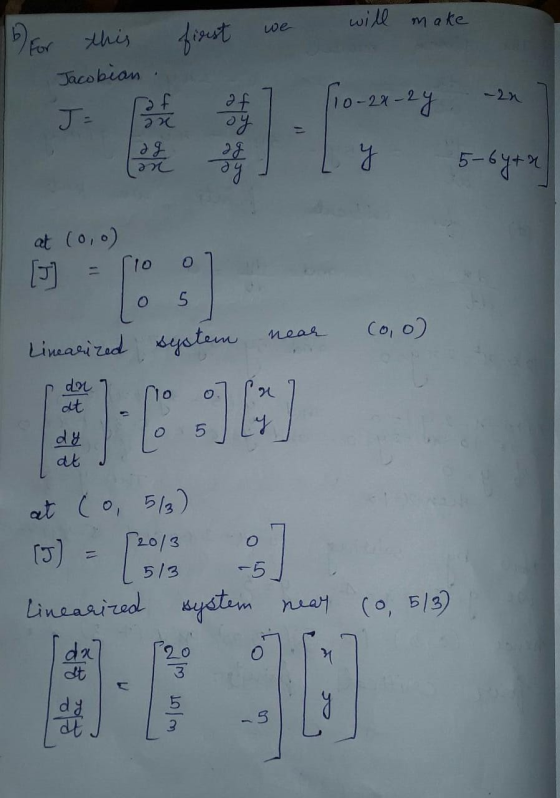
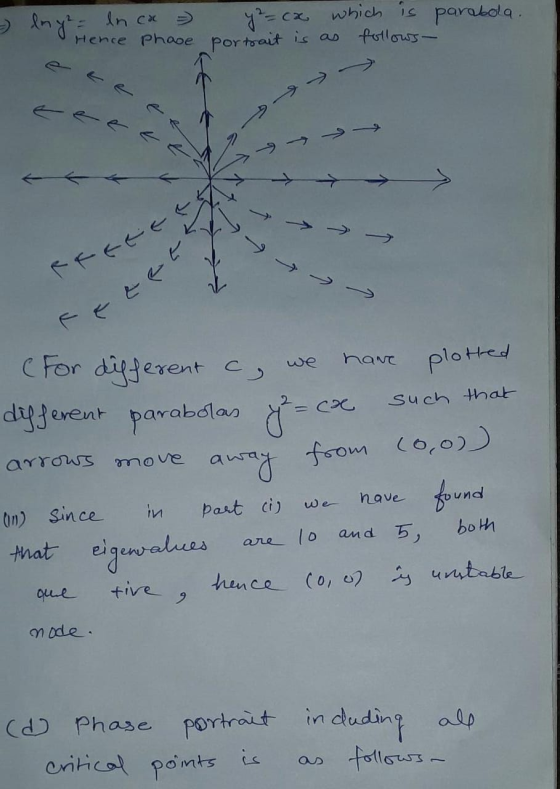
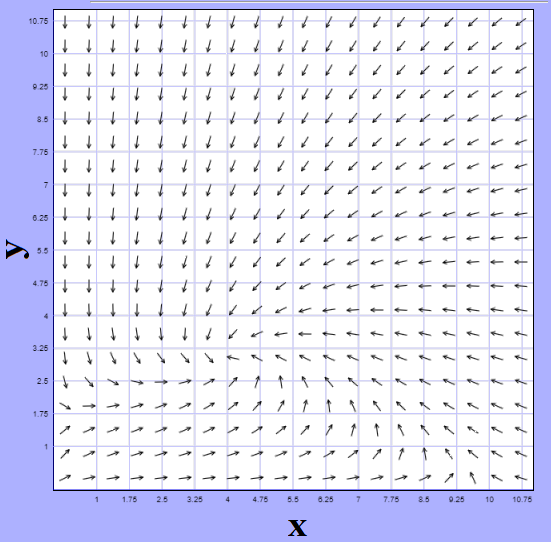
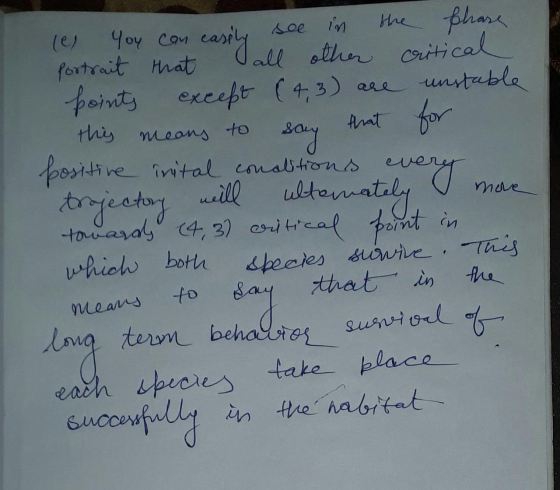
1. The populations of two competing species x(t) and y(t) are governed by the non-linear system...
Consider the nonlinear System of differential equations di dt dt (a) Determine all critical points of the system (b) For each critical point with nonnegative x value (20) i. Determine the linearised...
 Consider the nonlinear System of differential equations di dt dt (a) Determine all critical points of the system (b) For each critical point with nonnegative x value (20) i. Determine the linearised system and discuss whether it can be used to approximate the ii. For each critical point where the approximation is valid, determine the general solution of iii. Sketch by hand the phase portrait of each linearised system where the approximation behaviour of the non-linear system the linearised system...
1. The Duffing equation is a non-linear second-order differential equation used to model certain damped and...
 1. The Duffing equation is a non-linear second-order differential equation used to model certain damped and driven oscillators. The equation is given by -ax+3x3 = cos(wt) at medt dr. where function r = r(t) is the displacement at timet, is the velocity, and is the acceleration. The parameter 8 controls the amount of damping, a controls the linear stiffness, B controls the amount of non-linearity in the restoring force, and 7 and w are the amplitude and angular frequency of...
Please a- c for non linear system b 3. For each of the given non-linear systems,...
 Please a- c for non linear system b
3. For each of the given non-linear systems, (a) find the equilibrium points, (b) near each equilibrium point, sketch the phase portrait of the linearized system, (c) use the information in (a) and (b) to sketch the phase portrait of the system: x' = - 4x + 4xy Sx = 2x – 2x² + 5xy ly=2y-y² – ry ly' = y - 2y2 + 2xy
Please a- c for non linear system b
3. For each of the given non-linear systems, (a) find the equilibrium points, (b) near each equilibrium point, sketch the phase portrait of the linearized system, (c) use the information in (a) and (b) to sketch the phase portrait of the system: x' = - 4x + 4xy Sx = 2x – 2x² + 5xy ly=2y-y² – ry ly' = y - 2y2 + 2xy
Exercise 3, Section 9.5. Modified Lotka- Volterra Predator-Prey model Consider two species (rabbits and foxes) such that the population R (rabbits) and F (foxrs) obey the system of equations dR d...
 Exercise 3, Section 9.5. Modified Lotka- Volterra Predator-Prey model Consider two species (rabbits and foxes) such that the population R (rabbits) and F (foxrs) obey the system of equations dR dt dF dt R2-R)-12RF . What happens to the population of rabbits if the number of foxes is arro? (Use the phase line analysis from Chapter 2) What happens to the population of foxes if the number of rabbits is zero? 3. Using the method of nullclines, draw an approximate...
Consider the linear system. dy da dt = + 2y, at 9x + 4y. (1). Find...
 Consider the linear system. dy da dt = + 2y, at 9x + 4y. (1). Find the eigenvalues. (2). Find the eigenvectors. (3). Determine the type and stability of the critical point(0,0). (4). Roughly sketch the phase portrait, including directions.
2. (2 pts) Determine the type of the critical point (0,0) for the system x' =-7x+ 5y, y' =-6x 4y. Sketch a phas...
 2. (2 pts) Determine the type of the critical point (0,0) for the system x' =-7x+ 5y, y' =-6x 4y. Sketch a phase portrait based on the eigenvectors, and the direction that the sign of the eigenvalue indicates.
2. (2 pts) Determine the type of the critical point (0,0) for the system x' =-7x+ 5y, y' =-6x 4y. Sketch a phase portrait based on the eigenvectors, and the direction that the sign of the eigenvalue indicates.
2. (2 pts) Determine the type of the critical point (0,0) for the system x' =-7x+ 5y, y' =-6x 4y. Sketch a phase portrait based on the eigenvectors, and the direction that the sign of the eigenvalue indicates.
2. Consider the linear system: - (1 2) Y.with initial conditions) Y dt a) Compute the...
 2. Consider the linear system: - (1 2) Y.with initial conditions) Y dt a) Compute the eigenvalues and eigenvectors for the system. b) For each eigenvalue, pick an associated eigenvector V and determine a vector solution y(t) to the system. c) Draw an accurate phase portrait for this system. What type of equilibrium point is the origin?
Consider the non-linear system y-y(1-x-y). (a) Find equations for all of the x- and y-nullclines....
 Consider the non-linear system y-y(1-x-y). (a) Find equations for all of the x- and y-nullclines. (b) Find the coordinates of each equilibrium point of the system. (c) Sketch the nullclines in the phase plane. Clearly mark the equilibrium points. Also indicate the direction of flow on the nullclines.
Consider the non-linear system y-y(1-x-y). (a) Find equations for all of the x- and y-nullclines. (b) Find the coordinates of each equilibrium point of the system. (c) Sketch the nullclines in the...
Consider the non-linear system y-y(1-x-y). (a) Find equations for all of the x- and y-nullclines. (b) Find the coordinates of each equilibrium point of the system. (c) Sketch the nullclines in the phase plane. Clearly mark the equilibrium points. Also indicate the direction of flow on the nullclines.
Consider the non-linear system y-y(1-x-y). (a) Find equations for all of the x- and y-nullclines. (b) Find the coordinates of each equilibrium point of the system. (c) Sketch the nullclines in the...
Problem 1: For the following non-linear autonomous system 1 = X1 (1-X2) X2 = 2x1-12 nstruct...
 Problem 1: For the following non-linear autonomous system 1 = X1 (1-X2) X2 = 2x1-12 nstruct (i.e. sketch) the phase-portrait using linearization techniques. Discuss the qualitative behavior of the system. Justify your answers. Co
Problem 3. Consider the following continuous differential equation dx dt = αx − 2xy dy dt...
Problem 3. Consider the following continuous differential equation dx dt = αx − 2xy dy dt = 3xy − y 3a (5 pts): Find the steady states of the system. 3b (15 pts): Linearize the model about each of the fixed points and determine the type of stability. 3b (15 pts): Draw the phase portrait for this system, including nullclines, flow trajectories, and all fixed points. Problem 2 (25 pts): Two-dimensional linear ODEs For the following linear systems, identify the...
 Consider the nonlinear System of differential equations di dt dt (a) Determine all critical points of the system (b) For each critical point with nonnegative x value (20) i. Determine the linearised system and discuss whether it can be used to approximate the ii. For each critical point where the approximation is valid, determine the general solution of iii. Sketch by hand the phase portrait of each linearised system where the approximation behaviour of the non-linear system the linearised system...
 1. The Duffing equation is a non-linear second-order differential equation used to model certain damped and driven oscillators. The equation is given by -ax+3x3 = cos(wt) at medt dr. where function r = r(t) is the displacement at timet, is the velocity, and is the acceleration. The parameter 8 controls the amount of damping, a controls the linear stiffness, B controls the amount of non-linearity in the restoring force, and 7 and w are the amplitude and angular frequency of...
 Please a- c for non linear system b
3. For each of the given non-linear systems, (a) find the equilibrium points, (b) near each equilibrium point, sketch the phase portrait of the linearized system, (c) use the information in (a) and (b) to sketch the phase portrait of the system: x' = - 4x + 4xy Sx = 2x – 2x² + 5xy ly=2y-y² – ry ly' = y - 2y2 + 2xy
Please a- c for non linear system b
3. For each of the given non-linear systems, (a) find the equilibrium points, (b) near each equilibrium point, sketch the phase portrait of the linearized system, (c) use the information in (a) and (b) to sketch the phase portrait of the system: x' = - 4x + 4xy Sx = 2x – 2x² + 5xy ly=2y-y² – ry ly' = y - 2y2 + 2xy
 Exercise 3, Section 9.5. Modified Lotka- Volterra Predator-Prey model Consider two species (rabbits and foxes) such that the population R (rabbits) and F (foxrs) obey the system of equations dR dt dF dt R2-R)-12RF . What happens to the population of rabbits if the number of foxes is arro? (Use the phase line analysis from Chapter 2) What happens to the population of foxes if the number of rabbits is zero? 3. Using the method of nullclines, draw an approximate...
 Consider the linear system. dy da dt = + 2y, at 9x + 4y. (1). Find the eigenvalues. (2). Find the eigenvectors. (3). Determine the type and stability of the critical point(0,0). (4). Roughly sketch the phase portrait, including directions.
 2. (2 pts) Determine the type of the critical point (0,0) for the system x' =-7x+ 5y, y' =-6x 4y. Sketch a phase portrait based on the eigenvectors, and the direction that the sign of the eigenvalue indicates.
2. (2 pts) Determine the type of the critical point (0,0) for the system x' =-7x+ 5y, y' =-6x 4y. Sketch a phase portrait based on the eigenvectors, and the direction that the sign of the eigenvalue indicates.
2. (2 pts) Determine the type of the critical point (0,0) for the system x' =-7x+ 5y, y' =-6x 4y. Sketch a phase portrait based on the eigenvectors, and the direction that the sign of the eigenvalue indicates.
 2. Consider the linear system: - (1 2) Y.with initial conditions) Y dt a) Compute the eigenvalues and eigenvectors for the system. b) For each eigenvalue, pick an associated eigenvector V and determine a vector solution y(t) to the system. c) Draw an accurate phase portrait for this system. What type of equilibrium point is the origin?
 Consider the non-linear system y-y(1-x-y). (a) Find equations for all of the x- and y-nullclines. (b) Find the coordinates of each equilibrium point of the system. (c) Sketch the nullclines in the phase plane. Clearly mark the equilibrium points. Also indicate the direction of flow on the nullclines.
Consider the non-linear system y-y(1-x-y). (a) Find equations for all of the x- and y-nullclines. (b) Find the coordinates of each equilibrium point of the system. (c) Sketch the nullclines in the...
Consider the non-linear system y-y(1-x-y). (a) Find equations for all of the x- and y-nullclines. (b) Find the coordinates of each equilibrium point of the system. (c) Sketch the nullclines in the phase plane. Clearly mark the equilibrium points. Also indicate the direction of flow on the nullclines.
Consider the non-linear system y-y(1-x-y). (a) Find equations for all of the x- and y-nullclines. (b) Find the coordinates of each equilibrium point of the system. (c) Sketch the nullclines in the...
 Problem 1: For the following non-linear autonomous system 1 = X1 (1-X2) X2 = 2x1-12 nstruct (i.e. sketch) the phase-portrait using linearization techniques. Discuss the qualitative behavior of the system. Justify your answers. Co
Most questions answered within 3 hours.
-
Where is the error in this code sequence?
String s1 = "Hello";
String s2 = "ello";...
asked 11 months ago -
Financial data for Joel de Paris, Inc., for last year
follow:
Joel de Paris, Inc.
Balance...
asked 11 months ago -
Consider this reaction:
Al2(SO4)3 (aq)+ BaCl3
(aq) Al2Cl6 (aq)- +
3BaSO4(s) . What is the...
asked 11 months ago -
Suppose that Savneet is considering increasing her
recent random sample from 20 car rentals to 40...
asked 11 months ago -
Trucks arrive at an unloading terminal at an average rate of 120
per hour.
Trucks arrive...
asked 11 months ago -
Why are methanol and ethanol completely soluble in water while
octanol is not very little soluble....
asked 11 months ago -
A facilities manager at a university reads in a research report
that the mean amount of...
asked 11 months ago -
When the CuSO4 is rehydrated by adding water to the anhydrous
compound, is this an endothermic...
asked 11 months ago -
A ray of sunlight is passing from diamond into crown glass; the
angle of incidence is...
asked 11 months ago -
A block of mass 0.249 kg is placed on top of a light, vertical
spring of...
asked 11 months ago -
how do the kidneys compensate in the presences of acidosis
a) trigger hyperventilate
b) reserve acid...
asked 11 months ago -
Question 501 pts
The rental rate of capital to the firm increases. Which of the
following...
asked 11 months ago