Recall that an energy eigenfunction of any central potential V (r) may be writtren as ψn`m(r, θ, φ) = Rn`(r)Y`m(θ, φ). This problem explores the behavior of ψ in the vicinity of the origin r = 0. Recall that the function u(r) = rRn`(r) satisfies the equation
− ~ 2 2m d 2u dr2 + ~ 2 `(` + 1) 2mr2 + V (r) u = Eu, (1)
where E is the energy eigenvalue. Note that Eq. (1) has the usual one-dimensional kinetic-pluspotential form with respect to the radial coordinate r. The term ~ 2 `(` + 1)/2mr2 is an additional part of the “effective potential energy” called the centrifugal potential. Now assume that when r is small, V (r) ≈ crα , where α ≥ −1. In other words, even if the potential V (r) does blow up at the origin, it doesn’t blow up too quickly – the fastest it can blow up is r −1 , which, of course, is just what the Coulomb potential does. Thus, the Coulomb potential is covered by our assumption, but not potentials that blow up faster than the Coulomb potential. Now let us assume that ` > 0, so that the centrifugal potential does not vanish. Thus, near the origin, the centrifugal potential blows up like r −2 , and so it dominates over V (r). So, near the origin, we are justified in neglecting V (r), i.e. we may assume V (r) = 0.
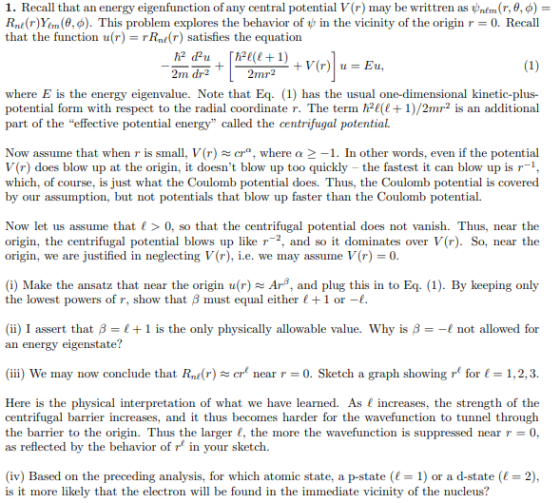
(i) Make the ansatz that near the origin u(r) ≈ Arβ , and plug this in to Eq. (1). By keeping only the lowest powers of r, show that β must equal either ` + 1 or −`.
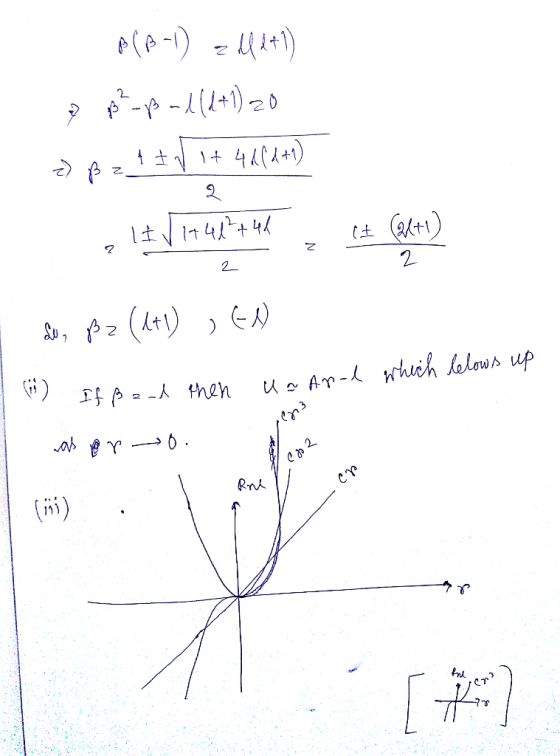
(ii) I assert that β = ` + 1 is the only physically allowable value. Why is β = −` not allowed for an energy eigenstate?
(iii) We may now conclude that Rn`(r) ≈ cr` near r = 0. Sketch a graph showing r ` for ` = 1, 2, 3. Here is the physical interpretation of what we have learned. As ` increases, the strength of the centrifugal barrier increases, and it thus becomes harder for the wavefunction to tunnel through the barrier to the origin. Thus the larger `, the more the wavefunction is suppressed near r = 0, as reflected by the behavior of r ` in your sketch.
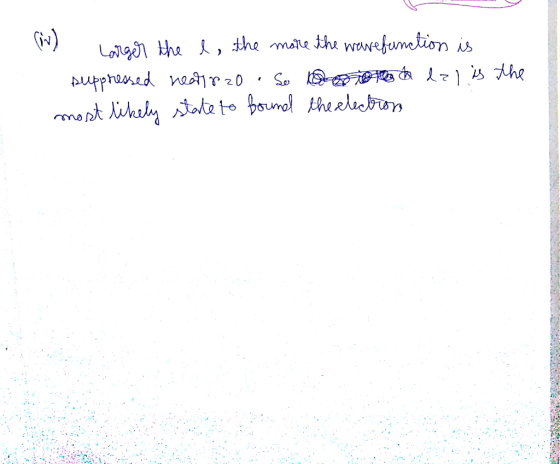
(iv) Based on the preceding analysis, for which atomic state, a p-state (` = 1) or a d-state (` = 2), is it more likely that the electron will be found in the immediate vicinity of the nucleus?
Homework Answers
![u EU h24 - A -(10) - via) u Eu | - 49 x x po e = [ 41m) Vin) - Ponte] 2mn? As porno, the centrifugal termidominates, 2 an2 s](http://img.homeworklib.com/questions/ba0114d0-c0a6-11eb-9dd3-d7b7e3cbaf6e.png?x-oss-process=image/resize,w_560)
Add Answer to:
Recall that an energy eigenfunction of any central potential V
(r) may be writtren as ψn`m(r,...
Suppose a particle has zero potential energy for x < 0, a constant value V, for...
Suppose a particle has zero potential energy for x < 0, a constant value V, for 0 ≤ x ≤ L, and then zero for x > L. Sketch the potential. Now suppose that wavefunction is a sine wave on the left of the barrier, declines exponentially inside the barrier, and then becomes a sine wave on the right, being continuous everywhere. Sketch the wavefunction on your sketch of the potential energy.
Suppose a particle has zero potential energy for x < 0, a constant value V, for...
Suppose a particle has zero potential energy for x < 0, a constant value V, for 0 ≤ x ≤ L, and then zero for x > L. Sketch the potential. Now suppose that wavefunction is a sine wave on the left of the barrier, declines exponentially inside the barrier, and then becomes a sine wave on the right, being continuous everywhere. Sketch the wavefunction on your sketch of the potential energy.
mechani mie The potential energy barrier shown below is a simplified model of thec electrons in...
 mechani mie The potential energy barrier shown below is a simplified model of thec electrons in metals. The metal workfunction (Ew), the minimum energy required to remove an electron from the metal, is given by Ew-,-E where 1s the height of the potential energy barrier and E is the energy of the electrons near the surface of the metal. The potential energy barrier is = 5 eV V(x) V=0 (a) The wavefunction of an electron on the surface (x< 0)...
2. Goal of this problem is to study how tunnelling in a two-well system emerges. In particular, w...
 2. Goal of this problem is to study how tunnelling in a two-well system emerges. In particular, we are interested in determining how the tunnelling rate T' of a particle with mass m scales as a function of the (effective) height Vo - E and width b of an energy barrier separating the two wells. The following graphics illustrates the set-up. Initially the particle may be trapped on the left side corresponding to the state |L〉, we are now interested...
(III) Quantum Tunneling Consider an electron in 1D in presence of a potential barrier of width...
 (III) Quantum Tunneling Consider an electron in 1D in presence of a potential barrier of width L represented by a step function ſo I<0 or 1>L V U. r>0 and 2<L The total wavefunction is subject to the time-independent Schrödinger equation = EV (2) 2m ar2 +V where E is the energy of the quantum particle in question and m is the mass of the quantum particle. A The total wavefunction of a free particle that enters the barrier from...
(a) Evaluate an expression for the expectation value of the potential energy for the n 3, 1-1, m ...
 Question blow and I need a, b and c, please help me.
(a) Evaluate an expression for the expectation value of the potential energy for the n 3, 1-1, m = 1 wavefunction of the hydrogen atom. You need to compute the integral, where e2 [4 marks] 0 wave- 6 marks] [2 marks] Write the answer in terms of h. e and me (b) Calculate the expectation value of the kinetic energy for the n-1,- function of the hydrogen atom....
Question blow and I need a, b and c, please help me.
(a) Evaluate an expression for the expectation value of the potential energy for the n 3, 1-1, m = 1 wavefunction of the hydrogen atom. You need to compute the integral, where e2 [4 marks] 0 wave- 6 marks] [2 marks] Write the answer in terms of h. e and me (b) Calculate the expectation value of the kinetic energy for the n-1,- function of the hydrogen atom....
3. A particle is in a 1D box (infinite potential well) of dimension, a, situated symmetrically ab...
 3. A particle is in a 1D box (infinite potential well) of dimension, a, situated symmetrically about the origin of the x-axis. A measurement of energy is made and the particle is found to have the ground state energy: 2ma The walls of the box are expanded instantaneously, doubling the well width symmetrically about the origin, leaving the particle in the same state. a) Sketch the initial potential well making it symmetric about x - 0 (note this is different...
zone 1 Consider the following piecewise continuous, finite potential energy: ro; x < -a V(x)={-U, ;...
 zone 1 Consider the following piecewise continuous, finite potential energy: ro; x < -a V(x)={-U, ; -a sxs a zone II U, > 0 (+ve) 10 ; x> a We consider zone III E>0: Unbound or scattering states (a) State the Time independent Schrödinger's Equation (TISE) and the expression of wave number k in each zone for the case of unbound state (b) Determine the expression of wave function u in each zone. (e) Determine the expression of probability Density...
3. Consider a particle of mass m moving in a potential given by: W (2, y,...
 3. Consider a particle of mass m moving in a potential given by: W (2, y, z) = 0 < x <a,0 < y <a l+o, elsewhere a) Write down the total energy and the 3D wavefunction for this particle. b) Assuming that hw > 312 h2/(2ma), find the energies and the corresponding degen- eracies for the ground state and the first excited state. c) Assume now that, in addition to the potential V(x, y, z), this particle also has...
2. A particle of mass m is moving in a plane under a force whose potential energy is given by V(r...
 2. A particle of mass m is moving in a plane under a force whose potential energy is given by V(r) -kin r + cr + gr cos θ with k,c,g positive constants. (a) Write down the force in polar coordinates. (b) Find the positions of equilibrium (1) if c>g and (2) if c<g. (c) By considering the direction of the force near these points, determine whether the equilibrium is stable or not
2. A particle of mass m is...
2. A particle of mass m is moving in a plane under a force whose potential energy is given by V(r) -kin r + cr + gr cos θ with k,c,g positive constants. (a) Write down the force in polar coordinates. (b) Find the positions of equilibrium (1) if c>g and (2) if c<g. (c) By considering the direction of the force near these points, determine whether the equilibrium is stable or not
2. A particle of mass m is...
 mechani mie The potential energy barrier shown below is a simplified model of thec electrons in metals. The metal workfunction (Ew), the minimum energy required to remove an electron from the metal, is given by Ew-,-E where 1s the height of the potential energy barrier and E is the energy of the electrons near the surface of the metal. The potential energy barrier is = 5 eV V(x) V=0 (a) The wavefunction of an electron on the surface (x< 0)...
 2. Goal of this problem is to study how tunnelling in a two-well system emerges. In particular, we are interested in determining how the tunnelling rate T' of a particle with mass m scales as a function of the (effective) height Vo - E and width b of an energy barrier separating the two wells. The following graphics illustrates the set-up. Initially the particle may be trapped on the left side corresponding to the state |L〉, we are now interested...
 (III) Quantum Tunneling Consider an electron in 1D in presence of a potential barrier of width L represented by a step function ſo I<0 or 1>L V U. r>0 and 2<L The total wavefunction is subject to the time-independent Schrödinger equation = EV (2) 2m ar2 +V where E is the energy of the quantum particle in question and m is the mass of the quantum particle. A The total wavefunction of a free particle that enters the barrier from...
 Question blow and I need a, b and c, please help me.
(a) Evaluate an expression for the expectation value of the potential energy for the n 3, 1-1, m = 1 wavefunction of the hydrogen atom. You need to compute the integral, where e2 [4 marks] 0 wave- 6 marks] [2 marks] Write the answer in terms of h. e and me (b) Calculate the expectation value of the kinetic energy for the n-1,- function of the hydrogen atom....
Question blow and I need a, b and c, please help me.
(a) Evaluate an expression for the expectation value of the potential energy for the n 3, 1-1, m = 1 wavefunction of the hydrogen atom. You need to compute the integral, where e2 [4 marks] 0 wave- 6 marks] [2 marks] Write the answer in terms of h. e and me (b) Calculate the expectation value of the kinetic energy for the n-1,- function of the hydrogen atom....
 3. A particle is in a 1D box (infinite potential well) of dimension, a, situated symmetrically about the origin of the x-axis. A measurement of energy is made and the particle is found to have the ground state energy: 2ma The walls of the box are expanded instantaneously, doubling the well width symmetrically about the origin, leaving the particle in the same state. a) Sketch the initial potential well making it symmetric about x - 0 (note this is different...
 zone 1 Consider the following piecewise continuous, finite potential energy: ro; x < -a V(x)={-U, ; -a sxs a zone II U, > 0 (+ve) 10 ; x> a We consider zone III E>0: Unbound or scattering states (a) State the Time independent Schrödinger's Equation (TISE) and the expression of wave number k in each zone for the case of unbound state (b) Determine the expression of wave function u in each zone. (e) Determine the expression of probability Density...
 3. Consider a particle of mass m moving in a potential given by: W (2, y, z) = 0 < x <a,0 < y <a l+o, elsewhere a) Write down the total energy and the 3D wavefunction for this particle. b) Assuming that hw > 312 h2/(2ma), find the energies and the corresponding degen- eracies for the ground state and the first excited state. c) Assume now that, in addition to the potential V(x, y, z), this particle also has...
 2. A particle of mass m is moving in a plane under a force whose potential energy is given by V(r) -kin r + cr + gr cos θ with k,c,g positive constants. (a) Write down the force in polar coordinates. (b) Find the positions of equilibrium (1) if c>g and (2) if c<g. (c) By considering the direction of the force near these points, determine whether the equilibrium is stable or not
2. A particle of mass m is...
2. A particle of mass m is moving in a plane under a force whose potential energy is given by V(r) -kin r + cr + gr cos θ with k,c,g positive constants. (a) Write down the force in polar coordinates. (b) Find the positions of equilibrium (1) if c>g and (2) if c<g. (c) By considering the direction of the force near these points, determine whether the equilibrium is stable or not
2. A particle of mass m is...
Most questions answered within 3 hours.
-
Where is the error in this code sequence?
String s1 = "Hello";
String s2 = "ello";...
asked 11 months ago -
Financial data for Joel de Paris, Inc., for last year
follow:
Joel de Paris, Inc.
Balance...
asked 11 months ago -
Consider this reaction:
Al2(SO4)3 (aq)+ BaCl3
(aq) Al2Cl6 (aq)- +
3BaSO4(s) . What is the...
asked 11 months ago -
Suppose that Savneet is considering increasing her
recent random sample from 20 car rentals to 40...
asked 11 months ago -
Trucks arrive at an unloading terminal at an average rate of 120
per hour.
Trucks arrive...
asked 11 months ago -
Why are methanol and ethanol completely soluble in water while
octanol is not very little soluble....
asked 11 months ago -
A facilities manager at a university reads in a research report
that the mean amount of...
asked 11 months ago -
When the CuSO4 is rehydrated by adding water to the anhydrous
compound, is this an endothermic...
asked 11 months ago -
A ray of sunlight is passing from diamond into crown glass; the
angle of incidence is...
asked 11 months ago -
A block of mass 0.249 kg is placed on top of a light, vertical
spring of...
asked 11 months ago -
how do the kidneys compensate in the presences of acidosis
a) trigger hyperventilate
b) reserve acid...
asked 11 months ago -
Question 501 pts
The rental rate of capital to the firm increases. Which of the
following...
asked 11 months ago