
Homework Answers
5.Since sodium borohydride is highly hygroscopic and reactive towards active hydrogen containing molecules such as water and acids. So any water content present in alcohol may lead to hazard.
6. Reduced product no longer possess keto functional group in benzoin (carbonyl group), hence there will be absent of strong peak in the region 1705-1725 cm-1, which is is present in starting compound benzoin.
7. Due to the formation of symmetrical dihydroxy product, 1H NMR of product shows simple splitting pattern compared to starting material. Product shows only 3 signals, one multiplet, and two singlets.
8. Again due to symmetry we can expect 5 13C NMR signals only.
9. Answer is in below image, the products are diastereomers. EtOH and H3O+ both will same as they supply H+.
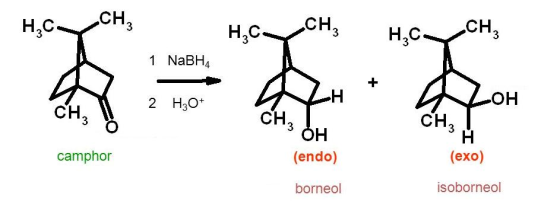
Hope this helped you!
Thank You So Much! Please Rate this answer as you wish.("Thumbs Up")
Add Answer to:
Sodium Borohydride Reduction of Benzoin Pre-Lab
Worksheet
(1) Why is it important to use 100% ethanol...
We performed a synthesis of methyl diantilis lab. The first step involved a Sodium Borohydride Reduction...
 We performed a synthesis of methyl diantilis lab. The first step
involved a Sodium Borohydride Reduction of
3-Ethoxy-4-hydroxybenzaldehyde (Ethylvanillin) shown below.
The next step of the experiment involved Etherification of
3-ethoxy-4-hydroxylbenzyl Alcohol using one of four alcohols
(methanol, ethanol, 1-propanol, or 2-propanol). The alcohol I used
was methanol. The reaction is predicted below.
Below is the NMR sample for my product with the integration and
ppm for each peak displayed.
Based on this information, answer the following questions.
a. Check...
We performed a synthesis of methyl diantilis lab. The first step
involved a Sodium Borohydride Reduction of
3-Ethoxy-4-hydroxybenzaldehyde (Ethylvanillin) shown below.
The next step of the experiment involved Etherification of
3-ethoxy-4-hydroxylbenzyl Alcohol using one of four alcohols
(methanol, ethanol, 1-propanol, or 2-propanol). The alcohol I used
was methanol. The reaction is predicted below.
Below is the NMR sample for my product with the integration and
ppm for each peak displayed.
Based on this information, answer the following questions.
a. Check...
hi, please help me with number 7. thank you EXPERIMENT SEVEN SODIUM BOROHYDRIDE REDUCTION OF ACETOPHENONE...
 hi, please help me with number 7. thank you
EXPERIMENT SEVEN SODIUM BOROHYDRIDE REDUCTION OF ACETOPHENONE HOCH, DISCUSSION The reduction of an aldehyde or ketone with sodium borohydride is straight forward and usually affords a high yield of the alcohol. The usual procedure (and the one employed in this experiment) involves dissolving the borohydride in 95% ethanol and adding the carbonyl compound to this solution. To ensure complete reaction, an excess of sodium borohydride is used. The reaction between sodium...
hi, please help me with number 7. thank you
EXPERIMENT SEVEN SODIUM BOROHYDRIDE REDUCTION OF ACETOPHENONE HOCH, DISCUSSION The reduction of an aldehyde or ketone with sodium borohydride is straight forward and usually affords a high yield of the alcohol. The usual procedure (and the one employed in this experiment) involves dissolving the borohydride in 95% ethanol and adding the carbonyl compound to this solution. To ensure complete reaction, an excess of sodium borohydride is used. The reaction between sodium...
EXPERIMENT 11 THE MICROSCALE REDUCTION OF BENZIL WITH SODIUM BOROHYDRIDE INTRODUCTION Oxidation-reduction (redox) reactions occur in...
 EXPERIMENT 11 THE MICROSCALE REDUCTION OF BENZIL WITH SODIUM BOROHYDRIDE INTRODUCTION Oxidation-reduction (redox) reactions occur in concert. One substance undergoes oxidation by donating electrons to another substance that is then reduced. In organic chemistry certain rules are followed in determining whether a particular substrate is being oxidized or reduced. Oxidation: The loss of hydrogen and/or gain of oxygen by a substrate Reduction: The gain of hydrogen and/or loss of oxygen by a substrate When an organic substrate is reduced, the...
EXPERIMENT 11 THE MICROSCALE REDUCTION OF BENZIL WITH SODIUM BOROHYDRIDE INTRODUCTION Oxidation-reduction (redox) reactions occur in...
 EXPERIMENT 11 THE MICROSCALE REDUCTION OF BENZIL WITH SODIUM BOROHYDRIDE INTRODUCTION Oxidation-reduction (redox) reactions occur in concert. One substance undergoes oxidation by donating electrons to another substance that is then reduced. In organic chemistry certain rules are followed in determining whether a particular substrate is being oxidized or reduced. Oxidation: The loss of hydrogen and/or gain of oxygen by a substrater Reduction: The gain of hydrogen and/or loss of oxygen by a substrate When an organic substrate is reduced, the...
Experiment . the reduction of bencil (March 2020) Your name Sodium borohydride is a convert recent...
 Experiment . the reduction of bencil (March 2020) Your name Sodium borohydride is a convert recent for the reduction of dehydes and ketones to 1" and 2 alcohols, respectively. The mechanism of the reaction - (below) is straightforward and is driven by boron's affinity for oxygen. In addition, given borohydride's remarkably low reactivity with OH groups under neutral and especially basic conditions, this reaction can be done in alcohol solvents. This means that (unlike LAH or Grignard reactions) no separate...
 We performed a synthesis of methyl diantilis lab. The first step
involved a Sodium Borohydride Reduction of
3-Ethoxy-4-hydroxybenzaldehyde (Ethylvanillin) shown below.
The next step of the experiment involved Etherification of
3-ethoxy-4-hydroxylbenzyl Alcohol using one of four alcohols
(methanol, ethanol, 1-propanol, or 2-propanol). The alcohol I used
was methanol. The reaction is predicted below.
Below is the NMR sample for my product with the integration and
ppm for each peak displayed.
Based on this information, answer the following questions.
a. Check...
We performed a synthesis of methyl diantilis lab. The first step
involved a Sodium Borohydride Reduction of
3-Ethoxy-4-hydroxybenzaldehyde (Ethylvanillin) shown below.
The next step of the experiment involved Etherification of
3-ethoxy-4-hydroxylbenzyl Alcohol using one of four alcohols
(methanol, ethanol, 1-propanol, or 2-propanol). The alcohol I used
was methanol. The reaction is predicted below.
Below is the NMR sample for my product with the integration and
ppm for each peak displayed.
Based on this information, answer the following questions.
a. Check...
 hi, please help me with number 7. thank you
EXPERIMENT SEVEN SODIUM BOROHYDRIDE REDUCTION OF ACETOPHENONE HOCH, DISCUSSION The reduction of an aldehyde or ketone with sodium borohydride is straight forward and usually affords a high yield of the alcohol. The usual procedure (and the one employed in this experiment) involves dissolving the borohydride in 95% ethanol and adding the carbonyl compound to this solution. To ensure complete reaction, an excess of sodium borohydride is used. The reaction between sodium...
hi, please help me with number 7. thank you
EXPERIMENT SEVEN SODIUM BOROHYDRIDE REDUCTION OF ACETOPHENONE HOCH, DISCUSSION The reduction of an aldehyde or ketone with sodium borohydride is straight forward and usually affords a high yield of the alcohol. The usual procedure (and the one employed in this experiment) involves dissolving the borohydride in 95% ethanol and adding the carbonyl compound to this solution. To ensure complete reaction, an excess of sodium borohydride is used. The reaction between sodium...
 EXPERIMENT 11 THE MICROSCALE REDUCTION OF BENZIL WITH SODIUM BOROHYDRIDE INTRODUCTION Oxidation-reduction (redox) reactions occur in concert. One substance undergoes oxidation by donating electrons to another substance that is then reduced. In organic chemistry certain rules are followed in determining whether a particular substrate is being oxidized or reduced. Oxidation: The loss of hydrogen and/or gain of oxygen by a substrate Reduction: The gain of hydrogen and/or loss of oxygen by a substrate When an organic substrate is reduced, the...
 EXPERIMENT 11 THE MICROSCALE REDUCTION OF BENZIL WITH SODIUM BOROHYDRIDE INTRODUCTION Oxidation-reduction (redox) reactions occur in concert. One substance undergoes oxidation by donating electrons to another substance that is then reduced. In organic chemistry certain rules are followed in determining whether a particular substrate is being oxidized or reduced. Oxidation: The loss of hydrogen and/or gain of oxygen by a substrater Reduction: The gain of hydrogen and/or loss of oxygen by a substrate When an organic substrate is reduced, the...
 Experiment . the reduction of bencil (March 2020) Your name Sodium borohydride is a convert recent for the reduction of dehydes and ketones to 1" and 2 alcohols, respectively. The mechanism of the reaction - (below) is straightforward and is driven by boron's affinity for oxygen. In addition, given borohydride's remarkably low reactivity with OH groups under neutral and especially basic conditions, this reaction can be done in alcohol solvents. This means that (unlike LAH or Grignard reactions) no separate...
Most questions answered within 3 hours.
-
Where is the error in this code sequence?
String s1 = "Hello";
String s2 = "ello";...
asked 11 months ago -
Financial data for Joel de Paris, Inc., for last year
follow:
Joel de Paris, Inc.
Balance...
asked 11 months ago -
Consider this reaction:
Al2(SO4)3 (aq)+ BaCl3
(aq) Al2Cl6 (aq)- +
3BaSO4(s) . What is the...
asked 11 months ago -
Suppose that Savneet is considering increasing her
recent random sample from 20 car rentals to 40...
asked 11 months ago -
Trucks arrive at an unloading terminal at an average rate of 120
per hour.
Trucks arrive...
asked 11 months ago -
Why are methanol and ethanol completely soluble in water while
octanol is not very little soluble....
asked 11 months ago -
A facilities manager at a university reads in a research report
that the mean amount of...
asked 11 months ago -
When the CuSO4 is rehydrated by adding water to the anhydrous
compound, is this an endothermic...
asked 11 months ago -
A ray of sunlight is passing from diamond into crown glass; the
angle of incidence is...
asked 11 months ago -
A block of mass 0.249 kg is placed on top of a light, vertical
spring of...
asked 11 months ago -
how do the kidneys compensate in the presences of acidosis
a) trigger hyperventilate
b) reserve acid...
asked 11 months ago -
Question 501 pts
The rental rate of capital to the firm increases. Which of the
following...
asked 11 months ago