

Homework Answers
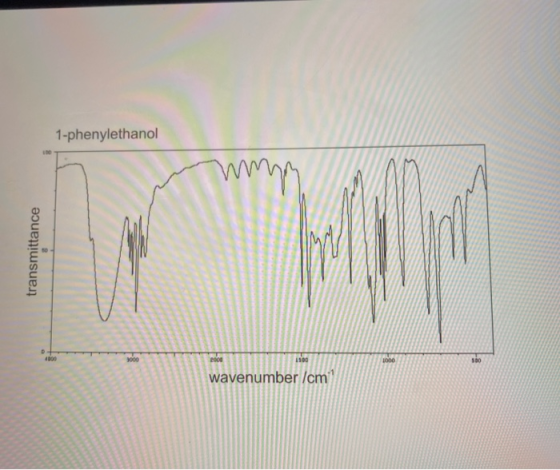
In IR we should see a band around 1700 cm-1 for carbonyl stretching.
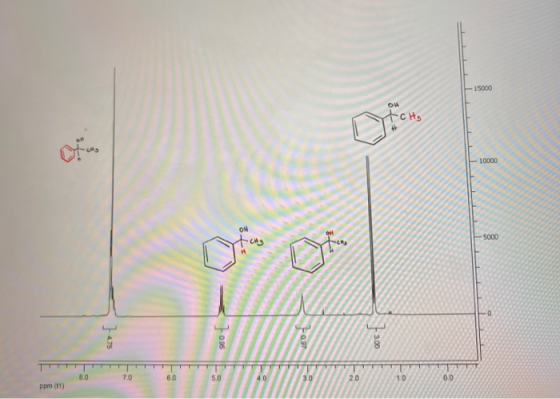
In NMR, the CH3 group appears as singlet at 2.1 which is characteristic of COCH3 group.we can see very small peak at 2.1 showing little impurity of acetophenone.
Add Answer to:
hi, please help me with number 7. thank you
EXPERIMENT SEVEN SODIUM BOROHYDRIDE REDUCTION OF ACETOPHENONE...
Experiment: Reduction of aldehyde or ketone using sodium borohydride as a catalyst and ethanol as the...
 Experiment: Reduction of aldehyde or ketone using sodium
borohydride as a catalyst and ethanol as the solvent sustem. Add
deionized water to the reaction mixture and perform liquid liquid
extraction with dichloromethane. Rotovap the organix extract with
the dlasj immersed in room temp until no chanfe is observed.
Merowave-Assisted Reduction of Aldehydes or Ketones Post-Lab Questions: 2. Students are asked to "wash their reaction solution, as well as the organic extraction layer. What is/are the most likely impurities that are...
Experiment: Reduction of aldehyde or ketone using sodium
borohydride as a catalyst and ethanol as the solvent sustem. Add
deionized water to the reaction mixture and perform liquid liquid
extraction with dichloromethane. Rotovap the organix extract with
the dlasj immersed in room temp until no chanfe is observed.
Merowave-Assisted Reduction of Aldehydes or Ketones Post-Lab Questions: 2. Students are asked to "wash their reaction solution, as well as the organic extraction layer. What is/are the most likely impurities that are...
Experiment . the reduction of bencil (March 2020) Your name Sodium borohydride is a convert recent...
 Experiment . the reduction of bencil (March 2020) Your name Sodium borohydride is a convert recent for the reduction of dehydes and ketones to 1" and 2 alcohols, respectively. The mechanism of the reaction - (below) is straightforward and is driven by boron's affinity for oxygen. In addition, given borohydride's remarkably low reactivity with OH groups under neutral and especially basic conditions, this reaction can be done in alcohol solvents. This means that (unlike LAH or Grignard reactions) no separate...
EXPERIMENT 11 THE MICROSCALE REDUCTION OF BENZIL WITH SODIUM BOROHYDRIDE INTRODUCTION Oxidation-reduction (redox) reactions occur in...
 EXPERIMENT 11 THE MICROSCALE REDUCTION OF BENZIL WITH SODIUM BOROHYDRIDE INTRODUCTION Oxidation-reduction (redox) reactions occur in concert. One substance undergoes oxidation by donating electrons to another substance that is then reduced. In organic chemistry certain rules are followed in determining whether a particular substrate is being oxidized or reduced. Oxidation: The loss of hydrogen and/or gain of oxygen by a substrate Reduction: The gain of hydrogen and/or loss of oxygen by a substrate When an organic substrate is reduced, the...
EXPERIMENT 11 THE MICROSCALE REDUCTION OF BENZIL WITH SODIUM BOROHYDRIDE INTRODUCTION Oxidation-reduction (redox) reactions occur in...
 EXPERIMENT 11 THE MICROSCALE REDUCTION OF BENZIL WITH SODIUM BOROHYDRIDE INTRODUCTION Oxidation-reduction (redox) reactions occur in concert. One substance undergoes oxidation by donating electrons to another substance that is then reduced. In organic chemistry certain rules are followed in determining whether a particular substrate is being oxidized or reduced. Oxidation: The loss of hydrogen and/or gain of oxygen by a substrater Reduction: The gain of hydrogen and/or loss of oxygen by a substrate When an organic substrate is reduced, the...
We performed a synthesis of methyl diantilis lab. The first step involved a Sodium Borohydride Reduction...
 We performed a synthesis of methyl diantilis lab. The first step
involved a Sodium Borohydride Reduction of
3-Ethoxy-4-hydroxybenzaldehyde (Ethylvanillin) shown below.
The next step of the experiment involved Etherification of
3-ethoxy-4-hydroxylbenzyl Alcohol using one of four alcohols
(methanol, ethanol, 1-propanol, or 2-propanol). The alcohol I used
was methanol. The reaction is predicted below.
Below is the NMR sample for my product with the integration and
ppm for each peak displayed.
Based on this information, answer the following questions.
a. Check...
We performed a synthesis of methyl diantilis lab. The first step
involved a Sodium Borohydride Reduction of
3-Ethoxy-4-hydroxybenzaldehyde (Ethylvanillin) shown below.
The next step of the experiment involved Etherification of
3-ethoxy-4-hydroxylbenzyl Alcohol using one of four alcohols
(methanol, ethanol, 1-propanol, or 2-propanol). The alcohol I used
was methanol. The reaction is predicted below.
Below is the NMR sample for my product with the integration and
ppm for each peak displayed.
Based on this information, answer the following questions.
a. Check...
You will apply what you have learned earlier in the semester when performing the Acid-Base Extraction...
You will apply what you have learned earlier in the semester when performing the Acid-Base Extraction experiment to perform a different separation: that of an organic neutral compound and organic base. You will also need to purify and characterize these compounds. You will have one lab period to execute your plan for separating the assigned mixture given below. There will be a 1:1 (by mass) mixture placed in the lab: 1,4-dichlorobenzene/ethyl 4-aminobenzoate. You will take approximately 1 g of your...
NaBH4(Sodium Borohydride) Reduction of Ketone (Organic Chemistry Lab) Questions 1. Explain the...
 NaBH4(Sodium Borohydride) Reduction of Ketone (Organic
Chemistry Lab)
Questions
1.
Explain the reaction mechanism and why each reagent was used.
2. Explain the need for 2 different drying agents
3. Use
IR stretches and melting point determination to explain your
results.
4.
Report sources of error.
Experiment Procedure
Assemble the reaction apparatus as shown in Figure 14.2a,
consisting of a 3.0 mL conical vial charged with 4-t-
butylcyclohexanone (amount calculated in pre-lab) and methanol (100
μL). Attach the air condenser...
NaBH4(Sodium Borohydride) Reduction of Ketone (Organic
Chemistry Lab)
Questions
1.
Explain the reaction mechanism and why each reagent was used.
2. Explain the need for 2 different drying agents
3. Use
IR stretches and melting point determination to explain your
results.
4.
Report sources of error.
Experiment Procedure
Assemble the reaction apparatus as shown in Figure 14.2a,
consisting of a 3.0 mL conical vial charged with 4-t-
butylcyclohexanone (amount calculated in pre-lab) and methanol (100
μL). Attach the air condenser...
This is for the Grignard Reaction laboratory. Please help me answer this question, much appreciated. 1....
This is for the Grignard Reaction laboratory. Please help me answer this question, much appreciated. 1. If a student performing Laboratory with Grignard reaction accidently used acetone as the reaction solvent instead of diethyl ether, what would the major organic product(s) be? Draw the structure of the product(s) (no mechanism necessary). b. What was the purpose of adding magnesium sulfate in this experiment? c. Grignard reagents react with both aldehyde and ketone functional groups. How do you predict the reaction...
i need help with #3 please! SAFETY NOTES: Bromobenene and acetophenone are irritants. Wear gloves and...
 i need help with #3 please!
SAFETY NOTES: Bromobenene and acetophenone are irritants. Wear gloves and avoid contact with skin, eyes, and clothing • MHC) is dritating to the skin avoid contact with the skin, eyes, and clothing Diethyl ether, usually referred to simply as "ether", is volatile and flammable. Keep a safe distance from hot electrical devices WASTE DISPOSAL *** A itrate is the liquid that passed through the Hirsch funnel, ending up in the bottom of the sidearm...
i need help with #3 please!
SAFETY NOTES: Bromobenene and acetophenone are irritants. Wear gloves and avoid contact with skin, eyes, and clothing • MHC) is dritating to the skin avoid contact with the skin, eyes, and clothing Diethyl ether, usually referred to simply as "ether", is volatile and flammable. Keep a safe distance from hot electrical devices WASTE DISPOSAL *** A itrate is the liquid that passed through the Hirsch funnel, ending up in the bottom of the sidearm...
multiple choise 5 questions answer all please 1.Which of the following compounds is the least reactive...
multiple choise 5 questions answer all please 1.Which of the following compounds is the least reactive in the nucleophilic substitution with NaOH? 2,4-dinitrochlorobenzene m-nitrochlorobenzene o-nitrochlorobenzene 3,5-dinitrochlorobenzene 2.which of the following is the correct ascending order, for boiling points? a. n-butane <1-butane <diethyl ether <2-butanone b. n-butane <2-butanone <diethyl ether <1-butane c. n-butane <diethyl ether <1-butane <2-butanone d. n-butane <diethyl ether <2-butanone <1-butane 3.What is the main product of the reaction between 1-cyclobutyl-1-ethanol and H2SO4 + heat? a. 1-methyl cyclopentene b....
 Experiment: Reduction of aldehyde or ketone using sodium
borohydride as a catalyst and ethanol as the solvent sustem. Add
deionized water to the reaction mixture and perform liquid liquid
extraction with dichloromethane. Rotovap the organix extract with
the dlasj immersed in room temp until no chanfe is observed.
Merowave-Assisted Reduction of Aldehydes or Ketones Post-Lab Questions: 2. Students are asked to "wash their reaction solution, as well as the organic extraction layer. What is/are the most likely impurities that are...
Experiment: Reduction of aldehyde or ketone using sodium
borohydride as a catalyst and ethanol as the solvent sustem. Add
deionized water to the reaction mixture and perform liquid liquid
extraction with dichloromethane. Rotovap the organix extract with
the dlasj immersed in room temp until no chanfe is observed.
Merowave-Assisted Reduction of Aldehydes or Ketones Post-Lab Questions: 2. Students are asked to "wash their reaction solution, as well as the organic extraction layer. What is/are the most likely impurities that are...
 Experiment . the reduction of bencil (March 2020) Your name Sodium borohydride is a convert recent for the reduction of dehydes and ketones to 1" and 2 alcohols, respectively. The mechanism of the reaction - (below) is straightforward and is driven by boron's affinity for oxygen. In addition, given borohydride's remarkably low reactivity with OH groups under neutral and especially basic conditions, this reaction can be done in alcohol solvents. This means that (unlike LAH or Grignard reactions) no separate...
 EXPERIMENT 11 THE MICROSCALE REDUCTION OF BENZIL WITH SODIUM BOROHYDRIDE INTRODUCTION Oxidation-reduction (redox) reactions occur in concert. One substance undergoes oxidation by donating electrons to another substance that is then reduced. In organic chemistry certain rules are followed in determining whether a particular substrate is being oxidized or reduced. Oxidation: The loss of hydrogen and/or gain of oxygen by a substrate Reduction: The gain of hydrogen and/or loss of oxygen by a substrate When an organic substrate is reduced, the...
 EXPERIMENT 11 THE MICROSCALE REDUCTION OF BENZIL WITH SODIUM BOROHYDRIDE INTRODUCTION Oxidation-reduction (redox) reactions occur in concert. One substance undergoes oxidation by donating electrons to another substance that is then reduced. In organic chemistry certain rules are followed in determining whether a particular substrate is being oxidized or reduced. Oxidation: The loss of hydrogen and/or gain of oxygen by a substrater Reduction: The gain of hydrogen and/or loss of oxygen by a substrate When an organic substrate is reduced, the...
 We performed a synthesis of methyl diantilis lab. The first step
involved a Sodium Borohydride Reduction of
3-Ethoxy-4-hydroxybenzaldehyde (Ethylvanillin) shown below.
The next step of the experiment involved Etherification of
3-ethoxy-4-hydroxylbenzyl Alcohol using one of four alcohols
(methanol, ethanol, 1-propanol, or 2-propanol). The alcohol I used
was methanol. The reaction is predicted below.
Below is the NMR sample for my product with the integration and
ppm for each peak displayed.
Based on this information, answer the following questions.
a. Check...
We performed a synthesis of methyl diantilis lab. The first step
involved a Sodium Borohydride Reduction of
3-Ethoxy-4-hydroxybenzaldehyde (Ethylvanillin) shown below.
The next step of the experiment involved Etherification of
3-ethoxy-4-hydroxylbenzyl Alcohol using one of four alcohols
(methanol, ethanol, 1-propanol, or 2-propanol). The alcohol I used
was methanol. The reaction is predicted below.
Below is the NMR sample for my product with the integration and
ppm for each peak displayed.
Based on this information, answer the following questions.
a. Check...
 NaBH4(Sodium Borohydride) Reduction of Ketone (Organic
Chemistry Lab)
Questions
1.
Explain the reaction mechanism and why each reagent was used.
2. Explain the need for 2 different drying agents
3. Use
IR stretches and melting point determination to explain your
results.
4.
Report sources of error.
Experiment Procedure
Assemble the reaction apparatus as shown in Figure 14.2a,
consisting of a 3.0 mL conical vial charged with 4-t-
butylcyclohexanone (amount calculated in pre-lab) and methanol (100
μL). Attach the air condenser...
NaBH4(Sodium Borohydride) Reduction of Ketone (Organic
Chemistry Lab)
Questions
1.
Explain the reaction mechanism and why each reagent was used.
2. Explain the need for 2 different drying agents
3. Use
IR stretches and melting point determination to explain your
results.
4.
Report sources of error.
Experiment Procedure
Assemble the reaction apparatus as shown in Figure 14.2a,
consisting of a 3.0 mL conical vial charged with 4-t-
butylcyclohexanone (amount calculated in pre-lab) and methanol (100
μL). Attach the air condenser...
 i need help with #3 please!
SAFETY NOTES: Bromobenene and acetophenone are irritants. Wear gloves and avoid contact with skin, eyes, and clothing • MHC) is dritating to the skin avoid contact with the skin, eyes, and clothing Diethyl ether, usually referred to simply as "ether", is volatile and flammable. Keep a safe distance from hot electrical devices WASTE DISPOSAL *** A itrate is the liquid that passed through the Hirsch funnel, ending up in the bottom of the sidearm...
i need help with #3 please!
SAFETY NOTES: Bromobenene and acetophenone are irritants. Wear gloves and avoid contact with skin, eyes, and clothing • MHC) is dritating to the skin avoid contact with the skin, eyes, and clothing Diethyl ether, usually referred to simply as "ether", is volatile and flammable. Keep a safe distance from hot electrical devices WASTE DISPOSAL *** A itrate is the liquid that passed through the Hirsch funnel, ending up in the bottom of the sidearm...
Most questions answered within 3 hours.
-
Where is the error in this code sequence?
String s1 = "Hello";
String s2 = "ello";...
asked 10 months ago -
Financial data for Joel de Paris, Inc., for last year
follow:
Joel de Paris, Inc.
Balance...
asked 10 months ago -
Consider this reaction:
Al2(SO4)3 (aq)+ BaCl3
(aq) Al2Cl6 (aq)- +
3BaSO4(s) . What is the...
asked 10 months ago -
Suppose that Savneet is considering increasing her
recent random sample from 20 car rentals to 40...
asked 10 months ago -
Trucks arrive at an unloading terminal at an average rate of 120
per hour.
Trucks arrive...
asked 10 months ago -
Why are methanol and ethanol completely soluble in water while
octanol is not very little soluble....
asked 10 months ago -
A facilities manager at a university reads in a research report
that the mean amount of...
asked 10 months ago -
When the CuSO4 is rehydrated by adding water to the anhydrous
compound, is this an endothermic...
asked 10 months ago -
A ray of sunlight is passing from diamond into crown glass; the
angle of incidence is...
asked 10 months ago -
A block of mass 0.249 kg is placed on top of a light, vertical
spring of...
asked 10 months ago -
how do the kidneys compensate in the presences of acidosis
a) trigger hyperventilate
b) reserve acid...
asked 10 months ago -
Question 501 pts
The rental rate of capital to the firm increases. Which of the
following...
asked 10 months ago