NaBH4(Sodium Borohydride) Reduction of Ketone (Organic Chemistry Lab)
Questions
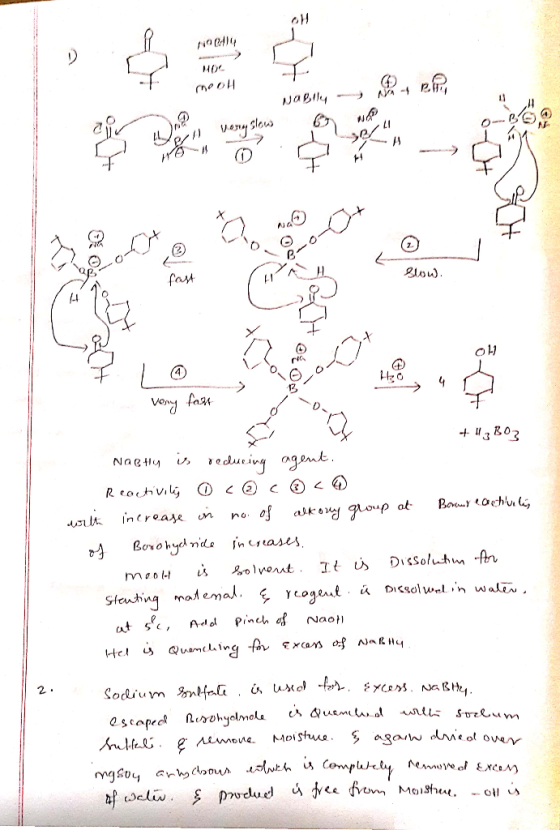
| 1. Explain the reaction mechanism and why each reagent was used. |
|
2. Explain the need for 2 different drying agents |
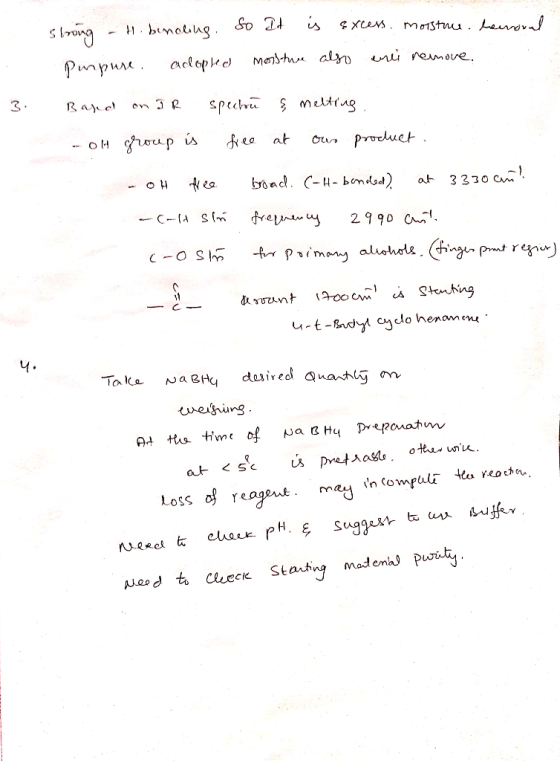
| 3. Use IR stretches and melting point determination to explain your results. |
| 4. Report sources of error. |
Experiment Procedure
-
Assemble the reaction apparatus as shown in Figure 14.2a, consisting of a 3.0 mL conical vial charged with 4-t- butylcyclohexanone (amount calculated in pre-lab) and methanol (100 μL). Attach the air condenser and after shaking the vial to dissolve the ketone, add the borohydride solution through the condenser (300 μL from an Eppendorf pipette).
-
Allow the solution to stand at room temperature for 10 minutes.
-
Chill dilute HCl (0.5 mL, 1 N, measured with your “calibrated” Pasteur pipette) in a small vial. Add this cold acid to the reaction mixture by Pasteur pipette.
-
Extract the reaction solution three times with methylene chloride (0.5 mL each time). After each addition of methylene chloride, cap the vial, shake gently, carefully vent when opening the cap and combine the organic portions in a separate vial.
-
Using a Pasteur pipette, transfer the combined organic portion to a vial containing 200 mg Na2SO4. After stirring this pre-dried solution,
transfer by pipette to a filter pipette containing a cotton plug and anhydrous magnesium sulfate (500 mg) (see Figure 15-2b) suspended over a tared 1 dram vial. Rinse the vial with additional methylene chloride (0.5 mL) and pass this solution through the drying filter. Dispose of the pipette column in the solid waste container.
-
Evaporate the solvent using the rotary evaporator (p.46). Reweigh your vial to get the mass of the product and determine the melting point of the product. Dispose of the tube in the solid waste container.
-
Add some of the solid sample (10 mg) to a GC vial labeled in marker with your name, sample and section number. Add methylene chloride (1 mL), cap and swirl to dissolve the product. Place your vial in the first available slot in the GC tray, record your name and sample on the GC signup sheet. [Record the tray number in your notebook.]
-
Turn in the rest of the neat product to the TA for IR analysis.
Experiment Results
IR spectra
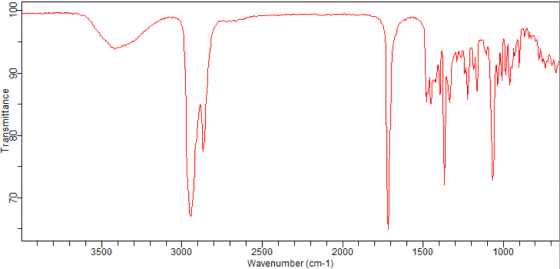
Melting point Determination (mp of product ( 4-t- butylcyclohexanol =62-70℃)
experimental product m.p=60-61℃
Homework Answers
Add Answer to:
NaBH4(Sodium Borohydride) Reduction of Ketone (Organic Chemistry Lab) Questions 1. Explain the...
Hydroboration-Oxidation (Organic Chemistry Laboratory) 1.Explain the mechanism of the reaction. 2.What was the most important piece...
Hydroboration-Oxidation (Organic Chemistry Laboratory) 1.Explain the mechanism of the reaction. 2.What was the most important piece of equipment for the success of the reaction? 3.Was there a rate determining step in the reaction? 4.Explain the purpose of the key reagent(s) in the reaction. Experiment Procedure Flame dry a 5.0 mL conical vial and a Claisen head at the start of the lab period. Place a dry spin vane in the dried conical vial. Assemble these pieces with a calcium chloride...
in FRIEDEL-CRAFTS ACYLATION AND COLUMN CHROMATOGRAPHY lab (2 pts) Amount of acetyl chloride used ____4______(drops) (each...
 in FRIEDEL-CRAFTS ACYLATION AND COLUMN CHROMATOGRAPHY lab
(2 pts) Amount of acetyl chloride used ____4______(drops) (each
drop is 0.01 mL) _____2______(equivalents) Based on the amount of
ferrocene you began the Friedel-Crafts reaction with, determine the
percent yield of acetylferrocene, diacetylferrocene, and the
percent recovery of unreacted ferrocene (show work)
react by 0.100 g of ferrocene at beginning
got 0 g of ferrocene, 0.012g of diacetylferrocene , 0.017g of
acetylferrocene
REACTION PROCEDURE: To a 5 mL conical vial, add a spin...
in FRIEDEL-CRAFTS ACYLATION AND COLUMN CHROMATOGRAPHY lab
(2 pts) Amount of acetyl chloride used ____4______(drops) (each
drop is 0.01 mL) _____2______(equivalents) Based on the amount of
ferrocene you began the Friedel-Crafts reaction with, determine the
percent yield of acetylferrocene, diacetylferrocene, and the
percent recovery of unreacted ferrocene (show work)
react by 0.100 g of ferrocene at beginning
got 0 g of ferrocene, 0.012g of diacetylferrocene , 0.017g of
acetylferrocene
REACTION PROCEDURE: To a 5 mL conical vial, add a spin...
Multistep Synthesis: Synthesis of Amine (Organic Chemistry Lab) Question 1. Explain each step of reaction mechanism....
 Multistep Synthesis: Synthesis of Amine (Organic Chemistry
Lab)
Question
1. Explain each step of reaction mechanism. (How does it
work?)
2. Discuss reason for reaction sequence. (Why must one reaction
occur before another?)
3. Explain how IR supports the major product.
Experiment Procedure
Imine Formation:
Weigh a 20 mL beaker and then add 380 mg of ortho-vanillin and
268 mg of para-toluidine. Care should be taken to add equivalent
molar amounts of the two reactants.
Observe the mixture and record...
Multistep Synthesis: Synthesis of Amine (Organic Chemistry
Lab)
Question
1. Explain each step of reaction mechanism. (How does it
work?)
2. Discuss reason for reaction sequence. (Why must one reaction
occur before another?)
3. Explain how IR supports the major product.
Experiment Procedure
Imine Formation:
Weigh a 20 mL beaker and then add 380 mg of ortho-vanillin and
268 mg of para-toluidine. Care should be taken to add equivalent
molar amounts of the two reactants.
Observe the mixture and record...
Experiment . the reduction of bencil (March 2020) Your name Sodium borohydride is a convert recent...
 Experiment . the reduction of bencil (March 2020) Your name Sodium borohydride is a convert recent for the reduction of dehydes and ketones to 1" and 2 alcohols, respectively. The mechanism of the reaction - (below) is straightforward and is driven by boron's affinity for oxygen. In addition, given borohydride's remarkably low reactivity with OH groups under neutral and especially basic conditions, this reaction can be done in alcohol solvents. This means that (unlike LAH or Grignard reactions) no separate...
Grignard Reaction with a Ketone: Triphenylmethanol Introduction: The purpose of this lab is to prepare phenylmagnesium...
Grignard Reaction with a Ketone: Triphenylmethanol Introduction: The purpose of this lab is to prepare phenylmagnesium bromide, a Grignard reagent, and react it with benzophenone to give triphenylmethanol. Grignard reagents are very reactive and must be synthesized in an environment free of water or any other source of potential proton donor. Once made, the Grignard reagent will do a nucleophilic attack on the carbonyl carbon of the ketone, benzophenone. The result is an alkoxide that is then protonated to give...
Refer to the assigned procedure and verify that an excess of NaBH4 is to be used for these reacti...
 Refer to the assigned procedure and verify that an excess of NaBH4
is to be used for these reactions. Explain using calculations.
We were unable to transcribe this imageAdd 2 mL of water. Heat the solution briefly to boiling. The solution should be clear and colorless. Transfer the clear, warm solution to a centrifuge tube using a filter pipet and allow to cool to room temperature. Add 4 mL of methylene chloride. Swirl and shake to mix the layers. Transfer...
Refer to the assigned procedure and verify that an excess of NaBH4
is to be used for these reactions. Explain using calculations.
We were unable to transcribe this imageAdd 2 mL of water. Heat the solution briefly to boiling. The solution should be clear and colorless. Transfer the clear, warm solution to a centrifuge tube using a filter pipet and allow to cool to room temperature. Add 4 mL of methylene chloride. Swirl and shake to mix the layers. Transfer...
question in first picture information located below mass of empty vial (979.2mg) then mass with crude...
 question in first picture
information located below
mass of empty vial (979.2mg) then mass with crude
(1769.1mg)
mass of empty vial (1769.1mg) then yield with pure
ester product(18535.6mg)
Actual ester yield (calculations in your lab notebook must be present, re-type it in the report). Theoretical yield (calculations in your lab notebook must be present, re-type it in the report). Percent yield (calculations in your lab notebook must be present, re-type it in the report). in loto in table format) drawstructure...
question in first picture
information located below
mass of empty vial (979.2mg) then mass with crude
(1769.1mg)
mass of empty vial (1769.1mg) then yield with pure
ester product(18535.6mg)
Actual ester yield (calculations in your lab notebook must be present, re-type it in the report). Theoretical yield (calculations in your lab notebook must be present, re-type it in the report). Percent yield (calculations in your lab notebook must be present, re-type it in the report). in loto in table format) drawstructure...
I need help finding the theoretical yield (in grams) of triphenyl methanol product in this experiment....
 I need help finding the theoretical yield (in grams) of
triphenyl methanol product in this experiment. PLEASE SHOW WORK, I
would like to learn the steps.
below is pictures of the procedure with amounts of chemicals
used
126 Experiment 10 EXPERIMENTAL PROCEDURE All glassware used in a Grignard reaction must be scrupulously dried, Dry the following glasstare in an af 110°C for at last 20 mini drying to Canadair 8 ml comical rial 5 ml con vial, air cond glass...
I need help finding the theoretical yield (in grams) of
triphenyl methanol product in this experiment. PLEASE SHOW WORK, I
would like to learn the steps.
below is pictures of the procedure with amounts of chemicals
used
126 Experiment 10 EXPERIMENTAL PROCEDURE All glassware used in a Grignard reaction must be scrupulously dried, Dry the following glasstare in an af 110°C for at last 20 mini drying to Canadair 8 ml comical rial 5 ml con vial, air cond glass...
Organic chemistry post-lab question: "Why is important to add the alkyl halide dropwise in your reaction?...
 Organic chemistry post-lab question: "Why is important
to add the alkyl halide dropwise in your reaction? (Hint: your
reaction is not heated, but you still need a water-cooled
condenser!)" Please answer in detail!
Here is a copy of the experiment, thank you!
The Grignard reaction is an important synthetic process by which a carbon-carbon bond is formed. Magnesium metal is first reacted with an organic halide. The resultant organo-magnesium halide (Grignard reagent) is then combined with a carbonyl compound, ultimately...
Organic chemistry post-lab question: "Why is important
to add the alkyl halide dropwise in your reaction? (Hint: your
reaction is not heated, but you still need a water-cooled
condenser!)" Please answer in detail!
Here is a copy of the experiment, thank you!
The Grignard reaction is an important synthetic process by which a carbon-carbon bond is formed. Magnesium metal is first reacted with an organic halide. The resultant organo-magnesium halide (Grignard reagent) is then combined with a carbonyl compound, ultimately...
can some one help me find a limiting reagent and percent tieldncalculation for acetanilide i started...
 can some one help me find a limiting reagent and percent
tieldncalculation for acetanilide
i started with 0.090 of acetanilide and after
recryatallization i ended up with the product weigh 0.2346g. p
bromoacetanilide.
please explain and show each and every step
Dispose of the filtrate from the Hirsch funnel tiltration 8P Al container for halogenated organic solvents rude proauct into a this mixture. Place all other filtrates into the R E Running the Reaction To a tared 5-mL conical vial...
can some one help me find a limiting reagent and percent
tieldncalculation for acetanilide
i started with 0.090 of acetanilide and after
recryatallization i ended up with the product weigh 0.2346g. p
bromoacetanilide.
please explain and show each and every step
Dispose of the filtrate from the Hirsch funnel tiltration 8P Al container for halogenated organic solvents rude proauct into a this mixture. Place all other filtrates into the R E Running the Reaction To a tared 5-mL conical vial...
 in FRIEDEL-CRAFTS ACYLATION AND COLUMN CHROMATOGRAPHY lab
(2 pts) Amount of acetyl chloride used ____4______(drops) (each
drop is 0.01 mL) _____2______(equivalents) Based on the amount of
ferrocene you began the Friedel-Crafts reaction with, determine the
percent yield of acetylferrocene, diacetylferrocene, and the
percent recovery of unreacted ferrocene (show work)
react by 0.100 g of ferrocene at beginning
got 0 g of ferrocene, 0.012g of diacetylferrocene , 0.017g of
acetylferrocene
REACTION PROCEDURE: To a 5 mL conical vial, add a spin...
in FRIEDEL-CRAFTS ACYLATION AND COLUMN CHROMATOGRAPHY lab
(2 pts) Amount of acetyl chloride used ____4______(drops) (each
drop is 0.01 mL) _____2______(equivalents) Based on the amount of
ferrocene you began the Friedel-Crafts reaction with, determine the
percent yield of acetylferrocene, diacetylferrocene, and the
percent recovery of unreacted ferrocene (show work)
react by 0.100 g of ferrocene at beginning
got 0 g of ferrocene, 0.012g of diacetylferrocene , 0.017g of
acetylferrocene
REACTION PROCEDURE: To a 5 mL conical vial, add a spin...
 Multistep Synthesis: Synthesis of Amine (Organic Chemistry
Lab)
Question
1. Explain each step of reaction mechanism. (How does it
work?)
2. Discuss reason for reaction sequence. (Why must one reaction
occur before another?)
3. Explain how IR supports the major product.
Experiment Procedure
Imine Formation:
Weigh a 20 mL beaker and then add 380 mg of ortho-vanillin and
268 mg of para-toluidine. Care should be taken to add equivalent
molar amounts of the two reactants.
Observe the mixture and record...
Multistep Synthesis: Synthesis of Amine (Organic Chemistry
Lab)
Question
1. Explain each step of reaction mechanism. (How does it
work?)
2. Discuss reason for reaction sequence. (Why must one reaction
occur before another?)
3. Explain how IR supports the major product.
Experiment Procedure
Imine Formation:
Weigh a 20 mL beaker and then add 380 mg of ortho-vanillin and
268 mg of para-toluidine. Care should be taken to add equivalent
molar amounts of the two reactants.
Observe the mixture and record...
 Experiment . the reduction of bencil (March 2020) Your name Sodium borohydride is a convert recent for the reduction of dehydes and ketones to 1" and 2 alcohols, respectively. The mechanism of the reaction - (below) is straightforward and is driven by boron's affinity for oxygen. In addition, given borohydride's remarkably low reactivity with OH groups under neutral and especially basic conditions, this reaction can be done in alcohol solvents. This means that (unlike LAH or Grignard reactions) no separate...
 Refer to the assigned procedure and verify that an excess of NaBH4
is to be used for these reactions. Explain using calculations.
We were unable to transcribe this imageAdd 2 mL of water. Heat the solution briefly to boiling. The solution should be clear and colorless. Transfer the clear, warm solution to a centrifuge tube using a filter pipet and allow to cool to room temperature. Add 4 mL of methylene chloride. Swirl and shake to mix the layers. Transfer...
Refer to the assigned procedure and verify that an excess of NaBH4
is to be used for these reactions. Explain using calculations.
We were unable to transcribe this imageAdd 2 mL of water. Heat the solution briefly to boiling. The solution should be clear and colorless. Transfer the clear, warm solution to a centrifuge tube using a filter pipet and allow to cool to room temperature. Add 4 mL of methylene chloride. Swirl and shake to mix the layers. Transfer...
 question in first picture
information located below
mass of empty vial (979.2mg) then mass with crude
(1769.1mg)
mass of empty vial (1769.1mg) then yield with pure
ester product(18535.6mg)
Actual ester yield (calculations in your lab notebook must be present, re-type it in the report). Theoretical yield (calculations in your lab notebook must be present, re-type it in the report). Percent yield (calculations in your lab notebook must be present, re-type it in the report). in loto in table format) drawstructure...
question in first picture
information located below
mass of empty vial (979.2mg) then mass with crude
(1769.1mg)
mass of empty vial (1769.1mg) then yield with pure
ester product(18535.6mg)
Actual ester yield (calculations in your lab notebook must be present, re-type it in the report). Theoretical yield (calculations in your lab notebook must be present, re-type it in the report). Percent yield (calculations in your lab notebook must be present, re-type it in the report). in loto in table format) drawstructure...
 I need help finding the theoretical yield (in grams) of
triphenyl methanol product in this experiment. PLEASE SHOW WORK, I
would like to learn the steps.
below is pictures of the procedure with amounts of chemicals
used
126 Experiment 10 EXPERIMENTAL PROCEDURE All glassware used in a Grignard reaction must be scrupulously dried, Dry the following glasstare in an af 110°C for at last 20 mini drying to Canadair 8 ml comical rial 5 ml con vial, air cond glass...
I need help finding the theoretical yield (in grams) of
triphenyl methanol product in this experiment. PLEASE SHOW WORK, I
would like to learn the steps.
below is pictures of the procedure with amounts of chemicals
used
126 Experiment 10 EXPERIMENTAL PROCEDURE All glassware used in a Grignard reaction must be scrupulously dried, Dry the following glasstare in an af 110°C for at last 20 mini drying to Canadair 8 ml comical rial 5 ml con vial, air cond glass...
 Organic chemistry post-lab question: "Why is important
to add the alkyl halide dropwise in your reaction? (Hint: your
reaction is not heated, but you still need a water-cooled
condenser!)" Please answer in detail!
Here is a copy of the experiment, thank you!
The Grignard reaction is an important synthetic process by which a carbon-carbon bond is formed. Magnesium metal is first reacted with an organic halide. The resultant organo-magnesium halide (Grignard reagent) is then combined with a carbonyl compound, ultimately...
Organic chemistry post-lab question: "Why is important
to add the alkyl halide dropwise in your reaction? (Hint: your
reaction is not heated, but you still need a water-cooled
condenser!)" Please answer in detail!
Here is a copy of the experiment, thank you!
The Grignard reaction is an important synthetic process by which a carbon-carbon bond is formed. Magnesium metal is first reacted with an organic halide. The resultant organo-magnesium halide (Grignard reagent) is then combined with a carbonyl compound, ultimately...
 can some one help me find a limiting reagent and percent
tieldncalculation for acetanilide
i started with 0.090 of acetanilide and after
recryatallization i ended up with the product weigh 0.2346g. p
bromoacetanilide.
please explain and show each and every step
Dispose of the filtrate from the Hirsch funnel tiltration 8P Al container for halogenated organic solvents rude proauct into a this mixture. Place all other filtrates into the R E Running the Reaction To a tared 5-mL conical vial...
can some one help me find a limiting reagent and percent
tieldncalculation for acetanilide
i started with 0.090 of acetanilide and after
recryatallization i ended up with the product weigh 0.2346g. p
bromoacetanilide.
please explain and show each and every step
Dispose of the filtrate from the Hirsch funnel tiltration 8P Al container for halogenated organic solvents rude proauct into a this mixture. Place all other filtrates into the R E Running the Reaction To a tared 5-mL conical vial...
Most questions answered within 3 hours.
-
Where is the error in this code sequence?
String s1 = "Hello";
String s2 = "ello";...
asked 11 months ago -
Financial data for Joel de Paris, Inc., for last year
follow:
Joel de Paris, Inc.
Balance...
asked 11 months ago -
Consider this reaction:
Al2(SO4)3 (aq)+ BaCl3
(aq) Al2Cl6 (aq)- +
3BaSO4(s) . What is the...
asked 11 months ago -
Suppose that Savneet is considering increasing her
recent random sample from 20 car rentals to 40...
asked 11 months ago -
Trucks arrive at an unloading terminal at an average rate of 120
per hour.
Trucks arrive...
asked 11 months ago -
Why are methanol and ethanol completely soluble in water while
octanol is not very little soluble....
asked 11 months ago -
A facilities manager at a university reads in a research report
that the mean amount of...
asked 11 months ago -
When the CuSO4 is rehydrated by adding water to the anhydrous
compound, is this an endothermic...
asked 11 months ago -
A ray of sunlight is passing from diamond into crown glass; the
angle of incidence is...
asked 11 months ago -
A block of mass 0.249 kg is placed on top of a light, vertical
spring of...
asked 11 months ago -
how do the kidneys compensate in the presences of acidosis
a) trigger hyperventilate
b) reserve acid...
asked 11 months ago -
Question 501 pts
The rental rate of capital to the firm increases. Which of the
following...
asked 11 months ago