Which of the following modes of action would not be fungicidal? a. inhibition of peptidoglycan synthesis...
Which of the following modes of action would not be fungicidal?
a. inhibition of peptidoglycan synthesis
b. inhibition of mitosis
c. injury to the plasma membrane
d. inhibition of nucleic acid synthesis
e. All of the above are fungicidal modes of action
Homework Answers
Correct option is A: inhibition of peptidoglycan synthesis is not fungicidal
During normal bacterial growth, bacterial enzymes called autolysins put breaks in the peptidoglycan in order to allow for insertion of peptidoglycan building blocks (monomers of NAG-NAM-peptide). These monomers are then attached to the growing end of the bacterial cell wall with transglycosidase enzymes. Finally, transpeptidase enzymes join the peptide of one monomer with that of another in order to provide strength to the cell wall. Penicillins and cephalosporins bind to the transpeptidase enzyme and block the formation of the peptide cross-links. This results in a weak cell wall and osmotic lysis of the bacterium.
All the other options are fungicidal
Add Answer to:
Which of the following modes of action would not be
fungicidal?
a. inhibition of peptidoglycan synthesis...
here are the possible choices for the questions: Inhibition of cell wall synthesis. Inhibition of nucleic...
here are the possible choices for the questions: Inhibition of cell wall synthesis. Inhibition of nucleic acid synthesis. Inhibition of protein synthesis. Inhibition of synthesis of essential metabolites. Injury to the plasma membrane. Here are the Questions: Which of the following best describes the mode of action of Penicillin? Which of the following best describes the mode of action of Sulfamethoxazole (a sulfa drug)? Which of the following best describes the mode of action of Tetracycline?
29) The peptidoglycan chain is made up of polymers of a) alanine and glycine b) cytosine...
 29) The peptidoglycan chain is made up of polymers of a) alanine and glycine b) cytosine and guanine e) glucose and ribose d) ATP and protein N-acetylmuramic acid and N-acetylglocosamine 30) Safranin is a counterstained used in the gram stain procedure because a) cells will not stain gram positive without it b) safranin accentuates the gram positive stain the gram negative cells will be unstained otherwise d) the purple color is hard to see in the microscope e) all of...
Which of the following statements about peptidoglycan (PG) synthesis are CORRECT? a) Ribosomes in the periplasm...
Which of the following statements about peptidoglycan (PG) synthesis are CORRECT? a) Ribosomes in the periplasm mediate the formation of the final peptide bond which X-links the glycan chains. b) Individual sugars and amino acids are taken from the environment and added to the expanding peptidoglycan in the periplasm. c) Partial degradation of peptidoglycan precedes new synthesis. d) Two of the above. e) All of the above.
Briefly explain how each of the following mechanisms of action inhibits or kills bacteria and give...
Briefly explain how each of the following mechanisms of action inhibits or kills bacteria and give examples of each: Inhibition of cell wall biosynthesis Inhibition of protein synthesis Inhibition of membrane function. Inhibition of nucleic acid synthesis Inhibition of metabolic pathways Inhibition of ATP synthase
Which of the following statements is NOT true of current-living bacteria (Eubacteria) Peptidoglycan cell wall  
Which of the following statements is NOT true of current-living bacteria (Eubacteria) Peptidoglycan cell wall c. Often named by their shape Cellulose cell membrane d. Capable of motion 2. Which of the following components is NOT one of the 4 main types of organic molecules? Nucleic Acids/DNA c. Minerals/Micronutrients Amino Acids/Proteins d. Fatty Acids/Lipids 3. In a scientific experiment, the variable that provides direct observable, changes to the data as it is directly influenced by the experiment’s conditions,...
What of the following is NOT included as one of the major components of the plasma...
What of the following is NOT included as one of the major components of the plasma membrane as described via the “Fluid Mosaic Model” Lipids/fatty acids c. Peripheral proteins Nucleic acids d. Integral proteins Which of the following statement is true regarding biological life & cell theory? All organisms are made of cells c. All cells come from mitosis All cells possess a nucleus d. All cells come from meiosis What is the most important cellular organelle for cellular respiration...
List 3 mechanisms of antibiotic resistance. (3pts) -Antimetabolite action (inhibit nucleic acid synthesis or function) -Alteration...
List 3 mechanisms of antibiotic resistance. (3pts) -Antimetabolite action (inhibit nucleic acid synthesis or function) -Alteration of cell membranes (Inhibit cell wall synthesis of function) -Inhibition of protein synthesis For the 3 mechanisms, you listed above, list an example, and the antibiotic the organism has become resistant to. (6pts)
QUESTION 37 Which of these would be included in the Gram-positive cell envelope? Cytosol, cell wall,...
 QUESTION 37 Which of these would be included in the Gram-positive cell envelope? Cytosol, cell wall, teichoic acid, LPS Peptidoglycan, slime-layer, cytosol, teichoic acid cytosol, peptidoglycan, te choic acid, capsule Plasma membrane, peptidoglycan, techoic acid, capsule Plasma membrane, cell walt, peptidoglycan, LPS
All of the following methods of actions are bacteriostatic except: competitive inhibition with folic acid synthesis...
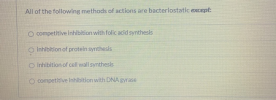 All of the following methods of actions are bacteriostatic except: competitive inhibition with folic acid synthesis inhibition of protein synthesis inhibition of cell wall synthesis competitive inhibition with DNA gyrase
SyULLI C. non-competitive inhibition 33. Which is not a mechanism to regulate enzyme activity? A. competitive...
 SyULLI C. non-competitive inhibition 33. Which is not a mechanism to regulate enzyme activity? A. competitive inhibition B. feedback inhibition D. prohibition 34. Which would not be found in a prokaryote? A. DNA B. plasma membrane C. cytoplasm C,D D. Ribosome E. A, B, 35. Non-competitive inhibition of enzymes involves A. binding to the active site B. binding to a second site function C. increasing enzyme 36. Moving vesicles across a cell is an example of A. Chemical work B....
 29) The peptidoglycan chain is made up of polymers of a) alanine and glycine b) cytosine and guanine e) glucose and ribose d) ATP and protein N-acetylmuramic acid and N-acetylglocosamine 30) Safranin is a counterstained used in the gram stain procedure because a) cells will not stain gram positive without it b) safranin accentuates the gram positive stain the gram negative cells will be unstained otherwise d) the purple color is hard to see in the microscope e) all of...
 QUESTION 37 Which of these would be included in the Gram-positive cell envelope? Cytosol, cell wall, teichoic acid, LPS Peptidoglycan, slime-layer, cytosol, teichoic acid cytosol, peptidoglycan, te choic acid, capsule Plasma membrane, peptidoglycan, techoic acid, capsule Plasma membrane, cell walt, peptidoglycan, LPS
 All of the following methods of actions are bacteriostatic except: competitive inhibition with folic acid synthesis inhibition of protein synthesis inhibition of cell wall synthesis competitive inhibition with DNA gyrase
 SyULLI C. non-competitive inhibition 33. Which is not a mechanism to regulate enzyme activity? A. competitive inhibition B. feedback inhibition D. prohibition 34. Which would not be found in a prokaryote? A. DNA B. plasma membrane C. cytoplasm C,D D. Ribosome E. A, B, 35. Non-competitive inhibition of enzymes involves A. binding to the active site B. binding to a second site function C. increasing enzyme 36. Moving vesicles across a cell is an example of A. Chemical work B....
Most questions answered within 3 hours.
-
Where is the error in this code sequence?
String s1 = "Hello";
String s2 = "ello";...
asked 11 months ago -
Financial data for Joel de Paris, Inc., for last year
follow:
Joel de Paris, Inc.
Balance...
asked 11 months ago -
Consider this reaction:
Al2(SO4)3 (aq)+ BaCl3
(aq) Al2Cl6 (aq)- +
3BaSO4(s) . What is the...
asked 11 months ago -
Suppose that Savneet is considering increasing her
recent random sample from 20 car rentals to 40...
asked 11 months ago -
Trucks arrive at an unloading terminal at an average rate of 120
per hour.
Trucks arrive...
asked 11 months ago -
Why are methanol and ethanol completely soluble in water while
octanol is not very little soluble....
asked 11 months ago -
A facilities manager at a university reads in a research report
that the mean amount of...
asked 11 months ago -
When the CuSO4 is rehydrated by adding water to the anhydrous
compound, is this an endothermic...
asked 11 months ago -
A ray of sunlight is passing from diamond into crown glass; the
angle of incidence is...
asked 11 months ago -
A block of mass 0.249 kg is placed on top of a light, vertical
spring of...
asked 11 months ago -
how do the kidneys compensate in the presences of acidosis
a) trigger hyperventilate
b) reserve acid...
asked 11 months ago -
Question 501 pts
The rental rate of capital to the firm increases. Which of the
following...
asked 11 months ago