
Homework Answers
Add Answer to:
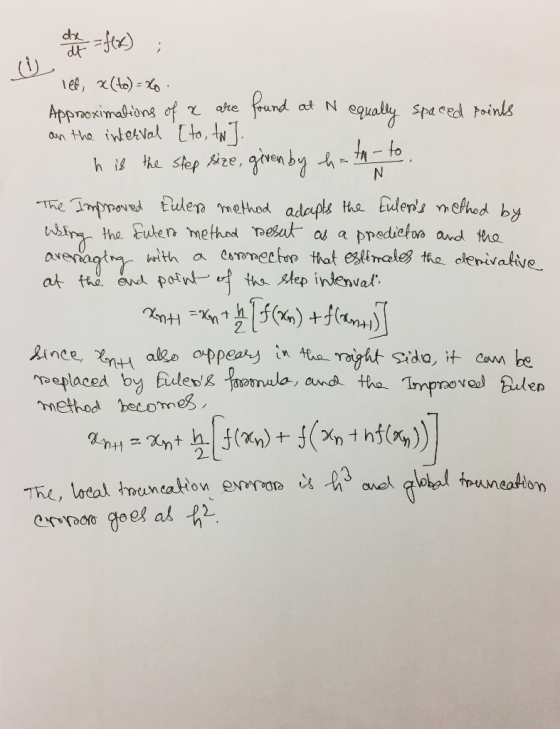
6. Consider the first order autonomous' ODE = f(c). (a) Write the Improved Euler method for...
Part A: What is the (forward) Euler method to solve the IVP y(t) = f(t, y(t))...
 Part A: What is the (forward) Euler method to solve the IVP y(t) = f(t, y(t)) te [0.tfinal] y(0) = 1 Part B: Derive the (forward) Euler method using an integration rule or by a Taylor series argument. Part C: Based on that derivation, state the local error (order of accuracy) for this Euler method. Part D: Assume that you apply this Euler method n times over an interval [a,b]. What is the global error here? Show your work.
Solve the following first order ODE with a given initial condition using Euler method in Excel...
 Solve the following first order ODE with a given initial condition using Euler method in Excel using the formula given with n= 3, 10, and 100: y(n1)y(n)f(x(n), y(n)). dx (b-a) dx y'(x(n), y (n)) y'6where y (3) = 1 on the interval [3,6] b.y'yinwhere y (2)= e on the interval [2,5] a. Create a table for each n-values given and a graph one separately.
Solve the following first order ODE with a given initial condition using Euler method in Excel...
Solve the following first order ODE with a given initial condition using Euler method in Excel using the formula given with n= 3, 10, and 100: y(n1)y(n)f(x(n), y(n)). dx (b-a) dx y'(x(n), y (n)) y'6where y (3) = 1 on the interval [3,6] b.y'yinwhere y (2)= e on the interval [2,5] a. Create a table for each n-values given and a graph one separately.
Solve the following first order ODE with a given initial condition using Euler method in Excel...
Please show MATLAB code for how to gain solution. 10.1 Consider the following first-order ODE: from...
 Please show MATLAB code for how to gain solution.
10.1 Consider the following first-order ODE: from x -0 to 2.1 with (0) 2 (a) Solve with Euler's explicit method using h 0.7. (b) Solve with the modified Euler method using h - 0.7. r Runge-Kutta method using h 0.7. The analytical solution of the ODE is24. In each part, calculate the eror between the true solution and the numerical solution at the points where the numerical solution is determined
Please show MATLAB code for how to gain solution.
10.1 Consider the following first-order ODE: from x -0 to 2.1 with (0) 2 (a) Solve with Euler's explicit method using h 0.7. (b) Solve with the modified Euler method using h - 0.7. r Runge-Kutta method using h 0.7. The analytical solution of the ODE is24. In each part, calculate the eror between the true solution and the numerical solution at the points where the numerical solution is determined
help, pls tq. 4. Consider the first order autonomous system d13-1 0)-1. (a) Estimate the solution of the system (1) at t0.2 using two steps of Euler's method with 2v, u(0)0 step-size h 0.1 T1+C2+...
 help, pls tq.
4. Consider the first order autonomous system d13-1 0)-1. (a) Estimate the solution of the system (1) at t0.2 using two steps of Euler's method with 2v, u(0)0 step-size h 0.1 T1+C2+A1-4 (b) An autonomous system of two first order differential equations can be written as: du dt=f(mu), u(to) = uo, dv dt=g(u, u), u(to) to. The Improved Euler's scheme for the system of two first order equations is tn+1 = tn + h, Use the Improved...
help, pls tq.
4. Consider the first order autonomous system d13-1 0)-1. (a) Estimate the solution of the system (1) at t0.2 using two steps of Euler's method with 2v, u(0)0 step-size h 0.1 T1+C2+A1-4 (b) An autonomous system of two first order differential equations can be written as: du dt=f(mu), u(to) = uo, dv dt=g(u, u), u(to) to. The Improved Euler's scheme for the system of two first order equations is tn+1 = tn + h, Use the Improved...
ASAP PLEASE e) Explain the idea of the Gauss integration formula. f Show on a figure the local and global truncation error for the first two iterations of a ODE solver g) Solve graphically the ODE h)...
 ASAP PLEASE
e) Explain the idea of the Gauss integration formula. f Show on a figure the local and global truncation error for the first two iterations of a ODE solver g) Solve graphically the ODE h) Explain how numerical adaptive ODE solvers works i) When is a numerical method for solving differential equations considered to be dy dx unstable ? Which parameter(s) is (are) influencing this stability (or instability)? j In general the total error done by any numerical...
ASAP PLEASE
e) Explain the idea of the Gauss integration formula. f Show on a figure the local and global truncation error for the first two iterations of a ODE solver g) Solve graphically the ODE h) Explain how numerical adaptive ODE solvers works i) When is a numerical method for solving differential equations considered to be dy dx unstable ? Which parameter(s) is (are) influencing this stability (or instability)? j In general the total error done by any numerical...
Consider the following autonomous first-order differential equation. Find the critical points and phase portrait of...
 Consider the following autonomous first-order differential equation. Find the critical points and phase portrait of the given differential equation. 0
Consider the following autonomous first-order differential equation. Find the critical points and phase portrait of the given differential equation. 0
Consider the following autonomous first-order differential equation. Find the critical points and phase portrait of the given differential equation. 0
4. Consider the pendulum with friction modeled by the second order ODE: where θ is the angle the ...
 4. please help with both parts a and b
4. Consider the pendulum with friction modeled by the second order ODE: where θ is the angle the pendulum makes with the vertical axis, α is a friction coefficient and w is the pendulum natural frequency. (a) Turn (4) into a first order system. (b) Use Euler method to find an approximation to the solution in [0,5] with initial conditions θ(0)-1 and θ'(0)-0. Take α-0.2 and w-2. Verify the expected order...
4. please help with both parts a and b
4. Consider the pendulum with friction modeled by the second order ODE: where θ is the angle the pendulum makes with the vertical axis, α is a friction coefficient and w is the pendulum natural frequency. (a) Turn (4) into a first order system. (b) Use Euler method to find an approximation to the solution in [0,5] with initial conditions θ(0)-1 and θ'(0)-0. Take α-0.2 and w-2. Verify the expected order...
Consider the following statements. (i) Given a second-order linear ODE, the method of variation of parameters...
 Consider the following statements.
(i) Given a second-order linear ODE, the method of variation of
parameters gives a particular solution in terms of an integral
provided y1 and y2 can be
found.
(ii) The Laplace Transform is an integral transform that turns
the problem of solving constant coefficient ODEs into an algebraic
problem. This transform is particularly useful when it comes to
studying problems arising in applications where the forcing
function in the ODE is piece-wise continuous but not necessarily...
Consider the following statements.
(i) Given a second-order linear ODE, the method of variation of
parameters gives a particular solution in terms of an integral
provided y1 and y2 can be
found.
(ii) The Laplace Transform is an integral transform that turns
the problem of solving constant coefficient ODEs into an algebraic
problem. This transform is particularly useful when it comes to
studying problems arising in applications where the forcing
function in the ODE is piece-wise continuous but not necessarily...
(e) Consider the Runge-Kutta method in solving the following first order ODE: dy First, using Taylor series expansion, we have the following approximation of y evaluated at the time step n+1 as a...
 (e) Consider the Runge-Kutta method in solving the following first order ODE: dy First, using Taylor series expansion, we have the following approximation of y evaluated at the time step n+1 as a function of y at the time step n: where h is the size of the time step. The fourth order Runge-Kutta method assumes the following form where the following approximations can be made at various iterations: )sh+รู้: ,f(t.ta, ),. Note that the first term is evaluated at...
4. Higher order method via higher order finite difference formula 4. Higher order method via higher...
 4. Higher order method via higher order finite difference
formula
4. Higher order method via higher order finite difference formula 1. Prove the finite difference formula 2. Use this finite difference formula to derive a numerical method to solve the ODE y' = f(y,t), y(0) = 10. 3. What is the local truncation error of this method?
4. Higher order method via higher order finite difference
formula
4. Higher order method via higher order finite difference formula 1. Prove the finite difference formula 2. Use this finite difference formula to derive a numerical method to solve the ODE y' = f(y,t), y(0) = 10. 3. What is the local truncation error of this method?
 Part A: What is the (forward) Euler method to solve the IVP y(t) = f(t, y(t)) te [0.tfinal] y(0) = 1 Part B: Derive the (forward) Euler method using an integration rule or by a Taylor series argument. Part C: Based on that derivation, state the local error (order of accuracy) for this Euler method. Part D: Assume that you apply this Euler method n times over an interval [a,b]. What is the global error here? Show your work.
 Solve the following first order ODE with a given initial condition using Euler method in Excel using the formula given with n= 3, 10, and 100: y(n1)y(n)f(x(n), y(n)). dx (b-a) dx y'(x(n), y (n)) y'6where y (3) = 1 on the interval [3,6] b.y'yinwhere y (2)= e on the interval [2,5] a. Create a table for each n-values given and a graph one separately.
Solve the following first order ODE with a given initial condition using Euler method in Excel...
Solve the following first order ODE with a given initial condition using Euler method in Excel using the formula given with n= 3, 10, and 100: y(n1)y(n)f(x(n), y(n)). dx (b-a) dx y'(x(n), y (n)) y'6where y (3) = 1 on the interval [3,6] b.y'yinwhere y (2)= e on the interval [2,5] a. Create a table for each n-values given and a graph one separately.
Solve the following first order ODE with a given initial condition using Euler method in Excel...
 Please show MATLAB code for how to gain solution.
10.1 Consider the following first-order ODE: from x -0 to 2.1 with (0) 2 (a) Solve with Euler's explicit method using h 0.7. (b) Solve with the modified Euler method using h - 0.7. r Runge-Kutta method using h 0.7. The analytical solution of the ODE is24. In each part, calculate the eror between the true solution and the numerical solution at the points where the numerical solution is determined
Please show MATLAB code for how to gain solution.
10.1 Consider the following first-order ODE: from x -0 to 2.1 with (0) 2 (a) Solve with Euler's explicit method using h 0.7. (b) Solve with the modified Euler method using h - 0.7. r Runge-Kutta method using h 0.7. The analytical solution of the ODE is24. In each part, calculate the eror between the true solution and the numerical solution at the points where the numerical solution is determined
 help, pls tq.
4. Consider the first order autonomous system d13-1 0)-1. (a) Estimate the solution of the system (1) at t0.2 using two steps of Euler's method with 2v, u(0)0 step-size h 0.1 T1+C2+A1-4 (b) An autonomous system of two first order differential equations can be written as: du dt=f(mu), u(to) = uo, dv dt=g(u, u), u(to) to. The Improved Euler's scheme for the system of two first order equations is tn+1 = tn + h, Use the Improved...
help, pls tq.
4. Consider the first order autonomous system d13-1 0)-1. (a) Estimate the solution of the system (1) at t0.2 using two steps of Euler's method with 2v, u(0)0 step-size h 0.1 T1+C2+A1-4 (b) An autonomous system of two first order differential equations can be written as: du dt=f(mu), u(to) = uo, dv dt=g(u, u), u(to) to. The Improved Euler's scheme for the system of two first order equations is tn+1 = tn + h, Use the Improved...
 ASAP PLEASE
e) Explain the idea of the Gauss integration formula. f Show on a figure the local and global truncation error for the first two iterations of a ODE solver g) Solve graphically the ODE h) Explain how numerical adaptive ODE solvers works i) When is a numerical method for solving differential equations considered to be dy dx unstable ? Which parameter(s) is (are) influencing this stability (or instability)? j In general the total error done by any numerical...
ASAP PLEASE
e) Explain the idea of the Gauss integration formula. f Show on a figure the local and global truncation error for the first two iterations of a ODE solver g) Solve graphically the ODE h) Explain how numerical adaptive ODE solvers works i) When is a numerical method for solving differential equations considered to be dy dx unstable ? Which parameter(s) is (are) influencing this stability (or instability)? j In general the total error done by any numerical...
 Consider the following autonomous first-order differential equation. Find the critical points and phase portrait of the given differential equation. 0
Consider the following autonomous first-order differential equation. Find the critical points and phase portrait of the given differential equation. 0
Consider the following autonomous first-order differential equation. Find the critical points and phase portrait of the given differential equation. 0
 4. please help with both parts a and b
4. Consider the pendulum with friction modeled by the second order ODE: where θ is the angle the pendulum makes with the vertical axis, α is a friction coefficient and w is the pendulum natural frequency. (a) Turn (4) into a first order system. (b) Use Euler method to find an approximation to the solution in [0,5] with initial conditions θ(0)-1 and θ'(0)-0. Take α-0.2 and w-2. Verify the expected order...
4. please help with both parts a and b
4. Consider the pendulum with friction modeled by the second order ODE: where θ is the angle the pendulum makes with the vertical axis, α is a friction coefficient and w is the pendulum natural frequency. (a) Turn (4) into a first order system. (b) Use Euler method to find an approximation to the solution in [0,5] with initial conditions θ(0)-1 and θ'(0)-0. Take α-0.2 and w-2. Verify the expected order...
 Consider the following statements.
(i) Given a second-order linear ODE, the method of variation of
parameters gives a particular solution in terms of an integral
provided y1 and y2 can be
found.
(ii) The Laplace Transform is an integral transform that turns
the problem of solving constant coefficient ODEs into an algebraic
problem. This transform is particularly useful when it comes to
studying problems arising in applications where the forcing
function in the ODE is piece-wise continuous but not necessarily...
Consider the following statements.
(i) Given a second-order linear ODE, the method of variation of
parameters gives a particular solution in terms of an integral
provided y1 and y2 can be
found.
(ii) The Laplace Transform is an integral transform that turns
the problem of solving constant coefficient ODEs into an algebraic
problem. This transform is particularly useful when it comes to
studying problems arising in applications where the forcing
function in the ODE is piece-wise continuous but not necessarily...
 (e) Consider the Runge-Kutta method in solving the following first order ODE: dy First, using Taylor series expansion, we have the following approximation of y evaluated at the time step n+1 as a function of y at the time step n: where h is the size of the time step. The fourth order Runge-Kutta method assumes the following form where the following approximations can be made at various iterations: )sh+รู้: ,f(t.ta, ),. Note that the first term is evaluated at...
 4. Higher order method via higher order finite difference
formula
4. Higher order method via higher order finite difference formula 1. Prove the finite difference formula 2. Use this finite difference formula to derive a numerical method to solve the ODE y' = f(y,t), y(0) = 10. 3. What is the local truncation error of this method?
4. Higher order method via higher order finite difference
formula
4. Higher order method via higher order finite difference formula 1. Prove the finite difference formula 2. Use this finite difference formula to derive a numerical method to solve the ODE y' = f(y,t), y(0) = 10. 3. What is the local truncation error of this method?
Most questions answered within 3 hours.
-
Where is the error in this code sequence?
String s1 = "Hello";
String s2 = "ello";...
asked 10 months ago -
Financial data for Joel de Paris, Inc., for last year
follow:
Joel de Paris, Inc.
Balance...
asked 10 months ago -
Consider this reaction:
Al2(SO4)3 (aq)+ BaCl3
(aq) Al2Cl6 (aq)- +
3BaSO4(s) . What is the...
asked 10 months ago -
Suppose that Savneet is considering increasing her
recent random sample from 20 car rentals to 40...
asked 10 months ago -
Trucks arrive at an unloading terminal at an average rate of 120
per hour.
Trucks arrive...
asked 10 months ago -
Why are methanol and ethanol completely soluble in water while
octanol is not very little soluble....
asked 10 months ago -
A facilities manager at a university reads in a research report
that the mean amount of...
asked 10 months ago -
When the CuSO4 is rehydrated by adding water to the anhydrous
compound, is this an endothermic...
asked 10 months ago -
A ray of sunlight is passing from diamond into crown glass; the
angle of incidence is...
asked 10 months ago -
A block of mass 0.249 kg is placed on top of a light, vertical
spring of...
asked 10 months ago -
how do the kidneys compensate in the presences of acidosis
a) trigger hyperventilate
b) reserve acid...
asked 10 months ago -
Question 501 pts
The rental rate of capital to the firm increases. Which of the
following...
asked 10 months ago