Data Structure and Algorithms
Find shortest path using Dijkstra algorithm for both examples. Draw a table with the values for each example. Trace the shortest path. Explain how you traced it using the values from the table. Write big. Thanks!


Homework Answers

Add Answer to:
Data Structure and Algorithms
Find shortest path using Dijkstra algorithm for both examples.
Draw a table...
Find the shortest path algorithm tables (for the graph on the homework sheet) using the (a)...
 Find the shortest path algorithm tables (for the graph on the
homework sheet) using the
(a) Dijkstra algorithm
(b) Ford-Fulkerson algorithm
Label the columns B,C,D from left to right. Node A is the root
node.
Use pointers for only the Ford Fulkerson algorithm as in the
Networks and Grids book.
(c) Let the link number be bandwidth (data rate). Create the
routing table that allows you find paths to the root node that
maximize the bottleneck bandwidth
Uhe
Find the shortest path algorithm tables (for the graph on the
homework sheet) using the
(a) Dijkstra algorithm
(b) Ford-Fulkerson algorithm
Label the columns B,C,D from left to right. Node A is the root
node.
Use pointers for only the Ford Fulkerson algorithm as in the
Networks and Grids book.
(c) Let the link number be bandwidth (data rate). Create the
routing table that allows you find paths to the root node that
maximize the bottleneck bandwidth
Uhe
Please help me with this answer. Performance Comparison for Dijkstra Algorithm and Bellman-Ford Algorithm Problem Description...
Please help me with this answer. Performance Comparison for Dijkstra Algorithm and Bellman-Ford Algorithm Problem Description The shortest path problem is one of most important problems in graph theory and computer science in general. Shortest path problem is one of typical optimization problems. Given a graph G = (V,E), the goal is to nd a minimum cost path from s → t, s,t ∈ V . This variant is called one-to-one shortest path problem. Other variants are one-to-all (compute shortest...
C++ Data structure and algorithm Graph Algorithms Q2. (30 pts) Find the minimum spanning tree using...
 C++ Data structure and algorithm
Graph Algorithms
Q2. (30 pts) Find the minimum spanning tree using Prim's algorithm for the following graph. For this question, the solution must be provided step by step as shown in your textbook in Figures 9.51 in page 415. 6 FRL B 4
C++ Data structure and algorithm
Graph Algorithms
Q2. (30 pts) Find the minimum spanning tree using Prim's algorithm for the following graph. For this question, the solution must be provided step by step as shown in your textbook in Figures 9.51 in page 415. 6 FRL B 4
Question 5 (5 points) Apply Dijkstra's Algorithm to the following graph, computing the shortest path for...
 Question 5 (5 points) Apply Dijkstra's Algorithm to the following graph, computing the shortest path for al vertices from vertex A. Present the results after each vertex has been processed 3 20 B 47 20 You may wish to present the results in the format of the following table: Stage Current Vertex Labels and Distances A 0 A 0 D 231 A 213 E 4 F21 A 90 Each row states (a) the current stage, (b) the vertex just added...
7. Using Moore's shortest path algorithm, fill the travel time table below and indicate how they...
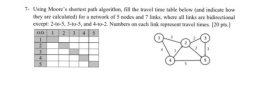 7. Using Moore's shortest path algorithm, fill the travel time table below and indicate how they are calculated) for a network of 5 nodes and 7 links, where all links are bidirectional except: 2-to-5, 3-to-5, and 4-to-2. Numbers on each link represent travel times. (20 pts.] OD 12 20 CMM
C. 7. True/False Questions. (2 points each) a. Applying Horner's Rule, an n-degree polynomial can be...
 C. 7. True/False Questions. (2 points each) a. Applying Horner's Rule, an n-degree polynomial can be evaluated at a given point using only n multiplications and n additions. b. Quick Sort and Merge Sort are comparison-based sorting algorithms. Heap Sort and Distribution Counting Sort are not comparison-based sorting algorithms. An AVL tree applies four types of rotations: RIGHT, LEFT, RIGHT-LEFT, and LEFT-RIGHT. d. When an AVL tree's left sub-tree is left-heavy, a LEFT rotation is needed. e. When an AVL...
Psuedocode works! DP is dynamic programming for this algorithm Problem 4.2. (Difficulty 3) Seam carving is...
 Psuedocode works! DP is dynamic programming for this
algorithm
Problem 4.2. (Difficulty 3) Seam carving is a real-world application of DP for content- aware image resizing. The simplest way to reduce the size of an image is cropping and scaling, i.e. cutting out parts of the image and scaling down the size. However, cropping leaves visible crop lines of incontinuity while scaling reduces the details of the image. We would like to intelligently reducing the size while accounting for the...
Psuedocode works! DP is dynamic programming for this
algorithm
Problem 4.2. (Difficulty 3) Seam carving is a real-world application of DP for content- aware image resizing. The simplest way to reduce the size of an image is cropping and scaling, i.e. cutting out parts of the image and scaling down the size. However, cropping leaves visible crop lines of incontinuity while scaling reduces the details of the image. We would like to intelligently reducing the size while accounting for the...
Programming Assignment 1 Data structure Java Implement Shellsort for a linked list, based on a variant...
Programming Assignment 1 Data structure Java Implement Shellsort for a linked list, based on a variant of bubble sort. The rather severe constraints imposed by the singly-linked list organization presents special problems for implementing Shellsort. Your task is to overcome these constraints and develop a simple, elegant implementation that does not sacrifice efficiency or waste space. Step 1. First, implement a routine to build a list: read integers from standard input, and build a list node for each item consisting...
//Need help ASAP in c++ please. Appreciate it! Thank you!! //This is the current code I have. #include <iostream> #include <sstream> #include <iomanip> using namespace std; cl...
//Need help ASAP in c++ please. Appreciate it! Thank you!! //This is the current code I have. #include <iostream> #include <sstream> #include <iomanip> using namespace std; class googlePlayApp { private: string name; double rating; int numInstalls; int numReviews; double price; public: googlePlayApp(string, double, int, int, double); ~ googlePlayApp(); googlePlayApp(); string getName(); double getRating(); int getNumInstalls(); int getNumReviews(); string getPrice(); void setName(string); void setRating(double); void setNumInstalls(int); void setNumReviews(int); void setPrice(double); }; googlePlayApp::googlePlayApp(string n, double r, int ni, int nr, double pr)...
Task The task for this assignment is to have the following user-defined data type: struct rgb...
Task The task for this assignment is to have the following user-defined data type: struct rgb { unsigned char red; unsigned char green; unsigned char blue; }; be able to be: read in from a stream (e.g., std::cin), i.e., write: std::istream& operator >>(std::istream& is, rgb& colour); (see below) written out to a stream (e.g., std::cout), i.e., write: std::ostream& operator <<(std::ostream& os, rgb const& colour); (see below) stored in a container, e.g., std::vector<rgb>, std::array<rgb,16>; (see below) processed via algorithms (and other...
 Find the shortest path algorithm tables (for the graph on the
homework sheet) using the
(a) Dijkstra algorithm
(b) Ford-Fulkerson algorithm
Label the columns B,C,D from left to right. Node A is the root
node.
Use pointers for only the Ford Fulkerson algorithm as in the
Networks and Grids book.
(c) Let the link number be bandwidth (data rate). Create the
routing table that allows you find paths to the root node that
maximize the bottleneck bandwidth
Uhe
Find the shortest path algorithm tables (for the graph on the
homework sheet) using the
(a) Dijkstra algorithm
(b) Ford-Fulkerson algorithm
Label the columns B,C,D from left to right. Node A is the root
node.
Use pointers for only the Ford Fulkerson algorithm as in the
Networks and Grids book.
(c) Let the link number be bandwidth (data rate). Create the
routing table that allows you find paths to the root node that
maximize the bottleneck bandwidth
Uhe
 C++ Data structure and algorithm
Graph Algorithms
Q2. (30 pts) Find the minimum spanning tree using Prim's algorithm for the following graph. For this question, the solution must be provided step by step as shown in your textbook in Figures 9.51 in page 415. 6 FRL B 4
C++ Data structure and algorithm
Graph Algorithms
Q2. (30 pts) Find the minimum spanning tree using Prim's algorithm for the following graph. For this question, the solution must be provided step by step as shown in your textbook in Figures 9.51 in page 415. 6 FRL B 4
 Question 5 (5 points) Apply Dijkstra's Algorithm to the following graph, computing the shortest path for al vertices from vertex A. Present the results after each vertex has been processed 3 20 B 47 20 You may wish to present the results in the format of the following table: Stage Current Vertex Labels and Distances A 0 A 0 D 231 A 213 E 4 F21 A 90 Each row states (a) the current stage, (b) the vertex just added...
 7. Using Moore's shortest path algorithm, fill the travel time table below and indicate how they are calculated) for a network of 5 nodes and 7 links, where all links are bidirectional except: 2-to-5, 3-to-5, and 4-to-2. Numbers on each link represent travel times. (20 pts.] OD 12 20 CMM
 C. 7. True/False Questions. (2 points each) a. Applying Horner's Rule, an n-degree polynomial can be evaluated at a given point using only n multiplications and n additions. b. Quick Sort and Merge Sort are comparison-based sorting algorithms. Heap Sort and Distribution Counting Sort are not comparison-based sorting algorithms. An AVL tree applies four types of rotations: RIGHT, LEFT, RIGHT-LEFT, and LEFT-RIGHT. d. When an AVL tree's left sub-tree is left-heavy, a LEFT rotation is needed. e. When an AVL...
 Psuedocode works! DP is dynamic programming for this
algorithm
Problem 4.2. (Difficulty 3) Seam carving is a real-world application of DP for content- aware image resizing. The simplest way to reduce the size of an image is cropping and scaling, i.e. cutting out parts of the image and scaling down the size. However, cropping leaves visible crop lines of incontinuity while scaling reduces the details of the image. We would like to intelligently reducing the size while accounting for the...
Psuedocode works! DP is dynamic programming for this
algorithm
Problem 4.2. (Difficulty 3) Seam carving is a real-world application of DP for content- aware image resizing. The simplest way to reduce the size of an image is cropping and scaling, i.e. cutting out parts of the image and scaling down the size. However, cropping leaves visible crop lines of incontinuity while scaling reduces the details of the image. We would like to intelligently reducing the size while accounting for the...
Most questions answered within 3 hours.
-
Where is the error in this code sequence?
String s1 = "Hello";
String s2 = "ello";...
asked 11 months ago -
Financial data for Joel de Paris, Inc., for last year
follow:
Joel de Paris, Inc.
Balance...
asked 11 months ago -
Consider this reaction:
Al2(SO4)3 (aq)+ BaCl3
(aq) Al2Cl6 (aq)- +
3BaSO4(s) . What is the...
asked 11 months ago -
Suppose that Savneet is considering increasing her
recent random sample from 20 car rentals to 40...
asked 11 months ago -
Trucks arrive at an unloading terminal at an average rate of 120
per hour.
Trucks arrive...
asked 11 months ago -
Why are methanol and ethanol completely soluble in water while
octanol is not very little soluble....
asked 11 months ago -
A facilities manager at a university reads in a research report
that the mean amount of...
asked 11 months ago -
When the CuSO4 is rehydrated by adding water to the anhydrous
compound, is this an endothermic...
asked 11 months ago -
A ray of sunlight is passing from diamond into crown glass; the
angle of incidence is...
asked 11 months ago -
A block of mass 0.249 kg is placed on top of a light, vertical
spring of...
asked 11 months ago -
how do the kidneys compensate in the presences of acidosis
a) trigger hyperventilate
b) reserve acid...
asked 11 months ago -
Question 501 pts
The rental rate of capital to the firm increases. Which of the
following...
asked 11 months ago