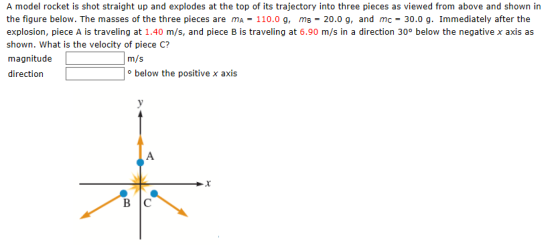
A model rocket is shot straight up and explodes at the top of its trajectory into three pieces as viewed from above and shown in the figure below. The masses of the three pieces are
mA = 110.0 g,
mB = 20.0 g,
and
mC = 30.0 g.
Immediately after the explosion, piece A is traveling at 1.40 m/s, and piece B is traveling at 6.90 m/s in a direction 30° below the negative x axis as shown. What is the velocity of piece C?
Homework Answers
Request Answer!
We need at least 10 more requests to produce the answer.
0 / 10 have requested this problem solution
The more requests, the faster the answer.
Add Answer to:
A model rocket is shot straight up and explodes at the top of
its trajectory into...
A model rocket is shot straight up and explodes at the top of its trajectory into...
 A model rocket is shot straight up and explodes at the top of its trajectory into three pieces as viewed from above and shown in the figure below. The masses of the three pieces are mA-107.5 g, ms- 20.0 g, and mc 30.0 g. Immediately after the explosion, piece A is traveling at 1.30 m/s, and piece B is traveling at 6.50 m/s in a direction 30° below the negative x axis as shown. What is the velocity of piece...
A missile is shot straight up into the air. At the peak of its trajectory, it...
A missile is shot straight up into the air. At the peak of its trajectory, it breaks up into three pieces of equal mass, all of which move horizontally away from the point of the explosion. One piece travels in a horizontal direction of 35° east of north with a speed of 31 m/s. The second piece travels in a horizontal direction of 11° south of west with a speed of 7 m/s. What is the velocity of the remaining...
A model rocket has a mishap in air, and it explodes apart into two pieces. The...
A model rocket has a mishap in air, and it explodes apart into two pieces. The 3.0 kg rocket was traveling at velocity <0, 9, 0> m/s just before the explosion, and the 2.0 kg piece of rocket is traveling at velocity <4, 8, 0> m/s just after the explosion. What is the velocity of the 1.0 kg piece just after the explosion?
a rocket shot at 22m/s at 75 degrees above the horizontal explodes into four equal pieces...
a rocket shot at 22m/s at 75 degrees above the horizontal explodes into four equal pieces at the highest point of its trajectory. One piece moves horizontally at 2m/s, a second one moves vertically upward at 3m/s and a third moves at 1.5 m/s vertically downward. What is the velocity of the fourth piece?
A giant "egg" explodes as part of a fireworks display. The egg is at rest before...
A giant "egg" explodes as part of a fireworks display. The egg is at rest before the explosion, and after the explosion, it breaks into two pieces, with piece B moving in the positive x direction. The masses of both pieces are indicated in (Figure 1) , shown traveling in opposite directions. The component of the momentum of piece B, pBx,f, is measured to be +500 kg?m/s after the explosion. Find the component of the momentum pAx,f of piece A...
Explosion Problem: A three-piece explosion A 10.0 g projectile is traveling east at 2.0 m/s when...
Explosion Problem: A three-piece explosion A 10.0 g projectile is traveling east at 2.0 m/s when it suddenly explodes into three pieces. A 3.0 g fragment is shot due west at 10 m/s while another 3.0 g fragment travels 40◦ north of east at 12 m/s. What are the speed and direction of the third fragment? Show and explain the steps for calculation.
A mortar fires a shell of mass m at speed v0. The shell explodes at the top of its trajectory (shown by a star in...
A mortar fires a shell of mass m at speed v0. The shell explodes at the top of its trajectory (shown by a star in the figure) as designed. However, rather than creating a shower of colored flares, it breaks into just two pieces, a smaller piece of mass 15m and a larger piece of mass 45m. Both pieces land at exactly the same time. The smaller piece lands perilously close to the mortar (at a distance of zero from...
Momentum in an Explosion A giant "egg" explodes as part of a fireworks display. The egg...
Momentum in an Explosion A giant "egg" explodes as part of a fireworks display. The egg is at rest before the explosion, and after the explosion, it breaks into two pieces, with piece B moving in the positive x direction. The masses of both pieces are indicated in (Figure 1) , shown traveling in opposite directions. A = 10kg b = 30 kg What is the magnitude of the momentum |p⃗A,i | of piece A before the explosion? Express your...
A vessel at rest at the origin of an xy coordinate system explodes into three pieces....
A vessel at rest at the origin of an xy coordinate system explodes into three pieces. Just after the explosion, one piece, of mass m, moves with velocity (-47 m/s) and a second piece, also of mass m, moves with velocity (-47 m/s) . The third piece has mass 3m. Just after the explosion, what are the (a) magnitude and (b) direction (as an angle relative to the +x axis) of the velocity of the third piece?
At an Independence Day celebration show, a large firework is shot from the ground and, in...
 At an Independence Day celebration show, a large firework is
shot from the ground and, in the first stage of its bursting
pattern, splits into two unequal parts.
Assume that the firework has a mass of m_o = 0.30 kg and is
launched from a cannon at an angle of theta_o= 48.8° with an
initial velocity of v= 20 m/s. Just as the firework reaches its
hight point in its trajectory, it explodes into two pieces.
Immediately after the explosion,...
At an Independence Day celebration show, a large firework is
shot from the ground and, in the first stage of its bursting
pattern, splits into two unequal parts.
Assume that the firework has a mass of m_o = 0.30 kg and is
launched from a cannon at an angle of theta_o= 48.8° with an
initial velocity of v= 20 m/s. Just as the firework reaches its
hight point in its trajectory, it explodes into two pieces.
Immediately after the explosion,...
 A model rocket is shot straight up and explodes at the top of its trajectory into three pieces as viewed from above and shown in the figure below. The masses of the three pieces are mA-107.5 g, ms- 20.0 g, and mc 30.0 g. Immediately after the explosion, piece A is traveling at 1.30 m/s, and piece B is traveling at 6.50 m/s in a direction 30° below the negative x axis as shown. What is the velocity of piece...
 At an Independence Day celebration show, a large firework is
shot from the ground and, in the first stage of its bursting
pattern, splits into two unequal parts.
Assume that the firework has a mass of m_o = 0.30 kg and is
launched from a cannon at an angle of theta_o= 48.8° with an
initial velocity of v= 20 m/s. Just as the firework reaches its
hight point in its trajectory, it explodes into two pieces.
Immediately after the explosion,...
At an Independence Day celebration show, a large firework is
shot from the ground and, in the first stage of its bursting
pattern, splits into two unequal parts.
Assume that the firework has a mass of m_o = 0.30 kg and is
launched from a cannon at an angle of theta_o= 48.8° with an
initial velocity of v= 20 m/s. Just as the firework reaches its
hight point in its trajectory, it explodes into two pieces.
Immediately after the explosion,...
Most questions answered within 3 hours.
-
Where is the error in this code sequence?
String s1 = "Hello";
String s2 = "ello";...
asked 10 months ago -
Financial data for Joel de Paris, Inc., for last year
follow:
Joel de Paris, Inc.
Balance...
asked 10 months ago -
Consider this reaction:
Al2(SO4)3 (aq)+ BaCl3
(aq) Al2Cl6 (aq)- +
3BaSO4(s) . What is the...
asked 10 months ago -
Suppose that Savneet is considering increasing her
recent random sample from 20 car rentals to 40...
asked 10 months ago -
Trucks arrive at an unloading terminal at an average rate of 120
per hour.
Trucks arrive...
asked 10 months ago -
Why are methanol and ethanol completely soluble in water while
octanol is not very little soluble....
asked 10 months ago -
A facilities manager at a university reads in a research report
that the mean amount of...
asked 10 months ago -
When the CuSO4 is rehydrated by adding water to the anhydrous
compound, is this an endothermic...
asked 10 months ago -
A ray of sunlight is passing from diamond into crown glass; the
angle of incidence is...
asked 10 months ago -
A block of mass 0.249 kg is placed on top of a light, vertical
spring of...
asked 10 months ago -
how do the kidneys compensate in the presences of acidosis
a) trigger hyperventilate
b) reserve acid...
asked 10 months ago -
Question 501 pts
The rental rate of capital to the firm increases. Which of the
following...
asked 10 months ago