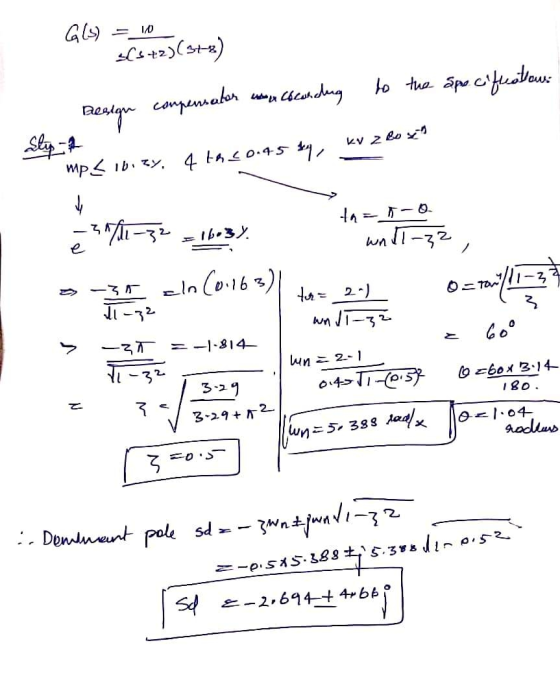
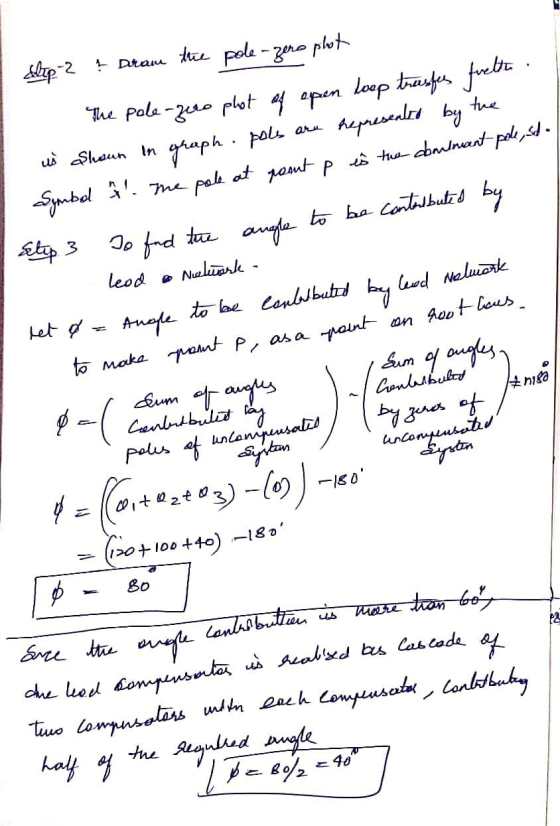
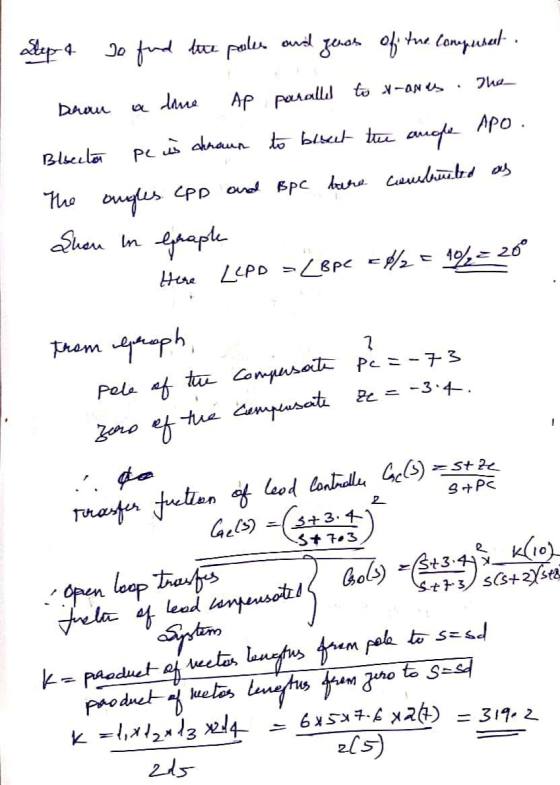
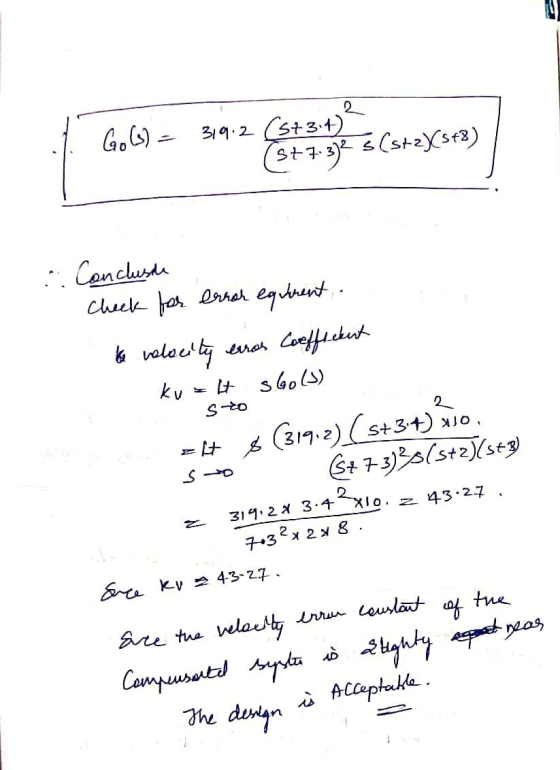
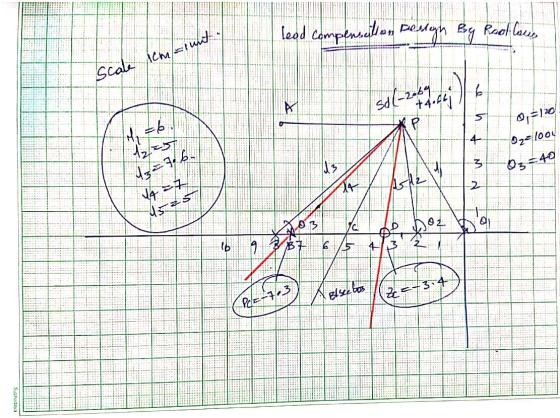
Consider a system with the following transfer function, G(s) = 10/[ s(s + 2)(s + 8)]...
Consider a system with the following transfer function,
G(s) = 10/[ s(s + 2)(s + 8)]
Design a compensator according to the following design objectives:
• Mp ≤ 16.3% and tr ≤ 0.45 sec;
• Kv ≥ 80 sec^−1 .
Submit your answer regarding the detailed compensator design procedures, and the corresponding MATLAB code and figures to verify your design.
Homework Answers
Add Answer to:
Consider a system with the following transfer function,
G(s) = 10/[ s(s + 2)(s + 8)]...
only b and c please 1 Consider the system whose transfer function is given by: G(S)...
 only b and c please
1 Consider the system whose transfer function is given by: G(S) == (2s +1)(s+3) unction is given by: G(s) - (a) Use the root-locus design methodology to design a lead compensator that will provide a closed-loop damping 5 =0.4 and a natural frequency on =9 rad/sec. The general transfer function for lead compensation is given by D(5)=K (977), p>z, 2=2 (b) Use MATLAB to plot the root locus of the feed-forward transfer function, D(s)*G(s), and...
only b and c please
1 Consider the system whose transfer function is given by: G(S) == (2s +1)(s+3) unction is given by: G(s) - (a) Use the root-locus design methodology to design a lead compensator that will provide a closed-loop damping 5 =0.4 and a natural frequency on =9 rad/sec. The general transfer function for lead compensation is given by D(5)=K (977), p>z, 2=2 (b) Use MATLAB to plot the root locus of the feed-forward transfer function, D(s)*G(s), and...
The transfer function of the given physical system is Gp(s)-1000 The physical system is controlle...
 The transfer function of the given physical system is Gp(s)-1000 The physical system is controlled with a unity-feedback system shown below, R(s) + Where Ge is the controller transfer function 3. Lead/Lag Compensator (a) Design a compensator such that the settling time of the compensated system T < 0.02 sec (Use 5% definition), and maximum overshoot of the compensated system is Mp 20%. Clearly explain all your steps. (b) Build a simulink model and use the compensator you designed above....
A transfer function is given by G(s) H (s) = s(s+1 ) (s + 8 (a)...
 A transfer function is given by
G(s) H (s) = s(s+1 ) (s + 8 (a) Design a Lead Compensator or PD controller such that the closed loop has the following specifications: Percent Overshoot (PO) 16 % Rise time 0.4 sec-2.16 ? + 0.6 (b) Determine the velocity error constant (Kv) of the uncompensated and compensated systems.
A transfer function is given by
G(s) H (s) = s(s+1 ) (s + 8 (a) Design a Lead Compensator or PD controller such that the closed loop has the following specifications: Percent Overshoot (PO) 16 % Rise time 0.4 sec-2.16 ? + 0.6 (b) Determine the velocity error constant (Kv) of the uncompensated and compensated systems.
1 Consider a unity feedback control system with plant transfer function G(s) (s+5) Design and implement...
 1 Consider a unity feedback control system with plant transfer function G(s) (s+5) Design and implement a controller without using pure differentiators or integrator to achieve the following specification: Mp <= 20%, tr <= 1 sec, and ess to acceleration 0.
Question 6 Consider the system shown in Figure 4. The open-loop transfer function is given by...
 Question 6 Consider the system shown in Figure 4. The open-loop transfer function is given by G() = - 2 (3+1)(0.59+1) Figure 4 Control diagram for Question 6 With the help of Matlab, design a compensator ab, design a compensator so that the static velocity error constant Kv is 5 sec, the phase margin is at least 45°, and the gain margin is at least 10 dB. [20]
design a lead compensator For the system with the following open loop transfer function, G(S) (05s+1 Design a lead c...
 design a lead compensator
For the system with the following open loop transfer function, G(S) (05s+1 Design a lead compensator so that the velocity error constant 20 sec and the phase margin is at least 50°
For the system with the following open loop transfer function, G(S) (05s+1 Design a lead compensator so that the velocity error constant 20 sec and the phase margin is at least 50°
design a lead compensator
For the system with the following open loop transfer function, G(S) (05s+1 Design a lead compensator so that the velocity error constant 20 sec and the phase margin is at least 50°
For the system with the following open loop transfer function, G(S) (05s+1 Design a lead compensator so that the velocity error constant 20 sec and the phase margin is at least 50°
Consider the system shown as below. Draw a Bode diagram of the open-loop transfer function G(s).
 1 Consider the system shown as below. Draw a Bode diagram of the open-loop transfer function G(s). Determine the phase margin, gain-crossover frequency, gain margin and phase-crossover frequency, (Sketch the bode diagram by hand) 2 Consider the system shown as below. Use MATLAB to draw a bode diagram of the open-loop transfer function G(s). Show the gain-crossover frequency and phase-crossover frequency in the Bode diagram and determine the phase margin and gain margin. 3. Consider the system shown as below. Design a...
A servomechanism position control has the plant transfer function G(s) =10/s(s + I )(s + 10)...
A servomechanism position control has the plant transfer function G(s) =10/s(s + I )(s + 10) You are to design a series of compensation transfer function Dc(s) in the unity feedback configuration to meet the following closed-loop specifications: -The response to a reference step input is to have no more than 16%overshoot. -The response to a ref ere nee step input is to have a rise time of no more than 0.4 sec. -The steady-state error to a unit ramp...
3. Consider a second order system with transfer fuction P(s) = 2-B2 with a = 4000...
 3. Consider a second order system with transfer fuction P(s) = 2-B2 with a = 4000 and ß = 25. Design a compensator assuming unity feedback for the gain and phase margins you apriori specify (try to achieve as high as possible). Compute the poles and zeros of the closed-loor system. Plot the Nyquist plot of your compensator and verify that the Nyquist criterion is satisfied. Plot the step response of the closed-loop system and specify maximum overshoot, peak time,...
Consider a system modelled by means of the following transfer function 10 G(s) s(s +1)(s +10)...
 Consider a system modelled by means of the following transfer function 10 G(s) s(s +1)(s +10) Given the standar negative feedback control structure, and the Bode plot of G(s): 1. Obtain (if possible) a lead compensator controller (C(s) Kc1+ts) that satisfies that the corresponding steady state error with respect to the ramp input is and that the overshoot is not greater than 15 per cent 2. Obtain (if possible) a lead compensator that satisfies that the correspond- ing steady state...
 only b and c please
1 Consider the system whose transfer function is given by: G(S) == (2s +1)(s+3) unction is given by: G(s) - (a) Use the root-locus design methodology to design a lead compensator that will provide a closed-loop damping 5 =0.4 and a natural frequency on =9 rad/sec. The general transfer function for lead compensation is given by D(5)=K (977), p>z, 2=2 (b) Use MATLAB to plot the root locus of the feed-forward transfer function, D(s)*G(s), and...
only b and c please
1 Consider the system whose transfer function is given by: G(S) == (2s +1)(s+3) unction is given by: G(s) - (a) Use the root-locus design methodology to design a lead compensator that will provide a closed-loop damping 5 =0.4 and a natural frequency on =9 rad/sec. The general transfer function for lead compensation is given by D(5)=K (977), p>z, 2=2 (b) Use MATLAB to plot the root locus of the feed-forward transfer function, D(s)*G(s), and...
 The transfer function of the given physical system is Gp(s)-1000 The physical system is controlled with a unity-feedback system shown below, R(s) + Where Ge is the controller transfer function 3. Lead/Lag Compensator (a) Design a compensator such that the settling time of the compensated system T < 0.02 sec (Use 5% definition), and maximum overshoot of the compensated system is Mp 20%. Clearly explain all your steps. (b) Build a simulink model and use the compensator you designed above....
 A transfer function is given by
G(s) H (s) = s(s+1 ) (s + 8 (a) Design a Lead Compensator or PD controller such that the closed loop has the following specifications: Percent Overshoot (PO) 16 % Rise time 0.4 sec-2.16 ? + 0.6 (b) Determine the velocity error constant (Kv) of the uncompensated and compensated systems.
A transfer function is given by
G(s) H (s) = s(s+1 ) (s + 8 (a) Design a Lead Compensator or PD controller such that the closed loop has the following specifications: Percent Overshoot (PO) 16 % Rise time 0.4 sec-2.16 ? + 0.6 (b) Determine the velocity error constant (Kv) of the uncompensated and compensated systems.
 1 Consider a unity feedback control system with plant transfer function G(s) (s+5) Design and implement a controller without using pure differentiators or integrator to achieve the following specification: Mp <= 20%, tr <= 1 sec, and ess to acceleration 0.
 Question 6 Consider the system shown in Figure 4. The open-loop transfer function is given by G() = - 2 (3+1)(0.59+1) Figure 4 Control diagram for Question 6 With the help of Matlab, design a compensator ab, design a compensator so that the static velocity error constant Kv is 5 sec, the phase margin is at least 45°, and the gain margin is at least 10 dB. [20]
 design a lead compensator
For the system with the following open loop transfer function, G(S) (05s+1 Design a lead compensator so that the velocity error constant 20 sec and the phase margin is at least 50°
For the system with the following open loop transfer function, G(S) (05s+1 Design a lead compensator so that the velocity error constant 20 sec and the phase margin is at least 50°
design a lead compensator
For the system with the following open loop transfer function, G(S) (05s+1 Design a lead compensator so that the velocity error constant 20 sec and the phase margin is at least 50°
For the system with the following open loop transfer function, G(S) (05s+1 Design a lead compensator so that the velocity error constant 20 sec and the phase margin is at least 50°
 3. Consider a second order system with transfer fuction P(s) = 2-B2 with a = 4000 and ß = 25. Design a compensator assuming unity feedback for the gain and phase margins you apriori specify (try to achieve as high as possible). Compute the poles and zeros of the closed-loor system. Plot the Nyquist plot of your compensator and verify that the Nyquist criterion is satisfied. Plot the step response of the closed-loop system and specify maximum overshoot, peak time,...
 Consider a system modelled by means of the following transfer function 10 G(s) s(s +1)(s +10) Given the standar negative feedback control structure, and the Bode plot of G(s): 1. Obtain (if possible) a lead compensator controller (C(s) Kc1+ts) that satisfies that the corresponding steady state error with respect to the ramp input is and that the overshoot is not greater than 15 per cent 2. Obtain (if possible) a lead compensator that satisfies that the correspond- ing steady state...
Most questions answered within 3 hours.
-
Where is the error in this code sequence?
String s1 = "Hello";
String s2 = "ello";...
asked 10 months ago -
Financial data for Joel de Paris, Inc., for last year
follow:
Joel de Paris, Inc.
Balance...
asked 10 months ago -
Consider this reaction:
Al2(SO4)3 (aq)+ BaCl3
(aq) Al2Cl6 (aq)- +
3BaSO4(s) . What is the...
asked 10 months ago -
Suppose that Savneet is considering increasing her
recent random sample from 20 car rentals to 40...
asked 10 months ago -
Trucks arrive at an unloading terminal at an average rate of 120
per hour.
Trucks arrive...
asked 10 months ago -
Why are methanol and ethanol completely soluble in water while
octanol is not very little soluble....
asked 10 months ago -
A facilities manager at a university reads in a research report
that the mean amount of...
asked 10 months ago -
When the CuSO4 is rehydrated by adding water to the anhydrous
compound, is this an endothermic...
asked 10 months ago -
A ray of sunlight is passing from diamond into crown glass; the
angle of incidence is...
asked 10 months ago -
A block of mass 0.249 kg is placed on top of a light, vertical
spring of...
asked 10 months ago -
how do the kidneys compensate in the presences of acidosis
a) trigger hyperventilate
b) reserve acid...
asked 10 months ago -
Question 501 pts
The rental rate of capital to the firm increases. Which of the
following...
asked 10 months ago