You could not see the image of the text when the lens to object-distance was less...
You could not see the image of the text when the lens to object-distance was less than the focal length, but you could see it when it was equal to or greater than the focal length. What does this tell you about the eyes ability to process diverging rays, parallel rays, and converging rays?
Homework Answers
The image formed is virtual when the object distance is less than the focal length. Hence, the image cannot be produced on the screen. So, the eyes cannot see the text when the object-distance is less than the focal length.
The image formed is read when the object distance is equal or greater than the focal length. Hence, the image can be obtained on the screen and the eyes can see a real image. Hence, an eyes can see when the object-distance is equal or greater than the focal length.
The eyes can process the converging and parallel rays but it cannot process the diverging rays.
Add Answer to:
You could not see the image of the text when the lens to
object-distance was less...
At some object distance and image distance, you can only see a sharp smaller image with...
At some object distance and image distance, you can only see a sharp smaller image with your eyes. How can we tell if the lens used is a converging or diverging lens?
A converging lens creates the image shown in: Is the object distance less than the focal...
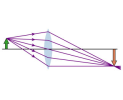 A converging lens creates the image shown in:
Is the object distance less than the focal length f,
between f and 2f, or greater than
2f?
A converging lens creates the image shown in:
Is the object distance less than the focal length f,
between f and 2f, or greater than
2f?
1. The distance from the center of a lens to the location where parallel rays converge...
 1. The distance from the center of a lens to the location where parallel rays converge or appear to converge is called the length. convergence O meeting O focal O None of the above 2. When incoming rays are the focal point and the image point are the same. O parallel O from a nearby object O passing through the near side focal point O None of the above 3. A(n) image will not appear on a screen placed at...
For what position of the object will a converging lens not project an image on the...
For what position of the object will a converging lens not project an image on the screen? a) At a distance greater than twice the focal length b) Between the focus and the lens c) At a distance equal to twice the focal length d) Between the focus and a distance of twice the focal length.
When an object is placed at the proper distance to the left of a converging lens,...
 When an object is placed at the proper distance to the left of a converging lens, the image is focused on a screen 30.0 cm to the right of the lens. A diverging lens with focal length f= -24 cm is now placed 15.0 cm to the right of the converging lens. a) How much do you need to move the screen farther to obtain a sharp image? Indicate if the screen should be moved to the right or to...
(2) An object is located at a distance of 4 cm from a thin converging lens...
 (2) An object is located at a distance of 4 cm from a thin converging lens with focal length of 2 cm. A diverging lens is located 3 cm from the converging lens and 7 cm from the object. The diverging lens has a focal length of -2 cm. Use the thin lens equation to predict the following (a) Location of the final image? to the object? (c) Is the final image real or virtual?
The distance between an object and its image formed by a diverging lens is 46.9 cm....
The distance between an object and its image formed by a diverging lens is 46.9 cm. The focal length of the lens is -244.2 cm. (a) Find the image distance. (b) Find the object distance. An object is 20 cm in front of a diverging lens that has a focal length of -13 cm. How far in front of the lens should the object be placed so that the size of its image is reduced by a factor of 1.0?
A diverging lens located in the y-z plane at x = 0 forms an image of...
 A diverging lens located in the y-z plane at x = 0 forms an image of an arrow at x = x2 = -14.1 cm. The image of the tip of the arrow is located at y = y2 = 6.3 cm. The magnitude of the focal length of the diverging lens is 28.8 cm. light image х 1 Ay 3) A converging lens of focal length fconverging = 9.02 cm is now inserted at x = x3 = -14.36...
For each of the following descriptions: Draw the 3 principal rays to locate the image. Then, using your drawing Gi...
 For each of the following descriptions: Draw the 3 principal rays to locate the image. Then, using your drawing Give the image height in centimeters Give the image distance from the lens in centimeters 7) An object is placed 6 cm to the left of a converging lens that has a focal length of 3 cm. 8) An object is placed 3 cm to the left of a converging lens that has a focal length of 9 cm. 9) The...
When an object is 16.5 cm from a lens, an image is formed 9.00 cm from...
When an object is 16.5 cm from a lens, an image is formed 9.00 cm from the lens on the same side as the object.What is the focal length of the lens? Is the lens converging or diverging?If the object is 9.00 mm tall, how tall is the image?,
 A converging lens creates the image shown in:
Is the object distance less than the focal length f,
between f and 2f, or greater than
2f?
A converging lens creates the image shown in:
Is the object distance less than the focal length f,
between f and 2f, or greater than
2f?
 1. The distance from the center of a lens to the location where parallel rays converge or appear to converge is called the length. convergence O meeting O focal O None of the above 2. When incoming rays are the focal point and the image point are the same. O parallel O from a nearby object O passing through the near side focal point O None of the above 3. A(n) image will not appear on a screen placed at...
 When an object is placed at the proper distance to the left of a converging lens, the image is focused on a screen 30.0 cm to the right of the lens. A diverging lens with focal length f= -24 cm is now placed 15.0 cm to the right of the converging lens. a) How much do you need to move the screen farther to obtain a sharp image? Indicate if the screen should be moved to the right or to...
 (2) An object is located at a distance of 4 cm from a thin converging lens with focal length of 2 cm. A diverging lens is located 3 cm from the converging lens and 7 cm from the object. The diverging lens has a focal length of -2 cm. Use the thin lens equation to predict the following (a) Location of the final image? to the object? (c) Is the final image real or virtual?
 A diverging lens located in the y-z plane at x = 0 forms an image of an arrow at x = x2 = -14.1 cm. The image of the tip of the arrow is located at y = y2 = 6.3 cm. The magnitude of the focal length of the diverging lens is 28.8 cm. light image х 1 Ay 3) A converging lens of focal length fconverging = 9.02 cm is now inserted at x = x3 = -14.36...
 For each of the following descriptions: Draw the 3 principal rays to locate the image. Then, using your drawing Give the image height in centimeters Give the image distance from the lens in centimeters 7) An object is placed 6 cm to the left of a converging lens that has a focal length of 3 cm. 8) An object is placed 3 cm to the left of a converging lens that has a focal length of 9 cm. 9) The...
Most questions answered within 3 hours.
-
Where is the error in this code sequence?
String s1 = "Hello";
String s2 = "ello";...
asked 11 months ago -
Financial data for Joel de Paris, Inc., for last year
follow:
Joel de Paris, Inc.
Balance...
asked 11 months ago -
Consider this reaction:
Al2(SO4)3 (aq)+ BaCl3
(aq) Al2Cl6 (aq)- +
3BaSO4(s) . What is the...
asked 11 months ago -
Suppose that Savneet is considering increasing her
recent random sample from 20 car rentals to 40...
asked 11 months ago -
Trucks arrive at an unloading terminal at an average rate of 120
per hour.
Trucks arrive...
asked 11 months ago -
Why are methanol and ethanol completely soluble in water while
octanol is not very little soluble....
asked 11 months ago -
A facilities manager at a university reads in a research report
that the mean amount of...
asked 11 months ago -
When the CuSO4 is rehydrated by adding water to the anhydrous
compound, is this an endothermic...
asked 11 months ago -
A ray of sunlight is passing from diamond into crown glass; the
angle of incidence is...
asked 11 months ago -
A block of mass 0.249 kg is placed on top of a light, vertical
spring of...
asked 11 months ago -
how do the kidneys compensate in the presences of acidosis
a) trigger hyperventilate
b) reserve acid...
asked 11 months ago -
Question 501 pts
The rental rate of capital to the firm increases. Which of the
following...
asked 11 months ago