Consider an L1 cache that has 8 sets, is direct-mapped (1-way), and supports a block size...
Consider an L1 cache that has 8 sets, is direct-mapped (1-way),
and supports a block size of 64 bytes. For the following memory
access pattern (shown as byte addresses), show which accesses are
hits and misses. For each hit, indicate the set that yields the
hit. (30 points)
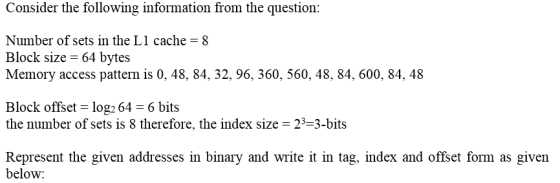
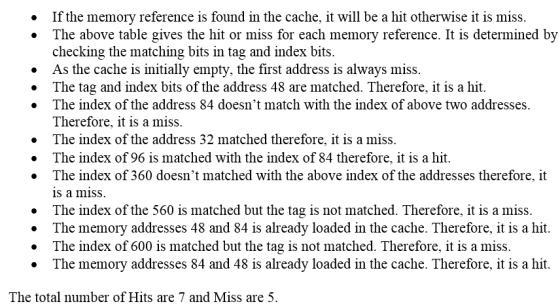
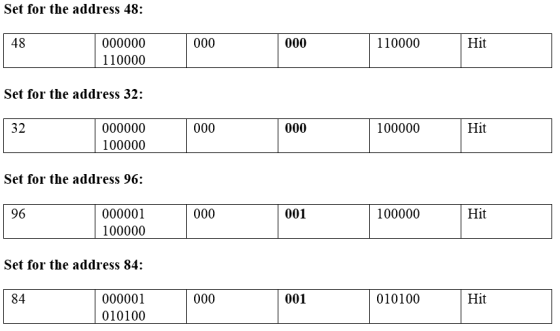
0, 48, 84, 32, 96, 360, 560, 48, 84, 600, 84, 48.
Homework Answers
Answer:

Add Answer to:
Consider an L1 cache that has 8 sets, is direct-mapped (1-way),
and supports a block size...
Question 33 10 pts For a direct mapped cache of 4 blocks with a cache block...
 Question 33 10 pts For a direct mapped cache of 4 blocks with a cache block size of 1 byte, in which cache block will each memory location map to? The order of accesses if given by the operation number. Indicate if each access is a hit or a miss, and what the tag value is for each entry. Assume that the cache is initially empty, and the accesses are in order of appearance. REDRAW AND COMPLETE THE CACHE TABLE...
Consider a direct-mapped cache with 32 blocks Cache is initially empty, Block size = 16 bytes...
Consider a direct-mapped cache with 32 blocks Cache is initially empty, Block size = 16 bytes The following memory addresses (in hexadecimal) are referenced: 0x2B4, 0x2B8, 0x2BC, 0x3E8, 0x3EC,0x4F0, 0x8F4, 0x8F8, 0x8FC. Map addresses to cache blocks and indicate whether hit or miss
6. (30) Consider a 64B direct-mapped cache with 16B blocks and 4 sets for an 8-bit architecture (...
6. (30) Consider a 64B direct-mapped cache with 16B blocks and 4 sets for an 8-bit architecture (i.e., 256 bytes of memory): a. (5) Write a C function unsigned char getTag(unsigned char address) that returns the cache tag for the specified address using bitwise operators: b. (5) Write a C function unsigned char getSet(unsigned char address) that returns the cache set for the specified address using bitwise operators: c. (10) Considering the following sequence of memory addresses, which addresses will...
For a 16K-byte, direct-mapped cache, suppose the block size is 32 bytes, draw a cache diagram....
For a 16K-byte, direct-mapped cache, suppose the block size is 32 bytes, draw a cache diagram. Indicate the block size, number of blocks, and address field decomposition (block offset, index, and tag bit width) assuming a 32-bit memory address.
A direct-mapped cache has 4 blocks and each block holds four bytes of data. The memory...
 A direct-mapped cache has 4 blocks and each block holds four bytes of data. The memory system is byte-addressable. Determine if each of the memory references below is a hit (H) or miss (M). You assume the cache is initially empty and memory references are given in decimal. Reference 27 0 13 24 50 24 36 14 48 45 47 48 H/M?
Consider a processor that has a 20-bit address and a 1K Byte Cache. The cache and...
Consider a processor that has a 20-bit address and a 1K Byte Cache. The cache and main memory are divided into blocks where each block is 256 Bytes. If direct mapping is used, what is the tag size of each block in cache and how many tag comparisons are made for a one-cache access? Repeat part (1) for fully associative mapping. Repeat part (1) for 2 way set-associative cache. For the direct map find out which of the following accesses...
2. Cache hierarchy You are building a computer system with in-order execution that runs at 1...
2. Cache hierarchy You are building a computer system with in-order execution that runs at 1 GHz and has a CPI of 1, with no memory accesses. The memory system is a split L1 cache. Both the I-cache and the D-cache are direct mapped and hold 32 KB each, with a block size of 64 bytes. The memory system is split L1 cache. Both the I-cache and the D-cache are direct mapped and hold 32 KB each, with a block...
Module 10 Assignment - Direct-mapped Cache Direct-Mapped Cache In this question you're given a 16-byte memory...
 Module 10 Assignment - Direct-mapped Cache Direct-Mapped Cache In this question you're given a 16-byte memory segment and an 8-byte cache. Given the following series of memory accesses, complete the table below. Use the first Contents/Tag column to insert an item to the cache the first time and use the second Contents/Tag column if a cache entry is overwritten. Note: no index will have more than two blocks mapped to it. The first two examples have been provided. How many...
Lab 8 final report A direct-mapped cache has 4 blocks and each block holds four bytes...
 Lab 8 final report A direct-mapped cache has 4 blocks and each block holds four bytes of data. The memory system is byte-addressable. Determine if each of the memory references below is a hit (H) or miss (M). You assume the cache is initially empty and memory references are given in decimal. 12 21 13 32 27 23 34 19 34 23 36 39 REFE RENC E H/M? I
A system uses 27-bit addresses and it has a 32KB of direct-mapped cache with 8 bytes...
 A system uses 27-bit addresses and it has a 32KB of direct-mapped cache with 8 bytes per block. Memory of this system is byte-addressed. How many blocks (lines) are in this cache? (don't write your answer in power of two) A/
 Question 33 10 pts For a direct mapped cache of 4 blocks with a cache block size of 1 byte, in which cache block will each memory location map to? The order of accesses if given by the operation number. Indicate if each access is a hit or a miss, and what the tag value is for each entry. Assume that the cache is initially empty, and the accesses are in order of appearance. REDRAW AND COMPLETE THE CACHE TABLE...
 A direct-mapped cache has 4 blocks and each block holds four bytes of data. The memory system is byte-addressable. Determine if each of the memory references below is a hit (H) or miss (M). You assume the cache is initially empty and memory references are given in decimal. Reference 27 0 13 24 50 24 36 14 48 45 47 48 H/M?
 Module 10 Assignment - Direct-mapped Cache Direct-Mapped Cache In this question you're given a 16-byte memory segment and an 8-byte cache. Given the following series of memory accesses, complete the table below. Use the first Contents/Tag column to insert an item to the cache the first time and use the second Contents/Tag column if a cache entry is overwritten. Note: no index will have more than two blocks mapped to it. The first two examples have been provided. How many...
 Lab 8 final report A direct-mapped cache has 4 blocks and each block holds four bytes of data. The memory system is byte-addressable. Determine if each of the memory references below is a hit (H) or miss (M). You assume the cache is initially empty and memory references are given in decimal. 12 21 13 32 27 23 34 19 34 23 36 39 REFE RENC E H/M? I
 A system uses 27-bit addresses and it has a 32KB of direct-mapped cache with 8 bytes per block. Memory of this system is byte-addressed. How many blocks (lines) are in this cache? (don't write your answer in power of two) A/
Most questions answered within 3 hours.
-
Where is the error in this code sequence?
String s1 = "Hello";
String s2 = "ello";...
asked 11 months ago -
Financial data for Joel de Paris, Inc., for last year
follow:
Joel de Paris, Inc.
Balance...
asked 11 months ago -
Consider this reaction:
Al2(SO4)3 (aq)+ BaCl3
(aq) Al2Cl6 (aq)- +
3BaSO4(s) . What is the...
asked 11 months ago -
Suppose that Savneet is considering increasing her
recent random sample from 20 car rentals to 40...
asked 11 months ago -
Trucks arrive at an unloading terminal at an average rate of 120
per hour.
Trucks arrive...
asked 11 months ago -
Why are methanol and ethanol completely soluble in water while
octanol is not very little soluble....
asked 11 months ago -
A facilities manager at a university reads in a research report
that the mean amount of...
asked 11 months ago -
When the CuSO4 is rehydrated by adding water to the anhydrous
compound, is this an endothermic...
asked 11 months ago -
A ray of sunlight is passing from diamond into crown glass; the
angle of incidence is...
asked 11 months ago -
A block of mass 0.249 kg is placed on top of a light, vertical
spring of...
asked 11 months ago -
how do the kidneys compensate in the presences of acidosis
a) trigger hyperventilate
b) reserve acid...
asked 11 months ago -
Question 501 pts
The rental rate of capital to the firm increases. Which of the
following...
asked 11 months ago