
Homework Answers
Add Answer to:
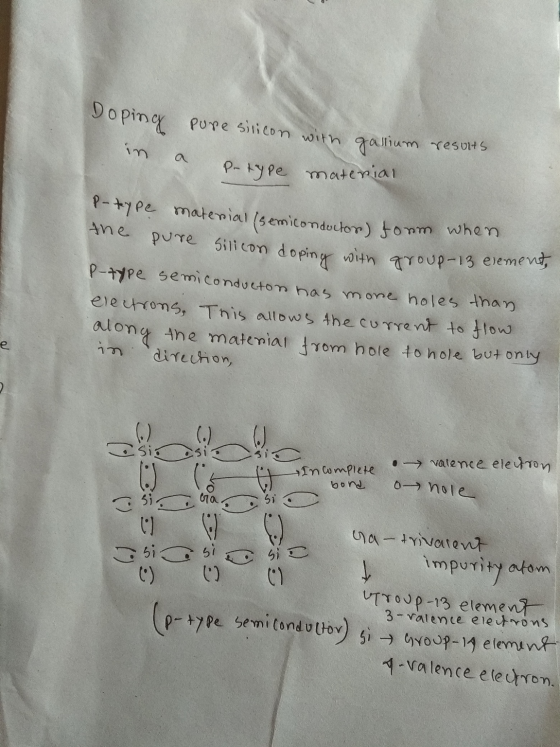
material. "Doping" pure silicon with gallium results in a(n) a. n-type b.p-type C. d-type d.s-type
I. [5%) A bar of Gallium Arsenide (GaAs) is doped with Silicon such that the Silicon...
 I. [5%) A bar of Gallium Arsenide (GaAs) is doped with Silicon such that the Silicon atoms occupy Gallium and Arsenide sites in the GaAs crystal. Which ONE of the following statements is true? A. Silicon atoms act as p-type dopants in Arsenic B. Silicon atoms act as n-type dopants in Arsenic C. Silicon atoms act as p-type dopants in Arsenic D. Silicon atoms act as n-type dopants in Arsenic sites and n-type dopants in Gallium sites sites and p-type...
Ap-type material can be made if pure germanium is doped with Silicon Arsenic Gallium Carbon Which...
 Ap-type material can be made if pure germanium is doped with Silicon Arsenic Gallium Carbon Which of these materials provides an example of an ionic crystalline solid? SIC SrCl2 C60 Which of the followings statements is true of dipole-dipole interactions? They are stronger than dispersion forces. They are also referred to as London forces. They are also referred to as instantaneous dipole-induced dipole forces. They are based on transient dipoles. Which pair of atoms is most likely to be involved...
If we have silicon at 300K with 10 microns of p-type doping of 5.38*10 17/cc and 10 microns of n-...
 If we have silicon at 300K with 10 microns of p-type doping of 5.38*10 17/cc and 10 microns of n-type doping 1000 times less, what is the total resistance in ohms outside the depletion region on the n-type side and at zero bias (use three significant digits and exponential notation). The diode is square with an edge length of 52 microns. Assume p and n mobilities are 500 & 1 500 стл2/(V*s) respectively.
If we have silicon at 300K with...
If we have silicon at 300K with 10 microns of p-type doping of 5.38*10 17/cc and 10 microns of n-type doping 1000 times less, what is the total resistance in ohms outside the depletion region on the n-type side and at zero bias (use three significant digits and exponential notation). The diode is square with an edge length of 52 microns. Assume p and n mobilities are 500 & 1 500 стл2/(V*s) respectively.
If we have silicon at 300K with...
, and n-type silicon with doping concentration of Find the: 1. vaule of the conductivity 2....
 ,
and n-type silicon with doping concentration of
Find the:
1. vaule of the conductivity
2. mobility,
3. conductance
4. sheet resistance
5. total mobile charge
6. mobile charge per unit area
7. field intensity
8. drift velocity
9. transit time
10. current.
,
and n-type silicon with doping concentration of
Find the:
1. vaule of the conductivity
2. mobility,
3. conductance
4. sheet resistance
5. total mobile charge
6. mobile charge per unit area
7. field intensity
8. drift velocity
9. transit time
10. current.
The compensated n-type silicon at 300 K has a conductivity: 16 (ohm-cm)-1 and an acceptor doping...
The compensated n-type silicon at 300 K has a conductivity: 16 (ohm-cm)-1 and an acceptor doping concentration: 1017 cm-3. a) Express the mobility as a function of the doping concentration. b) Calculate the mobility and conductivity when Nd=2 1017 cm-3.
Determine the equilibrium electron and hole concentrations for a given doping concentration. Consider an n-type silicon...
Determine the equilibrium electron and hole concentrations for a given doping concentration. Consider an n-type silicon semiconductor at T=300K in which Nd=1016cm-3 and Na=0. The intrinsic carrier concentration is assumed to be ni=1.5x1010cm-3. (15)
A n-type silicon crystal has 10^16 cm-3 of doping impurities. At equilibrium and at room temperature...
A n-type silicon crystal has 10^16 cm-3 of doping impurities. At equilibrium and at room temperature (T = 300 K) what the electron and hole concentrations. Indicate which constitutes the majority carriers
Assume a p-n step junction in silicon wi concentration of 2x10¹⁶,c? and the n-type material doped...
 Assume a p-n step junction in silicon wi concentration of 2x10¹⁶,c? and the n-type material doped at 3X10-s,cm3 The intrinsic carrier density is 1.25X101°/cm and all dopants are fully ionized Assume that the effective density of states for silicon is 3.3x10 cm3 for the conduction band and 1.75x101 cm for the valence band. Assume that the temperature is 300K and silicon relative permittivity of 11.7 a. Compute the hole concentration on the n-side and electron concentration th the p-type material...
For n-type silicon at room temperature, with a donor doping concentration of 10^(17) cm^(-3), approximately how...
For n-type silicon at room temperature, with a donor doping concentration of 10^(17) cm^(-3), approximately how much larger will be the electron concentration, compared to the hole concentration? Assuming ni=10^(10) cm^(-3).
1-8 pts) An n-type piece of silicon with a length of 1.0 Jim and a cross-sectional...
 1-8 pts) An n-type piece of silicon with a length of 1.0 Jim and a cross-sectional area of 0.05 um x 0.05 um sustains a voltage difference of 2.0 Volts between the two ends of the sample. The doping level is 107 cm Assume room temperature i.e. T = 300 K and that the electron mobility is 760 cm / V.sec a) What is the conductivity, o, of the material in ? 12. um b) What is the resistance of...
 I. [5%) A bar of Gallium Arsenide (GaAs) is doped with Silicon such that the Silicon atoms occupy Gallium and Arsenide sites in the GaAs crystal. Which ONE of the following statements is true? A. Silicon atoms act as p-type dopants in Arsenic B. Silicon atoms act as n-type dopants in Arsenic C. Silicon atoms act as p-type dopants in Arsenic D. Silicon atoms act as n-type dopants in Arsenic sites and n-type dopants in Gallium sites sites and p-type...
 Ap-type material can be made if pure germanium is doped with Silicon Arsenic Gallium Carbon Which of these materials provides an example of an ionic crystalline solid? SIC SrCl2 C60 Which of the followings statements is true of dipole-dipole interactions? They are stronger than dispersion forces. They are also referred to as London forces. They are also referred to as instantaneous dipole-induced dipole forces. They are based on transient dipoles. Which pair of atoms is most likely to be involved...
 If we have silicon at 300K with 10 microns of p-type doping of 5.38*10 17/cc and 10 microns of n-type doping 1000 times less, what is the total resistance in ohms outside the depletion region on the n-type side and at zero bias (use three significant digits and exponential notation). The diode is square with an edge length of 52 microns. Assume p and n mobilities are 500 & 1 500 стл2/(V*s) respectively.
If we have silicon at 300K with...
If we have silicon at 300K with 10 microns of p-type doping of 5.38*10 17/cc and 10 microns of n-type doping 1000 times less, what is the total resistance in ohms outside the depletion region on the n-type side and at zero bias (use three significant digits and exponential notation). The diode is square with an edge length of 52 microns. Assume p and n mobilities are 500 & 1 500 стл2/(V*s) respectively.
If we have silicon at 300K with...
 ,
and n-type silicon with doping concentration of
Find the:
1. vaule of the conductivity
2. mobility,
3. conductance
4. sheet resistance
5. total mobile charge
6. mobile charge per unit area
7. field intensity
8. drift velocity
9. transit time
10. current.
,
and n-type silicon with doping concentration of
Find the:
1. vaule of the conductivity
2. mobility,
3. conductance
4. sheet resistance
5. total mobile charge
6. mobile charge per unit area
7. field intensity
8. drift velocity
9. transit time
10. current.
 Assume a p-n step junction in silicon wi concentration of 2x10¹⁶,c? and the n-type material doped at 3X10-s,cm3 The intrinsic carrier density is 1.25X101°/cm and all dopants are fully ionized Assume that the effective density of states for silicon is 3.3x10 cm3 for the conduction band and 1.75x101 cm for the valence band. Assume that the temperature is 300K and silicon relative permittivity of 11.7 a. Compute the hole concentration on the n-side and electron concentration th the p-type material...
 1-8 pts) An n-type piece of silicon with a length of 1.0 Jim and a cross-sectional area of 0.05 um x 0.05 um sustains a voltage difference of 2.0 Volts between the two ends of the sample. The doping level is 107 cm Assume room temperature i.e. T = 300 K and that the electron mobility is 760 cm / V.sec a) What is the conductivity, o, of the material in ? 12. um b) What is the resistance of...
Most questions answered within 3 hours.
-
Where is the error in this code sequence?
String s1 = "Hello";
String s2 = "ello";...
asked 10 months ago -
Financial data for Joel de Paris, Inc., for last year
follow:
Joel de Paris, Inc.
Balance...
asked 10 months ago -
Consider this reaction:
Al2(SO4)3 (aq)+ BaCl3
(aq) Al2Cl6 (aq)- +
3BaSO4(s) . What is the...
asked 10 months ago -
Suppose that Savneet is considering increasing her
recent random sample from 20 car rentals to 40...
asked 10 months ago -
Trucks arrive at an unloading terminal at an average rate of 120
per hour.
Trucks arrive...
asked 10 months ago -
Why are methanol and ethanol completely soluble in water while
octanol is not very little soluble....
asked 10 months ago -
A facilities manager at a university reads in a research report
that the mean amount of...
asked 10 months ago -
When the CuSO4 is rehydrated by adding water to the anhydrous
compound, is this an endothermic...
asked 10 months ago -
A ray of sunlight is passing from diamond into crown glass; the
angle of incidence is...
asked 10 months ago -
A block of mass 0.249 kg is placed on top of a light, vertical
spring of...
asked 10 months ago -
how do the kidneys compensate in the presences of acidosis
a) trigger hyperventilate
b) reserve acid...
asked 10 months ago -
Question 501 pts
The rental rate of capital to the firm increases. Which of the
following...
asked 10 months ago