Homework Answers
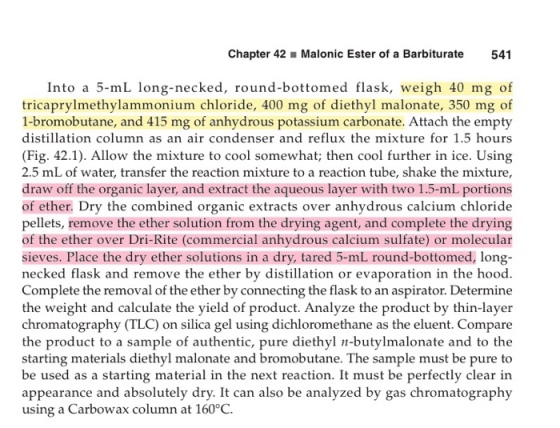
tricaprylmethylammonium chloride is a phase transfer catalyst (PTC).
Diethylmalonate and the 1-bromobutne are organic compounds and K2CO3 is inorganic base (water soluble).
Inorder to maintain contact between the base and the diethyl malonate need to have a phase transfer catalyst.
Without the catalyst the reaction proceeds with very slow rate.
Role of the the PTC is to promote the solubility and is not participating in the reaction, so PTC used in a nonstaichiometric ratio.
Hope you understand.
Good Luck.
Add Answer to:
This procedure was conducted for diethyl n-butylmalonate. The
question is: What is the purpose of the...
If you conducted this experiment using (R) 2-bromobutane, what would be the stereochemistry of the product?...
If you conducted this experiment using (R) 2-bromobutane, what would be the stereochemistry of the product? How, if at all, would the stereochemistry of the product differ if the sodium iodide had not been included in the reaction mixture? This is the experiment: Formation of n-Butyl Acetate Just Below Reflux Set up a sand bath on a magnetic stirrer— start on “4” until it reaches 100°C To a 5-mL long-necked round-bottomed flask, add 0.750 g of sodium acetate trihydrate (NaOAc...
For the portion of the procedure shown below, create a flow chart for the acid-base extraction...
 For the portion of the procedure shown below, create a
flow chart for the acid-base extraction at the end of the Grignard
Reaction. Start your flow chart with the crude reaction (see below)
mixture before addition of HCl and continue it until the product is
recovered. Depict the desired organic product, in its correct form
at each step of the procedure.
Crude reaction mixture procedure for reference: To
the flask add Mg turnings (120 mg, 4.94 mmol) to the flask...
For the portion of the procedure shown below, create a
flow chart for the acid-base extraction at the end of the Grignard
Reaction. Start your flow chart with the crude reaction (see below)
mixture before addition of HCl and continue it until the product is
recovered. Depict the desired organic product, in its correct form
at each step of the procedure.
Crude reaction mixture procedure for reference: To
the flask add Mg turnings (120 mg, 4.94 mmol) to the flask...
A Grignard reaction was performed using the following steps: Step 1: Addition of Grignard Reagent: Phenyl...
A Grignard reaction was performed using the following steps: Step 1: Addition of Grignard Reagent: Phenyl Magnesium Bromide a solution of phenyl magnesium bromide (2.7 mL of a 3.0 M solution in anhydrous diethyl ether) and 5 mL of anhydrous diethyl ether was dispensed into the round-bottom flask and stirred with a stir bar. Step 2: Addition Formation: Reaction with Benzophenone A solution of 0.72 g (mp = 48-49 degrees C) of benzophenone and 2.0 mL of anhydrous diethyl ether...
Hydroboration-Oxidation (Organic Chemistry Laboratory) 1.Explain the mechanism of the reaction. 2.What was the most important piece...
Hydroboration-Oxidation (Organic Chemistry Laboratory) 1.Explain the mechanism of the reaction. 2.What was the most important piece of equipment for the success of the reaction? 3.Was there a rate determining step in the reaction? 4.Explain the purpose of the key reagent(s) in the reaction. Experiment Procedure Flame dry a 5.0 mL conical vial and a Claisen head at the start of the lab period. Place a dry spin vane in the dried conical vial. Assemble these pieces with a calcium chloride...
____ What was the purpose of hydrogen peroxide and why was it added slowly with cooling?...
 ____ What was the purpose of hydrogen peroxide and why was it
added slowly with cooling?
HYDROBORATION-OXIDATION OF 1-HEXENE 1. In a screw cap V-vial, prepare a solution of 0.33 g of iodine in 3 mL of dry THF. Firmly tighten the cap; keep the vial closed until ready to use. 2. In a 25 mL round-bottom flask, weigh 0.12 g of sodium borohydride. Add 8 mL of dry THF; stopper the flask with a septum, and stir the mixture...
____ What was the purpose of hydrogen peroxide and why was it
added slowly with cooling?
HYDROBORATION-OXIDATION OF 1-HEXENE 1. In a screw cap V-vial, prepare a solution of 0.33 g of iodine in 3 mL of dry THF. Firmly tighten the cap; keep the vial closed until ready to use. 2. In a 25 mL round-bottom flask, weigh 0.12 g of sodium borohydride. Add 8 mL of dry THF; stopper the flask with a septum, and stir the mixture...
Organic chemistry post-lab question: "Why is important to add the alkyl halide dropwise in your reaction?...
 Organic chemistry post-lab question: "Why is important
to add the alkyl halide dropwise in your reaction? (Hint: your
reaction is not heated, but you still need a water-cooled
condenser!)" Please answer in detail!
Here is a copy of the experiment, thank you!
The Grignard reaction is an important synthetic process by which a carbon-carbon bond is formed. Magnesium metal is first reacted with an organic halide. The resultant organo-magnesium halide (Grignard reagent) is then combined with a carbonyl compound, ultimately...
Organic chemistry post-lab question: "Why is important
to add the alkyl halide dropwise in your reaction? (Hint: your
reaction is not heated, but you still need a water-cooled
condenser!)" Please answer in detail!
Here is a copy of the experiment, thank you!
The Grignard reaction is an important synthetic process by which a carbon-carbon bond is formed. Magnesium metal is first reacted with an organic halide. The resultant organo-magnesium halide (Grignard reagent) is then combined with a carbonyl compound, ultimately...
using pictures and a maximum of 10 words, explain why an oven-dried 5-ml conical vial and...
 using pictures and a maximum of 10 words, explain why an oven-dried
5-ml conical vial and drying tube(step 1 and 2 of part 1) are used
in the reaction. do both please! also the notebook pages are the
procedure
(1) Using pictures and a maximum of 10 words, explain why an oven-dried 5-ml conical vial and drying tube (step 1 and 2 of Part 1) are used in the reaction. (2) After the addition of benzophenone to the mixture of...
using pictures and a maximum of 10 words, explain why an oven-dried
5-ml conical vial and drying tube(step 1 and 2 of part 1) are used
in the reaction. do both please! also the notebook pages are the
procedure
(1) Using pictures and a maximum of 10 words, explain why an oven-dried 5-ml conical vial and drying tube (step 1 and 2 of Part 1) are used in the reaction. (2) After the addition of benzophenone to the mixture of...
write a mechanism for the following procedure opening directly above the flask and flame-dry the ensemble. At rt, ad...
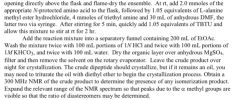 write a mechanism for the following procedure
opening directly above the flask and flame-dry the ensemble. At rt, add 2.0 mmoles of the appropriate N-protected amino acid to the flask, followed by 1.05 equivalents of L-alanine methyl ester hydrochloride, 4 mmoles of triethyl amine and 30 mL of anhydrous DMF, the latter two via syringe. After stirring for 5 min, quickly add 1.05 equivalents of TBTU and allow this mixture to stir at rt for 2 hr Add the reaction...
write a mechanism for the following procedure
opening directly above the flask and flame-dry the ensemble. At rt, add 2.0 mmoles of the appropriate N-protected amino acid to the flask, followed by 1.05 equivalents of L-alanine methyl ester hydrochloride, 4 mmoles of triethyl amine and 30 mL of anhydrous DMF, the latter two via syringe. After stirring for 5 min, quickly add 1.05 equivalents of TBTU and allow this mixture to stir at rt for 2 hr Add the reaction...
The following experiment synthesized N,N'-diethyl-3-benzamide from m-toluic acid. Initially, 2.5 g of m-toluic acid and 2.0...
The following experiment synthesized N,N'-diethyl-3-benzamide from m-toluic acid. Initially, 2.5 g of m-toluic acid and 2.0 mL of thionyl chloride are heated for a period of time. Then 30 mL of anhydrous ether was added to the mixture. 10 mL of anhydrous dry ether and 5.0 mL of diethylamine were added dropwise over a period of 10 minutes using a separatory funnel. After that, 15 mL of 2.5 M sodium hydroxide were added dropwise using a separatory funnel. Then the...
Preparation of Benzoic Acid using a Grignard Reagent URGENT 1. During your Grignard formation, a small...
Preparation of Benzoic Acid using a Grignard Reagent URGENT 1. During your Grignard formation, a small amount of benzene is formed. Provide a brief explanation and mechanism to explain this observation. 2. During your Grignard formation, a small amount of biphenyl is formed. Provide a brief explanation and mechanism to explain this observation. 3. What mass of water would be required to destroy the phenylmagnesium bromide that you prepared in this experiment? What volume does this represent? 4. Why is...
 For the portion of the procedure shown below, create a
flow chart for the acid-base extraction at the end of the Grignard
Reaction. Start your flow chart with the crude reaction (see below)
mixture before addition of HCl and continue it until the product is
recovered. Depict the desired organic product, in its correct form
at each step of the procedure.
Crude reaction mixture procedure for reference: To
the flask add Mg turnings (120 mg, 4.94 mmol) to the flask...
For the portion of the procedure shown below, create a
flow chart for the acid-base extraction at the end of the Grignard
Reaction. Start your flow chart with the crude reaction (see below)
mixture before addition of HCl and continue it until the product is
recovered. Depict the desired organic product, in its correct form
at each step of the procedure.
Crude reaction mixture procedure for reference: To
the flask add Mg turnings (120 mg, 4.94 mmol) to the flask...
 ____ What was the purpose of hydrogen peroxide and why was it
added slowly with cooling?
HYDROBORATION-OXIDATION OF 1-HEXENE 1. In a screw cap V-vial, prepare a solution of 0.33 g of iodine in 3 mL of dry THF. Firmly tighten the cap; keep the vial closed until ready to use. 2. In a 25 mL round-bottom flask, weigh 0.12 g of sodium borohydride. Add 8 mL of dry THF; stopper the flask with a septum, and stir the mixture...
____ What was the purpose of hydrogen peroxide and why was it
added slowly with cooling?
HYDROBORATION-OXIDATION OF 1-HEXENE 1. In a screw cap V-vial, prepare a solution of 0.33 g of iodine in 3 mL of dry THF. Firmly tighten the cap; keep the vial closed until ready to use. 2. In a 25 mL round-bottom flask, weigh 0.12 g of sodium borohydride. Add 8 mL of dry THF; stopper the flask with a septum, and stir the mixture...
 Organic chemistry post-lab question: "Why is important
to add the alkyl halide dropwise in your reaction? (Hint: your
reaction is not heated, but you still need a water-cooled
condenser!)" Please answer in detail!
Here is a copy of the experiment, thank you!
The Grignard reaction is an important synthetic process by which a carbon-carbon bond is formed. Magnesium metal is first reacted with an organic halide. The resultant organo-magnesium halide (Grignard reagent) is then combined with a carbonyl compound, ultimately...
Organic chemistry post-lab question: "Why is important
to add the alkyl halide dropwise in your reaction? (Hint: your
reaction is not heated, but you still need a water-cooled
condenser!)" Please answer in detail!
Here is a copy of the experiment, thank you!
The Grignard reaction is an important synthetic process by which a carbon-carbon bond is formed. Magnesium metal is first reacted with an organic halide. The resultant organo-magnesium halide (Grignard reagent) is then combined with a carbonyl compound, ultimately...
 using pictures and a maximum of 10 words, explain why an oven-dried
5-ml conical vial and drying tube(step 1 and 2 of part 1) are used
in the reaction. do both please! also the notebook pages are the
procedure
(1) Using pictures and a maximum of 10 words, explain why an oven-dried 5-ml conical vial and drying tube (step 1 and 2 of Part 1) are used in the reaction. (2) After the addition of benzophenone to the mixture of...
using pictures and a maximum of 10 words, explain why an oven-dried
5-ml conical vial and drying tube(step 1 and 2 of part 1) are used
in the reaction. do both please! also the notebook pages are the
procedure
(1) Using pictures and a maximum of 10 words, explain why an oven-dried 5-ml conical vial and drying tube (step 1 and 2 of Part 1) are used in the reaction. (2) After the addition of benzophenone to the mixture of...
 write a mechanism for the following procedure
opening directly above the flask and flame-dry the ensemble. At rt, add 2.0 mmoles of the appropriate N-protected amino acid to the flask, followed by 1.05 equivalents of L-alanine methyl ester hydrochloride, 4 mmoles of triethyl amine and 30 mL of anhydrous DMF, the latter two via syringe. After stirring for 5 min, quickly add 1.05 equivalents of TBTU and allow this mixture to stir at rt for 2 hr Add the reaction...
write a mechanism for the following procedure
opening directly above the flask and flame-dry the ensemble. At rt, add 2.0 mmoles of the appropriate N-protected amino acid to the flask, followed by 1.05 equivalents of L-alanine methyl ester hydrochloride, 4 mmoles of triethyl amine and 30 mL of anhydrous DMF, the latter two via syringe. After stirring for 5 min, quickly add 1.05 equivalents of TBTU and allow this mixture to stir at rt for 2 hr Add the reaction...
Most questions answered within 3 hours.
-
Where is the error in this code sequence?
String s1 = "Hello";
String s2 = "ello";...
asked 10 months ago -
Financial data for Joel de Paris, Inc., for last year
follow:
Joel de Paris, Inc.
Balance...
asked 10 months ago -
Consider this reaction:
Al2(SO4)3 (aq)+ BaCl3
(aq) Al2Cl6 (aq)- +
3BaSO4(s) . What is the...
asked 10 months ago -
Suppose that Savneet is considering increasing her
recent random sample from 20 car rentals to 40...
asked 10 months ago -
Trucks arrive at an unloading terminal at an average rate of 120
per hour.
Trucks arrive...
asked 10 months ago -
Why are methanol and ethanol completely soluble in water while
octanol is not very little soluble....
asked 10 months ago -
A facilities manager at a university reads in a research report
that the mean amount of...
asked 10 months ago -
When the CuSO4 is rehydrated by adding water to the anhydrous
compound, is this an endothermic...
asked 10 months ago -
A ray of sunlight is passing from diamond into crown glass; the
angle of incidence is...
asked 10 months ago -
A block of mass 0.249 kg is placed on top of a light, vertical
spring of...
asked 10 months ago -
how do the kidneys compensate in the presences of acidosis
a) trigger hyperventilate
b) reserve acid...
asked 10 months ago -
Question 501 pts
The rental rate of capital to the firm increases. Which of the
following...
asked 10 months ago