
Homework Answers
Add Answer to:
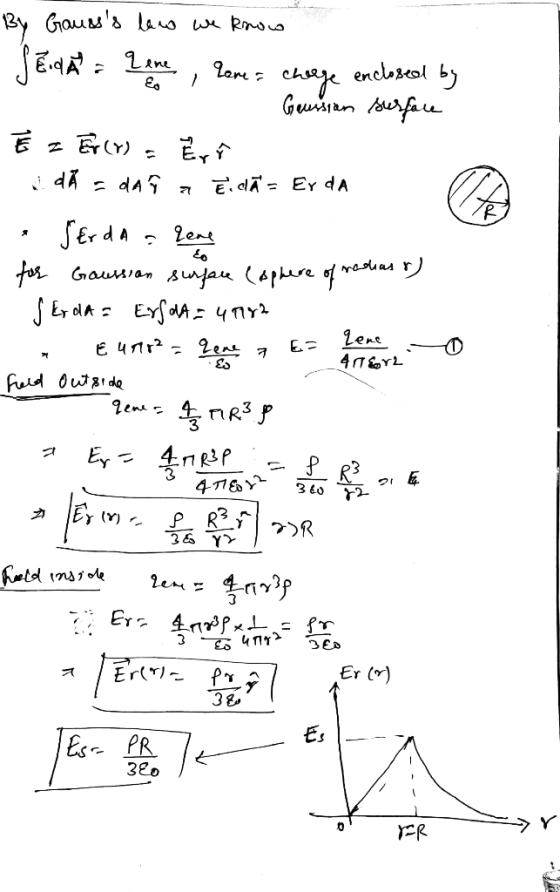
Spherical Symmetry I E = (r) For asphere w/ p= constant & known •Find Eoutside »...
The density of the charge distribution with spherical symmetry capability is: OSTSR- Por Py = R...
 The density of the charge distribution with spherical symmetry capability is: OSTSR- Por Py = R Py = 0, r>Re Find Ē at all point (use gauss law)
2. A charge distribution with spherical symmetry has density PoR (1) for 0< R< a, and...
 2. A charge distribution with spherical symmetry has density PoR (1) for 0< R< a, and is zero for R spherical variable. Determine a. Here po and a are constants, and R is the (a) (20 points) E everywhere. (b) (20 points) the potential, V, everywhere.
Charge distribution with spherical symmetry A) Consider a uniformly charged spherical crust of radius R and...
Charge distribution with spherical symmetry A) Consider a uniformly charged spherical crust of radius R and total charge Q. Calculate the value of the electric field E inside and outside the crust. b) Consider a solid sphere with radius R that has a uniform volumetric charge density ρy has a total charge Q.Calculate the value of the electric field E inside and outside the sphere.
A spherical system has electric field E(r) = E(0)exp(-r/R) E(0) and R are constant, r is...
A spherical system has electric field E(r) = E(0)exp(-r/R) E(0) and R are constant, r is distance to the center of sohere. Using Gauss law in differential form find electrostatic potential and volume charge density. E. Potential is 0 at infinity. Answer is expected in the form of equation (no numbers required)
G1. What is E for a spherical shell of charge p=0 for r < R1, p...
 G1. What is E for a spherical shell of charge p=0 for r < R1, p = po for R; <r < R2 and • P=0 for r > R2? R2 R1 Po What is the electric field for an infinitely long cylindrical pipe, inner radius Ry, outer radius R, and with p=Ar2 in the pipe wall between R, and R,? R2 R1 For problem G1 what is V in each region of space?
Consider a spherical charge distribution which has a constant density p from r = 0 out...
Consider a spherical charge distribution which has a constant density p from r = 0 out tor = a and is zero beyond. Find the electric field for all values of r, both less than and greater than a. Is there a discontinuous change in the field as we pass the surface of the charge distribution at r = a? Is there a discontinuous change at r = 0? (Please work in cgs units if possible)
A spherical charge distribution has a density p that is constant from r = 0 out...
A spherical charge distribution has a density p that is constant from r = 0 out to r = R and is zero beyond. What is the electrical field for r < R? What is the electric field for r > R? Please use Gauss’ Law to solve and answer this question in details, thank you!
A charge distribution with spherical symmetry has density: rv = ro for o srsr ry =...
 A charge distribution with spherical symmetry has density: rv = ro for o srsr ry = 0 for r>R a) Find the electric field E for r<R and r>R b) Find the electric potential V(r) at r=R c) Find the electric potential V(r) at r = 0 Hint: Integrate the field E found in (a) between Rand infinity, assuming V(r) = 0 at infinity. Then use the result found in (b) to integrate E between r and zero to find...
5. Find the center of mass of a solid of constant density & located in the...
 5. Find the center of mass of a solid of constant density & located in the upper semi-space (z 2 0) between the spheres S: r + y2 + 22 = 1 and S2: a2+ z2 = 4. Hint. Use spherical coordinates and the symmetry of the solid.
5. Find the center of mass of a solid of constant density & located in the upper semi-space (z 2 0) between the spheres S: r + y2 + 22 = 1...
5. Find the center of mass of a solid of constant density & located in the upper semi-space (z 2 0) between the spheres S: r + y2 + 22 = 1 and S2: a2+ z2 = 4. Hint. Use spherical coordinates and the symmetry of the solid.
5. Find the center of mass of a solid of constant density & located in the upper semi-space (z 2 0) between the spheres S: r + y2 + 22 = 1...
solve for: E= I= R= P= solve for E= 9 V I= R= P= 2.pdf sheet...
 solve for:
E=
I=
R=
P=
solve for
E= 9 V
I=
R=
P=
2.pdf sheet 1.pdf a 125% JAь х . Sign RESISTOR R1 RESISTOR R2 VOLTAGE SOURCE V1 12 V w 22 ohms 33 ohms VOLTAGE SOURCE 12 + RESISTOR R3 33 ohms RESISTOR R4 56 ohms RESISTOR R5 68 ohms 9V
solve for:
E=
I=
R=
P=
solve for
E= 9 V
I=
R=
P=
2.pdf sheet 1.pdf a 125% JAь х . Sign RESISTOR R1 RESISTOR R2 VOLTAGE SOURCE V1 12 V w 22 ohms 33 ohms VOLTAGE SOURCE 12 + RESISTOR R3 33 ohms RESISTOR R4 56 ohms RESISTOR R5 68 ohms 9V
 The density of the charge distribution with spherical symmetry capability is: OSTSR- Por Py = R Py = 0, r>Re Find Ē at all point (use gauss law)
 2. A charge distribution with spherical symmetry has density PoR (1) for 0< R< a, and is zero for R spherical variable. Determine a. Here po and a are constants, and R is the (a) (20 points) E everywhere. (b) (20 points) the potential, V, everywhere.
 G1. What is E for a spherical shell of charge p=0 for r < R1, p = po for R; <r < R2 and • P=0 for r > R2? R2 R1 Po What is the electric field for an infinitely long cylindrical pipe, inner radius Ry, outer radius R, and with p=Ar2 in the pipe wall between R, and R,? R2 R1 For problem G1 what is V in each region of space?
 A charge distribution with spherical symmetry has density: rv = ro for o srsr ry = 0 for r>R a) Find the electric field E for r<R and r>R b) Find the electric potential V(r) at r=R c) Find the electric potential V(r) at r = 0 Hint: Integrate the field E found in (a) between Rand infinity, assuming V(r) = 0 at infinity. Then use the result found in (b) to integrate E between r and zero to find...
 5. Find the center of mass of a solid of constant density & located in the upper semi-space (z 2 0) between the spheres S: r + y2 + 22 = 1 and S2: a2+ z2 = 4. Hint. Use spherical coordinates and the symmetry of the solid.
5. Find the center of mass of a solid of constant density & located in the upper semi-space (z 2 0) between the spheres S: r + y2 + 22 = 1...
5. Find the center of mass of a solid of constant density & located in the upper semi-space (z 2 0) between the spheres S: r + y2 + 22 = 1 and S2: a2+ z2 = 4. Hint. Use spherical coordinates and the symmetry of the solid.
5. Find the center of mass of a solid of constant density & located in the upper semi-space (z 2 0) between the spheres S: r + y2 + 22 = 1...
 solve for:
E=
I=
R=
P=
solve for
E= 9 V
I=
R=
P=
2.pdf sheet 1.pdf a 125% JAь х . Sign RESISTOR R1 RESISTOR R2 VOLTAGE SOURCE V1 12 V w 22 ohms 33 ohms VOLTAGE SOURCE 12 + RESISTOR R3 33 ohms RESISTOR R4 56 ohms RESISTOR R5 68 ohms 9V
solve for:
E=
I=
R=
P=
solve for
E= 9 V
I=
R=
P=
2.pdf sheet 1.pdf a 125% JAь х . Sign RESISTOR R1 RESISTOR R2 VOLTAGE SOURCE V1 12 V w 22 ohms 33 ohms VOLTAGE SOURCE 12 + RESISTOR R3 33 ohms RESISTOR R4 56 ohms RESISTOR R5 68 ohms 9V
Most questions answered within 3 hours.
-
Where is the error in this code sequence?
String s1 = "Hello";
String s2 = "ello";...
asked 10 months ago -
Financial data for Joel de Paris, Inc., for last year
follow:
Joel de Paris, Inc.
Balance...
asked 10 months ago -
Consider this reaction:
Al2(SO4)3 (aq)+ BaCl3
(aq) Al2Cl6 (aq)- +
3BaSO4(s) . What is the...
asked 10 months ago -
Suppose that Savneet is considering increasing her
recent random sample from 20 car rentals to 40...
asked 10 months ago -
Trucks arrive at an unloading terminal at an average rate of 120
per hour.
Trucks arrive...
asked 10 months ago -
Why are methanol and ethanol completely soluble in water while
octanol is not very little soluble....
asked 10 months ago -
A facilities manager at a university reads in a research report
that the mean amount of...
asked 10 months ago -
When the CuSO4 is rehydrated by adding water to the anhydrous
compound, is this an endothermic...
asked 10 months ago -
A ray of sunlight is passing from diamond into crown glass; the
angle of incidence is...
asked 10 months ago -
A block of mass 0.249 kg is placed on top of a light, vertical
spring of...
asked 10 months ago -
how do the kidneys compensate in the presences of acidosis
a) trigger hyperventilate
b) reserve acid...
asked 10 months ago -
Question 501 pts
The rental rate of capital to the firm increases. Which of the
following...
asked 10 months ago