
Homework Answers
Request Answer!
We need at least 10 more requests to produce the answer.
0 / 10 have requested this problem solution
The more requests, the faster the answer.
Add Answer to:
The logistic growth model) 2.000 1-3 -0.50 presents the number of families that own a home...
6000 The logistic growth model H(t) = -0.671 represents the number of fámilies that own a...
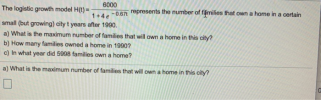 6000 The logistic growth model H(t) = -0.671 represents the number of fámilies that own a home in a certain 1 +4 e small (but growing) city t years after 1990. a) What is the maximum number of families that will own a home in this city? b) How many families owned a home in 1990? c) In what year did 5998 families own a home? a) What is the maximum number of families that will own a home in...
3. (17 points) The growth in a population of bacteria follows a logistic growth model given...
 3. (17 points) The growth in a population of bacteria follows a logistic growth model given by the differential equation dP 0.05P - 0.00001p? dt with units of number of bacteria and hours. (a) (3 points) What is the carrying capacity of this population? (b) (9 points) Given an initial population of 1000 bacteria, how long will it take for the population to double? (c) (5 points) What is the rate of change (per hour) in the size of the...
POPULATION MODELS: PLEASE ANSWSER ASAP: ALL 3 AND WILL RATE U ASAP. The logistic growth model...
 POPULATION MODELS: PLEASE
ANSWSER ASAP: ALL 3 AND WILL RATE U ASAP.
The logistic growth model describes population growth when
resources are constrained. It
is an extension to the exponential growth model that includes an
additional term introducing
the carrying capacity of the habitat.
The differential equation for this model is:
dP/dt=kP(t)(1-P(t)/M)
Where P(t) is the population (or population density) at time t,
k > 0 is a growth constant,
and M is the carrying capacity of the habitat. This...
POPULATION MODELS: PLEASE
ANSWSER ASAP: ALL 3 AND WILL RATE U ASAP.
The logistic growth model describes population growth when
resources are constrained. It
is an extension to the exponential growth model that includes an
additional term introducing
the carrying capacity of the habitat.
The differential equation for this model is:
dP/dt=kP(t)(1-P(t)/M)
Where P(t) is the population (or population density) at time t,
k > 0 is a growth constant,
and M is the carrying capacity of the habitat. This...
3. The following differential equation is known as the logistic growth equation: y = ry(1-1) where...
 3. The following differential equation is known as the logistic growth equation: y = ry(1-1) where r, k are positive real constants. (a) Note that the logistic growth equation is separable. Use separation of variables to solve the logistic growth equation when r = 1 and k = 2. That is, solve the separable equation: State your solution explicitly. (b) Note that the logistic growth equation is also a Bernoulli equation: y - ry=- C) Solve the logistic growth equation...
Population growth problems BIDE model: No.1 N, +(B + 1) - ( D Rates: b =...
 Population growth problems BIDE model: No.1 N, +(B + 1) - ( D Rates: b = B/N; d = D/N: E) Net growth rate: R = b-d Exponential growth (discrete): N, NR* where R = 1+b-d Intrinsic rate of increase: r = InR Exponential growth (continuous): N:Noe -or-dN/dt = IN Logistic growth 1. Suppose a species of fish in a lake is modeled by a logistic population model with relative growth rate ofr 0.3 per year and carrying capacity of...
question 3 Δt gets smaller). Question 3: (4 marks) In deriving the logistic equation for population growth, we ass...
 question 3
Δt gets smaller). Question 3: (4 marks) In deriving the logistic equation for population growth, we assumed the growth rate was proportional to the amount of excess resources, FA pFR where FA is the amount of available resources, p the population, and FR the amount of resources required per individual. Due to seasonal effects, FA may not be a constant (a) Derive a logistic-type equation assuming the amount of resources available are FA(1 + e sin(wt)), where 0...
question 3
Δt gets smaller). Question 3: (4 marks) In deriving the logistic equation for population growth, we assumed the growth rate was proportional to the amount of excess resources, FA pFR where FA is the amount of available resources, p the population, and FR the amount of resources required per individual. Due to seasonal effects, FA may not be a constant (a) Derive a logistic-type equation assuming the amount of resources available are FA(1 + e sin(wt)), where 0...
Question Number 3 1. Please show me the Gordon Growth Model formula. (Just copy it done....
 Question Number 3
1. Please show me the Gordon Growth Model formula. (Just copy it done. P,-?, 0.1 point) 2. As we mentioned, g not only governs the growth of d, g also tells us how P changes along the time. Please rewrite Pin terms of P, and g. (0.2 point) 3. Now, according to 1. and 2., we know 2 ways to express P. Equate them and derive d, in terms of P. 9, and r. (0.5 point) 4....
Question Number 3
1. Please show me the Gordon Growth Model formula. (Just copy it done. P,-?, 0.1 point) 2. As we mentioned, g not only governs the growth of d, g also tells us how P changes along the time. Please rewrite Pin terms of P, and g. (0.2 point) 3. Now, according to 1. and 2., we know 2 ways to express P. Equate them and derive d, in terms of P. 9, and r. (0.5 point) 4....
Question Number 4 1. Please show me the Gordon Growth Model formula. (Just copy it done....
 Question Number 4
1. Please show me the Gordon Growth Model formula. (Just copy it done. Po=?, 0.1 point) 2. As we mentioned, g not only governs the growth of d, g also tells us how P changes along the time. Please rewrite Po in terms of P and g. (0.2 point) 3. Now, according to 1. and 2., we know 2 ways to express Po. Equate them and derive d in terms of P, 9, and r. (0.5 point)...
Question Number 4
1. Please show me the Gordon Growth Model formula. (Just copy it done. Po=?, 0.1 point) 2. As we mentioned, g not only governs the growth of d, g also tells us how P changes along the time. Please rewrite Po in terms of P and g. (0.2 point) 3. Now, according to 1. and 2., we know 2 ways to express Po. Equate them and derive d in terms of P, 9, and r. (0.5 point)...
CASE STUDY You are the nurse administrator for a nursing home. You are monitoring the number...
 CASE STUDY You are the nurse administrator for a nursing home. You are monitoring the number of falls by month for a given year after implementing new fall prevention procedures and equipment. The number of falls were January 5, February 6, March 4, April 3, May 2, June 3, July 2. August 3, September 4, October 3, November 4, and December 4. 1. What is the sum of the number of falls? 2. What is the average number of falls...
Exercises 1. Verify equation (3) 2. Use the techniques of Section 13.7 and the fact that...
 Exercises 1. Verify equation (3) 2. Use the techniques of Section 13.7 and the fact that P(0) = 10 to solve equation (5). 3. The carrying capacity of Atlantic harp seals has been estimated to be C = 10 million seals. Let 1 = 0 correspond to the year 1980 when this seal population was estimated to be about 2 mil- lion. (Data from: Fisheries and Oceans Canada.) (a) Use a logistic growth model = kP(C - P) with k...
 6000 The logistic growth model H(t) = -0.671 represents the number of fámilies that own a home in a certain 1 +4 e small (but growing) city t years after 1990. a) What is the maximum number of families that will own a home in this city? b) How many families owned a home in 1990? c) In what year did 5998 families own a home? a) What is the maximum number of families that will own a home in...
 3. (17 points) The growth in a population of bacteria follows a logistic growth model given by the differential equation dP 0.05P - 0.00001p? dt with units of number of bacteria and hours. (a) (3 points) What is the carrying capacity of this population? (b) (9 points) Given an initial population of 1000 bacteria, how long will it take for the population to double? (c) (5 points) What is the rate of change (per hour) in the size of the...
 POPULATION MODELS: PLEASE
ANSWSER ASAP: ALL 3 AND WILL RATE U ASAP.
The logistic growth model describes population growth when
resources are constrained. It
is an extension to the exponential growth model that includes an
additional term introducing
the carrying capacity of the habitat.
The differential equation for this model is:
dP/dt=kP(t)(1-P(t)/M)
Where P(t) is the population (or population density) at time t,
k > 0 is a growth constant,
and M is the carrying capacity of the habitat. This...
POPULATION MODELS: PLEASE
ANSWSER ASAP: ALL 3 AND WILL RATE U ASAP.
The logistic growth model describes population growth when
resources are constrained. It
is an extension to the exponential growth model that includes an
additional term introducing
the carrying capacity of the habitat.
The differential equation for this model is:
dP/dt=kP(t)(1-P(t)/M)
Where P(t) is the population (or population density) at time t,
k > 0 is a growth constant,
and M is the carrying capacity of the habitat. This...
 3. The following differential equation is known as the logistic growth equation: y = ry(1-1) where r, k are positive real constants. (a) Note that the logistic growth equation is separable. Use separation of variables to solve the logistic growth equation when r = 1 and k = 2. That is, solve the separable equation: State your solution explicitly. (b) Note that the logistic growth equation is also a Bernoulli equation: y - ry=- C) Solve the logistic growth equation...
 Population growth problems BIDE model: No.1 N, +(B + 1) - ( D Rates: b = B/N; d = D/N: E) Net growth rate: R = b-d Exponential growth (discrete): N, NR* where R = 1+b-d Intrinsic rate of increase: r = InR Exponential growth (continuous): N:Noe -or-dN/dt = IN Logistic growth 1. Suppose a species of fish in a lake is modeled by a logistic population model with relative growth rate ofr 0.3 per year and carrying capacity of...
 question 3
Δt gets smaller). Question 3: (4 marks) In deriving the logistic equation for population growth, we assumed the growth rate was proportional to the amount of excess resources, FA pFR where FA is the amount of available resources, p the population, and FR the amount of resources required per individual. Due to seasonal effects, FA may not be a constant (a) Derive a logistic-type equation assuming the amount of resources available are FA(1 + e sin(wt)), where 0...
question 3
Δt gets smaller). Question 3: (4 marks) In deriving the logistic equation for population growth, we assumed the growth rate was proportional to the amount of excess resources, FA pFR where FA is the amount of available resources, p the population, and FR the amount of resources required per individual. Due to seasonal effects, FA may not be a constant (a) Derive a logistic-type equation assuming the amount of resources available are FA(1 + e sin(wt)), where 0...
 Question Number 3
1. Please show me the Gordon Growth Model formula. (Just copy it done. P,-?, 0.1 point) 2. As we mentioned, g not only governs the growth of d, g also tells us how P changes along the time. Please rewrite Pin terms of P, and g. (0.2 point) 3. Now, according to 1. and 2., we know 2 ways to express P. Equate them and derive d, in terms of P. 9, and r. (0.5 point) 4....
Question Number 3
1. Please show me the Gordon Growth Model formula. (Just copy it done. P,-?, 0.1 point) 2. As we mentioned, g not only governs the growth of d, g also tells us how P changes along the time. Please rewrite Pin terms of P, and g. (0.2 point) 3. Now, according to 1. and 2., we know 2 ways to express P. Equate them and derive d, in terms of P. 9, and r. (0.5 point) 4....
 Question Number 4
1. Please show me the Gordon Growth Model formula. (Just copy it done. Po=?, 0.1 point) 2. As we mentioned, g not only governs the growth of d, g also tells us how P changes along the time. Please rewrite Po in terms of P and g. (0.2 point) 3. Now, according to 1. and 2., we know 2 ways to express Po. Equate them and derive d in terms of P, 9, and r. (0.5 point)...
Question Number 4
1. Please show me the Gordon Growth Model formula. (Just copy it done. Po=?, 0.1 point) 2. As we mentioned, g not only governs the growth of d, g also tells us how P changes along the time. Please rewrite Po in terms of P and g. (0.2 point) 3. Now, according to 1. and 2., we know 2 ways to express Po. Equate them and derive d in terms of P, 9, and r. (0.5 point)...
 CASE STUDY You are the nurse administrator for a nursing home. You are monitoring the number of falls by month for a given year after implementing new fall prevention procedures and equipment. The number of falls were January 5, February 6, March 4, April 3, May 2, June 3, July 2. August 3, September 4, October 3, November 4, and December 4. 1. What is the sum of the number of falls? 2. What is the average number of falls...
 Exercises 1. Verify equation (3) 2. Use the techniques of Section 13.7 and the fact that P(0) = 10 to solve equation (5). 3. The carrying capacity of Atlantic harp seals has been estimated to be C = 10 million seals. Let 1 = 0 correspond to the year 1980 when this seal population was estimated to be about 2 mil- lion. (Data from: Fisheries and Oceans Canada.) (a) Use a logistic growth model = kP(C - P) with k...
Most questions answered within 3 hours.
-
Where is the error in this code sequence?
String s1 = "Hello";
String s2 = "ello";...
asked 10 months ago -
Financial data for Joel de Paris, Inc., for last year
follow:
Joel de Paris, Inc.
Balance...
asked 10 months ago -
Consider this reaction:
Al2(SO4)3 (aq)+ BaCl3
(aq) Al2Cl6 (aq)- +
3BaSO4(s) . What is the...
asked 10 months ago -
Suppose that Savneet is considering increasing her
recent random sample from 20 car rentals to 40...
asked 10 months ago -
Trucks arrive at an unloading terminal at an average rate of 120
per hour.
Trucks arrive...
asked 10 months ago -
Why are methanol and ethanol completely soluble in water while
octanol is not very little soluble....
asked 10 months ago -
A facilities manager at a university reads in a research report
that the mean amount of...
asked 10 months ago -
When the CuSO4 is rehydrated by adding water to the anhydrous
compound, is this an endothermic...
asked 10 months ago -
A ray of sunlight is passing from diamond into crown glass; the
angle of incidence is...
asked 10 months ago -
A block of mass 0.249 kg is placed on top of a light, vertical
spring of...
asked 10 months ago -
how do the kidneys compensate in the presences of acidosis
a) trigger hyperventilate
b) reserve acid...
asked 10 months ago -
Question 501 pts
The rental rate of capital to the firm increases. Which of the
following...
asked 10 months ago