
Homework Answers
Add Answer to:
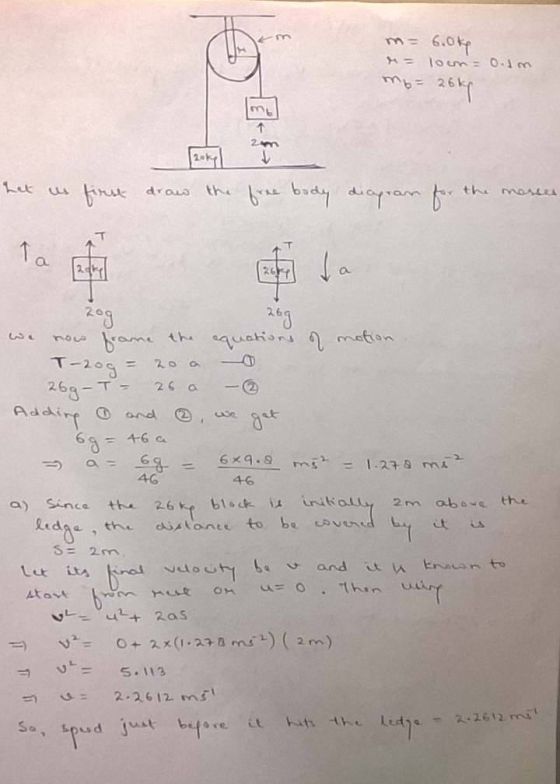
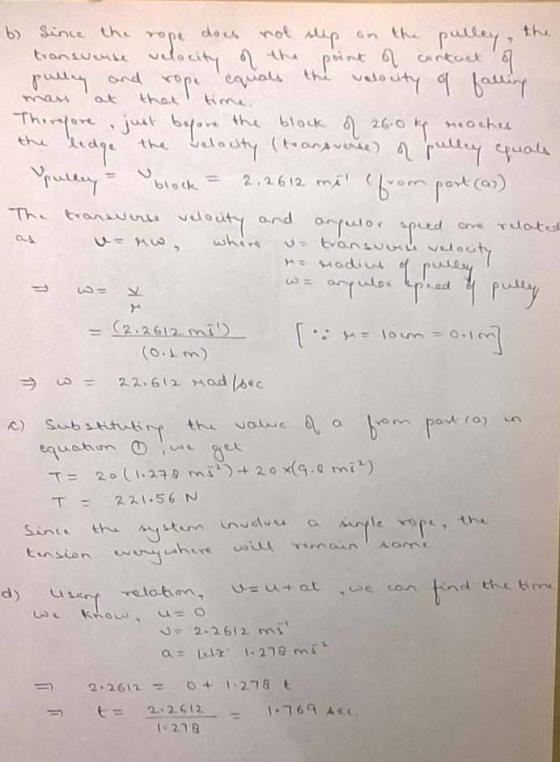
The system shown below is released from rest. The m_b = 26 kg block is 2...
In the system shown below, there is a block of mass M = 3.6 kg resting...
In the system shown below, there is a block of mass M = 3.6 kg resting on a horizontal ledge. The coefficient of kinetic friction between the ledge and the block is 0.25. The block is attached to a string that passes over a pulley, and the other end of the string is attached to a hanging block of mass m = 2.2 kg. The pulley is a uniform disk of radius 7.9 cm and mass 0.66 kg. Find the...
The system shown in the figure below consists of a mass M = 3.3-kg block resting...
The system shown in the figure below consists of a mass M = 3.3-kg block resting on a frictionless horizontal ledge. This block is attached to a string that passes over a pulley, and the other end of the string is attached to a hanging m = 1.7-kg block. The pulley is a uniform disk of radius 8.0 cm and mass 0.60 kg. (a) What is the acceleration of each block? acceleration of M = 3.3 kg _____ m/s2 acceleration...
2. A uniform, solid cylinder with mass M and radius 2R is on an incline plane with angle of inclination of 6. A str...
 2. A uniform, solid cylinder with mass M and radius 2R is on an incline plane with angle of inclination of 6. A string is attached by a yoke to a frictionless axle through the center of the cylinder so that the cylinder can rotate about the axle. The string runs over a disk-shaped pulley with mass M and radius R that is mounted on a frictionless axle through its center. A block of mass M is suspended from the...
A 3 kg block (block A) is released from rest at the top of a 20...
A 3 kg block (block A) is released from rest at the top of a 20 m long frictionless ramp that is 4 m high. At the same time, an identical block (block B) is released next to the ramp so that it drops straight down the same 4 m. Find the values for each of the following for the blocks just before they reach ground level. (a) gravitational potential energy Block A ? Block B ? (B) kinetic...
(1) A thin stick is glued to a uniform disk to form a composite pulley. Then...
 (1) A thin stick is glued to a uniform disk to form a composite pulley. Then a non-slip string with two masses is hung over the disk and the system is released from rest. Uniform Disk mass: 4 kg radius: 5 cm Calculate the moment of inertia of the stick plus disk combination and find the angular acceleration of the composite pulley, the linear acceleration of the two hanging blocks, and the tensions in each part of the string (which...
A 65-N weight is released from rest and falls to the floor as shown in the...
A 65-N weight is released from rest and falls to the floor as shown in the figure. It is suspended by a string of negligible mass that is wrapped around a 5.0 kg pulley that is essentially a solid disk of a radius of 1.75 m and rotates through 5.5 radians. What is the angular speed of the pulley? (Note: Since the pulley has mass, the sum total of the forces acting on the pulley is not simply the weight...
Question 3. Two blocks having mass m (2 kg) and m, (5 kg) are connected by...
 Question 3. Two blocks having mass m (2 kg) and m, (5 kg) are connected by a string passing over a pulley as shown in the figure. The pulley (in cylindrical disc shape) has a radius R (0.4 m) and mass (0.5 kg). The string does not slip on the pulley and the system is released from rest. Find the translational speeds of the blocks after mass 2 descends through a distance h (1.0 m) and find the angular speed...
4. A 6-kg block (my), initially at rest on a rough shelf, is connected to a...
 4. A 6-kg block (my), initially at rest on a rough shelf, is connected to a 4-kg block (m2) that hangs by an inextensible string of negligible mass passing over a pulley. The uniform disk-shaped pulley, having a mass of 3.0-kg and a radius of 10 cm, rotates about the symmetry axis through its center. The 6-kg block, which is attached to the spring, is initially pushed against the spring compressing it a distance of 30 cm from its equilibrium...
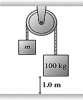
The figure shows a 100-kg block being released from rest from a height of 1.0 m
 The figure shows a 100-kg block
being released from rest from a height of 1.0 m. It then takes it
0.90 s to reach the floor. What is the mass m of the other
block? The pulley has no appreciable mass or friction.
The figure shows a 100-kg block
being released from rest from a height of 1.0 m. It then takes it
0.90 s to reach the floor. What is the mass m of the other
block? The pulley has no appreciable mass or friction.
1. A 4 kg block is placed on a smooth 30° incline and released from rest,...
1. A 4 kg block is placed on a smooth 30° incline and released from rest, but a string connected to the block runs up the incline parallel to the surface, over a frictionless pulley, and horizontally to a 6 kg block on a level surface with a kinetic friction coefficient of 1/6. Find the acceleration of the system and the speed at the end of 4 s assuming the 6 kg block doesn't run into the pulley first. 2....
 2. A uniform, solid cylinder with mass M and radius 2R is on an incline plane with angle of inclination of 6. A string is attached by a yoke to a frictionless axle through the center of the cylinder so that the cylinder can rotate about the axle. The string runs over a disk-shaped pulley with mass M and radius R that is mounted on a frictionless axle through its center. A block of mass M is suspended from the...
 (1) A thin stick is glued to a uniform disk to form a composite pulley. Then a non-slip string with two masses is hung over the disk and the system is released from rest. Uniform Disk mass: 4 kg radius: 5 cm Calculate the moment of inertia of the stick plus disk combination and find the angular acceleration of the composite pulley, the linear acceleration of the two hanging blocks, and the tensions in each part of the string (which...
 Question 3. Two blocks having mass m (2 kg) and m, (5 kg) are connected by a string passing over a pulley as shown in the figure. The pulley (in cylindrical disc shape) has a radius R (0.4 m) and mass (0.5 kg). The string does not slip on the pulley and the system is released from rest. Find the translational speeds of the blocks after mass 2 descends through a distance h (1.0 m) and find the angular speed...
 4. A 6-kg block (my), initially at rest on a rough shelf, is connected to a 4-kg block (m2) that hangs by an inextensible string of negligible mass passing over a pulley. The uniform disk-shaped pulley, having a mass of 3.0-kg and a radius of 10 cm, rotates about the symmetry axis through its center. The 6-kg block, which is attached to the spring, is initially pushed against the spring compressing it a distance of 30 cm from its equilibrium...
 The figure shows a 100-kg block
being released from rest from a height of 1.0 m. It then takes it
0.90 s to reach the floor. What is the mass m of the other
block? The pulley has no appreciable mass or friction.
The figure shows a 100-kg block
being released from rest from a height of 1.0 m. It then takes it
0.90 s to reach the floor. What is the mass m of the other
block? The pulley has no appreciable mass or friction.
Most questions answered within 3 hours.
-
Where is the error in this code sequence?
String s1 = "Hello";
String s2 = "ello";...
asked 10 months ago -
Financial data for Joel de Paris, Inc., for last year
follow:
Joel de Paris, Inc.
Balance...
asked 10 months ago -
Consider this reaction:
Al2(SO4)3 (aq)+ BaCl3
(aq) Al2Cl6 (aq)- +
3BaSO4(s) . What is the...
asked 10 months ago -
Suppose that Savneet is considering increasing her
recent random sample from 20 car rentals to 40...
asked 10 months ago -
Trucks arrive at an unloading terminal at an average rate of 120
per hour.
Trucks arrive...
asked 10 months ago -
Why are methanol and ethanol completely soluble in water while
octanol is not very little soluble....
asked 10 months ago -
A facilities manager at a university reads in a research report
that the mean amount of...
asked 10 months ago -
When the CuSO4 is rehydrated by adding water to the anhydrous
compound, is this an endothermic...
asked 10 months ago -
A ray of sunlight is passing from diamond into crown glass; the
angle of incidence is...
asked 10 months ago -
A block of mass 0.249 kg is placed on top of a light, vertical
spring of...
asked 10 months ago -
how do the kidneys compensate in the presences of acidosis
a) trigger hyperventilate
b) reserve acid...
asked 10 months ago -
Question 501 pts
The rental rate of capital to the firm increases. Which of the
following...
asked 10 months ago