
Homework Answers
Add Answer to:
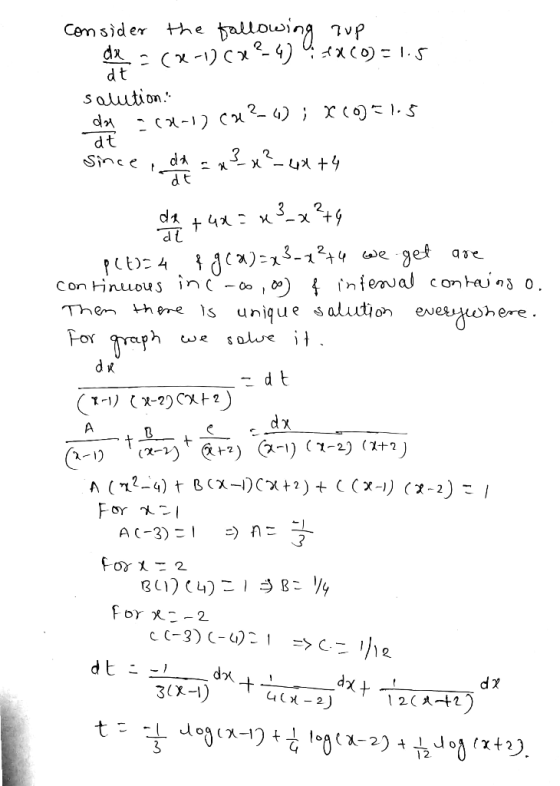
need help with #3
L. (3Upts) Consider the following ivp I)(24), 2(0) = 1.5. ut show...
2. Consider a thin rod of length L = π (so that 0 x-7) with a...
 2. Consider a thin rod of length L = π (so that 0 x-7) with a general internal source of heat, Q(a,t) Ot (10) subject to insulated boundary conditions The initial temperature of the bar is zero a(x, 0) = 0 (12) (a) (3pts) What is k in (10)? (b) (10pts) Assume a separable solution to the homogeneous version of the PDE and boundary conditions (10)-(11) of the form u(r, t)- o(x)G(t). Write down or find the eigenvalues λη and...
Consider the following IVP y″ + 5y′ + y = f (t), y(0) = 3, y′(0) ...
 Consider the following IVP
y″ + 5y′ +
y = f (t), y(0) = 3,
y′(0) = 0,
where
f (t) =
{
8
0 ≤ t ≤ 2π
cos(7t)
t > 2π
(a)
Find the Laplace transform F(s) =
ℒ { f (t)} of f (t).
(b)
Find the Laplace transform Y(s) =
ℒ {y(t)} of the solution y(t)
of the above IVP.
Consider the following IVP y" + 5y' + y = f(t), y(0) = 3, y'(0) =...
Consider the following IVP
y″ + 5y′ +
y = f (t), y(0) = 3,
y′(0) = 0,
where
f (t) =
{
8
0 ≤ t ≤ 2π
cos(7t)
t > 2π
(a)
Find the Laplace transform F(s) =
ℒ { f (t)} of f (t).
(b)
Find the Laplace transform Y(s) =
ℒ {y(t)} of the solution y(t)
of the above IVP.
Consider the following IVP y" + 5y' + y = f(t), y(0) = 3, y'(0) =...
1. [5 Consider the IVP rty(t) + 2 sin(t)y(t) = tan(t) y(5)=2 Does a unique solution of the IVP ex...
 pls do all questions.
thanx
1. [5 Consider the IVP rty(t) + 2 sin(t)y(t) = tan(t) y(5)=2 Does a unique solution of the IVP exist? Do not solve the IVP but fully justify you answer. What is the IOE? 2. 4 Consider the ODE Using undetermined coefficients, what is an approprite guess for the coefficient (s) in yp but fully justify you answer. ? Do not solve for 3. [10] Solve the IVP. Use any approach you like y(x) 6y'(x)...
pls do all questions.
thanx
1. [5 Consider the IVP rty(t) + 2 sin(t)y(t) = tan(t) y(5)=2 Does a unique solution of the IVP exist? Do not solve the IVP but fully justify you answer. What is the IOE? 2. 4 Consider the ODE Using undetermined coefficients, what is an approprite guess for the coefficient (s) in yp but fully justify you answer. ? Do not solve for 3. [10] Solve the IVP. Use any approach you like y(x) 6y'(x)...
please help Problem 5-15pts A magnetic field B points in the x-direction and electric field E...
 please help
Problem 5-15pts A magnetic field B points in the x-direction and electric field E points in the 2-direction. A positive particle at rest is released from the origin. a) Starting with general solution y(t) = 6 cos wt + C sin wt + + + C3; z(t) = C2 cos wt - Csin wt + C4 and using initial conditions, determine the constants G,C2, Cand C, and write the exact solution (10pts) b) Find the trajectory of the...
please help
Problem 5-15pts A magnetic field B points in the x-direction and electric field E points in the 2-direction. A positive particle at rest is released from the origin. a) Starting with general solution y(t) = 6 cos wt + C sin wt + + + C3; z(t) = C2 cos wt - Csin wt + C4 and using initial conditions, determine the constants G,C2, Cand C, and write the exact solution (10pts) b) Find the trajectory of the...
please help Fundamental Existence Theorem for Linear Differential Equations Given an IVP d"y d" y dy...
 please help
Fundamental Existence Theorem for Linear Differential Equations Given an IVP d"y d" y dy +ao(x)ygx) dx ... a1 (x)- + an-1 (x) dx" а, (х) dx"-1 yу-D (хо) — Уп-1 У(хо) %3D Уо, у (хо) — У1, ..., If the coefficients a,(x), ... , ao(x) and the right hand side of the equation g(x) are continuous on an interval I and if a,(x) 0 on I then the IVP has a unique solution for the point xo E...
please help
Fundamental Existence Theorem for Linear Differential Equations Given an IVP d"y d" y dy +ao(x)ygx) dx ... a1 (x)- + an-1 (x) dx" а, (х) dx"-1 yу-D (хо) — Уп-1 У(хо) %3D Уо, у (хо) — У1, ..., If the coefficients a,(x), ... , ao(x) and the right hand side of the equation g(x) are continuous on an interval I and if a,(x) 0 on I then the IVP has a unique solution for the point xo E...
Consider the solution to the IVP y' - xy = x; y(0) = 2 Find y'...
 Consider the solution to the IVP y' - xy = x; y(0) = 2 Find y' (0) Consider the solution to the IVP y' - xy = t; y(0) = 2 Find y" (0)
In Problems 1-3, solve the given DE or IVP (Initial-Value Problem). [First, you need to determine...
 In Problems 1-3, solve the given DE or IVP (Initial-Value Problem). [First, you need to determine what type of DE it is.) 1. (2xy + cos y) dx + (x2 – 2 siny – 2y) dy = 0. 2. + cos2 - 2ary dy dar y(y +sin x), y(0) = 1. 1+ y2 3. [2ry cos (x²y) - sin r) dx + r?cos (r?y) dy = 0. 4. Determine the values of the constants r and s such that (x,y)...
The following IVP will be used for Question 1 and Question 2 on this quiz. Solve...
 The following IVP will be used for Question 1 and Question 2 on this quiz. Solve the initial value problem using the method of Laplace Transforms. y' - y' = 6x y(0) = 2,y'(0) = -1 The solution will be accomplished through answering the two questions below. In using the Laplace Transform to solve the above IVP, solving for Y(s) gives Y(8) = Y(s) = + 8+3 $-2 s-2 Y(s) – + 5 $+2 8-3 3 5 Y(s) = +...
Consider the IVP: x = √2, 2(0) = 0 A) Is the function S 0, 0<t...
 Consider the IVP: x = √2, 2(0) = 0 A) Is the function S 0, 0<t < 5 X(t) = iſt - 5), t>5 a solution of the DE on I = 0,0), Justify your answer. (Hint: Verify the first two conditions for each interval (0,5) and (5,0).
Consider the IVP, 1. Apply the FEUT to show that a solution exists. 2. Use the...
Consider the IVP, 1. Apply the FEUT to show that a solution exists. 2. Use the Runge-Kutta method with various step-sizes to estimate the maximum t-value, t=t∗>0, for which the solution is defined on the interval [0,t∗). Include a few representative graphs with your submission, but not the lists of points. 3. Find the exact solution to the IVP and solve for t∗ analytically. How close was your approximation from the previous question? 4. The Runge-Kutta method continues to give...
 2. Consider a thin rod of length L = π (so that 0 x-7) with a general internal source of heat, Q(a,t) Ot (10) subject to insulated boundary conditions The initial temperature of the bar is zero a(x, 0) = 0 (12) (a) (3pts) What is k in (10)? (b) (10pts) Assume a separable solution to the homogeneous version of the PDE and boundary conditions (10)-(11) of the form u(r, t)- o(x)G(t). Write down or find the eigenvalues λη and...
 Consider the following IVP
y″ + 5y′ +
y = f (t), y(0) = 3,
y′(0) = 0,
where
f (t) =
{
8
0 ≤ t ≤ 2π
cos(7t)
t > 2π
(a)
Find the Laplace transform F(s) =
ℒ { f (t)} of f (t).
(b)
Find the Laplace transform Y(s) =
ℒ {y(t)} of the solution y(t)
of the above IVP.
Consider the following IVP y" + 5y' + y = f(t), y(0) = 3, y'(0) =...
Consider the following IVP
y″ + 5y′ +
y = f (t), y(0) = 3,
y′(0) = 0,
where
f (t) =
{
8
0 ≤ t ≤ 2π
cos(7t)
t > 2π
(a)
Find the Laplace transform F(s) =
ℒ { f (t)} of f (t).
(b)
Find the Laplace transform Y(s) =
ℒ {y(t)} of the solution y(t)
of the above IVP.
Consider the following IVP y" + 5y' + y = f(t), y(0) = 3, y'(0) =...
 pls do all questions.
thanx
1. [5 Consider the IVP rty(t) + 2 sin(t)y(t) = tan(t) y(5)=2 Does a unique solution of the IVP exist? Do not solve the IVP but fully justify you answer. What is the IOE? 2. 4 Consider the ODE Using undetermined coefficients, what is an approprite guess for the coefficient (s) in yp but fully justify you answer. ? Do not solve for 3. [10] Solve the IVP. Use any approach you like y(x) 6y'(x)...
pls do all questions.
thanx
1. [5 Consider the IVP rty(t) + 2 sin(t)y(t) = tan(t) y(5)=2 Does a unique solution of the IVP exist? Do not solve the IVP but fully justify you answer. What is the IOE? 2. 4 Consider the ODE Using undetermined coefficients, what is an approprite guess for the coefficient (s) in yp but fully justify you answer. ? Do not solve for 3. [10] Solve the IVP. Use any approach you like y(x) 6y'(x)...
 please help
Problem 5-15pts A magnetic field B points in the x-direction and electric field E points in the 2-direction. A positive particle at rest is released from the origin. a) Starting with general solution y(t) = 6 cos wt + C sin wt + + + C3; z(t) = C2 cos wt - Csin wt + C4 and using initial conditions, determine the constants G,C2, Cand C, and write the exact solution (10pts) b) Find the trajectory of the...
please help
Problem 5-15pts A magnetic field B points in the x-direction and electric field E points in the 2-direction. A positive particle at rest is released from the origin. a) Starting with general solution y(t) = 6 cos wt + C sin wt + + + C3; z(t) = C2 cos wt - Csin wt + C4 and using initial conditions, determine the constants G,C2, Cand C, and write the exact solution (10pts) b) Find the trajectory of the...
 please help
Fundamental Existence Theorem for Linear Differential Equations Given an IVP d"y d" y dy +ao(x)ygx) dx ... a1 (x)- + an-1 (x) dx" а, (х) dx"-1 yу-D (хо) — Уп-1 У(хо) %3D Уо, у (хо) — У1, ..., If the coefficients a,(x), ... , ao(x) and the right hand side of the equation g(x) are continuous on an interval I and if a,(x) 0 on I then the IVP has a unique solution for the point xo E...
please help
Fundamental Existence Theorem for Linear Differential Equations Given an IVP d"y d" y dy +ao(x)ygx) dx ... a1 (x)- + an-1 (x) dx" а, (х) dx"-1 yу-D (хо) — Уп-1 У(хо) %3D Уо, у (хо) — У1, ..., If the coefficients a,(x), ... , ao(x) and the right hand side of the equation g(x) are continuous on an interval I and if a,(x) 0 on I then the IVP has a unique solution for the point xo E...
 Consider the solution to the IVP y' - xy = x; y(0) = 2 Find y' (0) Consider the solution to the IVP y' - xy = t; y(0) = 2 Find y" (0)
 In Problems 1-3, solve the given DE or IVP (Initial-Value Problem). [First, you need to determine what type of DE it is.) 1. (2xy + cos y) dx + (x2 – 2 siny – 2y) dy = 0. 2. + cos2 - 2ary dy dar y(y +sin x), y(0) = 1. 1+ y2 3. [2ry cos (x²y) - sin r) dx + r?cos (r?y) dy = 0. 4. Determine the values of the constants r and s such that (x,y)...
 The following IVP will be used for Question 1 and Question 2 on this quiz. Solve the initial value problem using the method of Laplace Transforms. y' - y' = 6x y(0) = 2,y'(0) = -1 The solution will be accomplished through answering the two questions below. In using the Laplace Transform to solve the above IVP, solving for Y(s) gives Y(8) = Y(s) = + 8+3 $-2 s-2 Y(s) – + 5 $+2 8-3 3 5 Y(s) = +...
 Consider the IVP: x = √2, 2(0) = 0 A) Is the function S 0, 0<t < 5 X(t) = iſt - 5), t>5 a solution of the DE on I = 0,0), Justify your answer. (Hint: Verify the first two conditions for each interval (0,5) and (5,0).
Most questions answered within 3 hours.
-
Where is the error in this code sequence?
String s1 = "Hello";
String s2 = "ello";...
asked 10 months ago -
Financial data for Joel de Paris, Inc., for last year
follow:
Joel de Paris, Inc.
Balance...
asked 10 months ago -
Consider this reaction:
Al2(SO4)3 (aq)+ BaCl3
(aq) Al2Cl6 (aq)- +
3BaSO4(s) . What is the...
asked 10 months ago -
Suppose that Savneet is considering increasing her
recent random sample from 20 car rentals to 40...
asked 10 months ago -
Trucks arrive at an unloading terminal at an average rate of 120
per hour.
Trucks arrive...
asked 10 months ago -
Why are methanol and ethanol completely soluble in water while
octanol is not very little soluble....
asked 10 months ago -
A facilities manager at a university reads in a research report
that the mean amount of...
asked 10 months ago -
When the CuSO4 is rehydrated by adding water to the anhydrous
compound, is this an endothermic...
asked 10 months ago -
A ray of sunlight is passing from diamond into crown glass; the
angle of incidence is...
asked 10 months ago -
A block of mass 0.249 kg is placed on top of a light, vertical
spring of...
asked 10 months ago -
how do the kidneys compensate in the presences of acidosis
a) trigger hyperventilate
b) reserve acid...
asked 10 months ago -
Question 501 pts
The rental rate of capital to the firm increases. Which of the
following...
asked 10 months ago