 The example is saying it's not aromatic but how come 18.11d is
aromatic ?
The example is saying it's not aromatic but how come 18.11d is
aromatic ?Homework Answers
18.11.d is cyclic structure
planar all pi electrons are conjugated system.
it obeys 4n+2 pi system also.
(4 x2 + 2) 10 electrons so it is aromatic in nature.
Add Answer to:
The example is saying it's not aromatic but how come 18.11d is
aromatic ?
TIC, OR...
For structures: a.- 1. determine: 1) aromatic, antiaromatic, or non-aromatic 2) number of conjugated p-orbital or...
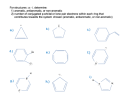 For structures: a.- 1. determine: 1) aromatic, antiaromatic, or non-aromatic 2) number of conjugated p-orbital or lone pair electrons within each ring that contributes towards the system chosen (aromatic, antiaromatic, or non-aromatic) e.) "O "
please help in all sections asap!! Identify whether the compound will be aromatic, nonaromatic, or antiaromatic....
 please help in all sections asap!!
Identify whether the compound will be aromatic, nonaromatic, or antiaromatic. Aromatic Nonaromatic Antiaromatic Choose the correct reason from the below options. This structure contains 20 x electrons. This structure exhibits a ring of continuously overlapping p orbitals, and there are 22 i electrons. In this structure, the ring does not possess a continuously overlapping p orbitals. Propose an efficient synthesis for the following transformation. Choose the correct reagents listed in the table below. 1)...
please help in all sections asap!!
Identify whether the compound will be aromatic, nonaromatic, or antiaromatic. Aromatic Nonaromatic Antiaromatic Choose the correct reason from the below options. This structure contains 20 x electrons. This structure exhibits a ring of continuously overlapping p orbitals, and there are 22 i electrons. In this structure, the ring does not possess a continuously overlapping p orbitals. Propose an efficient synthesis for the following transformation. Choose the correct reagents listed in the table below. 1)...
Aromaticity Worksheet CHEM 2410 Fall 2019 Determine if the following compounds are aromatic, anti-aromatic or non-...
 Aromaticity Worksheet CHEM 2410 Fall 2019 Determine if the following compounds are aromatic, anti-aromatic or non-aromatic. Give reasons for your answer. ***Assume all the cyclic compounds are planar (flat) for these problems. Summary Notes: Aromatic - 4n+2 pi electrons, complete cyclic conjugated pi system and planar (flat) Anti-aromatic - 4n pi electrons, ccyclic conjugated pi system and planar(flat) Non-aromatic - breaks any of the above rules (all other compounds) Sp3 hybridized heteroatoms (O, S, N) are involved in the pi...
please help in all sections asap!!!! What is the major product of the following reaction sequence?...
 please help in all sections asap!!!!
What is the major product of the following reaction sequence? 1) NBS (one equiv.), heat 2) t-BuOK The lone pairs on pyrimidine (structure below) are not delocalized because of which factor? The lone pairs are in sp orbitals. The lone pairs are in sp orbitals. The lone pairs are in orbitals at 90 degrees to the pi system. None of the above. Choose the five different acceptable IUPAC names for the following compound. meta-dimethylbenzene...
please help in all sections asap!!!!
What is the major product of the following reaction sequence? 1) NBS (one equiv.), heat 2) t-BuOK The lone pairs on pyrimidine (structure below) are not delocalized because of which factor? The lone pairs are in sp orbitals. The lone pairs are in sp orbitals. The lone pairs are in orbitals at 90 degrees to the pi system. None of the above. Choose the five different acceptable IUPAC names for the following compound. meta-dimethylbenzene...
please help in all sections asap! The following two drawings are resonance structures of one compound....
 please help in all sections asap!
The following two drawings are resonance structures of one compound. a-o But the following two drawings are not resonance structures Not resonance structures They are, in fact, two different compounds. Choose the correct explanation(s). Select all that apply. Benzene does not have three C-C single bond and three C-C double bonds. In fact, all six C-C bonds of the ring have the same bond order and same length. Benzene have three C- single bond...
please help in all sections asap!
The following two drawings are resonance structures of one compound. a-o But the following two drawings are not resonance structures Not resonance structures They are, in fact, two different compounds. Choose the correct explanation(s). Select all that apply. Benzene does not have three C-C single bond and three C-C double bonds. In fact, all six C-C bonds of the ring have the same bond order and same length. Benzene have three C- single bond...
Which of the following compounds are aromatic? 25. NH2 N: Which of the following structures, if flat, would be classified as antiaromatic? 26. HN 11 and Ⅳ (C) IV and V (D) only Ⅳ (B) only 11 (A)...
 Which of the following compounds are aromatic? 25. NH2 N: Which of the following structures, if flat, would be classified as antiaromatic? 26. HN 11 and Ⅳ (C) IV and V (D) only Ⅳ (B) only 11 (A) l and 111 Which nitrogen atoms are basic? 27. (A) 1 and 3(B) 2 and 4 H. (D)2,4,and5 (C) 1,3, and5 Nitrogen's lone pair electrons occupy what type of orbital in pyridine? 28. (A)s (B)p () sp(D)sp (E) sp
Which of the...
Which of the following compounds are aromatic? 25. NH2 N: Which of the following structures, if flat, would be classified as antiaromatic? 26. HN 11 and Ⅳ (C) IV and V (D) only Ⅳ (B) only 11 (A) l and 111 Which nitrogen atoms are basic? 27. (A) 1 and 3(B) 2 and 4 H. (D)2,4,and5 (C) 1,3, and5 Nitrogen's lone pair electrons occupy what type of orbital in pyridine? 28. (A)s (B)p () sp(D)sp (E) sp
Which of the...
please help in all sections asap!! Which type of electron is the highest in energy? An electron in an an...
 please help in all sections asap!!
Which type of electron is the highest in energy? An electron in an anti-bonding molecular orbital. An electron in a bonding molecular orbital. An electron in an atomic orbital. O A non-bonding electron. Choose a systematic name for the following compound. 1,4 dimethyl ethyl benzene 1,4 diethyl methyl benzene 1,4-diisopropylbenzene 1,4 dipropylbenzene Answer the following questions. -OR Would you expect the above compound to be aromatic? Yes No Choose the correct explanations for the...
please help in all sections asap!!
Which type of electron is the highest in energy? An electron in an anti-bonding molecular orbital. An electron in a bonding molecular orbital. An electron in an atomic orbital. O A non-bonding electron. Choose a systematic name for the following compound. 1,4 dimethyl ethyl benzene 1,4 diethyl methyl benzene 1,4-diisopropylbenzene 1,4 dipropylbenzene Answer the following questions. -OR Would you expect the above compound to be aromatic? Yes No Choose the correct explanations for the...
please help in all questions!! Which of the molecules below is the expected major product of...
 please help in all questions!!
Which of the molecules below is the expected major product of the following reduction? Na, NH3) Н H Н нн H H For the given compounds answer the following. Compound A Compound B Compound C Identify which compound is expected to be most acidic. Compound A Compound B Compound C Choose the correct option to justify your choice. ODeprotonation of the compound generates an antiaromatic lon. Deprotonation of the compound generates an aromatic ion. Deprotonation...
please help in all questions!!
Which of the molecules below is the expected major product of the following reduction? Na, NH3) Н H Н нн H H For the given compounds answer the following. Compound A Compound B Compound C Identify which compound is expected to be most acidic. Compound A Compound B Compound C Choose the correct option to justify your choice. ODeprotonation of the compound generates an antiaromatic lon. Deprotonation of the compound generates an aromatic ion. Deprotonation...
Due 462 CHAPTER 1O Stracture and Symthesis of Alcohols mercaptan (thiol) The sulfur analogse of an...
 Due 462 CHAPTER 1O Stracture and Symthesis of Alcohols mercaptan (thiol) The sulfur analogse of an alcobol, R-SH. (p 455) futually sobuble in any proportions. (p 432 An organiietallic peapont of the form R-Li. Ip.44n organometallic reagents) Compounds containing metal atoms carbon. (p. 440) organolithium reagent Raney nickel with a hydeosyl group bonded directly to an aromatic ring. up. 426) A finely divided nickel/aluminum alloy that has been treated with N a0H to dissoive out 451ed as a catalyst for...
VSEPR Objective : This lab is to study the shape and polarity of molecules using VSEPR theory with emphasis on sigma bon...
VSEPR Objective : This lab is to study the shape and polarity of molecules using VSEPR theory with emphasis on sigma bonds (Part 1) and pi bonds and resonance (Part 2) Procedures: Nothing to do before the lab. We are making the models together in class. Prelab Questions : PART 1: (PL1) Draw the Lewis dot structure of each compound (as having covalent bonds). (a) BeH2 (b) BH3 (c) GeH2 (d) CH4 (e) NH3 (f) H2O (g) PCl5 (h)...
 For structures: a.- 1. determine: 1) aromatic, antiaromatic, or non-aromatic 2) number of conjugated p-orbital or lone pair electrons within each ring that contributes towards the system chosen (aromatic, antiaromatic, or non-aromatic) e.) "O "
 please help in all sections asap!!
Identify whether the compound will be aromatic, nonaromatic, or antiaromatic. Aromatic Nonaromatic Antiaromatic Choose the correct reason from the below options. This structure contains 20 x electrons. This structure exhibits a ring of continuously overlapping p orbitals, and there are 22 i electrons. In this structure, the ring does not possess a continuously overlapping p orbitals. Propose an efficient synthesis for the following transformation. Choose the correct reagents listed in the table below. 1)...
please help in all sections asap!!
Identify whether the compound will be aromatic, nonaromatic, or antiaromatic. Aromatic Nonaromatic Antiaromatic Choose the correct reason from the below options. This structure contains 20 x electrons. This structure exhibits a ring of continuously overlapping p orbitals, and there are 22 i electrons. In this structure, the ring does not possess a continuously overlapping p orbitals. Propose an efficient synthesis for the following transformation. Choose the correct reagents listed in the table below. 1)...
 Aromaticity Worksheet CHEM 2410 Fall 2019 Determine if the following compounds are aromatic, anti-aromatic or non-aromatic. Give reasons for your answer. ***Assume all the cyclic compounds are planar (flat) for these problems. Summary Notes: Aromatic - 4n+2 pi electrons, complete cyclic conjugated pi system and planar (flat) Anti-aromatic - 4n pi electrons, ccyclic conjugated pi system and planar(flat) Non-aromatic - breaks any of the above rules (all other compounds) Sp3 hybridized heteroatoms (O, S, N) are involved in the pi...
 please help in all sections asap!!!!
What is the major product of the following reaction sequence? 1) NBS (one equiv.), heat 2) t-BuOK The lone pairs on pyrimidine (structure below) are not delocalized because of which factor? The lone pairs are in sp orbitals. The lone pairs are in sp orbitals. The lone pairs are in orbitals at 90 degrees to the pi system. None of the above. Choose the five different acceptable IUPAC names for the following compound. meta-dimethylbenzene...
please help in all sections asap!!!!
What is the major product of the following reaction sequence? 1) NBS (one equiv.), heat 2) t-BuOK The lone pairs on pyrimidine (structure below) are not delocalized because of which factor? The lone pairs are in sp orbitals. The lone pairs are in sp orbitals. The lone pairs are in orbitals at 90 degrees to the pi system. None of the above. Choose the five different acceptable IUPAC names for the following compound. meta-dimethylbenzene...
 please help in all sections asap!
The following two drawings are resonance structures of one compound. a-o But the following two drawings are not resonance structures Not resonance structures They are, in fact, two different compounds. Choose the correct explanation(s). Select all that apply. Benzene does not have three C-C single bond and three C-C double bonds. In fact, all six C-C bonds of the ring have the same bond order and same length. Benzene have three C- single bond...
please help in all sections asap!
The following two drawings are resonance structures of one compound. a-o But the following two drawings are not resonance structures Not resonance structures They are, in fact, two different compounds. Choose the correct explanation(s). Select all that apply. Benzene does not have three C-C single bond and three C-C double bonds. In fact, all six C-C bonds of the ring have the same bond order and same length. Benzene have three C- single bond...
 Which of the following compounds are aromatic? 25. NH2 N: Which of the following structures, if flat, would be classified as antiaromatic? 26. HN 11 and Ⅳ (C) IV and V (D) only Ⅳ (B) only 11 (A) l and 111 Which nitrogen atoms are basic? 27. (A) 1 and 3(B) 2 and 4 H. (D)2,4,and5 (C) 1,3, and5 Nitrogen's lone pair electrons occupy what type of orbital in pyridine? 28. (A)s (B)p () sp(D)sp (E) sp
Which of the...
Which of the following compounds are aromatic? 25. NH2 N: Which of the following structures, if flat, would be classified as antiaromatic? 26. HN 11 and Ⅳ (C) IV and V (D) only Ⅳ (B) only 11 (A) l and 111 Which nitrogen atoms are basic? 27. (A) 1 and 3(B) 2 and 4 H. (D)2,4,and5 (C) 1,3, and5 Nitrogen's lone pair electrons occupy what type of orbital in pyridine? 28. (A)s (B)p () sp(D)sp (E) sp
Which of the...
 please help in all sections asap!!
Which type of electron is the highest in energy? An electron in an anti-bonding molecular orbital. An electron in a bonding molecular orbital. An electron in an atomic orbital. O A non-bonding electron. Choose a systematic name for the following compound. 1,4 dimethyl ethyl benzene 1,4 diethyl methyl benzene 1,4-diisopropylbenzene 1,4 dipropylbenzene Answer the following questions. -OR Would you expect the above compound to be aromatic? Yes No Choose the correct explanations for the...
please help in all sections asap!!
Which type of electron is the highest in energy? An electron in an anti-bonding molecular orbital. An electron in a bonding molecular orbital. An electron in an atomic orbital. O A non-bonding electron. Choose a systematic name for the following compound. 1,4 dimethyl ethyl benzene 1,4 diethyl methyl benzene 1,4-diisopropylbenzene 1,4 dipropylbenzene Answer the following questions. -OR Would you expect the above compound to be aromatic? Yes No Choose the correct explanations for the...
 please help in all questions!!
Which of the molecules below is the expected major product of the following reduction? Na, NH3) Н H Н нн H H For the given compounds answer the following. Compound A Compound B Compound C Identify which compound is expected to be most acidic. Compound A Compound B Compound C Choose the correct option to justify your choice. ODeprotonation of the compound generates an antiaromatic lon. Deprotonation of the compound generates an aromatic ion. Deprotonation...
please help in all questions!!
Which of the molecules below is the expected major product of the following reduction? Na, NH3) Н H Н нн H H For the given compounds answer the following. Compound A Compound B Compound C Identify which compound is expected to be most acidic. Compound A Compound B Compound C Choose the correct option to justify your choice. ODeprotonation of the compound generates an antiaromatic lon. Deprotonation of the compound generates an aromatic ion. Deprotonation...
 Due 462 CHAPTER 1O Stracture and Symthesis of Alcohols mercaptan (thiol) The sulfur analogse of an alcobol, R-SH. (p 455) futually sobuble in any proportions. (p 432 An organiietallic peapont of the form R-Li. Ip.44n organometallic reagents) Compounds containing metal atoms carbon. (p. 440) organolithium reagent Raney nickel with a hydeosyl group bonded directly to an aromatic ring. up. 426) A finely divided nickel/aluminum alloy that has been treated with N a0H to dissoive out 451ed as a catalyst for...
Most questions answered within 3 hours.
-
Where is the error in this code sequence?
String s1 = "Hello";
String s2 = "ello";...
asked 10 months ago -
Financial data for Joel de Paris, Inc., for last year
follow:
Joel de Paris, Inc.
Balance...
asked 10 months ago -
Consider this reaction:
Al2(SO4)3 (aq)+ BaCl3
(aq) Al2Cl6 (aq)- +
3BaSO4(s) . What is the...
asked 10 months ago -
Suppose that Savneet is considering increasing her
recent random sample from 20 car rentals to 40...
asked 10 months ago -
Trucks arrive at an unloading terminal at an average rate of 120
per hour.
Trucks arrive...
asked 10 months ago -
Why are methanol and ethanol completely soluble in water while
octanol is not very little soluble....
asked 10 months ago -
A facilities manager at a university reads in a research report
that the mean amount of...
asked 10 months ago -
When the CuSO4 is rehydrated by adding water to the anhydrous
compound, is this an endothermic...
asked 10 months ago -
A ray of sunlight is passing from diamond into crown glass; the
angle of incidence is...
asked 10 months ago -
A block of mass 0.249 kg is placed on top of a light, vertical
spring of...
asked 10 months ago -
how do the kidneys compensate in the presences of acidosis
a) trigger hyperventilate
b) reserve acid...
asked 10 months ago -
Question 501 pts
The rental rate of capital to the firm increases. Which of the
following...
asked 10 months ago