
Homework Answers
Transcription factors include wide range of DNA protein that regulates as well as initiates the transcription of genes , i.e. transcription factors are such proteins which assist in the process of converting or modifying (transcribing) a DNA into RNA. These proteins are sequence-specific DNA binding factors.
The two types of functional transcription factors are
- Constituitive transcription factor- these proteins are active proteins which are present in the nucleus and assist in turning 'on' of the transcription process.
- Regulatory transcription factor- these proteins are conditional transcription factors as these transcribe only in specific factors or conditions present in the cell.
The two structural domain of the transcription factor are
-DNA binding domain
-activator domain.
Add Answer to:
6. What are transcription factors and what are the two functional classes of transcription factor? What...
1.) Transcription a.) Every non-general transcription factor (e.g. CREB1) needs at least two functional domains to...
1.) Transcription a.) Every non-general transcription factor (e.g. CREB1) needs at least two functional domains to initiate transcription. Name and describe the function of these two domains. (15 words per domain)(10 points) b.) How is chromatin around active promoters different from a transcriptionally inactive areas of the genome? (30 words) (10 points) c.) TFIIH is a general transcription factor with Helicase and Kinase activity. Describe how these two activities assist RNA Pol II with transcription initiation? (30 words) (10 points)
Last week we discussed the role of general transcription factors in forming the transcription initiation complex...
Last week we discussed the role of general transcription factors in forming the transcription initiation complex in eukaryotes. Next week we will look more closely at the regulation of gene expression and the role played by specific transcription factors. Prokaryotes and eukaryotes utilize very different mechanisms for determining which genes are turned on and off and when. In lieu of the prokaryotic operon model, eukaryotes employ a combinatorics approach utilizing both general and specific transcription factors. For this week’s forum,...
List the two transcription factor classes that strictly use protein-protein interactions to stabilize the recognition helix...
List the two transcription factor classes that strictly use protein-protein interactions to stabilize the recognition helix in DNA? Need help please.
Two genes (B and C) are transcription factors that affect the expression of gene A. The...
Two genes (B and C) are transcription factors that affect the expression of gene A. The protein product of gene B allows gene A to be transcribed while the protein product of gene C doubles the rate of transcription of gene A. How does the expression of gene A differ between two individuals with the following genotypes? Assume lower case alleles produce non-functional proteins and each gene shows complete dominance. Individual 1: AA : BB : Cc Individual 2: AA...
What is the role of the transcription factors? A mutation exists in transcription factors that causes...
What is the role of the transcription factors? A mutation exists in transcription factors that causes them to bind slightly downstream of the TATA box, causing them to cover the first 3 nucleotides of a gene. RNA polymerase can still transcribe the gene to mRNA, but it misses the first 3 nucleotides. How would this impact translation?
6. The APOE protein is a type of protein that Regulates transcription (a transcription factor) Is...
 6. The APOE protein is a type of protein that Regulates transcription (a transcription factor) Is responsible for packaging cholesterol and other fat a. b. 7. For gene amplification using the PCR technique, Two primers are needed, and their sequence designs are customized based on the gene of interest. One primer is needed, and its sequence design is customized based on the gene of interest. Two primers are needed and are commercially available because all genes use the same primers....
What is the role of the transcription factors? A mutation exists in transcription factors that causes...
What is the role of the transcription factors? A mutation exists in transcription factors that causes them to bind slightly downstream of the TATA box, causing them to cover the first 3 nucleotides of a gene. RNA polymerase can still transcribe the gene to mRNA, but it misses the first 3 nucleotides. How would this impact translation? RNA is single stranded, and as such, undergoes rapid rates of mutation. How would this affect the ability of siRNAs to combat RNA...
QUESTION 1 Hox genes are genes that code for transcription factors. What do transcription factors do?...
QUESTION 1 Hox genes are genes that code for transcription factors. What do transcription factors do? A. Bind to DNA to make it available for transcription B. Make up specific body parts C. Activate ribosomes QUESTION 2 Genes that need to be turned on at the same time (for example, the genes that encode the proteins that build toes) will all respond to the same transcription factor. A. True B. False QUESTION 3 Hox genes are sometimes called "master switches"....
D Question 25 What does cell surface glycoprotein EP-cadherin interact with: Maternal factors O A transcription...
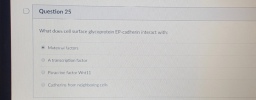 D Question 25 What does cell surface glycoprotein EP-cadherin interact with: Maternal factors O A transcription factor Paracrine factor Wnt11 Cadherins from ncighboring cells
Fill in the following chart with important factors and sequences required for pol I transcription. Then...
Fill in the following chart with important factors and sequences required for pol I transcription. Then complete the chart as if there was a mutation in that factor or sequence. Factor or Sequence Describe the consequences Universal or gene specific What would the RNA look like? Why? UCE UBF1 unable to bind Gene specific Same but lower levels Only basal transcription would occur
 6. The APOE protein is a type of protein that Regulates transcription (a transcription factor) Is responsible for packaging cholesterol and other fat a. b. 7. For gene amplification using the PCR technique, Two primers are needed, and their sequence designs are customized based on the gene of interest. One primer is needed, and its sequence design is customized based on the gene of interest. Two primers are needed and are commercially available because all genes use the same primers....
 D Question 25 What does cell surface glycoprotein EP-cadherin interact with: Maternal factors O A transcription factor Paracrine factor Wnt11 Cadherins from ncighboring cells
Most questions answered within 3 hours.
-
Where is the error in this code sequence?
String s1 = "Hello";
String s2 = "ello";...
asked 11 months ago -
Financial data for Joel de Paris, Inc., for last year
follow:
Joel de Paris, Inc.
Balance...
asked 11 months ago -
Consider this reaction:
Al2(SO4)3 (aq)+ BaCl3
(aq) Al2Cl6 (aq)- +
3BaSO4(s) . What is the...
asked 11 months ago -
Suppose that Savneet is considering increasing her
recent random sample from 20 car rentals to 40...
asked 11 months ago -
Trucks arrive at an unloading terminal at an average rate of 120
per hour.
Trucks arrive...
asked 11 months ago -
Why are methanol and ethanol completely soluble in water while
octanol is not very little soluble....
asked 11 months ago -
A facilities manager at a university reads in a research report
that the mean amount of...
asked 11 months ago -
When the CuSO4 is rehydrated by adding water to the anhydrous
compound, is this an endothermic...
asked 11 months ago -
A ray of sunlight is passing from diamond into crown glass; the
angle of incidence is...
asked 11 months ago -
A block of mass 0.249 kg is placed on top of a light, vertical
spring of...
asked 11 months ago -
how do the kidneys compensate in the presences of acidosis
a) trigger hyperventilate
b) reserve acid...
asked 11 months ago -
Question 501 pts
The rental rate of capital to the firm increases. Which of the
following...
asked 11 months ago