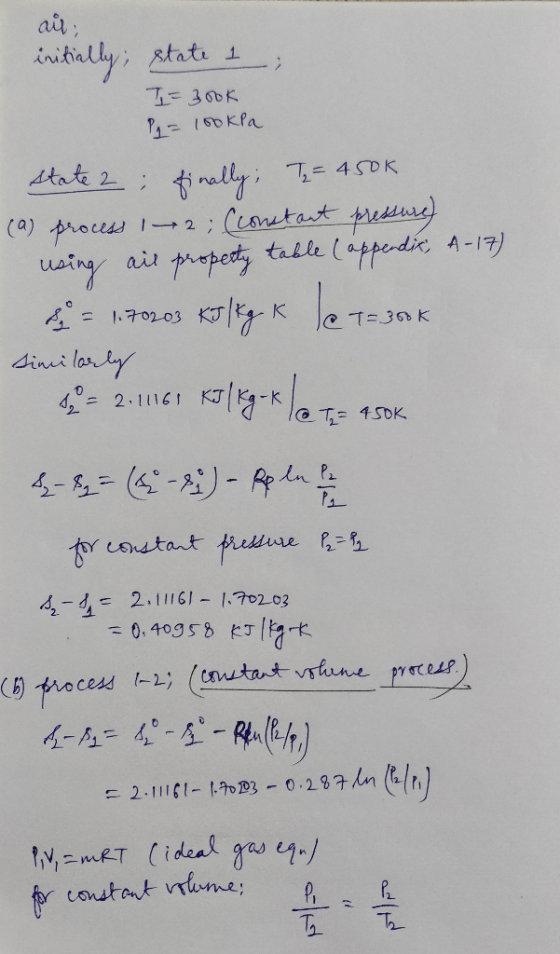
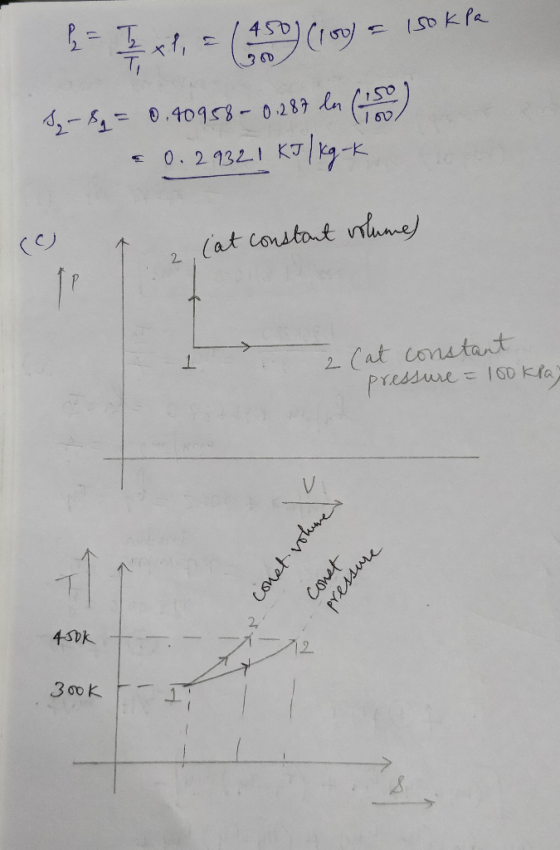
![Problem 1 [15 pts] Air (R=0.287 kJ/kgK), initially at 300 K and 100 kPa is heated to 450 K in an internally reversible closed](http://img.homeworklib.com/questions/fd0cc370-cb95-11eb-8301-53e28b9a47d0.png?x-oss-process=image/resize,w_560)
Homework Answers

Add Answer to:
Problem 1 [15 pts] Air (R=0.287 kJ/kgK), initially at 300 K and 100 kPa is heated...
0.15 kg of air in a frictionless piston cylinder at 100 kPa and 600 K is...
 0.15 kg of air in a frictionless piston cylinder at 100 kPa and 600 K is cooled to a final temperature of 25°C by heat rejection to the surroundings which are at a temperature of 25°C. (a) Show the process on a P-v diagram with lines of constant temperature, and on a T-s diagram with lines of constant pressure. (b) Determine the total work done and the total heat transfer for the process. (c) Calculate the entropy change for the...
1)(Hint: Cp=1.005 kJ/kg-K, Cv=0.718 kJ/kg-K, R=0.287 kJ/kg-K). An air-tight room contains 80 kg of air, and...
1)(Hint: Cp=1.005 kJ/kg-K, Cv=0.718 kJ/kg-K, R=0.287 kJ/kg-K). An air-tight room contains 80 kg of air, and a 2-kW baseboard electric resistance heater in the room is turned on and kept on for 15 min. The temperature rise of air at the end of 15 min is 2)An example of when it is appropriate to model a substance as an ideal gas is when a. The pressure and temperature are close to the critcal point b. The pressure and temperature are...
15-43.) Air undergoes an internally reversible adiabatic process from 200 kPa, 50°C to a final pressure...
 15-43.) Air undergoes an internally reversible adiabatic process from 200 kPa, 50°C to a final pressure of 2.5 MPa. Assuming ideal-gas behavior with constant spe- cific heats, calculate the temperature and the specific volume at the final state.
A piston-cylinder assembly initially contains 0.8 kg of air at 100 kPa and 300 K. It...
 A piston-cylinder assembly initially contains 0.8 kg of air at 100 kPa and 300 K. It is then compressed in a polytropic process PV3 = C to half the original volume. Assuming the ideal gas model for air and specific heat ratio is constant, k=1.4, determine (a) the final temperature, (b) work and heat transfer, each in kJ. R= 0.287 kJ/kg K. W, 82
7. An industrial turbine process requires a steady 0.5 kg/s of air at 200 kPa. This air is to be the exhaust from a...
 7. An industrial turbine process requires a steady 0.5 kg/s of air at 200 kPa. This air is to be the exhaust from a specially designed turbine with inlet state 400 kPa, 400 K. The heat transfer could be obtained from a source at 500 K if necessary. This process may be assumed to be reversible and the changes in kinetic and potential energy are negligible. Air is an ideal gas, with constant specific heats, using Table A.S (a) Which...
Problem 7: (15 pts) An ideal air-standard Brayton cycle operates steadily with pressure limits of the...
 Problem 7: (15 pts) An ideal air-standard Brayton cycle operates steadily with pressure limits of the cycle are 100 kPa and 800 kPa. The temperature at the exit of turbine is 500 K. During the heat rejection process, heat is released from the cycle at a rate of 320 kW and the mass flow rate is 2 kg/s. The air is treated as an ideal gas with constant specific heats, i.e. k = 1.4 and R = 0.287 kJ/(kg ·...
Air, initially at 300 K and 100 kPa, is compressed adiabatically in a steady flow compressor...
Air, initially at 300 K and 100 kPa, is compressed adiabatically in a steady flow compressor to 600 K and 500 kPa. a) Perform the necessary calculations to show that the process is irreversible b) Compare the change in energy carried by the air due to the process. Briefly comment. c)How would the comparison in part (b) look like if the process were reversible? TO answer this question, you can either use equations or briefly explain. d) Calculate the isentropic...
In an Otto cycle air is compressed from an initial pressure 120 kPa and temperature 370...
In an Otto cycle air is compressed from an initial pressure 120 kPa and temperature 370 T (K). The cycle has compression ratio of 10. In the constant volume heat addition process 1000 kJ/kg heat is added into the air. Considering variation on the specific heat of air with temperature, determine, (a) the pressure and temperature at the end of heat addition process (show the points on P-v diagram) (b) the network output (c) the thermal efficiency (d) the mean...
Problem 7-173- A piston–cylinder device contains air that undergoes a reversible thermodynamic cycle. Initially, air is...
Problem 7-173- A piston–cylinder device contains air that undergoes a reversible thermodynamic cycle. Initially, air is at 400 kPa and 300 K with a volume of 0.3 m3. Air is first expanded isothermally to 150 kPa, then compressed adiabatically to the initial pressure, and finally compressed at the constant pressure to the initial state. Accounting for the variation of specific heats with temperature, determine the work and heat transfer for each process.
 0.15 kg of air in a frictionless piston cylinder at 100 kPa and 600 K is cooled to a final temperature of 25°C by heat rejection to the surroundings which are at a temperature of 25°C. (a) Show the process on a P-v diagram with lines of constant temperature, and on a T-s diagram with lines of constant pressure. (b) Determine the total work done and the total heat transfer for the process. (c) Calculate the entropy change for the...
 15-43.) Air undergoes an internally reversible adiabatic process from 200 kPa, 50°C to a final pressure of 2.5 MPa. Assuming ideal-gas behavior with constant spe- cific heats, calculate the temperature and the specific volume at the final state.
 A piston-cylinder assembly initially contains 0.8 kg of air at 100 kPa and 300 K. It is then compressed in a polytropic process PV3 = C to half the original volume. Assuming the ideal gas model for air and specific heat ratio is constant, k=1.4, determine (a) the final temperature, (b) work and heat transfer, each in kJ. R= 0.287 kJ/kg K. W, 82
 7. An industrial turbine process requires a steady 0.5 kg/s of air at 200 kPa. This air is to be the exhaust from a specially designed turbine with inlet state 400 kPa, 400 K. The heat transfer could be obtained from a source at 500 K if necessary. This process may be assumed to be reversible and the changes in kinetic and potential energy are negligible. Air is an ideal gas, with constant specific heats, using Table A.S (a) Which...
 Problem 7: (15 pts) An ideal air-standard Brayton cycle operates steadily with pressure limits of the cycle are 100 kPa and 800 kPa. The temperature at the exit of turbine is 500 K. During the heat rejection process, heat is released from the cycle at a rate of 320 kW and the mass flow rate is 2 kg/s. The air is treated as an ideal gas with constant specific heats, i.e. k = 1.4 and R = 0.287 kJ/(kg ·...
Most questions answered within 3 hours.
-
Where is the error in this code sequence?
String s1 = "Hello";
String s2 = "ello";...
asked 11 months ago -
Financial data for Joel de Paris, Inc., for last year
follow:
Joel de Paris, Inc.
Balance...
asked 11 months ago -
Consider this reaction:
Al2(SO4)3 (aq)+ BaCl3
(aq) Al2Cl6 (aq)- +
3BaSO4(s) . What is the...
asked 11 months ago -
Suppose that Savneet is considering increasing her
recent random sample from 20 car rentals to 40...
asked 11 months ago -
Trucks arrive at an unloading terminal at an average rate of 120
per hour.
Trucks arrive...
asked 11 months ago -
Why are methanol and ethanol completely soluble in water while
octanol is not very little soluble....
asked 11 months ago -
A facilities manager at a university reads in a research report
that the mean amount of...
asked 11 months ago -
When the CuSO4 is rehydrated by adding water to the anhydrous
compound, is this an endothermic...
asked 11 months ago -
A ray of sunlight is passing from diamond into crown glass; the
angle of incidence is...
asked 11 months ago -
A block of mass 0.249 kg is placed on top of a light, vertical
spring of...
asked 11 months ago -
how do the kidneys compensate in the presences of acidosis
a) trigger hyperventilate
b) reserve acid...
asked 11 months ago -
Question 501 pts
The rental rate of capital to the firm increases. Which of the
following...
asked 11 months ago