
Homework Answers
Themechanism written in following reaction scheme
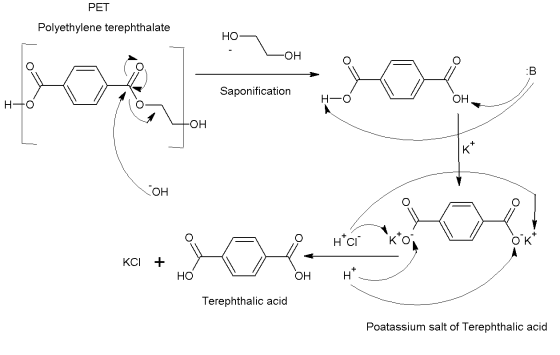
See the answer above
Add Answer to:
Draw the mechanism for this reaction?
HCl was used for the “work-up”
кон НЕО "Saponification" "Work-up"...
Hydrolysis of Polyethylene Terephthalate Although you used a base-catalyzed procedure for this hydrolysis, acid catalysis also...
Hydrolysis of Polyethylene Terephthalate Although you used a base-catalyzed procedure for this hydrolysis, acid catalysis also works well (as discussed in the text above). Draw a complete step-by-step mechanism showing how acid catalysis would promote the reaction. Would a work-up be required after hydrolysis? If so, provide a proposed work-up.
Discuss the purpose of the reaction. Discuss the function of the reagents used and what you...
 Discuss the purpose of the reaction. Discuss the function of the
reagents used and what you are monitoring in that reaction.
JVCUDDL/64/1/649?response-content-dispositioninline Introduction: It is estimated that approximately 150 million metric tons of plastics are currently circulating in our global system of oceans and waterways. This seems like a fairly generic "big! number", and it's difficult to understand the scale of the problem without converting it to something more relatable. A standard empty plastic water bottle weighs approximately 12.7 g....
Discuss the purpose of the reaction. Discuss the function of the
reagents used and what you are monitoring in that reaction.
JVCUDDL/64/1/649?response-content-dispositioninline Introduction: It is estimated that approximately 150 million metric tons of plastics are currently circulating in our global system of oceans and waterways. This seems like a fairly generic "big! number", and it's difficult to understand the scale of the problem without converting it to something more relatable. A standard empty plastic water bottle weighs approximately 12.7 g....
Experiment #6: Saponification of Wintergreen Oil 1.) Draw a reaction mechanism for the conversion of wintergreen...
Experiment #6: Saponification of Wintergreen Oil 1.) Draw a reaction mechanism for the conversion of wintergreen oil into salicylic acid. 2. ) If you wanted to take an IR spectrum to confirm that the reaction worked, what would you look for in the spectrum? 3.) It is also possible to hydrolyze an ester under acidic conditions. Draw a mechanism for the acid-catalyzed conversion of wintergreen oil to salicylic acid.
Saponification of triglycerides II. Saponification of triglycerides 1. Draw the reaction for the saponification of a...
 Saponification of
triglycerides
II. Saponification of triglycerides 1. Draw the reaction for the saponification of a triglyceride with NaOH that contains palmitic acid, stearic acid and linoleic acid:
Saponification of
triglycerides
II. Saponification of triglycerides 1. Draw the reaction for the saponification of a triglyceride with NaOH that contains palmitic acid, stearic acid and linoleic acid:
Which one of the following structures is an intermediate in the mechanism of the following reaction?...
 Which one of the following structures is an intermediate in the mechanism of the following reaction? OH A) B) H2SO4 H20 OH ОН C) D) Which one of the following structures is an intermediate in the mechanism of the following reaction? НО. ОН ОН А) B) 1) Кон, Н-0, heat 2) dl. aq Hсі Он но ТОН НО он НО C) D)
C. Review of Lipids 6. Draw the complete reaction for the hydrogenation and saponification of the...
 C. Review of Lipids 6. Draw the complete reaction for the hydrogenation and saponification of the triacylglycerol below. Make sure you the reaction is balanced. HC I Hydrogenation reaction using 2 moles of H (9) banoro Saponification reaction os c) a cyclic secondary alcohol biolo wolvo Mode ostin obrolan insand word do Ya d) a tertiary amine that contains no more than 4 carbons. (0) Holmsgniew more nownegosby e) the aromatic isomers of an aromatic ring that contains one hydroxyl...
Mechanism #2. The hydrolysis of esters using base (typically NaOH) is termed "saponification", and is often...
 Mechanism #2. The hydrolysis of esters using base (typically NaOH) is termed "saponification", and is often used to make soaps. Propose a mechanism for the saponification reaction shown below. Remember, hydroxide is a strong nucleophile. OH H20 HO
Mechanism #2. The hydrolysis of esters using base (typically NaOH) is termed "saponification", and is often...
 Mechanism #2. The hydrolysis of esters using base (typically NaOH) is termed "saponification", and is often used to make soaps. Propose a mechanism for the saponification reaction shown below. Remember, hydroxide is a strong nucleophile. & hand "OH H20 HO
For the following saponification reaction, propose a mechanism. Provide the structures of the three intermediates and...
 For the following saponification reaction, propose a mechanism.
Provide the structures of the three intermediates and two
products.
CH2CH2CH.COOCH CH3 + NaOH HO Intermediate 1 Intermediate(s) 2
For the following saponification reaction, propose a mechanism.
Provide the structures of the three intermediates and two
products.
CH2CH2CH.COOCH CH3 + NaOH HO Intermediate 1 Intermediate(s) 2
1) Complete the reaction and draw the mechanism 0 [H*) -H,O кон / Heat ETTI Н,0...
 1) Complete the reaction and draw the mechanism 0 [H*) -H,O кон / Heat ETTI Н,0 HANT
 Discuss the purpose of the reaction. Discuss the function of the
reagents used and what you are monitoring in that reaction.
JVCUDDL/64/1/649?response-content-dispositioninline Introduction: It is estimated that approximately 150 million metric tons of plastics are currently circulating in our global system of oceans and waterways. This seems like a fairly generic "big! number", and it's difficult to understand the scale of the problem without converting it to something more relatable. A standard empty plastic water bottle weighs approximately 12.7 g....
Discuss the purpose of the reaction. Discuss the function of the
reagents used and what you are monitoring in that reaction.
JVCUDDL/64/1/649?response-content-dispositioninline Introduction: It is estimated that approximately 150 million metric tons of plastics are currently circulating in our global system of oceans and waterways. This seems like a fairly generic "big! number", and it's difficult to understand the scale of the problem without converting it to something more relatable. A standard empty plastic water bottle weighs approximately 12.7 g....
 Saponification of
triglycerides
II. Saponification of triglycerides 1. Draw the reaction for the saponification of a triglyceride with NaOH that contains palmitic acid, stearic acid and linoleic acid:
Saponification of
triglycerides
II. Saponification of triglycerides 1. Draw the reaction for the saponification of a triglyceride with NaOH that contains palmitic acid, stearic acid and linoleic acid:
 Which one of the following structures is an intermediate in the mechanism of the following reaction? OH A) B) H2SO4 H20 OH ОН C) D) Which one of the following structures is an intermediate in the mechanism of the following reaction? НО. ОН ОН А) B) 1) Кон, Н-0, heat 2) dl. aq Hсі Он но ТОН НО он НО C) D)
 C. Review of Lipids 6. Draw the complete reaction for the hydrogenation and saponification of the triacylglycerol below. Make sure you the reaction is balanced. HC I Hydrogenation reaction using 2 moles of H (9) banoro Saponification reaction os c) a cyclic secondary alcohol biolo wolvo Mode ostin obrolan insand word do Ya d) a tertiary amine that contains no more than 4 carbons. (0) Holmsgniew more nownegosby e) the aromatic isomers of an aromatic ring that contains one hydroxyl...
 Mechanism #2. The hydrolysis of esters using base (typically NaOH) is termed "saponification", and is often used to make soaps. Propose a mechanism for the saponification reaction shown below. Remember, hydroxide is a strong nucleophile. OH H20 HO
 Mechanism #2. The hydrolysis of esters using base (typically NaOH) is termed "saponification", and is often used to make soaps. Propose a mechanism for the saponification reaction shown below. Remember, hydroxide is a strong nucleophile. & hand "OH H20 HO
 For the following saponification reaction, propose a mechanism.
Provide the structures of the three intermediates and two
products.
CH2CH2CH.COOCH CH3 + NaOH HO Intermediate 1 Intermediate(s) 2
For the following saponification reaction, propose a mechanism.
Provide the structures of the three intermediates and two
products.
CH2CH2CH.COOCH CH3 + NaOH HO Intermediate 1 Intermediate(s) 2
 1) Complete the reaction and draw the mechanism 0 [H*) -H,O кон / Heat ETTI Н,0 HANT
Most questions answered within 3 hours.
-
Where is the error in this code sequence?
String s1 = "Hello";
String s2 = "ello";...
asked 11 months ago -
Financial data for Joel de Paris, Inc., for last year
follow:
Joel de Paris, Inc.
Balance...
asked 11 months ago -
Consider this reaction:
Al2(SO4)3 (aq)+ BaCl3
(aq) Al2Cl6 (aq)- +
3BaSO4(s) . What is the...
asked 11 months ago -
Suppose that Savneet is considering increasing her
recent random sample from 20 car rentals to 40...
asked 11 months ago -
Trucks arrive at an unloading terminal at an average rate of 120
per hour.
Trucks arrive...
asked 11 months ago -
Why are methanol and ethanol completely soluble in water while
octanol is not very little soluble....
asked 11 months ago -
A facilities manager at a university reads in a research report
that the mean amount of...
asked 11 months ago -
When the CuSO4 is rehydrated by adding water to the anhydrous
compound, is this an endothermic...
asked 11 months ago -
A ray of sunlight is passing from diamond into crown glass; the
angle of incidence is...
asked 11 months ago -
A block of mass 0.249 kg is placed on top of a light, vertical
spring of...
asked 11 months ago -
how do the kidneys compensate in the presences of acidosis
a) trigger hyperventilate
b) reserve acid...
asked 11 months ago -
Question 501 pts
The rental rate of capital to the firm increases. Which of the
following...
asked 11 months ago