The switch moves from open to close at t=0. Use your
knowledge of first order circuits to find v(t) for
t>0. Show all hand calculations below. Attach graph of
v(t).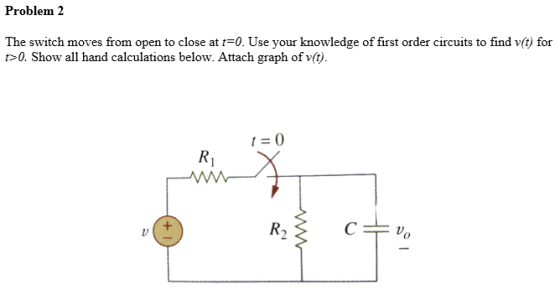
Homework Answers
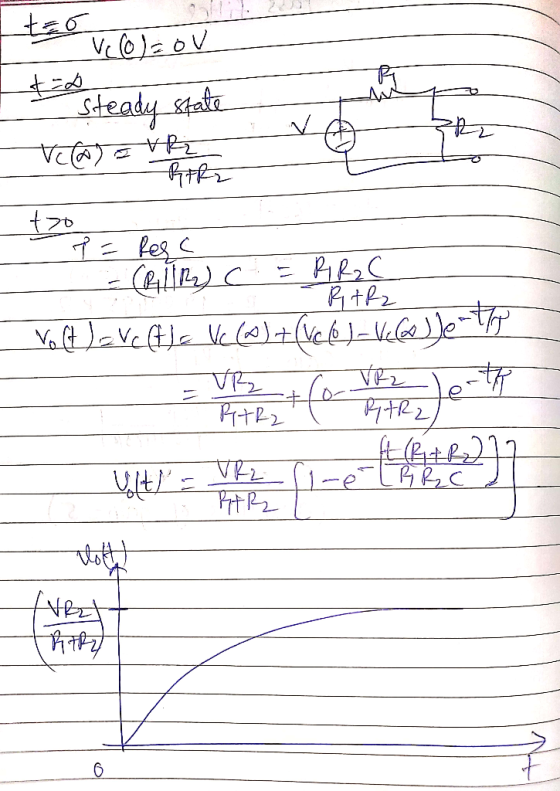
Add Answer to:
The switch moves from open to close at t=0. Use your
knowledge of first order circuits...
First Order Circuits 263 14 The switch was closed for a long time and opened at...
 First Order Circuits 263 14 The switch was closed for a long time and opened at t - closed for a long time and opened at t 11.4 Th O, find the voltage v, for t >0 in the circuit 0, find the voltage vo for t>0 in the circuit shown in Figure 11-35. 6 V Vo(t) FIGURE 11-35: Circuit schematic for problem 11.4.
2 First-Order RC Circuit: Natural Response The switch in the circuit in Figure 2 has been...
 2 First-Order RC Circuit: Natural Response The switch in the circuit in Figure 2 has been in position for a long time. At t = 0, the switch moves to position (the switch opens) and stays there. Assuming that V. > O for the constant voltage source, (a) find vc(0-), vc(0+), ic(0-), and ic(0+); (b) find vc(t) when t 20 (if you want, you can write vo(t) by circuit inspection; you don't need to show the differential equation); and (c)...
First-order circuits For the circuit shown below, the switch has been closed for a long time...
 First-order circuits For the circuit shown below, the switch has been closed for a long time and it is opened at t = 0. Calculate the capacitor voltage, v(t) for all t. 6.2 30V V 2F !
Q5) In the circuit below the switch S, has been in open position for t <...
 Q5) In the circuit below the switch S, has been in open position for t < 0 for a long time, but it closes at t = 0. Find the capacitor voltage (Vc) for t <0 and t > 0. C1 Vs +L S1 R2 V = 10 V 1s = 1 A R= 20 R = 40 R1 w CSF
circuits urgent help Q3. In the circuit in Figure 3, the switch S has been open...
 circuits urgent help
Q3. In the circuit in Figure 3, the switch S has been open for a very long time. It is closed at t= 0. (a) Find the current i(t) through the inductor for t2 0. (15 pts) (b) Find the voltage volt) for all t (i.e. for -- <t<5). (10 pts) 102 20 2 Vo t = 0 S + 50 V 0.100 50 mH
circuits urgent help
Q3. In the circuit in Figure 3, the switch S has been open for a very long time. It is closed at t= 0. (a) Find the current i(t) through the inductor for t2 0. (15 pts) (b) Find the voltage volt) for all t (i.e. for -- <t<5). (10 pts) 102 20 2 Vo t = 0 S + 50 V 0.100 50 mH
1. RLC Circuits Revisited. The first example of a RLC circuit illustrates the use of circuit...
 1. RLC Circuits Revisited. The first example of a RLC circuit illustrates the use of circuit elements in the s domain to represent initial conditions and a forced response. Next an example of sinusoidal excitation will follow where the transient response and steady state response are combined into one response waveform.. Transient RLC Circuit with Initial Conditions. Consider the RLC circuit below in Figure 7.14 which has two DC sources (Vco and V) applied before and after a switch is...
The switch in the figure given below moves from position 1 to position 2 at t...
 The switch in the figure given below moves from position 1 to position 2 at t = 0. Find v(t), for all t> 0. Assume: V1 = 18 V. t=0 + 2 + V 10 mF ע 0.25 H The value of v(t) = (Click to select) |t)] u(t) V.
9. The switch in the circuit below is at first open, but at t-0, it is...
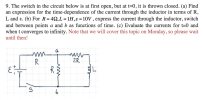 9. The switch in the circuit below is at first open, but at t-0, it is thrown closed. (a) Find an expression for the time-dependence of the current through the inductor in terms of R, L and e. (b) For R 42,L 1H,E 10V, express the current through the inductor, switch and between points a and b as functions of time. (c) Evaluate the currents for t-0 and when t converges to infinity. Note that we will cover this topic...
Problem 4 = 20A Find i(t) and v(t) for t > 0 in the circuit below...
 Problem 4 = 20A Find i(t) and v(t) for t > 0 in the circuit below if i(0) 2 H 202 5Ω v(t) 1Ω Problem 5 If the switch in circuit below has been open for a long time and is closed at t = 0, find vo(t) a. Suppose that the switch has been closed for a long time and is opened at t = 0. Find vo(t). b. t = 0 2Ω WW 3 F 4Ω 18 V
Solve for I.(t) fort >0 as the switch moves from 20 V voltage source to 150...
 Solve for I.(t) fort >0 as the switch moves from 20 V voltage source to 150 mA current source for t>0. t=0 R=2000 IL R2 Vs1 20V 10uF 100 L (1/4.1) H 150 mA
 First Order Circuits 263 14 The switch was closed for a long time and opened at t - closed for a long time and opened at t 11.4 Th O, find the voltage v, for t >0 in the circuit 0, find the voltage vo for t>0 in the circuit shown in Figure 11-35. 6 V Vo(t) FIGURE 11-35: Circuit schematic for problem 11.4.
 2 First-Order RC Circuit: Natural Response The switch in the circuit in Figure 2 has been in position for a long time. At t = 0, the switch moves to position (the switch opens) and stays there. Assuming that V. > O for the constant voltage source, (a) find vc(0-), vc(0+), ic(0-), and ic(0+); (b) find vc(t) when t 20 (if you want, you can write vo(t) by circuit inspection; you don't need to show the differential equation); and (c)...
 First-order circuits For the circuit shown below, the switch has been closed for a long time and it is opened at t = 0. Calculate the capacitor voltage, v(t) for all t. 6.2 30V V 2F !
 Q5) In the circuit below the switch S, has been in open position for t < 0 for a long time, but it closes at t = 0. Find the capacitor voltage (Vc) for t <0 and t > 0. C1 Vs +L S1 R2 V = 10 V 1s = 1 A R= 20 R = 40 R1 w CSF
 circuits urgent help
Q3. In the circuit in Figure 3, the switch S has been open for a very long time. It is closed at t= 0. (a) Find the current i(t) through the inductor for t2 0. (15 pts) (b) Find the voltage volt) for all t (i.e. for -- <t<5). (10 pts) 102 20 2 Vo t = 0 S + 50 V 0.100 50 mH
circuits urgent help
Q3. In the circuit in Figure 3, the switch S has been open for a very long time. It is closed at t= 0. (a) Find the current i(t) through the inductor for t2 0. (15 pts) (b) Find the voltage volt) for all t (i.e. for -- <t<5). (10 pts) 102 20 2 Vo t = 0 S + 50 V 0.100 50 mH
 1. RLC Circuits Revisited. The first example of a RLC circuit illustrates the use of circuit elements in the s domain to represent initial conditions and a forced response. Next an example of sinusoidal excitation will follow where the transient response and steady state response are combined into one response waveform.. Transient RLC Circuit with Initial Conditions. Consider the RLC circuit below in Figure 7.14 which has two DC sources (Vco and V) applied before and after a switch is...
 The switch in the figure given below moves from position 1 to position 2 at t = 0. Find v(t), for all t> 0. Assume: V1 = 18 V. t=0 + 2 + V 10 mF ע 0.25 H The value of v(t) = (Click to select) |t)] u(t) V.
 9. The switch in the circuit below is at first open, but at t-0, it is thrown closed. (a) Find an expression for the time-dependence of the current through the inductor in terms of R, L and e. (b) For R 42,L 1H,E 10V, express the current through the inductor, switch and between points a and b as functions of time. (c) Evaluate the currents for t-0 and when t converges to infinity. Note that we will cover this topic...
 Problem 4 = 20A Find i(t) and v(t) for t > 0 in the circuit below if i(0) 2 H 202 5Ω v(t) 1Ω Problem 5 If the switch in circuit below has been open for a long time and is closed at t = 0, find vo(t) a. Suppose that the switch has been closed for a long time and is opened at t = 0. Find vo(t). b. t = 0 2Ω WW 3 F 4Ω 18 V
 Solve for I.(t) fort >0 as the switch moves from 20 V voltage source to 150 mA current source for t>0. t=0 R=2000 IL R2 Vs1 20V 10uF 100 L (1/4.1) H 150 mA
Most questions answered within 3 hours.
-
Where is the error in this code sequence?
String s1 = "Hello";
String s2 = "ello";...
asked 11 months ago -
Financial data for Joel de Paris, Inc., for last year
follow:
Joel de Paris, Inc.
Balance...
asked 11 months ago -
Consider this reaction:
Al2(SO4)3 (aq)+ BaCl3
(aq) Al2Cl6 (aq)- +
3BaSO4(s) . What is the...
asked 11 months ago -
Suppose that Savneet is considering increasing her
recent random sample from 20 car rentals to 40...
asked 11 months ago -
Trucks arrive at an unloading terminal at an average rate of 120
per hour.
Trucks arrive...
asked 11 months ago -
Why are methanol and ethanol completely soluble in water while
octanol is not very little soluble....
asked 11 months ago -
A facilities manager at a university reads in a research report
that the mean amount of...
asked 11 months ago -
When the CuSO4 is rehydrated by adding water to the anhydrous
compound, is this an endothermic...
asked 11 months ago -
A ray of sunlight is passing from diamond into crown glass; the
angle of incidence is...
asked 11 months ago -
A block of mass 0.249 kg is placed on top of a light, vertical
spring of...
asked 11 months ago -
how do the kidneys compensate in the presences of acidosis
a) trigger hyperventilate
b) reserve acid...
asked 11 months ago -
Question 501 pts
The rental rate of capital to the firm increases. Which of the
following...
asked 11 months ago