
Homework Answers

Add Answer to:
13. The amino acid histidine, Hist, is essential to the functioning of many proteins because it,...
2. Histidine is an amino acid important for tissue growth and repair. Histidine is metabolized by the body to produce h...
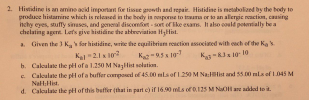 2. Histidine is an amino acid important for tissue growth and repair. Histidine is metabolized by the body to produce histamine which is released in the body in response to trauma or to an allergic reaction, causing itchy eyes, stuffy sinuses, and general discomfort - sort of like exams. It also could potentially be a chelating agent. Let's give histidine the abbreviation Hz Hist. a. Given the 3 Kg 's for histidine, write the equilibrium reaction associated with each of...
20. Properties of a Buffer The amino acid glycine is often used as the main ingredient...
 20. Properties of a Buffer The amino acid glycine is often used as the main ingredient of a buffer in biochemical experi- ments. The amino group of glycine, which has a pKa of 9.6, can exist either in the protonated form (-NH3 or as the free base (-NH2), because of the reversible equilibrium (a) In what pH range can glycine be used as an effective buffer due to its amino group? (b) In a 0.1 M solution of glycine at...
find pH is this right im confusing myself a bit we ? for calculehen Calculated pH...
 find pH
is this right im confusing myself a bit
we ? for calculehen Calculated pH Measured pH 4.54 deionized water should be 7 40 mL DI water + 1.0 mL of 6.0 M HCl(aq) 40 mL DI water + 1.0 mL of 6.0 M NaOH(aq) 1.57 11.93 Compare the change in pH you observed when 1.0 mL of 6.0 M HCl is added to 40 mL of the buffer versus 40 mL of water. Is there a difference, and...
find pH
is this right im confusing myself a bit
we ? for calculehen Calculated pH Measured pH 4.54 deionized water should be 7 40 mL DI water + 1.0 mL of 6.0 M HCl(aq) 40 mL DI water + 1.0 mL of 6.0 M NaOH(aq) 1.57 11.93 Compare the change in pH you observed when 1.0 mL of 6.0 M HCl is added to 40 mL of the buffer versus 40 mL of water. Is there a difference, and...
Buffer action 4 A buffer solution consisting of 0.05 mol/L acetic acid (CH3COOH) and 0.05 mol/L...
 Buffer action 4 A buffer solution consisting of 0.05 mol/L acetic acid (CH3COOH) and 0.05 mol/L acetate (CH3COO-) has been used to buffer a 1 L solution at pH 4.7. A small amount of sodium hydroxide solution containing 0.0001 mol NaOH was added. Which of the following reactions best represents the buffer action? + Select one: O a. NaOH(aq) Na+(aq) + OH(aq) O b. CH3COOH(aq) + H2O(1) CH3COO(aq) H30*(aq) O c. CH3COO(aq) + H2O(0) CH3COOH(aq) OH(aq) O d. CH3COOH(aq) +...
Post-Lab Questions 1. The pKa value for the carboxylic structure of acetic acid at (a) pH- 1, (b)...
 1,2,and 3 please!!
Post-Lab Questions 1. The pKa value for the carboxylic structure of acetic acid at (a) pH- 1, (b) pH-7, and (c) p-13 acid group in acetic acid is 4.75. Write the predominant 2. Fill in the following table to show the theoretical results for the titration of 1.0 L of 0.20 M acetic acid by adding the designated amount of solid (no volume change) potassium hydroxide, KOH. Show a sample calculation of your work below. pH IH'T...
1,2,and 3 please!!
Post-Lab Questions 1. The pKa value for the carboxylic structure of acetic acid at (a) pH- 1, (b) pH-7, and (c) p-13 acid group in acetic acid is 4.75. Write the predominant 2. Fill in the following table to show the theoretical results for the titration of 1.0 L of 0.20 M acetic acid by adding the designated amount of solid (no volume change) potassium hydroxide, KOH. Show a sample calculation of your work below. pH IH'T...
3. One liter of buffer solution was prepared by mixing 0.1 mole of acetic acid CH3COOH...
 3. One liter of buffer solution was prepared by mixing 0.1 mole of acetic acid CH3COOH and 0.05 mole of sodium acetate CH3COONa. Calculate a. pH of that solution b. How much of a strong base, say NaOH, in mol/L needs to be added to that solution to change its pH to 6.0? Notes and useful data: For acetic acid pK4.75 For carbonic acid pKa 6.3 and pKa 10.3 Sodium acetate CH3COONa dissociates entirely to Na'CH3COO
Tris, (HOCH2)3CNH2 (pKb = 5.91), a very common buffer for studying biochemical processes, is prepared by...
Tris, (HOCH2)3CNH2 (pKb = 5.91), a very common buffer for studying biochemical processes, is prepared by a biological chemist using 10.0M NaOH to a pH of 7.79 using 31.52 g of (HOCH2)3CNH3Cl, or TrisH+, (MW=157.597g/mol, pKa 8.075). (a) Calculate the ratio of [Tris]/[TrisH+] at a pH of 7.79. (b) Calculate the initial moles of (HOCH2)3CNH3Cl (MW=157.597g/mol) that were added. (c) Write the chemical reaction between the TrisH+ and the added NaOH. (d) Calculate the moles of hydroxide used to produce...
Can anyone check my answers, and correct me if I’m wrong? USE THE FOLLOWING SCENARIO FOR...
 Can anyone check my answers, and correct me if I’m wrong?
USE THE FOLLOWING SCENARIO FOR QUESTIONS 6-10. A 25-ml sample of 0.10 Macetic acid is titrated with 15-ml 0.10 M NaOH. (K, for acetic acid - 1.8 x 10-) Titration curve Vol.Titrant added 6. Which of the following balanced equations represents the equilibrium at the 15-ml point in the titration? A. CH3COOH(aq) + H2O(1) = H30*(aq) + CH,COO"(aq) B. CH3COOH(aq) + NaOH(aq) + H2O(l) + NaCH3COO(aq) C. CHC00 (aq)...
Can anyone check my answers, and correct me if I’m wrong?
USE THE FOLLOWING SCENARIO FOR QUESTIONS 6-10. A 25-ml sample of 0.10 Macetic acid is titrated with 15-ml 0.10 M NaOH. (K, for acetic acid - 1.8 x 10-) Titration curve Vol.Titrant added 6. Which of the following balanced equations represents the equilibrium at the 15-ml point in the titration? A. CH3COOH(aq) + H2O(1) = H30*(aq) + CH,COO"(aq) B. CH3COOH(aq) + NaOH(aq) + H2O(l) + NaCH3COO(aq) C. CHC00 (aq)...
Set+ 16/viewContent/869712ViewTou 59016 5. Identify the acid, base, conjugate acid, and conjugate base in the reactions...
 Set+ 16/viewContent/869712ViewTou 59016 5. Identify the acid, base, conjugate acid, and conjugate base in the reactions below. Circle any amphoteric species. a) HOCl (aq) + H2O (l) → H3of (aq) + OCǐ b) NH3(aq)+H2NH4 (aq) OH (aq) 6. Consider the following reaction: 2 H20)+2 SO2() 2H2S(g)-3 O2(2) A reaction mixture initially contains 2.8 M H20O and 2.6 M SO2. Determine the equilibrium concentration of H2S if Kc for the reaction at this temperature is 1.3 10-6 2 13 Mew as...
The original given concentration was 25.0mL of 0.100 M HCO2H (formic acid Ka= 1.8x10^-4) with 0.100...
 The original given concentration was 25.0mL of 0.100 M HCO2H
(formic acid Ka= 1.8x10^-4) with 0.100 M of NaOH.
f) pH after adding 25.0 mL NaOH (Equivalence point). At this point 0.00250" ist 00250 mol of OH have been added, and therefore all the acid (HCO2H) has been converted into its conjugale the table below. 25.0 mL x L/1000 mL = 0.025 L 0.025 L x 0.1 mol/L = 0.0025 mol of NaOH added n converted into its conjugate base...
The original given concentration was 25.0mL of 0.100 M HCO2H
(formic acid Ka= 1.8x10^-4) with 0.100 M of NaOH.
f) pH after adding 25.0 mL NaOH (Equivalence point). At this point 0.00250" ist 00250 mol of OH have been added, and therefore all the acid (HCO2H) has been converted into its conjugale the table below. 25.0 mL x L/1000 mL = 0.025 L 0.025 L x 0.1 mol/L = 0.0025 mol of NaOH added n converted into its conjugate base...
 2. Histidine is an amino acid important for tissue growth and repair. Histidine is metabolized by the body to produce histamine which is released in the body in response to trauma or to an allergic reaction, causing itchy eyes, stuffy sinuses, and general discomfort - sort of like exams. It also could potentially be a chelating agent. Let's give histidine the abbreviation Hz Hist. a. Given the 3 Kg 's for histidine, write the equilibrium reaction associated with each of...
 20. Properties of a Buffer The amino acid glycine is often used as the main ingredient of a buffer in biochemical experi- ments. The amino group of glycine, which has a pKa of 9.6, can exist either in the protonated form (-NH3 or as the free base (-NH2), because of the reversible equilibrium (a) In what pH range can glycine be used as an effective buffer due to its amino group? (b) In a 0.1 M solution of glycine at...
 find pH
is this right im confusing myself a bit
we ? for calculehen Calculated pH Measured pH 4.54 deionized water should be 7 40 mL DI water + 1.0 mL of 6.0 M HCl(aq) 40 mL DI water + 1.0 mL of 6.0 M NaOH(aq) 1.57 11.93 Compare the change in pH you observed when 1.0 mL of 6.0 M HCl is added to 40 mL of the buffer versus 40 mL of water. Is there a difference, and...
find pH
is this right im confusing myself a bit
we ? for calculehen Calculated pH Measured pH 4.54 deionized water should be 7 40 mL DI water + 1.0 mL of 6.0 M HCl(aq) 40 mL DI water + 1.0 mL of 6.0 M NaOH(aq) 1.57 11.93 Compare the change in pH you observed when 1.0 mL of 6.0 M HCl is added to 40 mL of the buffer versus 40 mL of water. Is there a difference, and...
 Buffer action 4 A buffer solution consisting of 0.05 mol/L acetic acid (CH3COOH) and 0.05 mol/L acetate (CH3COO-) has been used to buffer a 1 L solution at pH 4.7. A small amount of sodium hydroxide solution containing 0.0001 mol NaOH was added. Which of the following reactions best represents the buffer action? + Select one: O a. NaOH(aq) Na+(aq) + OH(aq) O b. CH3COOH(aq) + H2O(1) CH3COO(aq) H30*(aq) O c. CH3COO(aq) + H2O(0) CH3COOH(aq) OH(aq) O d. CH3COOH(aq) +...
 1,2,and 3 please!!
Post-Lab Questions 1. The pKa value for the carboxylic structure of acetic acid at (a) pH- 1, (b) pH-7, and (c) p-13 acid group in acetic acid is 4.75. Write the predominant 2. Fill in the following table to show the theoretical results for the titration of 1.0 L of 0.20 M acetic acid by adding the designated amount of solid (no volume change) potassium hydroxide, KOH. Show a sample calculation of your work below. pH IH'T...
1,2,and 3 please!!
Post-Lab Questions 1. The pKa value for the carboxylic structure of acetic acid at (a) pH- 1, (b) pH-7, and (c) p-13 acid group in acetic acid is 4.75. Write the predominant 2. Fill in the following table to show the theoretical results for the titration of 1.0 L of 0.20 M acetic acid by adding the designated amount of solid (no volume change) potassium hydroxide, KOH. Show a sample calculation of your work below. pH IH'T...
 3. One liter of buffer solution was prepared by mixing 0.1 mole of acetic acid CH3COOH and 0.05 mole of sodium acetate CH3COONa. Calculate a. pH of that solution b. How much of a strong base, say NaOH, in mol/L needs to be added to that solution to change its pH to 6.0? Notes and useful data: For acetic acid pK4.75 For carbonic acid pKa 6.3 and pKa 10.3 Sodium acetate CH3COONa dissociates entirely to Na'CH3COO
 Can anyone check my answers, and correct me if I’m wrong?
USE THE FOLLOWING SCENARIO FOR QUESTIONS 6-10. A 25-ml sample of 0.10 Macetic acid is titrated with 15-ml 0.10 M NaOH. (K, for acetic acid - 1.8 x 10-) Titration curve Vol.Titrant added 6. Which of the following balanced equations represents the equilibrium at the 15-ml point in the titration? A. CH3COOH(aq) + H2O(1) = H30*(aq) + CH,COO"(aq) B. CH3COOH(aq) + NaOH(aq) + H2O(l) + NaCH3COO(aq) C. CHC00 (aq)...
Can anyone check my answers, and correct me if I’m wrong?
USE THE FOLLOWING SCENARIO FOR QUESTIONS 6-10. A 25-ml sample of 0.10 Macetic acid is titrated with 15-ml 0.10 M NaOH. (K, for acetic acid - 1.8 x 10-) Titration curve Vol.Titrant added 6. Which of the following balanced equations represents the equilibrium at the 15-ml point in the titration? A. CH3COOH(aq) + H2O(1) = H30*(aq) + CH,COO"(aq) B. CH3COOH(aq) + NaOH(aq) + H2O(l) + NaCH3COO(aq) C. CHC00 (aq)...
 Set+ 16/viewContent/869712ViewTou 59016 5. Identify the acid, base, conjugate acid, and conjugate base in the reactions below. Circle any amphoteric species. a) HOCl (aq) + H2O (l) → H3of (aq) + OCǐ b) NH3(aq)+H2NH4 (aq) OH (aq) 6. Consider the following reaction: 2 H20)+2 SO2() 2H2S(g)-3 O2(2) A reaction mixture initially contains 2.8 M H20O and 2.6 M SO2. Determine the equilibrium concentration of H2S if Kc for the reaction at this temperature is 1.3 10-6 2 13 Mew as...
 The original given concentration was 25.0mL of 0.100 M HCO2H
(formic acid Ka= 1.8x10^-4) with 0.100 M of NaOH.
f) pH after adding 25.0 mL NaOH (Equivalence point). At this point 0.00250" ist 00250 mol of OH have been added, and therefore all the acid (HCO2H) has been converted into its conjugale the table below. 25.0 mL x L/1000 mL = 0.025 L 0.025 L x 0.1 mol/L = 0.0025 mol of NaOH added n converted into its conjugate base...
The original given concentration was 25.0mL of 0.100 M HCO2H
(formic acid Ka= 1.8x10^-4) with 0.100 M of NaOH.
f) pH after adding 25.0 mL NaOH (Equivalence point). At this point 0.00250" ist 00250 mol of OH have been added, and therefore all the acid (HCO2H) has been converted into its conjugale the table below. 25.0 mL x L/1000 mL = 0.025 L 0.025 L x 0.1 mol/L = 0.0025 mol of NaOH added n converted into its conjugate base...
Most questions answered within 3 hours.
-
Where is the error in this code sequence?
String s1 = "Hello";
String s2 = "ello";...
asked 11 months ago -
Financial data for Joel de Paris, Inc., for last year
follow:
Joel de Paris, Inc.
Balance...
asked 11 months ago -
Consider this reaction:
Al2(SO4)3 (aq)+ BaCl3
(aq) Al2Cl6 (aq)- +
3BaSO4(s) . What is the...
asked 11 months ago -
Suppose that Savneet is considering increasing her
recent random sample from 20 car rentals to 40...
asked 11 months ago -
Trucks arrive at an unloading terminal at an average rate of 120
per hour.
Trucks arrive...
asked 11 months ago -
Why are methanol and ethanol completely soluble in water while
octanol is not very little soluble....
asked 11 months ago -
A facilities manager at a university reads in a research report
that the mean amount of...
asked 11 months ago -
When the CuSO4 is rehydrated by adding water to the anhydrous
compound, is this an endothermic...
asked 11 months ago -
A ray of sunlight is passing from diamond into crown glass; the
angle of incidence is...
asked 11 months ago -
A block of mass 0.249 kg is placed on top of a light, vertical
spring of...
asked 11 months ago -
how do the kidneys compensate in the presences of acidosis
a) trigger hyperventilate
b) reserve acid...
asked 11 months ago -
Question 501 pts
The rental rate of capital to the firm increases. Which of the
following...
asked 11 months ago