
Homework Answers
Add Answer to:
Examine the table (next page) and use it to answer the following questions. 1. Write the...
Use the solubility table to answer the following. You do not need to mix any chemicals....
 Use the solubility table to answer the following. You do not need to mix any chemicals. 1. Circle the following compounds if they will not dissolve completely or will form ppt in H a CaSO4 (s) Cu(IO3)2(s) AgNO3(s) Baco3 (s) Pb(NO3)2(s) Al(OH)3(s) 2. circle all of the following solutions that will form a precipitate with addition of Mg(IO3)2 aq) Ba (NO3)2(aq) Pb (NO3)2(aq) K2CO3 (aq) CuCl2(aq) NH40H (aq) ZnSO4(aq) 3. Circle all of the following solutions that will not form...
write the balanced net ionic equations for the cell reactions for the following QUESTIONS Write the...
 write the balanced net ionic equations for the cell reactions
for the following
QUESTIONS Write the balanced, net-ionic equations for the sell reactions for the following half-cell combinations at standard conditions. Bc sure to consider direction of 1. spontaneicy a. Cu/Cu, Zn/Zn2: b. Ag/Ag, Mg/Mg* c. Zn/Zn, Pb/Pb d. Ni/Ni+, Ag/Ag: e. Cu/Cu2t, Mg/Mg*:
write the balanced net ionic equations for the cell reactions
for the following
QUESTIONS Write the balanced, net-ionic equations for the sell reactions for the following half-cell combinations at standard conditions. Bc sure to consider direction of 1. spontaneicy a. Cu/Cu, Zn/Zn2: b. Ag/Ag, Mg/Mg* c. Zn/Zn, Pb/Pb d. Ni/Ni+, Ag/Ag: e. Cu/Cu2t, Mg/Mg*:
POST LAB QUESTIONS Answer the following questions in your lab notebook: 1. Give the chemical formula...
 POST LAB QUESTIONS Answer the following questions in your lab notebook: 1. Give the chemical formula for a single chemical reagent that would : (a) separate Ag from Cut b) separate AgCl from PbCl2 - separate Cu2+ from Mat (d) separate Fet from Zn2+ (e) Dissolve Zn(OH), but not Fe(OH)3 (f) separate Ba2+ from Mn2+ and Zn2+ 2. Write balanced ionic chemical equations for: a. The dissolution of AgCl in excess ammonia b. The precipitation of Pb * to PbCrO4(s)...
Write balanced molecular equations for the following potential precipitation reactions. Indicate the states of reactants and...
Write balanced molecular equations for the following potential precipitation reactions. Indicate the states of reactants and products [(aq) or (s)]. (b) In those cases where a precipitate forms, write the net ionic equation. If there is no reaction, state "No reaction." (i) (NH4)2SO4 (aq) + Cr(NO3)3 (aq) → (ii) K2SO4 (aq) + AgNO3 (aq) → (iii) Cr(CH3CO2)3 (aq) + KOH (aq) → (iv) Mg(ClO3)2 (aq) + K3PO4 (aq) → Each of the following salts can be prepared from an acid...
QUESTIONS Which of the following reactions are metathesis reactions? (a) 2KciO3 2KCI+302 (b) Cu(NO3)2+ZnCu+Zn(NO,)2 (e) BaCOs...
 QUESTIONS Which of the following reactions are metathesis reactions? (a) 2KciO3 2KCI+302 (b) Cu(NO3)2+ZnCu+Zn(NO,)2 (e) BaCOs + 2 HCBaCl2 +H20+Co2 (d) Na2CO, +Cuso Na,SO,+CuCO 1. 2a. How many grams of each of the following substances will dissolve in 100 mL of cold water? Consult a handbook or the Internet and cite your source. Ce(lO3)4 RaSO4 Pb(NO) (NH)SeO 2b. Which of these substances is least soluble on a gram-per-100 mL basis? 3. Suppose you have a solution that might contain any...
3. Pb(OH)2 (8) is amphoteric and forms the complex ion Pb(OH)/(aq) with excess OH in solution....
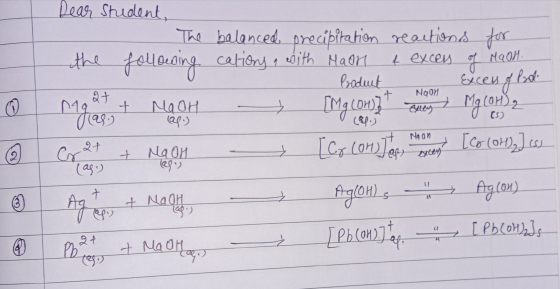
 3. Pb(OH)2 (8) is amphoteric and forms the complex ion Pb(OH)/(aq) with excess OH in solution. Write the balanced equilibrium equation of Pb(OH)2 (s) in the presence of excess hydroxide. 4. A solution contains Pb(NO3)2 and Zn(NO3)2. Consult the solubility table and answer the following questions: a. NaOH (aq) is added to the solution. What precipitate (or precipitates) forms? b. Can you separate the two metal ions using NaOH? c. Nat (aq) is added to the solution. What precipitate (or...
PLEASE PLEASE answer all :) Name: CEII2L Spring 2020 Pre-Lab Questions WinQual 2 1. Forcach reaction...
 PLEASE PLEASE answer all :)
Name: CEII2L Spring 2020 Pre-Lab Questions WinQual 2 1. Forcach reaction described below, write the chemical equation a) Lead(II) nitrate and sodium sulfate solutions are mixed together b) Silver nitrate and sodium chloride solutions are mixed together c) Silver nitrate and sodium hydroxide solutions are mixed together 2. Write the balanced precipitation reactions for the following reactions. Use the solubility rules to determine if a precipitate happened. 11.51 Nal + AgNO, Na SO4 + AgNO3-...
PLEASE PLEASE answer all :)
Name: CEII2L Spring 2020 Pre-Lab Questions WinQual 2 1. Forcach reaction described below, write the chemical equation a) Lead(II) nitrate and sodium sulfate solutions are mixed together b) Silver nitrate and sodium chloride solutions are mixed together c) Silver nitrate and sodium hydroxide solutions are mixed together 2. Write the balanced precipitation reactions for the following reactions. Use the solubility rules to determine if a precipitate happened. 11.51 Nal + AgNO, Na SO4 + AgNO3-...
17. On the basis of the general solubility rules given in Table 7.1, write a balanced...
 17. On the basis of the general solubility rules given in Table 7.1, write a balanced molecular equation for the precipitation reactions that take place when the following aqueous solutions are mixed. Underline the formula of the precipitate (solid) that forms. If no precipitation reaction is likely for the reactants given, explain why. a. ammonium chloride, NH,CI, and sulfuric acid, H,SO b. potassium carbonate, K,CO3, and tin(IV) chloride, Snc c. ammonium chloride, NH CI, and lead(II) nitrate, Pb(NO3) d. copper(II)...
please write legible. answer all questions. 1. Identify each of the following reactions as a precipitation...
 please write legible. answer all questions.
1. Identify each of the following reactions as a precipitation reaction, an acid-base reaction or as a redox reaction Pb(NO), (aq) + 2 HCl(aq) - PbCl(s) + 2 HNO(aq) b. 2 H2 + Oxel - 2 H2O CHNO, (aq) + KOH(aq) - KNO, (aq) + H2O (1) d. Zn + 2HCl - ZnCl + H e. Ba"(aq) + 2 Br(aq) + 2 Na' (aq) +SO. (aq) BaSO. (s) + 2 Na'(aq) + 2 Br"...
please write legible. answer all questions.
1. Identify each of the following reactions as a precipitation reaction, an acid-base reaction or as a redox reaction Pb(NO), (aq) + 2 HCl(aq) - PbCl(s) + 2 HNO(aq) b. 2 H2 + Oxel - 2 H2O CHNO, (aq) + KOH(aq) - KNO, (aq) + H2O (1) d. Zn + 2HCl - ZnCl + H e. Ba"(aq) + 2 Br(aq) + 2 Na' (aq) +SO. (aq) BaSO. (s) + 2 Na'(aq) + 2 Br"...
When you write the answers, please write the page number for which the question is located....
 When you write the answers, please write the page number for
which the question is located. Thank you!
Experiment 8 Name: Double Replacement Reactions Background: Some reactions have the net effect of causing the cation of cach reactant to trade places, forming a compound with the other anion. These reactions are known as double replacement reactions. In the example below (unbalanced equation), the barium and sodium cations switch places so that barium forms a product with sulfate while sodium forms...
When you write the answers, please write the page number for
which the question is located. Thank you!
Experiment 8 Name: Double Replacement Reactions Background: Some reactions have the net effect of causing the cation of cach reactant to trade places, forming a compound with the other anion. These reactions are known as double replacement reactions. In the example below (unbalanced equation), the barium and sodium cations switch places so that barium forms a product with sulfate while sodium forms...
 Use the solubility table to answer the following. You do not need to mix any chemicals. 1. Circle the following compounds if they will not dissolve completely or will form ppt in H a CaSO4 (s) Cu(IO3)2(s) AgNO3(s) Baco3 (s) Pb(NO3)2(s) Al(OH)3(s) 2. circle all of the following solutions that will form a precipitate with addition of Mg(IO3)2 aq) Ba (NO3)2(aq) Pb (NO3)2(aq) K2CO3 (aq) CuCl2(aq) NH40H (aq) ZnSO4(aq) 3. Circle all of the following solutions that will not form...
 write the balanced net ionic equations for the cell reactions
for the following
QUESTIONS Write the balanced, net-ionic equations for the sell reactions for the following half-cell combinations at standard conditions. Bc sure to consider direction of 1. spontaneicy a. Cu/Cu, Zn/Zn2: b. Ag/Ag, Mg/Mg* c. Zn/Zn, Pb/Pb d. Ni/Ni+, Ag/Ag: e. Cu/Cu2t, Mg/Mg*:
write the balanced net ionic equations for the cell reactions
for the following
QUESTIONS Write the balanced, net-ionic equations for the sell reactions for the following half-cell combinations at standard conditions. Bc sure to consider direction of 1. spontaneicy a. Cu/Cu, Zn/Zn2: b. Ag/Ag, Mg/Mg* c. Zn/Zn, Pb/Pb d. Ni/Ni+, Ag/Ag: e. Cu/Cu2t, Mg/Mg*:
 POST LAB QUESTIONS Answer the following questions in your lab notebook: 1. Give the chemical formula for a single chemical reagent that would : (a) separate Ag from Cut b) separate AgCl from PbCl2 - separate Cu2+ from Mat (d) separate Fet from Zn2+ (e) Dissolve Zn(OH), but not Fe(OH)3 (f) separate Ba2+ from Mn2+ and Zn2+ 2. Write balanced ionic chemical equations for: a. The dissolution of AgCl in excess ammonia b. The precipitation of Pb * to PbCrO4(s)...
 QUESTIONS Which of the following reactions are metathesis reactions? (a) 2KciO3 2KCI+302 (b) Cu(NO3)2+ZnCu+Zn(NO,)2 (e) BaCOs + 2 HCBaCl2 +H20+Co2 (d) Na2CO, +Cuso Na,SO,+CuCO 1. 2a. How many grams of each of the following substances will dissolve in 100 mL of cold water? Consult a handbook or the Internet and cite your source. Ce(lO3)4 RaSO4 Pb(NO) (NH)SeO 2b. Which of these substances is least soluble on a gram-per-100 mL basis? 3. Suppose you have a solution that might contain any...
 3. Pb(OH)2 (8) is amphoteric and forms the complex ion Pb(OH)/(aq) with excess OH in solution. Write the balanced equilibrium equation of Pb(OH)2 (s) in the presence of excess hydroxide. 4. A solution contains Pb(NO3)2 and Zn(NO3)2. Consult the solubility table and answer the following questions: a. NaOH (aq) is added to the solution. What precipitate (or precipitates) forms? b. Can you separate the two metal ions using NaOH? c. Nat (aq) is added to the solution. What precipitate (or...
 PLEASE PLEASE answer all :)
Name: CEII2L Spring 2020 Pre-Lab Questions WinQual 2 1. Forcach reaction described below, write the chemical equation a) Lead(II) nitrate and sodium sulfate solutions are mixed together b) Silver nitrate and sodium chloride solutions are mixed together c) Silver nitrate and sodium hydroxide solutions are mixed together 2. Write the balanced precipitation reactions for the following reactions. Use the solubility rules to determine if a precipitate happened. 11.51 Nal + AgNO, Na SO4 + AgNO3-...
PLEASE PLEASE answer all :)
Name: CEII2L Spring 2020 Pre-Lab Questions WinQual 2 1. Forcach reaction described below, write the chemical equation a) Lead(II) nitrate and sodium sulfate solutions are mixed together b) Silver nitrate and sodium chloride solutions are mixed together c) Silver nitrate and sodium hydroxide solutions are mixed together 2. Write the balanced precipitation reactions for the following reactions. Use the solubility rules to determine if a precipitate happened. 11.51 Nal + AgNO, Na SO4 + AgNO3-...
 17. On the basis of the general solubility rules given in Table 7.1, write a balanced molecular equation for the precipitation reactions that take place when the following aqueous solutions are mixed. Underline the formula of the precipitate (solid) that forms. If no precipitation reaction is likely for the reactants given, explain why. a. ammonium chloride, NH,CI, and sulfuric acid, H,SO b. potassium carbonate, K,CO3, and tin(IV) chloride, Snc c. ammonium chloride, NH CI, and lead(II) nitrate, Pb(NO3) d. copper(II)...
 please write legible. answer all questions.
1. Identify each of the following reactions as a precipitation reaction, an acid-base reaction or as a redox reaction Pb(NO), (aq) + 2 HCl(aq) - PbCl(s) + 2 HNO(aq) b. 2 H2 + Oxel - 2 H2O CHNO, (aq) + KOH(aq) - KNO, (aq) + H2O (1) d. Zn + 2HCl - ZnCl + H e. Ba"(aq) + 2 Br(aq) + 2 Na' (aq) +SO. (aq) BaSO. (s) + 2 Na'(aq) + 2 Br"...
please write legible. answer all questions.
1. Identify each of the following reactions as a precipitation reaction, an acid-base reaction or as a redox reaction Pb(NO), (aq) + 2 HCl(aq) - PbCl(s) + 2 HNO(aq) b. 2 H2 + Oxel - 2 H2O CHNO, (aq) + KOH(aq) - KNO, (aq) + H2O (1) d. Zn + 2HCl - ZnCl + H e. Ba"(aq) + 2 Br(aq) + 2 Na' (aq) +SO. (aq) BaSO. (s) + 2 Na'(aq) + 2 Br"...
 When you write the answers, please write the page number for
which the question is located. Thank you!
Experiment 8 Name: Double Replacement Reactions Background: Some reactions have the net effect of causing the cation of cach reactant to trade places, forming a compound with the other anion. These reactions are known as double replacement reactions. In the example below (unbalanced equation), the barium and sodium cations switch places so that barium forms a product with sulfate while sodium forms...
When you write the answers, please write the page number for
which the question is located. Thank you!
Experiment 8 Name: Double Replacement Reactions Background: Some reactions have the net effect of causing the cation of cach reactant to trade places, forming a compound with the other anion. These reactions are known as double replacement reactions. In the example below (unbalanced equation), the barium and sodium cations switch places so that barium forms a product with sulfate while sodium forms...
Most questions answered within 3 hours.
-
Where is the error in this code sequence?
String s1 = "Hello";
String s2 = "ello";...
asked 10 months ago -
Financial data for Joel de Paris, Inc., for last year
follow:
Joel de Paris, Inc.
Balance...
asked 10 months ago -
Consider this reaction:
Al2(SO4)3 (aq)+ BaCl3
(aq) Al2Cl6 (aq)- +
3BaSO4(s) . What is the...
asked 10 months ago -
Suppose that Savneet is considering increasing her
recent random sample from 20 car rentals to 40...
asked 10 months ago -
Trucks arrive at an unloading terminal at an average rate of 120
per hour.
Trucks arrive...
asked 10 months ago -
Why are methanol and ethanol completely soluble in water while
octanol is not very little soluble....
asked 10 months ago -
A facilities manager at a university reads in a research report
that the mean amount of...
asked 10 months ago -
When the CuSO4 is rehydrated by adding water to the anhydrous
compound, is this an endothermic...
asked 10 months ago -
A ray of sunlight is passing from diamond into crown glass; the
angle of incidence is...
asked 10 months ago -
A block of mass 0.249 kg is placed on top of a light, vertical
spring of...
asked 10 months ago -
how do the kidneys compensate in the presences of acidosis
a) trigger hyperventilate
b) reserve acid...
asked 10 months ago -
Question 501 pts
The rental rate of capital to the firm increases. Which of the
following...
asked 10 months ago