Testbank, Question 033 Does a reaction with a ΔH of 20 kJ/mol and a ΔS of...
Testbank, Question 033
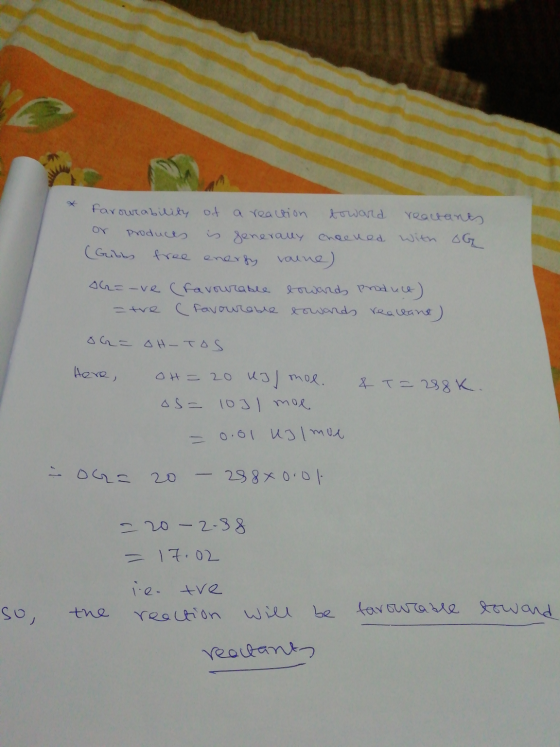
Does a reaction with a ΔH of 20 kJ/mol and a ΔS of 10 J/mol·K at 298 K favor reactants or products?
Homework Answers
Add Answer to:
Testbank, Question 033
Does a reaction with a ΔH of 20 kJ/mol and a ΔS of...
A certain reaction has ΔH°= -19.5 kJ/mol and ΔS°= +42.7 J/mol K a) Is the reaction...
A certain reaction has ΔH°= -19.5 kJ/mol and ΔS°= +42.7 J/mol K a) Is the reaction exothermic or endothermic? b) Does the reaction lead to an increase or decrease in the disorder of the system? c) Calculate ΔG° for the reaction at 298K. d) Is the reaction spontaneous at 298 K under standard conditions?
Given the values of ΔH∘rxn, ΔS∘rxn, and T , determine ΔSuniv: A) ΔH∘rxn=− 124 kJ ,...
Given the values of ΔH∘rxn, ΔS∘rxn, and T , determine ΔSuniv: A) ΔH∘rxn=− 124 kJ , ΔS∘rxn= 258 J/K , T= 298 K B) ΔH∘rxn= 124 kJ , ΔS∘rxn=− 258 J/K , T= 298 K C)ΔH∘rxn=− 124 kJ , ΔS∘rxn=− 258 J/K , T= 298 K D) H∘rxn=− 124 kJ , ΔS∘rxn=− 258 J/K , T= 554 K
A reaction has a ΔH°= 204.6 kJ and a ΔS°= -19.5 J/K. a. Given the sign...
A reaction has a ΔH°= 204.6 kJ and a ΔS°= -19.5 J/K. a. Given the sign and magnitude of ΔH and ΔS, will the reaction be spontaneous at all temperatures, nonspontaneous at all temperatures? Briefly explain your reasoning. b. Calculate the standard free energy change for the reaction at 298 K. c. Is the reaction spontaneous or nonspontaneous at 298 K?
Consider the following reaction at 298 K. C(graphite)+2H2(g)⟶CH4(g)ΔH∘=−74.6 kJ and ΔS∘=−80.8 J/KC(graphite)+2H2(g)⟶CH4(g)ΔH∘=−74.6 kJ and ΔS∘=−80.8 J/K...
Consider the following reaction at 298 K. C(graphite)+2H2(g)⟶CH4(g)ΔH∘=−74.6 kJ and ΔS∘=−80.8 J/KC(graphite)+2H2(g)⟶CH4(g)ΔH∘=−74.6 kJ and ΔS∘=−80.8 J/K Calculate the following quantities. ΔSsys=ΔSsys J/K ΔSsurr= J/K ΔSuniv= J/K
Consider a reaction for which ΔH = 6.03 kJ/mol; ΔS = 22.1 J/K-mol. Which of the...
Consider a reaction for which ΔH = 6.03 kJ/mol; ΔS = 22.1 J/K-mol. Which of the following statements is true? a. The reaction becomes spontaneous at high temperatures above 273 K b. The reaction becomes spontaneous at low temperatures below 273 K c. The reaction is spontaneous at all temperatures d. The reaction is never spontaneous
For the reaction Cl2O(g) + 3/2O2(g) → 2ClO2(g) ΔH° = 126.4 kJ/mol and ΔS° = -74.9...
For the reaction Cl2O(g) + 3/2O2(g) → 2ClO2(g) ΔH° = 126.4 kJ/mol and ΔS° = -74.9 J/K mol. At 381°C, what is ΔG?
A) If ΔH = -70.0 kJ and ΔS = -0.400 kJ/K , the reaction is spontaneous...
A) If ΔH = -70.0 kJ and ΔS = -0.400 kJ/K , the reaction is spontaneous below a certain temperature. Calculate that temperature. Express your answer numerically in kelvins. B) Glacial acetic acid is the concentrated form of acetic acid, the acid in vinegar. The term "glacial" refers to the appearance of the solid form, which resembles ice-like crystals. What is the melting point of this compound, in degrees Celsius, based on its thermodynamic data shown here? ΔHfus (kJ/mol) ΔSfus...
For a particular reaction, ΔH = -32 kJ and ΔS =-98 J/K. Assume that ΔH and ΔS do not vary withtemperature. A) At wha...
For a particular reaction, ΔH = -32 kJ and ΔS =-98 J/K. Assume that ΔH and ΔS do not vary withtemperature. A) At what temperature will the reaction have ΔG= 0? B) If T is increased from that in part A, will the reaction bespontaneous or nonspontaneous?
For the reaction ΔH°=+61.14 kJ and ΔS° = +132 J/K at 25°C. At what For the...
For the reaction ΔH°=+61.14 kJ and ΔS° = +132 J/K at 25°C. At what For the reaction ΔH°=+61.14 kJ and ΔS° = +132 J/K at 25°C. At what minimum temperature will the reaction be spontaneous?minimum temperature will the reaction be spontaneous? Select one: a. 479 K b. 500 K c. 463 K d. 571 K e. 2904 K
1. Consider a process at 286 K with ΔH = -72.5 kJ/mol and ΔS = -96.8...
1. Consider a process at 286 K with ΔH = -72.5 kJ/mol and ΔS = -96.8 J/K mol Which of the following is true? ΔG = -44.8 kJ/mol and the process will not be spontaneous ΔG = +39.4 kJ/mol and the process will be spontaneous ΔG = -44.8 kJ/mol and the process will be spontaneous ΔG = -19.1 kJ/mol and the process will not be spontaneous ΔG = +39.4 kJ/mol and the process will not be spontaneous 2. Consider a...
Most questions answered within 3 hours.
-
Where is the error in this code sequence?
String s1 = "Hello";
String s2 = "ello";...
asked 10 months ago -
Financial data for Joel de Paris, Inc., for last year
follow:
Joel de Paris, Inc.
Balance...
asked 10 months ago -
Consider this reaction:
Al2(SO4)3 (aq)+ BaCl3
(aq) Al2Cl6 (aq)- +
3BaSO4(s) . What is the...
asked 10 months ago -
Suppose that Savneet is considering increasing her
recent random sample from 20 car rentals to 40...
asked 10 months ago -
Trucks arrive at an unloading terminal at an average rate of 120
per hour.
Trucks arrive...
asked 10 months ago -
Why are methanol and ethanol completely soluble in water while
octanol is not very little soluble....
asked 10 months ago -
A facilities manager at a university reads in a research report
that the mean amount of...
asked 10 months ago -
When the CuSO4 is rehydrated by adding water to the anhydrous
compound, is this an endothermic...
asked 10 months ago -
A ray of sunlight is passing from diamond into crown glass; the
angle of incidence is...
asked 10 months ago -
A block of mass 0.249 kg is placed on top of a light, vertical
spring of...
asked 10 months ago -
how do the kidneys compensate in the presences of acidosis
a) trigger hyperventilate
b) reserve acid...
asked 10 months ago -
Question 501 pts
The rental rate of capital to the firm increases. Which of the
following...
asked 10 months ago