
Homework Answers
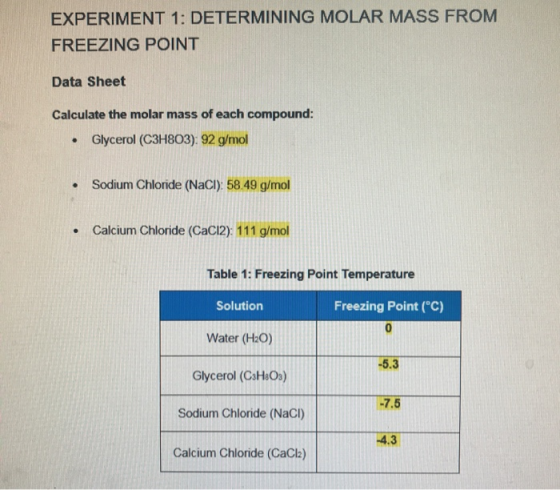
If we totally ignore the effects of hydrigen bonds, the order of freezing point depression depends on molality of the solutes. On taking equal quantities of all the salts, the biggest depression will be given by the compound with lowest molar mass, therefore the order should be: NaCl > Glycerol > CaCl2 which means the order does'nt really change. However since glycerol forms hydrogen bond the actual depression is higher than that from your results.
Add Answer to:
these are my results but im not sure exactly how to explain
this.
thank you!
5....
In this exercise, you will determine the molar mass of a known substance using its freezing...
 In this exercise, you will determine the molar mass of a known substance using its freezing point depression in a solution. Table 1 contains the freezing point depression data from a laboratory experiment. Use this data to determine the molar mass of each compound, calculated using stoichiometry Table 1: Freezing Point Temperatures Masssolvent Solution Amount Solute Added Freezing Point (°C) 0.025 kg H2O Н2О n/a 0.025 kg H2O Glycerol (CэHaОз) 5 mL -4.2 0.025 kg H20 -5.1 NaCl 2 g...
Solute Mass(g) Observed Freezing Point (Celcius) m i Theoretical Freezing Point (Celcius) NaCl 2.94g -1 CaCl2...
Solute Mass(g) Observed Freezing Point (Celcius) m i Theoretical Freezing Point (Celcius) NaCl 2.94g -1 CaCl2 * 2H20 7.37g 0 C12H22O11 17.14g 0.5 100.0g of pure ice water freezing point 0.5 C Final Freezing Point -3 Your solvent mass should be the mass of the water and the mass of the ice You should use your observed freezing point of pure water to adjust the values for the observed freezing point of the solution, that will make comparing your observed...
All multiple parts to the same problem, thank you! :) Solution Stoichiometry: We need to make...
 All multiple parts to the same problem, thank you! :)
Solution Stoichiometry: We need to make a 0.250 M sodium carbonate solution. We will use a 100.00 mL volumetric flask. How many grams of solid sodium carbonate should we add to the flask to make the solution? Use 105.99 as the molar mass, report correct sig figs, and use g as the unit. Solution Stoichiometry: We need to make a 0.200 M calcium chloride solution. We will use a 100.00...
All multiple parts to the same problem, thank you! :)
Solution Stoichiometry: We need to make a 0.250 M sodium carbonate solution. We will use a 100.00 mL volumetric flask. How many grams of solid sodium carbonate should we add to the flask to make the solution? Use 105.99 as the molar mass, report correct sig figs, and use g as the unit. Solution Stoichiometry: We need to make a 0.200 M calcium chloride solution. We will use a 100.00...
Determination of Molar Mass by freezing Point depression Not sure how to answer these two questions...
 Determination of Molar Mass by freezing Point depression
Not sure how to answer these two questions
Calcium chloride, CaCI_2 is commonly used as road salt. If one mole of CaCI_2 is dissolved in 1 kg v of water, would the freezing point of the solution be greater than, less than, or the same as a solution prepared by dissolving one mole of table sugar (sucrose, C_12H_22O_11) in 1 kg of water? Explain your answer. A student followed our lab procedure...
Determination of Molar Mass by freezing Point depression
Not sure how to answer these two questions
Calcium chloride, CaCI_2 is commonly used as road salt. If one mole of CaCI_2 is dissolved in 1 kg v of water, would the freezing point of the solution be greater than, less than, or the same as a solution prepared by dissolving one mole of table sugar (sucrose, C_12H_22O_11) in 1 kg of water? Explain your answer. A student followed our lab procedure...
PLEASE SHOW WORK FOR EACH TABLE CLEARLY AND IN CORRECT ORDER! I WILL GIVE YOU A...
 PLEASE SHOW WORK FOR EACH TABLE CLEARLY AND IN CORRECT
ORDER! I WILL GIVE YOU A GOOD RATING IF DONE CLEARLY AND CORRECTLY
:)
DATA:
Sodium chloride
Freezing point of Water (°C)
0.00
Freezing point of NaCl (°C)
-4.40
Mass of solute (g)
5.89
Volume of Solvent, mL
100.0
Sugar
Volume of Solvent, mL
100.0
Freezing point of Sucrose (°C)
-1.70
Mass of solute (g)
34.05
Ethyl alcohol
Freezing point of E.G (°C)
-1.80
Mass of solute (g)
6.202
Volume...
PLEASE SHOW WORK FOR EACH TABLE CLEARLY AND IN CORRECT
ORDER! I WILL GIVE YOU A GOOD RATING IF DONE CLEARLY AND CORRECTLY
:)
DATA:
Sodium chloride
Freezing point of Water (°C)
0.00
Freezing point of NaCl (°C)
-4.40
Mass of solute (g)
5.89
Volume of Solvent, mL
100.0
Sugar
Volume of Solvent, mL
100.0
Freezing point of Sucrose (°C)
-1.70
Mass of solute (g)
34.05
Ethyl alcohol
Freezing point of E.G (°C)
-1.80
Mass of solute (g)
6.202
Volume...
4. In an experiment, when 23.6 of calcium chloride, CaCl2 were dissolved in water in a...
 4. In an experiment, when 23.6 of calcium chloride, CaCl2 were dissolved in water in a coffee- cup calorimeter (at constant pressure), the temperature rose from 25.0°C to 38.7°C. The dissolution process is: CaCiz(s) - Ca2+ (aq) + 2C1-(aq) The heat capacity of the solution and the calorimeter is 1258 J/°C. The molar mass of CaCl2 is 110.98 g/mol. 1) Determine the heat that was absorbed by the solution and calorimeter. (1 point) 2) Determine the heat that was released...
hey i really need help for the molality to mass question. the solvent is water and...
 hey i really need help for the molality to mass question. the
solvent is water and 100g. SOS!
Table 3: Data obtained for the boiling point elevation simulation. (3 marks) Solute Molality (mol/kg) Solution Boiling Point (°C) NaCl(s) 0.0000 100.00 AT) (°C) 0.0 NaCl(s) 0.1711 NaCl(s) 0.3422 NaCl(s) 0.6844 NaCl(s) 1.3688 CaCl2(s) 0.1711 C12H22011(s) 0.1711 Molality to Mass Sample Calculation: (1 mark) PART 3 BOILING POINT ELEVATION 16. Visit this webpage: https://pages, oregon.edu/tgreenbo/colligative.html; the screenshot (Figure 5) below should be...
hey i really need help for the molality to mass question. the
solvent is water and 100g. SOS!
Table 3: Data obtained for the boiling point elevation simulation. (3 marks) Solute Molality (mol/kg) Solution Boiling Point (°C) NaCl(s) 0.0000 100.00 AT) (°C) 0.0 NaCl(s) 0.1711 NaCl(s) 0.3422 NaCl(s) 0.6844 NaCl(s) 1.3688 CaCl2(s) 0.1711 C12H22011(s) 0.1711 Molality to Mass Sample Calculation: (1 mark) PART 3 BOILING POINT ELEVATION 16. Visit this webpage: https://pages, oregon.edu/tgreenbo/colligative.html; the screenshot (Figure 5) below should be...
im doing a dry lab, can anyone check over problems:1-4 see if i did it correct...
 im doing a dry lab, can anyone check over problems:1-4 see if
i did it correct ? thank you
Name Part A Data Table Mass (9) 46.0076a 45.68259 0.3251 45.8370g 45.68759 0.1551 1. Mass of dean, dry evaporating dish and watch 45.6825. glass 2. Mass of evaporating dish, watch glass, and 910 00 Na.Co 3. Mass of Na2CO 10.3251 4. Mass of evaporating dish, watch glass, and Nadi4545210 residue after drying 5 .Experimental mass of NaCl(sodium chloride) 10.1551 6. Theoretical...
im doing a dry lab, can anyone check over problems:1-4 see if
i did it correct ? thank you
Name Part A Data Table Mass (9) 46.0076a 45.68259 0.3251 45.8370g 45.68759 0.1551 1. Mass of dean, dry evaporating dish and watch 45.6825. glass 2. Mass of evaporating dish, watch glass, and 910 00 Na.Co 3. Mass of Na2CO 10.3251 4. Mass of evaporating dish, watch glass, and Nadi4545210 residue after drying 5 .Experimental mass of NaCl(sodium chloride) 10.1551 6. Theoretical...
may you please provide details on how you recieved the answer thank you. 3 pages. Chem...
 may
you please provide details on how you recieved the answer thank
you.
3 pages.
Chem 143 - Lab Pre-lab Exercise Show the details of each calculation to get full credit 1. Magnesium oxide, a white powdery substance can often be made by heating magnesium metal in presence of oxygen. a. Write the balanced chemical equation for this reaction (including the state symbols such as (s) () or (aq)] b. When 10.1 g magnesium is allowed to react with 10.5g...
may
you please provide details on how you recieved the answer thank
you.
3 pages.
Chem 143 - Lab Pre-lab Exercise Show the details of each calculation to get full credit 1. Magnesium oxide, a white powdery substance can often be made by heating magnesium metal in presence of oxygen. a. Write the balanced chemical equation for this reaction (including the state symbols such as (s) () or (aq)] b. When 10.1 g magnesium is allowed to react with 10.5g...
can you respond to the 3 questions in the second photo Mole Ratios and Reaction Stoichiometry...
 can you respond to the 3 questions in the second photo
Mole Ratios and Reaction Stoichiometry Reaction A: Sodium Bicarbonate and Hydrochloric Acid Experimental Data (a) Mass of evaporating dish + watch glass (6) Mass of evaporating dish + watch glass + sodium bicarbonate (c) Mass of sodium bicarbonate used (d) Mass of evaporating dish + watch glass + sodium chloride (e) Mass of sodium chloride collected (experimental yield) 164.79 165.19 10. 49 165.19 164.7 9 Data Analysis 1) Use...
can you respond to the 3 questions in the second photo
Mole Ratios and Reaction Stoichiometry Reaction A: Sodium Bicarbonate and Hydrochloric Acid Experimental Data (a) Mass of evaporating dish + watch glass (6) Mass of evaporating dish + watch glass + sodium bicarbonate (c) Mass of sodium bicarbonate used (d) Mass of evaporating dish + watch glass + sodium chloride (e) Mass of sodium chloride collected (experimental yield) 164.79 165.19 10. 49 165.19 164.7 9 Data Analysis 1) Use...
 In this exercise, you will determine the molar mass of a known substance using its freezing point depression in a solution. Table 1 contains the freezing point depression data from a laboratory experiment. Use this data to determine the molar mass of each compound, calculated using stoichiometry Table 1: Freezing Point Temperatures Masssolvent Solution Amount Solute Added Freezing Point (°C) 0.025 kg H2O Н2О n/a 0.025 kg H2O Glycerol (CэHaОз) 5 mL -4.2 0.025 kg H20 -5.1 NaCl 2 g...
 All multiple parts to the same problem, thank you! :)
Solution Stoichiometry: We need to make a 0.250 M sodium carbonate solution. We will use a 100.00 mL volumetric flask. How many grams of solid sodium carbonate should we add to the flask to make the solution? Use 105.99 as the molar mass, report correct sig figs, and use g as the unit. Solution Stoichiometry: We need to make a 0.200 M calcium chloride solution. We will use a 100.00...
All multiple parts to the same problem, thank you! :)
Solution Stoichiometry: We need to make a 0.250 M sodium carbonate solution. We will use a 100.00 mL volumetric flask. How many grams of solid sodium carbonate should we add to the flask to make the solution? Use 105.99 as the molar mass, report correct sig figs, and use g as the unit. Solution Stoichiometry: We need to make a 0.200 M calcium chloride solution. We will use a 100.00...
 Determination of Molar Mass by freezing Point depression
Not sure how to answer these two questions
Calcium chloride, CaCI_2 is commonly used as road salt. If one mole of CaCI_2 is dissolved in 1 kg v of water, would the freezing point of the solution be greater than, less than, or the same as a solution prepared by dissolving one mole of table sugar (sucrose, C_12H_22O_11) in 1 kg of water? Explain your answer. A student followed our lab procedure...
Determination of Molar Mass by freezing Point depression
Not sure how to answer these two questions
Calcium chloride, CaCI_2 is commonly used as road salt. If one mole of CaCI_2 is dissolved in 1 kg v of water, would the freezing point of the solution be greater than, less than, or the same as a solution prepared by dissolving one mole of table sugar (sucrose, C_12H_22O_11) in 1 kg of water? Explain your answer. A student followed our lab procedure...
 PLEASE SHOW WORK FOR EACH TABLE CLEARLY AND IN CORRECT
ORDER! I WILL GIVE YOU A GOOD RATING IF DONE CLEARLY AND CORRECTLY
:)
DATA:
Sodium chloride
Freezing point of Water (°C)
0.00
Freezing point of NaCl (°C)
-4.40
Mass of solute (g)
5.89
Volume of Solvent, mL
100.0
Sugar
Volume of Solvent, mL
100.0
Freezing point of Sucrose (°C)
-1.70
Mass of solute (g)
34.05
Ethyl alcohol
Freezing point of E.G (°C)
-1.80
Mass of solute (g)
6.202
Volume...
PLEASE SHOW WORK FOR EACH TABLE CLEARLY AND IN CORRECT
ORDER! I WILL GIVE YOU A GOOD RATING IF DONE CLEARLY AND CORRECTLY
:)
DATA:
Sodium chloride
Freezing point of Water (°C)
0.00
Freezing point of NaCl (°C)
-4.40
Mass of solute (g)
5.89
Volume of Solvent, mL
100.0
Sugar
Volume of Solvent, mL
100.0
Freezing point of Sucrose (°C)
-1.70
Mass of solute (g)
34.05
Ethyl alcohol
Freezing point of E.G (°C)
-1.80
Mass of solute (g)
6.202
Volume...
 4. In an experiment, when 23.6 of calcium chloride, CaCl2 were dissolved in water in a coffee- cup calorimeter (at constant pressure), the temperature rose from 25.0°C to 38.7°C. The dissolution process is: CaCiz(s) - Ca2+ (aq) + 2C1-(aq) The heat capacity of the solution and the calorimeter is 1258 J/°C. The molar mass of CaCl2 is 110.98 g/mol. 1) Determine the heat that was absorbed by the solution and calorimeter. (1 point) 2) Determine the heat that was released...
 hey i really need help for the molality to mass question. the
solvent is water and 100g. SOS!
Table 3: Data obtained for the boiling point elevation simulation. (3 marks) Solute Molality (mol/kg) Solution Boiling Point (°C) NaCl(s) 0.0000 100.00 AT) (°C) 0.0 NaCl(s) 0.1711 NaCl(s) 0.3422 NaCl(s) 0.6844 NaCl(s) 1.3688 CaCl2(s) 0.1711 C12H22011(s) 0.1711 Molality to Mass Sample Calculation: (1 mark) PART 3 BOILING POINT ELEVATION 16. Visit this webpage: https://pages, oregon.edu/tgreenbo/colligative.html; the screenshot (Figure 5) below should be...
hey i really need help for the molality to mass question. the
solvent is water and 100g. SOS!
Table 3: Data obtained for the boiling point elevation simulation. (3 marks) Solute Molality (mol/kg) Solution Boiling Point (°C) NaCl(s) 0.0000 100.00 AT) (°C) 0.0 NaCl(s) 0.1711 NaCl(s) 0.3422 NaCl(s) 0.6844 NaCl(s) 1.3688 CaCl2(s) 0.1711 C12H22011(s) 0.1711 Molality to Mass Sample Calculation: (1 mark) PART 3 BOILING POINT ELEVATION 16. Visit this webpage: https://pages, oregon.edu/tgreenbo/colligative.html; the screenshot (Figure 5) below should be...
 im doing a dry lab, can anyone check over problems:1-4 see if
i did it correct ? thank you
Name Part A Data Table Mass (9) 46.0076a 45.68259 0.3251 45.8370g 45.68759 0.1551 1. Mass of dean, dry evaporating dish and watch 45.6825. glass 2. Mass of evaporating dish, watch glass, and 910 00 Na.Co 3. Mass of Na2CO 10.3251 4. Mass of evaporating dish, watch glass, and Nadi4545210 residue after drying 5 .Experimental mass of NaCl(sodium chloride) 10.1551 6. Theoretical...
im doing a dry lab, can anyone check over problems:1-4 see if
i did it correct ? thank you
Name Part A Data Table Mass (9) 46.0076a 45.68259 0.3251 45.8370g 45.68759 0.1551 1. Mass of dean, dry evaporating dish and watch 45.6825. glass 2. Mass of evaporating dish, watch glass, and 910 00 Na.Co 3. Mass of Na2CO 10.3251 4. Mass of evaporating dish, watch glass, and Nadi4545210 residue after drying 5 .Experimental mass of NaCl(sodium chloride) 10.1551 6. Theoretical...
 may
you please provide details on how you recieved the answer thank
you.
3 pages.
Chem 143 - Lab Pre-lab Exercise Show the details of each calculation to get full credit 1. Magnesium oxide, a white powdery substance can often be made by heating magnesium metal in presence of oxygen. a. Write the balanced chemical equation for this reaction (including the state symbols such as (s) () or (aq)] b. When 10.1 g magnesium is allowed to react with 10.5g...
may
you please provide details on how you recieved the answer thank
you.
3 pages.
Chem 143 - Lab Pre-lab Exercise Show the details of each calculation to get full credit 1. Magnesium oxide, a white powdery substance can often be made by heating magnesium metal in presence of oxygen. a. Write the balanced chemical equation for this reaction (including the state symbols such as (s) () or (aq)] b. When 10.1 g magnesium is allowed to react with 10.5g...
 can you respond to the 3 questions in the second photo
Mole Ratios and Reaction Stoichiometry Reaction A: Sodium Bicarbonate and Hydrochloric Acid Experimental Data (a) Mass of evaporating dish + watch glass (6) Mass of evaporating dish + watch glass + sodium bicarbonate (c) Mass of sodium bicarbonate used (d) Mass of evaporating dish + watch glass + sodium chloride (e) Mass of sodium chloride collected (experimental yield) 164.79 165.19 10. 49 165.19 164.7 9 Data Analysis 1) Use...
can you respond to the 3 questions in the second photo
Mole Ratios and Reaction Stoichiometry Reaction A: Sodium Bicarbonate and Hydrochloric Acid Experimental Data (a) Mass of evaporating dish + watch glass (6) Mass of evaporating dish + watch glass + sodium bicarbonate (c) Mass of sodium bicarbonate used (d) Mass of evaporating dish + watch glass + sodium chloride (e) Mass of sodium chloride collected (experimental yield) 164.79 165.19 10. 49 165.19 164.7 9 Data Analysis 1) Use...
Most questions answered within 3 hours.
-
Where is the error in this code sequence?
String s1 = "Hello";
String s2 = "ello";...
asked 11 months ago -
Financial data for Joel de Paris, Inc., for last year
follow:
Joel de Paris, Inc.
Balance...
asked 11 months ago -
Consider this reaction:
Al2(SO4)3 (aq)+ BaCl3
(aq) Al2Cl6 (aq)- +
3BaSO4(s) . What is the...
asked 11 months ago -
Suppose that Savneet is considering increasing her
recent random sample from 20 car rentals to 40...
asked 11 months ago -
Trucks arrive at an unloading terminal at an average rate of 120
per hour.
Trucks arrive...
asked 11 months ago -
Why are methanol and ethanol completely soluble in water while
octanol is not very little soluble....
asked 11 months ago -
A facilities manager at a university reads in a research report
that the mean amount of...
asked 11 months ago -
When the CuSO4 is rehydrated by adding water to the anhydrous
compound, is this an endothermic...
asked 11 months ago -
A ray of sunlight is passing from diamond into crown glass; the
angle of incidence is...
asked 11 months ago -
A block of mass 0.249 kg is placed on top of a light, vertical
spring of...
asked 11 months ago -
how do the kidneys compensate in the presences of acidosis
a) trigger hyperventilate
b) reserve acid...
asked 11 months ago -
Question 501 pts
The rental rate of capital to the firm increases. Which of the
following...
asked 11 months ago