What reagent could you add acetyl chloride to form ethyl acetate, a common laboratory solvent?
What reagent could you add acetyl chloride to form ethyl acetate, a common laboratory solvent?
Homework Answers
The common reagent is ethanol.

Add Answer to:
What reagent could you add acetyl chloride to form ethyl
acetate, a common laboratory solvent?
What other ACYL compound could be used instead of acetyl chloride to form ester?
What other ACYL compound could be used instead of acetyl chloride to form ester?
1.In the laboratory you dissolve 12.8 g of barium acetate in a volumetric flask and add...
1.In the laboratory you dissolve 12.8 g of barium acetate in a volumetric flask and add water to a total volume of 375 mL. What is the molarity of the solution? M. What is the concentration of the barium cation? M. 2.In the laboratory you dissolve 18.2 g of potassium bromide in a volumetric flask and add water to a total volume of 125 mL. What is the molarity of the solution? M. What is the concentration of the potassium cation? M. What is...
Ethyl acetate is a popular solvent in organic chemistry laboratories. What are the potential health hazards...
Ethyl acetate is a popular solvent in organic chemistry laboratories. What are the potential health hazards of this solvent? Would you consider dichloromethane more or less hazardous?
Check Your Learning Ethanol and acetic acid react and form water and ethyl acetate,the solvent responsible...
 Check Your Learning Ethanol and acetic acid react and form water and ethyl acetate,the solvent responsible for the odor of some nail polish removers. 2 15 When 1 mol each of C2H5OH and CH3CO2H are allowed to react in 1 L of the solvent dioxane, equilibrium is established when mol of each of the reactants remains. Calculate the equilibrium constant for the reaction. (Note: Water is not a solvent in this reaction.)
a) What two products will be produced when adding acetyl chloride to ethanol? b) Draw the...
a) What two products will be produced when adding acetyl chloride to ethanol? b) Draw the mechanism for the esterification (ferulic acid- ethyl p-Hydroxycinnamates) c) Why do you want to use 200-proof ethanol as the reaction solvent? (Why 200 proof, not 190 proof?)
Ethyl acetate, C4H802, is a fragrant substance used both as a solvent and as an aroma...
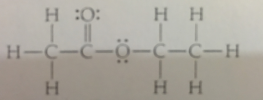 Ethyl acetate, C4H802, is a fragrant substance used both as a
solvent and as an aroma enhancer.
a. What is the hybridization at each carbon atom of the
molecule?
b. What is the total number of valence electrons in ethyl
acetate?
c. How many of the valence electrons are used to make
bonds?
d. How many of the valence electrons are used to make
bonds?
e. How many of the valence electrons remain in non-bonding
pairs?
Ethyl acetate, C4H802, is a fragrant substance used both as a
solvent and as an aroma enhancer.
a. What is the hybridization at each carbon atom of the
molecule?
b. What is the total number of valence electrons in ethyl
acetate?
c. How many of the valence electrons are used to make
bonds?
d. How many of the valence electrons are used to make
bonds?
e. How many of the valence electrons remain in non-bonding
pairs?
If 4.2 mL of isoamyl alcohol was reacted with 3.5 mL of acetyl chloride and 2.7...
 If 4.2 mL of isoamyl alcohol was reacted with 3.5 mL of acetyl chloride and 2.7 grams of isoamyl acetate was recovered, what is the % yield? Include calculations for density conversions the limiting reagent, theoretical yield and %yield.
What reagent might be added to phenylmagnesium bromide to produce methyl phenyl ketone? (Hint: ethyl acetate...
What reagent might be added to phenylmagnesium bromide to produce methyl phenyl ketone? (Hint: ethyl acetate is not a good choice.) Draw the mechanism for this reaction
In the laboratory you dissolve 12.2 g of aluminum acetate in a volumetric flask and add...
In the laboratory you dissolve 12.2 g of aluminum acetate in a volumetric flask and add water to a total volume of 125 mL. What is the molarity of the solution? M. What is the concentration of the aluminum cation? M. What is the concentration of the acetate anion? M.
Common solvents used in TLC analysis are hexane and ethyl acetate, the latter being more polar. A TLC has been performed...
Common solvents used in TLC analysis are hexane and ethyl acetate, the latter being more polar. A TLC has been performed on a mixture of two compounds. The solvent ran for 3 cm(plate length is 6cm) with 5% ethyl acetate in hexane. The two spots were not resolved, meaning they showed up too close to each other. What can you suggest to possible improve the results of the separation?
 Check Your Learning Ethanol and acetic acid react and form water and ethyl acetate,the solvent responsible for the odor of some nail polish removers. 2 15 When 1 mol each of C2H5OH and CH3CO2H are allowed to react in 1 L of the solvent dioxane, equilibrium is established when mol of each of the reactants remains. Calculate the equilibrium constant for the reaction. (Note: Water is not a solvent in this reaction.)
 Ethyl acetate, C4H802, is a fragrant substance used both as a
solvent and as an aroma enhancer.
a. What is the hybridization at each carbon atom of the
molecule?
b. What is the total number of valence electrons in ethyl
acetate?
c. How many of the valence electrons are used to make
bonds?
d. How many of the valence electrons are used to make
bonds?
e. How many of the valence electrons remain in non-bonding
pairs?
Ethyl acetate, C4H802, is a fragrant substance used both as a
solvent and as an aroma enhancer.
a. What is the hybridization at each carbon atom of the
molecule?
b. What is the total number of valence electrons in ethyl
acetate?
c. How many of the valence electrons are used to make
bonds?
d. How many of the valence electrons are used to make
bonds?
e. How many of the valence electrons remain in non-bonding
pairs?
 If 4.2 mL of isoamyl alcohol was reacted with 3.5 mL of acetyl chloride and 2.7 grams of isoamyl acetate was recovered, what is the % yield? Include calculations for density conversions the limiting reagent, theoretical yield and %yield.
Most questions answered within 3 hours.
-
Where is the error in this code sequence?
String s1 = "Hello";
String s2 = "ello";...
asked 10 months ago -
Financial data for Joel de Paris, Inc., for last year
follow:
Joel de Paris, Inc.
Balance...
asked 10 months ago -
Consider this reaction:
Al2(SO4)3 (aq)+ BaCl3
(aq) Al2Cl6 (aq)- +
3BaSO4(s) . What is the...
asked 10 months ago -
Suppose that Savneet is considering increasing her
recent random sample from 20 car rentals to 40...
asked 10 months ago -
Trucks arrive at an unloading terminal at an average rate of 120
per hour.
Trucks arrive...
asked 10 months ago -
Why are methanol and ethanol completely soluble in water while
octanol is not very little soluble....
asked 10 months ago -
A facilities manager at a university reads in a research report
that the mean amount of...
asked 10 months ago -
When the CuSO4 is rehydrated by adding water to the anhydrous
compound, is this an endothermic...
asked 10 months ago -
A ray of sunlight is passing from diamond into crown glass; the
angle of incidence is...
asked 10 months ago -
A block of mass 0.249 kg is placed on top of a light, vertical
spring of...
asked 10 months ago -
how do the kidneys compensate in the presences of acidosis
a) trigger hyperventilate
b) reserve acid...
asked 10 months ago -
Question 501 pts
The rental rate of capital to the firm increases. Which of the
following...
asked 10 months ago