Ethyl acetate is a popular solvent in organic chemistry laboratories. What are the potential health hazards...
Ethyl acetate is a popular solvent in organic chemistry laboratories. What are the potential health hazards of this solvent? Would you consider dichloromethane more or less hazardous?
Homework Answers
Ethyl acetate --> it irritates eyes, nose and throat. Also can produce headache and as much time is present, this increases nausea nad vomiting . High concentrations will cause toxicity. Prolonged exposure = live r+ kindey problems as well as carcinogenic
dichloroethane --> this is also considered a very flammable + dangereous and even carcinogenic material. Will vaporate readilty. The cnacer risk for dichlorotehane >> ethyl acetate
Therefore, use Ethyl acetate when possible
Add Answer to:
Ethyl acetate is a popular solvent in organic chemistry
laboratories. What are the potential health hazards...
organic chemistry. why is CH3ONa not used in the claisen condensation of ethyl acetate 12. Why...
 organic chemistry. why is CH3ONa not used in the claisen
condensation of ethyl acetate
12. Why is CH3ONa not used in the Claisen condensation of ethyl acetate? a. CH30 is a weaker base than the CH3CH20-which is used. b. CH3O- Nat is more difficult to prepare than CH3CH2O Nat. c. CH3O- would abstract a proton from the ethyl group of the ester. d. Use of CH,O- Na would result in transesterification e. CH,O- Na can be used as well as...
organic chemistry. why is CH3ONa not used in the claisen
condensation of ethyl acetate
12. Why is CH3ONa not used in the Claisen condensation of ethyl acetate? a. CH30 is a weaker base than the CH3CH20-which is used. b. CH3O- Nat is more difficult to prepare than CH3CH2O Nat. c. CH3O- would abstract a proton from the ethyl group of the ester. d. Use of CH,O- Na would result in transesterification e. CH,O- Na can be used as well as...
why is ethyl acetate a good choice as organic solvent for separating benzoin and benzoic acid...
why is ethyl acetate a good choice as organic solvent for separating benzoin and benzoic acid in TLC experiment?
1)When you perform a liquid-liquid extraction using a separatory funnel, which of the following organic solvent...
 1)When you perform a liquid-liquid extraction using a separatory funnel, which of the following organic solvent is on the bottom of the aqueous phase and which is on top? (write your answer by the solvent name) a) Ethyl acetate b) hexane c) Dichloromethane d) diethyl ether 2) If you are performing a liquid-liquid extraction and you have a mix of a carboxylic acid and a non-acidic compound, which combination of solvents would you use for the separation? a) dichloromethane/HCI b)...
What reagent could you add acetyl chloride to form ethyl acetate, a common laboratory solvent?
What reagent could you add acetyl chloride to form ethyl acetate, a common laboratory solvent?
I need help with a 2-part organic chemistry lab. The main topic is esterification of fatty...
I need help with a 2-part organic chemistry lab. The main topic is esterification of fatty acids. In the reaction, I mix acetic acid, ethanol, and diethyl ether (solvent) together and then add the reagent (H2SO4) to the flask. The final product of this reaction is ethyl acetate. Ethyl acetate is then extracted in a separatory funnel using NaOH. For this reaction, I need help with 2 things. I need help with the overall reaction mechanism, and in identifying the...
(4pts) When you perform a liquid-liquid ext 17) which of the following organic solvent is on...
 (4pts) When you perform a liquid-liquid ext 17) which of the following organic solvent is on the bottoming a extraction us which is on top? (write your answer by the solvent name p a) Ethyl acetate b) hexane c) Dichloromethane d) diethyl ether a liquid-liquid extraction and you have a 18) (3pts) If you are performing carboxylic acid and a non-acidic compound, which combinat you use for the separation? of solvents a) dichloromethane/HCI b) dichloromethane/methanol c) dicholoromethane/NaOH d) NaOH and...
The recrystallization technique discusses using a drying agent before recrystallizing out of an organic solvent, however,...
 The recrystallization technique discusses using a drying agent before recrystallizing out of an organic solvent, however, we omitted the drying step before evaporating off the ethyl acetate. Since we didn't dry this sample, what potential issues might this have caused for analysis of the benzoin sample? Be specific about the effects it would have (if any) on each of the three analysis techniques we used. (4 pts) Melting Point, thin layer chromotography, and gas chromotography
1. Methyl ethyl ketone (MEK) is a common organic solvent used in lacquers and varnishes. a....
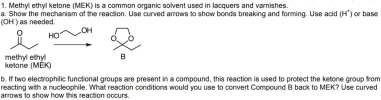 1. Methyl ethyl ketone (MEK) is a common organic solvent used in lacquers and varnishes. a. Show the mechanism of the reaction. Use curved arrows to show bonds breaking and forming. Use acid (H) or base (OH) as needed. O. O methyl ethyl ketone (MEK) b. If two electrophilic functional groups are present in a compound, this reaction is used to protect the ketone group from reacting with a nucleophile. What reaction conditions would you use to convert Compound B...
Risk assessment for: Synthesis of isoamyl acetate via Fischer esterification Student Name: Chemical Potential hazards How...
 Risk assessment for: Synthesis of isoamyl acetate via Fischer esterification Student Name: Chemical Potential hazards How could you be exposed to this hazard? given the exposure, Level of risk what is negative (probability) 0–4 outcome? Suggested protective measure Isopentyl alcohol Glacial acetic acid conc. Sulfuric acid aq 5% sodium bicarbonate anhydrous sodium sulfate isopenyl acetate
Risk assessment for: Synthesis of isoamyl acetate via Fischer esterification Student Name: Chemical Potential hazards How...
 Risk assessment for: Synthesis of isoamyl acetate via Fischer esterification Student Name: Chemical Potential hazards How could you be exposed to this hazard? given the exposure, Level of risk what is negative (probability) 0–4 outcome? Suggested protective measure Isopentyl alcohol Glacial acetic acid conc. Sulfuric acid aq 5% sodium bicarbonate anhydrous sodium sulfate isopenyl acetate
 organic chemistry. why is CH3ONa not used in the claisen
condensation of ethyl acetate
12. Why is CH3ONa not used in the Claisen condensation of ethyl acetate? a. CH30 is a weaker base than the CH3CH20-which is used. b. CH3O- Nat is more difficult to prepare than CH3CH2O Nat. c. CH3O- would abstract a proton from the ethyl group of the ester. d. Use of CH,O- Na would result in transesterification e. CH,O- Na can be used as well as...
organic chemistry. why is CH3ONa not used in the claisen
condensation of ethyl acetate
12. Why is CH3ONa not used in the Claisen condensation of ethyl acetate? a. CH30 is a weaker base than the CH3CH20-which is used. b. CH3O- Nat is more difficult to prepare than CH3CH2O Nat. c. CH3O- would abstract a proton from the ethyl group of the ester. d. Use of CH,O- Na would result in transesterification e. CH,O- Na can be used as well as...
 1)When you perform a liquid-liquid extraction using a separatory funnel, which of the following organic solvent is on the bottom of the aqueous phase and which is on top? (write your answer by the solvent name) a) Ethyl acetate b) hexane c) Dichloromethane d) diethyl ether 2) If you are performing a liquid-liquid extraction and you have a mix of a carboxylic acid and a non-acidic compound, which combination of solvents would you use for the separation? a) dichloromethane/HCI b)...
 (4pts) When you perform a liquid-liquid ext 17) which of the following organic solvent is on the bottoming a extraction us which is on top? (write your answer by the solvent name p a) Ethyl acetate b) hexane c) Dichloromethane d) diethyl ether a liquid-liquid extraction and you have a 18) (3pts) If you are performing carboxylic acid and a non-acidic compound, which combinat you use for the separation? of solvents a) dichloromethane/HCI b) dichloromethane/methanol c) dicholoromethane/NaOH d) NaOH and...
 The recrystallization technique discusses using a drying agent before recrystallizing out of an organic solvent, however, we omitted the drying step before evaporating off the ethyl acetate. Since we didn't dry this sample, what potential issues might this have caused for analysis of the benzoin sample? Be specific about the effects it would have (if any) on each of the three analysis techniques we used. (4 pts) Melting Point, thin layer chromotography, and gas chromotography
 1. Methyl ethyl ketone (MEK) is a common organic solvent used in lacquers and varnishes. a. Show the mechanism of the reaction. Use curved arrows to show bonds breaking and forming. Use acid (H) or base (OH) as needed. O. O methyl ethyl ketone (MEK) b. If two electrophilic functional groups are present in a compound, this reaction is used to protect the ketone group from reacting with a nucleophile. What reaction conditions would you use to convert Compound B...
 Risk assessment for: Synthesis of isoamyl acetate via Fischer esterification Student Name: Chemical Potential hazards How could you be exposed to this hazard? given the exposure, Level of risk what is negative (probability) 0–4 outcome? Suggested protective measure Isopentyl alcohol Glacial acetic acid conc. Sulfuric acid aq 5% sodium bicarbonate anhydrous sodium sulfate isopenyl acetate
 Risk assessment for: Synthesis of isoamyl acetate via Fischer esterification Student Name: Chemical Potential hazards How could you be exposed to this hazard? given the exposure, Level of risk what is negative (probability) 0–4 outcome? Suggested protective measure Isopentyl alcohol Glacial acetic acid conc. Sulfuric acid aq 5% sodium bicarbonate anhydrous sodium sulfate isopenyl acetate
Most questions answered within 3 hours.
-
Where is the error in this code sequence?
String s1 = "Hello";
String s2 = "ello";...
asked 10 months ago -
Financial data for Joel de Paris, Inc., for last year
follow:
Joel de Paris, Inc.
Balance...
asked 10 months ago -
Consider this reaction:
Al2(SO4)3 (aq)+ BaCl3
(aq) Al2Cl6 (aq)- +
3BaSO4(s) . What is the...
asked 10 months ago -
Suppose that Savneet is considering increasing her
recent random sample from 20 car rentals to 40...
asked 10 months ago -
Trucks arrive at an unloading terminal at an average rate of 120
per hour.
Trucks arrive...
asked 10 months ago -
Why are methanol and ethanol completely soluble in water while
octanol is not very little soluble....
asked 10 months ago -
A facilities manager at a university reads in a research report
that the mean amount of...
asked 10 months ago -
When the CuSO4 is rehydrated by adding water to the anhydrous
compound, is this an endothermic...
asked 10 months ago -
A ray of sunlight is passing from diamond into crown glass; the
angle of incidence is...
asked 10 months ago -
A block of mass 0.249 kg is placed on top of a light, vertical
spring of...
asked 10 months ago -
how do the kidneys compensate in the presences of acidosis
a) trigger hyperventilate
b) reserve acid...
asked 10 months ago -
Question 501 pts
The rental rate of capital to the firm increases. Which of the
following...
asked 10 months ago