Low solute retention in gas chromatography is loosely associated with: A) low boiling points. B) low...
Low solute retention in gas chromatography is loosely associated with:
A) low boiling points.
B) low vapor pressure.
C) high boiling points.
D) high molar mass.
E) high viscosity.
Homework Answers
Option A
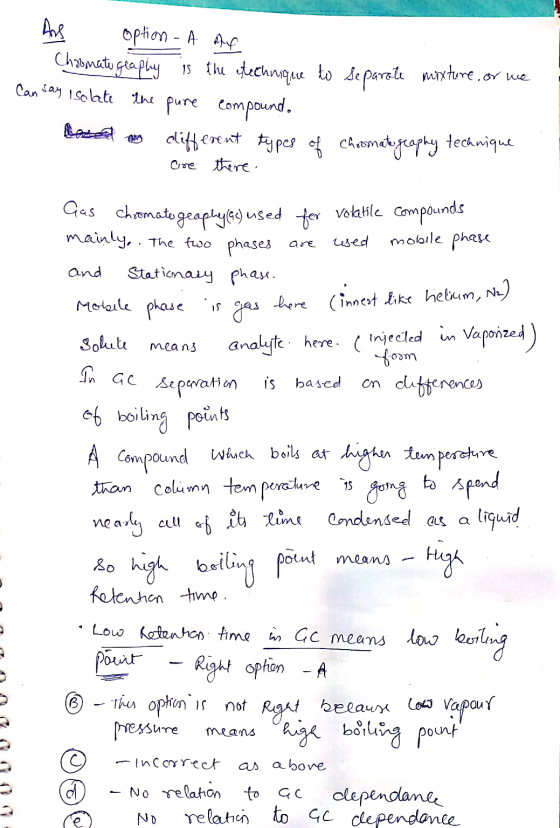
Add Answer to:
Low solute retention in gas chromatography is loosely associated
with:
A) low boiling points.
B) low...
As you increase the gas chromatography column temperature, analytes’ ______________ increases and stationary phase solubility _______________....
As you increase the gas chromatography column temperature, analytes’ ______________ increases and stationary phase solubility _______________. A) boiling point; increases B) vapor pressure; decreases C) vapor pressure; increases D) retention time; increases E) retention time; decreases
Lab #2: Gas Chromatography Theory behind gas chromatography What do all types of chromatography share in...
 Lab #2: Gas Chromatography Theory behind gas chromatography What do all types of chromatography share in common? Relationship between retention time and boiling point/vapor pressure How changing parameters affect the retention time Ramp rate Temperature Length of column Pressure Whether column is packed or unpacked
1. A mixture of four alkenes (1-decene, 1-heptene, 1-nonene, and 1-octene) was analyzed by gas chromatography....
 1. A mixture of four alkenes (1-decene, 1-heptene, 1-nonene, and 1-octene) was analyzed by gas chromatography. Below, on the line, list the four alkenes in order of increasing retention time: 2. At 760.0 mm atmospheric pressure, a binary liquid mixture of components A and B gives the temperature composition diagram shown below. The liquid curve plots boiling point vs. composition of the liquid mixture. The vapor curve plots temperature vs. equilibrium vapor composition. A horizontal line on the diagram, such...
1. Calculate the vapor pressure of heptane (b.p. 98.0 ∘C98.0 ∘C) at the gas chromatography column...
1. Calculate the vapor pressure of heptane (b.p. 98.0 ∘C98.0 ∘C) at the gas chromatography column temperature of 94.0 ∘C94.0 ∘C using the form of the Clausius–Clapeyron equation shown ln(P1P2)=−(ΔHvapR)(1T1−1T2)ln(P1P2)=−(ΔHvapR)(1T1−1T2) where RR is the ideal gas constant, ΔHvapΔHvap is the enthalpy of vaporization, T1T1 and T2T2 are two different temperatures, and P1P1 and P2P2 are the vapor pressures at the respective temperatures. The enthalpy of vaporization can be estimated using Trouton's rule, ΔH∘vap=(88 J⋅mol−1⋅K−1)×Tbp.ΔHvap∘=(88 J·mol−1⋅K−1)×Tbp. P= 2. Calculate the vapor...
Calculate the vapor pressure of 3-pentanone (b.p. 102.0 °C) at the gas chromatography column temperature of...
 Calculate the vapor pressure of 3-pentanone (b.p. 102.0 °C) at the gas chromatography column temperature of 96.0"C using the form of the Clausius-Clapeyron equation shown below, P1 P. vap where R is the ideal gas constant, ???? is the enthalpy of vaporization, T1 and T2 are two different temperatures, and P1 and P2 are the vapor pressures at the respective temperatures. The enthalpy of vaporization can be estimated using Trouton's rule, ??'vap-(88 J mol-1 K-1), Tp. Number Torr Calculate the...
PART 1: In a gas chromatography experiment using a non-polar stationary phase A) solutes are eluted...
PART 1: In a gas chromatography experiment using a non-polar stationary phase A) solutes are eluted in order of increasing boiling point. B) solutes are eluted in order of increasing vapor pressure. C) solutes are eluted in order of increasing polarity. PART 2: You can improve the separation of components in gas chromatography by A) raising the temperature of the injection port. B)raising the temperature of the column isothermally. C) raising the temperature of the column programmatically.
Which of the following is not an assumptions associated with the Clausius Clapeyron equation? a)the system...
Which of the following is not an assumptions associated with the Clausius Clapeyron equation? a)the system is at high pressure b)the vapor phase is an ideal gas c) the latent heat of vaporisation is constant d) the molar volume of the liquid is negligible compared with the molar volume of the vapor
In a boiling point elevation experiment, the number of mol of a nonionizing, nonvolatile solute dissolved...
In a boiling point elevation experiment, the number of mol of a nonionizing, nonvolatile solute dissolved in benzene is 0.00176 mol. The mass of the solute is 3.55g. What is the approximate molar mass of the nonionizing, nonvolatile substance? Consider amu equivalent to g / mol (molar mass ) A. 20,000 amu B. 20 amu C. 2000 amu D. 500 amu
9) An increase in the temperature of a solution usually A) increases the boiling point. B)...
 9) An increase in the temperature of a solution usually A) increases the boiling point. B) increases the solubility of a gas in the solution. C) increases the solubility of a solid solute in the solution. D) decreases the solubility of a solid solute in the solution. E) decreases the solubility of a liquid solute in the solution. 10) The solubility of Kl is 50 g in 100 g of H20 at 20°C. If 110 grams of Kl are added...
A) The normal boiling point of ethanol, CH3CH2OH, is 78.4 ∘C. When 8.45 g of a...
A) The normal boiling point of ethanol, CH3CH2OH, is 78.4 ∘C. When 8.45 g of a soluble nonelectrolyte is dissolved in 100.0 g of ethanol at that temperature, the vapor pressure of the solution is 7.40×10²torr. What is the molar mass of the solute?
 Lab #2: Gas Chromatography Theory behind gas chromatography What do all types of chromatography share in common? Relationship between retention time and boiling point/vapor pressure How changing parameters affect the retention time Ramp rate Temperature Length of column Pressure Whether column is packed or unpacked
 1. A mixture of four alkenes (1-decene, 1-heptene, 1-nonene, and 1-octene) was analyzed by gas chromatography. Below, on the line, list the four alkenes in order of increasing retention time: 2. At 760.0 mm atmospheric pressure, a binary liquid mixture of components A and B gives the temperature composition diagram shown below. The liquid curve plots boiling point vs. composition of the liquid mixture. The vapor curve plots temperature vs. equilibrium vapor composition. A horizontal line on the diagram, such...
 Calculate the vapor pressure of 3-pentanone (b.p. 102.0 °C) at the gas chromatography column temperature of 96.0"C using the form of the Clausius-Clapeyron equation shown below, P1 P. vap where R is the ideal gas constant, ???? is the enthalpy of vaporization, T1 and T2 are two different temperatures, and P1 and P2 are the vapor pressures at the respective temperatures. The enthalpy of vaporization can be estimated using Trouton's rule, ??'vap-(88 J mol-1 K-1), Tp. Number Torr Calculate the...
 9) An increase in the temperature of a solution usually A) increases the boiling point. B) increases the solubility of a gas in the solution. C) increases the solubility of a solid solute in the solution. D) decreases the solubility of a solid solute in the solution. E) decreases the solubility of a liquid solute in the solution. 10) The solubility of Kl is 50 g in 100 g of H20 at 20°C. If 110 grams of Kl are added...
Most questions answered within 3 hours.
-
Where is the error in this code sequence?
String s1 = "Hello";
String s2 = "ello";...
asked 11 months ago -
Financial data for Joel de Paris, Inc., for last year
follow:
Joel de Paris, Inc.
Balance...
asked 11 months ago -
Consider this reaction:
Al2(SO4)3 (aq)+ BaCl3
(aq) Al2Cl6 (aq)- +
3BaSO4(s) . What is the...
asked 11 months ago -
Suppose that Savneet is considering increasing her
recent random sample from 20 car rentals to 40...
asked 11 months ago -
Trucks arrive at an unloading terminal at an average rate of 120
per hour.
Trucks arrive...
asked 11 months ago -
Why are methanol and ethanol completely soluble in water while
octanol is not very little soluble....
asked 11 months ago -
A facilities manager at a university reads in a research report
that the mean amount of...
asked 11 months ago -
When the CuSO4 is rehydrated by adding water to the anhydrous
compound, is this an endothermic...
asked 11 months ago -
A ray of sunlight is passing from diamond into crown glass; the
angle of incidence is...
asked 11 months ago -
A block of mass 0.249 kg is placed on top of a light, vertical
spring of...
asked 11 months ago -
how do the kidneys compensate in the presences of acidosis
a) trigger hyperventilate
b) reserve acid...
asked 11 months ago -
Question 501 pts
The rental rate of capital to the firm increases. Which of the
following...
asked 11 months ago