![11) Which rate law is unimolecular? A) Rate = k[A]2 B) Rate =k[A][B] C) Rate = k[A][B][C] D) Rate = k[A] E) Rate =k[A]3 12) W](http://img.homeworklib.com/questions/478afae0-d1ae-11eb-870e-bdde108c0b94.png?x-oss-process=image/resize,w_560)
Homework Answers
Add Answer to:
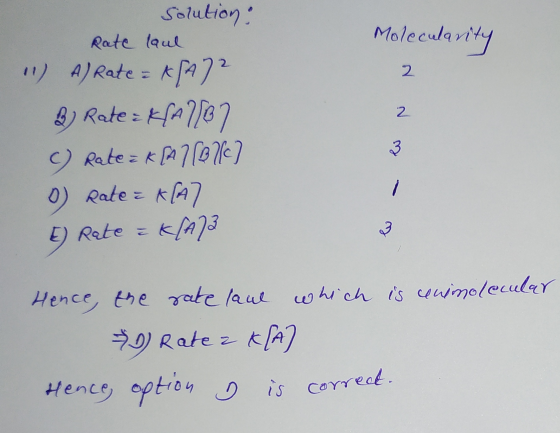
11) Which rate law is unimolecular? A) Rate = k[A]2 B) Rate =k[A][B] C) Rate =...
62) Which rate law is termolecular? A) rate = k[A]2[B] B) rate = k [A] [B]3...
 62) Which rate law is termolecular? A) rate = k[A]2[B] B) rate = k [A] [B]3 C) rate = k [A] D) rate = k [A][B][C][D] E) rate = k [A]2 63) Which rate law is bimolecular? A) rate = k[A] [B13 B) rate = k[A][B] C) rate = k[A]3 D) rate = k[A][B][C][D] E) rate = k[A]2[B]4
Which rate law is bimolecular? rate = k[A]2[B]4 rate = k[A]5[B]3 rate = k[A][B][C][D] rate =...
Which rate law is bimolecular? rate = k[A]2[B]4 rate = k[A]5[B]3 rate = k[A][B][C][D] rate = k[A][B] rate = k[A]3
Consider the overall reaction.... A+B--C+D which has an observed rate law of Rate=k[A12 Which of the...
 Consider the overall reaction.... A+B--C+D which has an observed rate law of Rate=k[A12 Which of the following choices would be a sensible 2-step mechanism, given this observed rate law? O A+A-->E slow E+B-->C+D fast A+B--> 2 E --> C+D fast slow A+A-->E E+B-->C+D fast slow A+B-->E 2 E -->C+D slow fast
Which rate law is termolecular? SmallCircle rate = k[A]^2 [B] SmallCircle rate = k[A]^2 SmallCircle rate...
 Which rate law is termolecular? SmallCircle rate = k[A]^2 [B] SmallCircle rate = k[A]^2 SmallCircle rate = k[A][B]^3 SmallCircle rate = k[A] SmallCircle rate = k[A][B][C][D]
The reaction of NO gas with H2 gas has the following rate law: Rate = k[H2][NO]2...
The reaction of NO gas with H2 gas has the following rate law: Rate = k[H2][NO]2 A proposed mechanism is: Step 1: H2 (g) + 2 NO (g) → N2O (g) + H2O (g) Step 2: N2O (g) + H2 (g) → N2 (g) + H2O (g) What is the molecularity is step 1? What is the molecularity in step 2? Which step is the rate-determining step?
2 6. Which of the following is true of enzymes? The majority of enzymes are nonspecific...
 2 6. Which of the following is true of enzymes? The majority of enzymes are nonspecific b. The majority of enzymes operate under extremely high temperatures e. They are biological catalysts d. They are all irreversible 7. Activation energy is a. Energy that must be added to a reaction started, which is recovered as the reaction proceeds b. Difference in energy between reactants and products c. Energy lost as heat d. free energy 8. Metal ions enhance catalysis by a....
For the chemical reaction: A + B 3 C observed to have a rate law...
For the chemical reaction: A + B 3 C observed to have a rate law of Rate = k [B]2, the following reaction mechanism has been proposed. 2 B D (slow) D + A 3 C + B In your evaluation of the reaction mechanism you would conclude the mechanism is: A) a plausible representation of the reaction B) an implausible representation as the predicted rate law does not match the observed rate law C) an implausible...
Enzymes are biological catalysts and Unction by A) increasing the free energy in a system. B)...
 Enzymes are biological catalysts and Unction by A) increasing the free energy in a system. B) lowering the activation energy of a reaction. C) lowering entropy in a system. D) increasing the temperature near a reaction. E) altering the equilibrium of a reaction. Which of the following contributes to the specificity of enzymes? A) Each enzyme has a wide range of temperature and pH optimum B) Each enzyme has an active site that interacts with many C) Substrates themselves may...
36. Many biochemical enzyme reactions fit the form of Michaelis Menton Kinetics. These reactions have the...
 36. Many biochemical enzyme reactions fit the form of Michaelis Menton Kinetics. These reactions have the following characteristics: a) the rate of reaction is proportional to the enzyme concentration, E. b) at low substrate concentration the rate is proportional to the substrate concentration, S. c) at high substrate concentration the rate is independent of the substrate concentration, S. This type of reaction rate has the form - SE Ky + S When carried out in a batch reactor a material...
Which mechanism is consistent with the rate law rate = k[A][B]for the reaction A + 2B...
Which mechanism is consistent with the rate law rate = k[A][B]for the reaction A + 2B --> 2C? A) Step 1. A + B ---> F, slow Step 2. B + F ---> 2C, fast B) Step 1. B + B ---> D, slow Step 2. A + D ---> 2C, fast C) Step 1. A + A ---> E, slow Step 2. B + E ---> 2C, fast D) Step 1. A + B ---> G, fast Step 2....
 62) Which rate law is termolecular? A) rate = k[A]2[B] B) rate = k [A] [B]3 C) rate = k [A] D) rate = k [A][B][C][D] E) rate = k [A]2 63) Which rate law is bimolecular? A) rate = k[A] [B13 B) rate = k[A][B] C) rate = k[A]3 D) rate = k[A][B][C][D] E) rate = k[A]2[B]4
 Consider the overall reaction.... A+B--C+D which has an observed rate law of Rate=k[A12 Which of the following choices would be a sensible 2-step mechanism, given this observed rate law? O A+A-->E slow E+B-->C+D fast A+B--> 2 E --> C+D fast slow A+A-->E E+B-->C+D fast slow A+B-->E 2 E -->C+D slow fast
 Which rate law is termolecular? SmallCircle rate = k[A]^2 [B] SmallCircle rate = k[A]^2 SmallCircle rate = k[A][B]^3 SmallCircle rate = k[A] SmallCircle rate = k[A][B][C][D]
 2 6. Which of the following is true of enzymes? The majority of enzymes are nonspecific b. The majority of enzymes operate under extremely high temperatures e. They are biological catalysts d. They are all irreversible 7. Activation energy is a. Energy that must be added to a reaction started, which is recovered as the reaction proceeds b. Difference in energy between reactants and products c. Energy lost as heat d. free energy 8. Metal ions enhance catalysis by a....
 Enzymes are biological catalysts and Unction by A) increasing the free energy in a system. B) lowering the activation energy of a reaction. C) lowering entropy in a system. D) increasing the temperature near a reaction. E) altering the equilibrium of a reaction. Which of the following contributes to the specificity of enzymes? A) Each enzyme has a wide range of temperature and pH optimum B) Each enzyme has an active site that interacts with many C) Substrates themselves may...
 36. Many biochemical enzyme reactions fit the form of Michaelis Menton Kinetics. These reactions have the following characteristics: a) the rate of reaction is proportional to the enzyme concentration, E. b) at low substrate concentration the rate is proportional to the substrate concentration, S. c) at high substrate concentration the rate is independent of the substrate concentration, S. This type of reaction rate has the form - SE Ky + S When carried out in a batch reactor a material...
Most questions answered within 3 hours.
-
Where is the error in this code sequence?
String s1 = "Hello";
String s2 = "ello";...
asked 11 months ago -
Financial data for Joel de Paris, Inc., for last year
follow:
Joel de Paris, Inc.
Balance...
asked 11 months ago -
Consider this reaction:
Al2(SO4)3 (aq)+ BaCl3
(aq) Al2Cl6 (aq)- +
3BaSO4(s) . What is the...
asked 11 months ago -
Suppose that Savneet is considering increasing her
recent random sample from 20 car rentals to 40...
asked 11 months ago -
Trucks arrive at an unloading terminal at an average rate of 120
per hour.
Trucks arrive...
asked 11 months ago -
Why are methanol and ethanol completely soluble in water while
octanol is not very little soluble....
asked 11 months ago -
A facilities manager at a university reads in a research report
that the mean amount of...
asked 11 months ago -
When the CuSO4 is rehydrated by adding water to the anhydrous
compound, is this an endothermic...
asked 11 months ago -
A ray of sunlight is passing from diamond into crown glass; the
angle of incidence is...
asked 11 months ago -
A block of mass 0.249 kg is placed on top of a light, vertical
spring of...
asked 11 months ago -
how do the kidneys compensate in the presences of acidosis
a) trigger hyperventilate
b) reserve acid...
asked 11 months ago -
Question 501 pts
The rental rate of capital to the firm increases. Which of the
following...
asked 11 months ago