REPOSTING: observing pH changes in Water and Buffer solutions.
the amount added of HCl and NaOH are both 25mL.
the buffer solution is made of 2grams of NaC2H3O2 and 4 mL of 6M HC2H3O2 in a 50 mL solution (46mL of water). the solution will contain 2.4x10^-2 mol each of NaC2H3O2 a d HC2H3O2.
question:
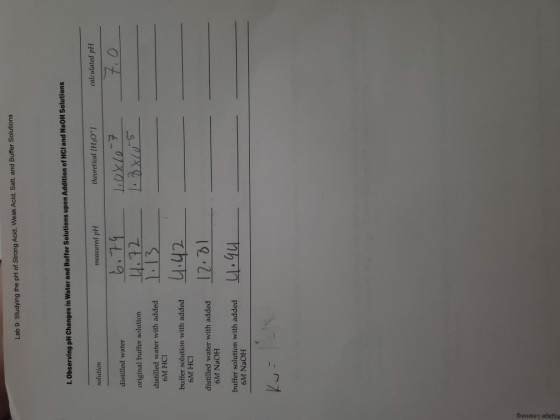
how to answer it (I'm not sure I'm doing it right and
want an expert to double check):
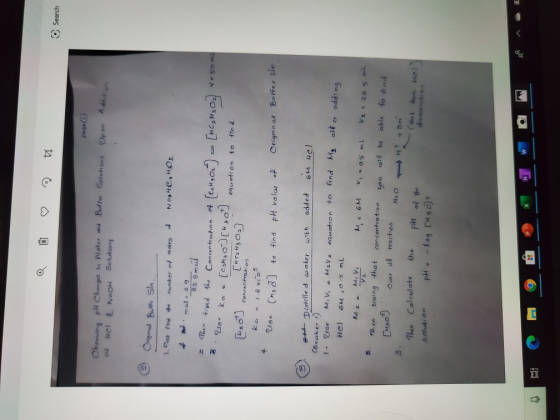
I need help calculating the theoretical and H3O+ concentration and the pH based off the theoretical.
Homework Answers
1. For the distilled water, pH = -log[H+] = - log(1* 10-7) = 7
2. For your original buffer solution:
The pH of a buffer solution is calculated from the Henderson-Hasselbach equation which is given below.
![salt pH = pka +log CH3COONa = pka + log! CH3O0H] Jacid](http://img.homeworklib.com/questions/a8389ec0-d215-11eb-b1e5-41164d44ecdb.png?x-oss-process=image/resize,w_560)
where, pH = -log[H+]
pKa = -log(Ka) = -log(1.78* 10-5) =4.75 ; Ka = acid dissociation constant of the weak acid (here CH3COOH)
[salt] = concentration of the salt (here CH3COONa)
[acid] = concentration of the weak acid (here CH3COOH)
Now,
Molecular mass of CH3COONa = 82 g/mol
Therefore, 2g CH3COONa = (2/ 82) mol = 2.4* 10-2 mol CH3COONa.
![2.4 x 10⁻² mol CH3COONa] =? = 0.48 M](http://img.homeworklib.com/questions/a88cdcb0-d215-11eb-b9e8-e32800b6d775.png?x-oss-process=image/resize,w_560)
[CH3COOH] is calculated from the dilution principle, which is

where, 






Therefore, ![SLT=l+H]601-](http://img.homeworklib.com/questions/ab8a1d10-d215-11eb-94cf-f5756367dff0.png?x-oss-process=image/resize,w_560)

3. Distilled water with added 0.5 mL 6M HCl solution:
Since HCl is a strong acid, it will be completely dissociated and produce a solution of 6M H+ solution. Now, the contribution of water to the concentration of H+ is negligible compared to that produced by HCl.
We will again use the formula  to calculate the final concentration of H+ in the solution.

Therefore, 
![pH = -log[H+] = -log(0.118) = 0.93](http://img.homeworklib.com/questions/ad2c0420-d215-11eb-b8ae-8d7432de5bc8.png?x-oss-process=image/resize,w_560)
4. For bufffer solution+0.5 mL 6M HCl solution:
0.5 mL 6M HCl contains  of HCl
This will convert the 3* 10-3 moles of CH3COONa to form additional 3* 10-3 moles of CH3COOH.
Therefore, the concentrations after adding HCl are
![(2.4 x 10⁻² – 3 x 10⁻³) mol CH3COONa] =? -= 0.42 M](http://img.homeworklib.com/questions/add37c20-d215-11eb-9ba8-59bba7135e33.png?x-oss-process=image/resize,w_560)
50 mL of 0.48M CH3COOH contains 2.4* 10-2 CH3COOH.

Therefore,


![Ꭽ9Ꭽ =l+H]601-](http://img.homeworklib.com/questions/af1c50c0-d215-11eb-be7b-95cd2b047d3a.png?x-oss-process=image/resize,w_560)

5.Distilled water with added 0.5 mL 6M NaOH solution:
Since NaOH is a strong base, it will be completely dissociated and produce a solution of 6M OH- .
We will again use the formula
to calculate the final concentration of OH- in the solution.
Therefore, ![OH-]=0.118 M](http://img.homeworklib.com/questions/b044f860-d215-11eb-9ca4-f3095bb62821.png?x-oss-process=image/resize,w_560)
![pOH = -log[OH-] = -log(0.118) = 0.93](http://img.homeworklib.com/questions/b09ef7d0-d215-11eb-8841-e95abf1938f6.png?x-oss-process=image/resize,w_560)

![pH = -log[H+] = 13.07](http://img.homeworklib.com/questions/b13f8280-d215-11eb-9378-493fc2d38c5a.png?x-oss-process=image/resize,w_560)

6.For bufffer solution+0.5 mL 6M NaOH solution:
0.5 mL 6M NaOH contains
of NaOH.
This will convert the 3* 10-3 moles of CH3COOH to form additional 3* 10-3 moles of CH3COONa.
Therefore, the concentrations after adding NaOH are

50 mL of 0.48M CH3COOH contains 2.4* 10-2 CH3COOH.

Therefore,
![CH3COON poh = pKa +log CH300H = 4.75 +log 0.541 0.42]](http://img.homeworklib.com/questions/b2cef9e0-d215-11eb-9f08-33f674e9fa46.png?x-oss-process=image/resize,w_560)


![+16=l+H]601-](http://img.homeworklib.com/questions/b3d11500-d215-11eb-9cdc-759732aeb56a.png?x-oss-process=image/resize,w_560)

Add Answer to:
REPOSTING: observing pH changes in Water and Buffer
solutions.
the amount added of HCl and NaOH...
buffer is HC2H3O2/NaC2H3O2 difference in PH: big change when added to buffer. small change when added...
 buffer is HC2H3O2/NaC2H3O2
difference in PH: big change when added to buffer. small
change when added to water. why?
why such a bug change when you add an acud or base to water
but not to butfer?
1. a) Describe the difference in observed pH changes upon adding a small amount of strong acid or base to 25.0 mL of water vs to 25.0 mL of your buffer. b) Explain why there was a difference. 6.0M HC,H,O, is corrosive. Prevent...
buffer is HC2H3O2/NaC2H3O2
difference in PH: big change when added to buffer. small
change when added to water. why?
why such a bug change when you add an acud or base to water
but not to butfer?
1. a) Describe the difference in observed pH changes upon adding a small amount of strong acid or base to 25.0 mL of water vs to 25.0 mL of your buffer. b) Explain why there was a difference. 6.0M HC,H,O, is corrosive. Prevent...
This pH is close to the pH of the original buffer solution (7.52). Procedure Preview vations =neutral Salt (ka=kb)...
 This pH is close to the pH of the original buffer solution (7.52). Procedure Preview vations =neutral Salt (ka=kb) 16 - 10.2] 1715 = Calculated K, for 0.1 MNH.CI, based on measured pH and Equation log CH 30+) chokw/kbpH of NH4Cl-5.61pit= - log [H3O+ sob 0 1 | ºf T4 M4 | 4 | 5 CNHH C 130+ | | 701 / 60H- Kh= (NH3] HP) - 10-5.6' x 10-5.6/0.13.1-.270.1 I. Observing pH Changes in Water and Butte ng pH...
Prepare dilute acid and base solutions and buffered acid and base solutions to observe how buffering...
 Prepare dilute acid and base solutions and buffered acid and base solutions to observe how buffering affects the pH. Use four clean, dry 50 ml beakers. Put these pH measurments in the Data Sheet Dilute NaOH Beaker 3 1. add 25 mL distilled H2O Buffered NaOH Beaker 4 1. add 25 mL of original buffer solution Dilute HCI Buffered HCI Beaker 1 Beaker 2 1. add 25 mL distilled 1. add 25 mL of H2O original buffer solution 2. Measure...
Calculate the pH of the acetate buffer after 4 mL of 0.100 M HCl has been...
Calculate the pH of the acetate buffer after 4 mL of 0.100 M HCl has been added. Acetate buffer is made with 0.160 M NaC2H3O2 & 0.200 M HC2H3O2. We also took 10 mL of acetate buffer and diluted with 30mL of distilled water at the beginning. Ka of HC2H3O2 is 1.8 x 10^-5. I tried doing the SRF table and the pH I got was higher than the pH at the beginning so I know I am doing something...
Calculate the pH of the acetate buffer after 28.00 mL 0.100 M HCl has been added....
Calculate the pH of the acetate buffer after 28.00 mL 0.100 M HCl has been added. There is 10 mL of the acetate buffer (0.16 M NaC2H3O2 / 0.2 M HC2H3O2) mixed with 30 mL of water in the buffer solution. The Pka of the buffer is 4.74. Ka = 1.76 x 10^-5 Please help, I've made ICE tables and tried using ph = pka +log (base/acid) and the pH I get is bigger than it should be. As more...
EQUL 499- Det. Of pH of Strong Acid, weak acid, salt, and buffer solution Discussion Topics...
 EQUL 499- Det. Of pH of Strong Acid, weak acid, salt, and buffer solution Discussion Topics Discussion Topics (need to submit in Blackboard): 1. What is a buffer? • A buffer is a solution that, when introduced to a new environment, undergoes minimal pH change, typically when adding acidic or basic solutions. These are extremely important for life because the pH of human blood is delicate and even if it is changed by 0.1, there may be catastrophic effects. 2....
Questions 1: A) Calculate the pH of a buffer solution that is 0.246 M in HCN...
Questions 1: A) Calculate the pH of a buffer solution that is 0.246 M in HCN and 0.166 M in KCN. For HCN, Ka = 4.9×10⁻¹⁰ (pKa = 9.31). B) Calculate the pH of a buffer solution that is 0.200 M in HC2H3O2 and 0.160 M in NaC2H3O2. (Ka for HC2H3O2 is 1.8×10⁻⁵.) C) Consider a buffer solution that is 0.50 M in NH3 and 0.20 M in NH4Cl. For ammonia, pKb=4.75. Calculate the pH of 1.0 L of the...
In this problem you will predict the pH of a buffer solution and then predict the...
In this problem you will predict the pH of a buffer solution and then predict the new pH after you add NaOH or HCl. Write your answers to three decimal places (X.XXX). The Ka of HC2H3O2 is 1.8×10−51.8×10−5. 1) Calculate the pH of a buffer made from mixing 11.011.0 mL of 0.080.08 M NaC2H3O2 and 9.29.2 mL of 0.080.08 M HC2H3O2. 2) Calculate the pH of the buffer when 5.25.2 mL of 0.0090.009 M NaOH is added to the buffer...
Calculate the pH of the acetate buffer after 28.00 mL 0.100 HCl has been added. 10...
Calculate the pH of the acetate buffer after 28.00 mL 0.100 HCl has been added. 10 mL of acetate buffer (Ka = 1.8 x 10^-5): 0.160 M NaC2H3O2 / 0.200 M HC2H3O2
PH of a buffer solution: Mass of NaC2H3O2 * 3H2O (FW=136g/mol): 3.540g Calculate the Theoretical ...
pH of a buffer solution: Mass of NaC2H3O2 * 3H2O (FW=136g/mol): 3.540g Calculate the Theoretical pH of these buffer solutions: A. pH of original buffer solution (with 8.8 mL of 3.0 M acetic acid and 55.6 mL of water) : 4.7 B. pH of buffer + 1.0 mL of 6.0 M HCl: 3.8 C. pH of buffer + 1.0 mL of 6.0 M NaOH: 4.9
 buffer is HC2H3O2/NaC2H3O2
difference in PH: big change when added to buffer. small
change when added to water. why?
why such a bug change when you add an acud or base to water
but not to butfer?
1. a) Describe the difference in observed pH changes upon adding a small amount of strong acid or base to 25.0 mL of water vs to 25.0 mL of your buffer. b) Explain why there was a difference. 6.0M HC,H,O, is corrosive. Prevent...
buffer is HC2H3O2/NaC2H3O2
difference in PH: big change when added to buffer. small
change when added to water. why?
why such a bug change when you add an acud or base to water
but not to butfer?
1. a) Describe the difference in observed pH changes upon adding a small amount of strong acid or base to 25.0 mL of water vs to 25.0 mL of your buffer. b) Explain why there was a difference. 6.0M HC,H,O, is corrosive. Prevent...
 This pH is close to the pH of the original buffer solution (7.52). Procedure Preview vations =neutral Salt (ka=kb) 16 - 10.2] 1715 = Calculated K, for 0.1 MNH.CI, based on measured pH and Equation log CH 30+) chokw/kbpH of NH4Cl-5.61pit= - log [H3O+ sob 0 1 | ºf T4 M4 | 4 | 5 CNHH C 130+ | | 701 / 60H- Kh= (NH3] HP) - 10-5.6' x 10-5.6/0.13.1-.270.1 I. Observing pH Changes in Water and Butte ng pH...
 Prepare dilute acid and base solutions and buffered acid and base solutions to observe how buffering affects the pH. Use four clean, dry 50 ml beakers. Put these pH measurments in the Data Sheet Dilute NaOH Beaker 3 1. add 25 mL distilled H2O Buffered NaOH Beaker 4 1. add 25 mL of original buffer solution Dilute HCI Buffered HCI Beaker 1 Beaker 2 1. add 25 mL distilled 1. add 25 mL of H2O original buffer solution 2. Measure...
 EQUL 499- Det. Of pH of Strong Acid, weak acid, salt, and buffer solution Discussion Topics Discussion Topics (need to submit in Blackboard): 1. What is a buffer? • A buffer is a solution that, when introduced to a new environment, undergoes minimal pH change, typically when adding acidic or basic solutions. These are extremely important for life because the pH of human blood is delicate and even if it is changed by 0.1, there may be catastrophic effects. 2....
Most questions answered within 3 hours.
-
Where is the error in this code sequence?
String s1 = "Hello";
String s2 = "ello";...
asked 11 months ago -
Financial data for Joel de Paris, Inc., for last year
follow:
Joel de Paris, Inc.
Balance...
asked 11 months ago -
Consider this reaction:
Al2(SO4)3 (aq)+ BaCl3
(aq) Al2Cl6 (aq)- +
3BaSO4(s) . What is the...
asked 11 months ago -
Suppose that Savneet is considering increasing her
recent random sample from 20 car rentals to 40...
asked 11 months ago -
Trucks arrive at an unloading terminal at an average rate of 120
per hour.
Trucks arrive...
asked 11 months ago -
Why are methanol and ethanol completely soluble in water while
octanol is not very little soluble....
asked 11 months ago -
A facilities manager at a university reads in a research report
that the mean amount of...
asked 11 months ago -
When the CuSO4 is rehydrated by adding water to the anhydrous
compound, is this an endothermic...
asked 11 months ago -
A ray of sunlight is passing from diamond into crown glass; the
angle of incidence is...
asked 11 months ago -
A block of mass 0.249 kg is placed on top of a light, vertical
spring of...
asked 11 months ago -
how do the kidneys compensate in the presences of acidosis
a) trigger hyperventilate
b) reserve acid...
asked 11 months ago -
Question 501 pts
The rental rate of capital to the firm increases. Which of the
following...
asked 11 months ago