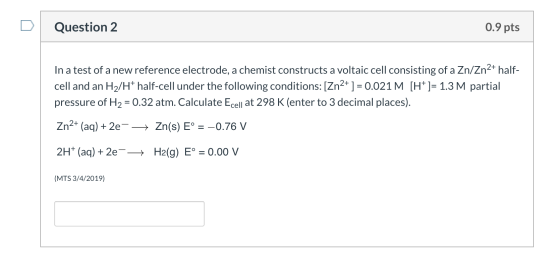
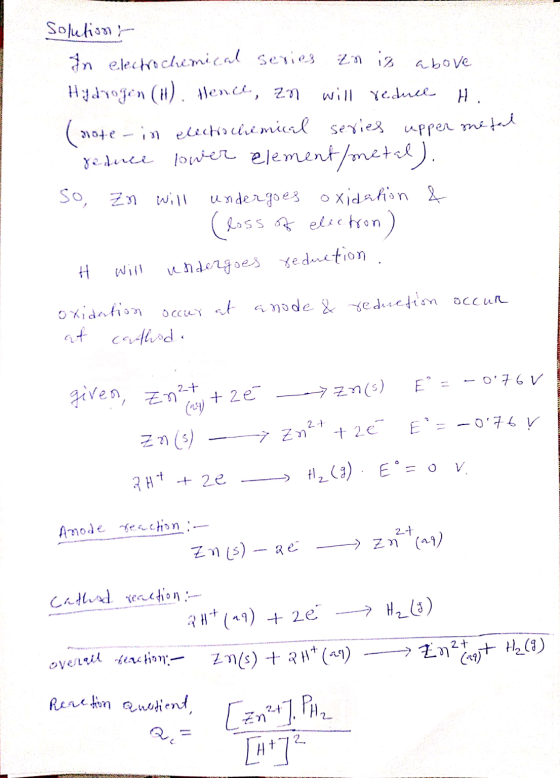
In a test of a new reference electrode, a chemist constructs a voltaic cell consisting of a Zn/Zn2+ half-cell and an H2/H+ half-cell under the following conditions: [Zn2+ ] = 0.021 M [H+ ]= 1.3 M partial pressure of H2 = 0.32 atm. Calculate Ecell at 298 K (enter to 3 decimal places).
Zn2+ (aq) + 2e −
−
 ⟶ Zn(s) E° = − 0.76 V
2H+ (aq) + 2e −
⟶ H2(g) E° = 0.00 V
Homework Answers
![Q = [zn 2+] x PHz H = partial pressme of H₂ gas, given, [2n++] = 0.021 M TH+] = 13 M latm=1013 bar A 0.32 atm ] = 032X1013](http://img.homeworklib.com/questions/fe1e8d50-d291-11eb-8d99-c36e23afa550.png?x-oss-process=image/resize,w_560)
Add Answer to:
In a test of a new reference electrode, a chemist constructs a
voltaic cell consisting of...
In a test of a new reference electrode, a chemist constructs a voltaic cell consisting of...
 In a test of a new reference electrode, a chemist constructs a voltaic cell consisting of a Zn/Zn2 half- cell and an H2/H half-cell under the following conditions: [Zn2] = 0.042 M [H]- 19 M partial pressure of H2 =0.37 atm. Calculate Ecell at 298 K (enter to 3 decimal places). Zn2 (aq) + 2e +2H (aq) + 2e1 Eo-0.76 V E 0.00 V Zn(s) H2(g)
Consider a voltaic cell al 25 degree Celsius in which the reaction is: Zn (s) +...
 Consider a voltaic cell al 25 degree Celsius in which the reaction is: Zn (s) + 2H+ (aq) → Zn2+ (aq) + H2(g) It is found that the voltage (think Ecell) is +0.560 V when [Zn2+1 -0.85 M and PH2 = = 0.988 atm. What is the pH in the H2-H half-cell?
The standard cell potential (E°) of a voltaic cell constructed using the cell reaction below is...
The standard cell potential (E°) of a voltaic cell constructed using the cell reaction below is 0.76 V: Zn (s) + 2H+ (aq) → Zn2+ (aq) + H2 (g) With PH2 = 1.0 atm and [Zn2+] = 1.0 M, the cell potential is 0.42 V. The concentration of H+ in the cathode compartment is ________ M. please explain the math Thank you
1.A voltaic cell is constructed that uses the following reaction and operates at 298 K. Zn(s)...
 1.A voltaic cell is constructed that uses the following reaction
and operates at 298 K.
Zn(s) + Ni2+(aq)
Zn2+(aq) + Ni(s)
2.A voltaic cell utilizes the following reaction and operates at
298 K.
3 Ce4+(aq) + Cr(s)
3 Ce3+(aq) + Cr3+(aq)
We were unable to transcribe this imageA voltaic cell is constructed that uses the following reaction and operates at 298 K. Zn(s) + Ni2+(aq) → Zn2+ (aq) + Ni(s) (a) What is the emf of this cell under standard...
1.A voltaic cell is constructed that uses the following reaction
and operates at 298 K.
Zn(s) + Ni2+(aq)
Zn2+(aq) + Ni(s)
2.A voltaic cell utilizes the following reaction and operates at
298 K.
3 Ce4+(aq) + Cr(s)
3 Ce3+(aq) + Cr3+(aq)
We were unable to transcribe this imageA voltaic cell is constructed that uses the following reaction and operates at 298 K. Zn(s) + Ni2+(aq) → Zn2+ (aq) + Ni(s) (a) What is the emf of this cell under standard...
In a copper-zinc voltaic cell, one half-cell consists of a ZnZn electrode inserted in a solution...
 In a copper-zinc voltaic cell, one half-cell consists of a ZnZn
electrode inserted in a solution of zinc sulfate and the other
half-cell consists of a CuCu electrode inserted in a copper sulfate
solution. These two half-cells are separated by a salt bridge.
At the zinc electrode (anode), ZnZn metal undergoes oxidation by
losing two electrons and enters the solution as Zn2+Zn2+ ions. The
oxidation half-cell reaction that takes place at the anode is
Zn(s)→Zn2+(aq)+2e−Zn(s)→Zn2+(aq)+2e−
The CuCu ions undergo reduction...
In a copper-zinc voltaic cell, one half-cell consists of a ZnZn
electrode inserted in a solution of zinc sulfate and the other
half-cell consists of a CuCu electrode inserted in a copper sulfate
solution. These two half-cells are separated by a salt bridge.
At the zinc electrode (anode), ZnZn metal undergoes oxidation by
losing two electrons and enters the solution as Zn2+Zn2+ ions. The
oxidation half-cell reaction that takes place at the anode is
Zn(s)→Zn2+(aq)+2e−Zn(s)→Zn2+(aq)+2e−
The CuCu ions undergo reduction...
A voltaic cell is set up with one beaker containing 1.0 M Zn(NO 3) 2 and...
A voltaic cell is set up with one beaker containing 1.0 M Zn(NO 3) 2 and a zinc electrode, and another beaker containing 1.0 M Ni(NO 3) 2 and a nickel electrode. Given the following standard reduction potentials, answer the 3 questions below: Eº Zn2+(aq) + 2e → Zn(s) -0.76 V Ni2+(aq) + 2e → Ni(s) -0.23V Part a. Write out the half-cell reaction that occurs at the anode of the voltaic cell. Part b. In which direction do...
The standard cell potential (E°) of a voltaic cell constructed using the cell reaction below is...
The standard cell potential (E°) of a voltaic cell constructed using the cell reaction below is 0.76 V: Zn(s) + 2H+(aq) → Zn2+(aq) + H2(g) With PH2= 1.0 atm and [Zn2+] = 1.0 mol L-1, the cell potential is 0.37 V. The concentration of H+ in the cathode compartment is ________ mol L-1. Answers: 2.6 × 10⁻⁷ 5.1 × 10⁻⁴ 0.686.6 × 10-14 4.3 × 10⁻²⁷
tion 3 of 40 ) A voltaic cell employs the redox reaction: Zn (s) + Pb2+...
 tion 3 of 40 ) A voltaic cell employs the redox reaction: Zn (s) + Pb2+ (aq) — Zn2+ (aq) + Pb () where Pb2+ (aq) + 2e Zn2+(aq) + 2e Pb(s) E = -0.1262 V Zn(s) E = -0.7618 V The cell potential (Ecell) of this voltaic cell when [Pb2+1 = 1.10 M and [Zn2+) = 0.00110 Mis:
17. A voltaic cell consists of a Hg/Hg2+ electrode (E°=0.85 V) and a Sn/Sn?* electrode (E°=...
 17. A voltaic cell consists of a Hg/Hg2+ electrode (E°=0.85 V) and a Sn/Sn?* electrode (E°= -0.14 V). Calculate [Sn2] if [Hg2+] = 0.48 M and Ecell = 1.04 V at 25°C. A. 6.8E-2 M B. 9.8E-3 M C. 3.4E0M D. 2.4E1 M E. 4.8E-1 M We were unable to transcribe this image
Separate galvanic cells are made from the following half-cells: cell 1: H+(aq)/H2(g) and Pb2+(aq)/Pb(s) cell 2:...
 Separate galvanic cells are made from the following half-cells: cell 1: H+(aq)/H2(g) and Pb2+(aq)/Pb(s) cell 2: Fe2+(aq)/Fe(s) and Zn2+(aq)/Zn(s) Which of the following is correct for the working cells? Standard reduction potentials, 298 K, Aqueous Solution (pH = 0): Cl2(g) + 2e --> 2C1-(aq); E° = +1.36 V Fe3+(aq) + e --> Fe2+(aq); E° = +0.77 V Cu2+(aq) + 2e --> Cu(s); E° = +0.34 V 2H+(aq) + 2e --> H2(g); E° = 0.00 V Pb2+(aq) + 2e --> Pb(s);...
 In a test of a new reference electrode, a chemist constructs a voltaic cell consisting of a Zn/Zn2 half- cell and an H2/H half-cell under the following conditions: [Zn2] = 0.042 M [H]- 19 M partial pressure of H2 =0.37 atm. Calculate Ecell at 298 K (enter to 3 decimal places). Zn2 (aq) + 2e +2H (aq) + 2e1 Eo-0.76 V E 0.00 V Zn(s) H2(g)
 Consider a voltaic cell al 25 degree Celsius in which the reaction is: Zn (s) + 2H+ (aq) → Zn2+ (aq) + H2(g) It is found that the voltage (think Ecell) is +0.560 V when [Zn2+1 -0.85 M and PH2 = = 0.988 atm. What is the pH in the H2-H half-cell?
 1.A voltaic cell is constructed that uses the following reaction
and operates at 298 K.
Zn(s) + Ni2+(aq)
Zn2+(aq) + Ni(s)
2.A voltaic cell utilizes the following reaction and operates at
298 K.
3 Ce4+(aq) + Cr(s)
3 Ce3+(aq) + Cr3+(aq)
We were unable to transcribe this imageA voltaic cell is constructed that uses the following reaction and operates at 298 K. Zn(s) + Ni2+(aq) → Zn2+ (aq) + Ni(s) (a) What is the emf of this cell under standard...
1.A voltaic cell is constructed that uses the following reaction
and operates at 298 K.
Zn(s) + Ni2+(aq)
Zn2+(aq) + Ni(s)
2.A voltaic cell utilizes the following reaction and operates at
298 K.
3 Ce4+(aq) + Cr(s)
3 Ce3+(aq) + Cr3+(aq)
We were unable to transcribe this imageA voltaic cell is constructed that uses the following reaction and operates at 298 K. Zn(s) + Ni2+(aq) → Zn2+ (aq) + Ni(s) (a) What is the emf of this cell under standard...
 In a copper-zinc voltaic cell, one half-cell consists of a ZnZn
electrode inserted in a solution of zinc sulfate and the other
half-cell consists of a CuCu electrode inserted in a copper sulfate
solution. These two half-cells are separated by a salt bridge.
At the zinc electrode (anode), ZnZn metal undergoes oxidation by
losing two electrons and enters the solution as Zn2+Zn2+ ions. The
oxidation half-cell reaction that takes place at the anode is
Zn(s)→Zn2+(aq)+2e−Zn(s)→Zn2+(aq)+2e−
The CuCu ions undergo reduction...
In a copper-zinc voltaic cell, one half-cell consists of a ZnZn
electrode inserted in a solution of zinc sulfate and the other
half-cell consists of a CuCu electrode inserted in a copper sulfate
solution. These two half-cells are separated by a salt bridge.
At the zinc electrode (anode), ZnZn metal undergoes oxidation by
losing two electrons and enters the solution as Zn2+Zn2+ ions. The
oxidation half-cell reaction that takes place at the anode is
Zn(s)→Zn2+(aq)+2e−Zn(s)→Zn2+(aq)+2e−
The CuCu ions undergo reduction...
 tion 3 of 40 ) A voltaic cell employs the redox reaction: Zn (s) + Pb2+ (aq) — Zn2+ (aq) + Pb () where Pb2+ (aq) + 2e Zn2+(aq) + 2e Pb(s) E = -0.1262 V Zn(s) E = -0.7618 V The cell potential (Ecell) of this voltaic cell when [Pb2+1 = 1.10 M and [Zn2+) = 0.00110 Mis:
 17. A voltaic cell consists of a Hg/Hg2+ electrode (E°=0.85 V) and a Sn/Sn?* electrode (E°= -0.14 V). Calculate [Sn2] if [Hg2+] = 0.48 M and Ecell = 1.04 V at 25°C. A. 6.8E-2 M B. 9.8E-3 M C. 3.4E0M D. 2.4E1 M E. 4.8E-1 M We were unable to transcribe this image
 Separate galvanic cells are made from the following half-cells: cell 1: H+(aq)/H2(g) and Pb2+(aq)/Pb(s) cell 2: Fe2+(aq)/Fe(s) and Zn2+(aq)/Zn(s) Which of the following is correct for the working cells? Standard reduction potentials, 298 K, Aqueous Solution (pH = 0): Cl2(g) + 2e --> 2C1-(aq); E° = +1.36 V Fe3+(aq) + e --> Fe2+(aq); E° = +0.77 V Cu2+(aq) + 2e --> Cu(s); E° = +0.34 V 2H+(aq) + 2e --> H2(g); E° = 0.00 V Pb2+(aq) + 2e --> Pb(s);...
Most questions answered within 3 hours.
-
Where is the error in this code sequence?
String s1 = "Hello";
String s2 = "ello";...
asked 10 months ago -
Financial data for Joel de Paris, Inc., for last year
follow:
Joel de Paris, Inc.
Balance...
asked 10 months ago -
Consider this reaction:
Al2(SO4)3 (aq)+ BaCl3
(aq) Al2Cl6 (aq)- +
3BaSO4(s) . What is the...
asked 10 months ago -
Suppose that Savneet is considering increasing her
recent random sample from 20 car rentals to 40...
asked 10 months ago -
Trucks arrive at an unloading terminal at an average rate of 120
per hour.
Trucks arrive...
asked 10 months ago -
Why are methanol and ethanol completely soluble in water while
octanol is not very little soluble....
asked 10 months ago -
A facilities manager at a university reads in a research report
that the mean amount of...
asked 10 months ago -
When the CuSO4 is rehydrated by adding water to the anhydrous
compound, is this an endothermic...
asked 10 months ago -
A ray of sunlight is passing from diamond into crown glass; the
angle of incidence is...
asked 10 months ago -
A block of mass 0.249 kg is placed on top of a light, vertical
spring of...
asked 10 months ago -
how do the kidneys compensate in the presences of acidosis
a) trigger hyperventilate
b) reserve acid...
asked 10 months ago -
Question 501 pts
The rental rate of capital to the firm increases. Which of the
following...
asked 10 months ago