
Homework Answers
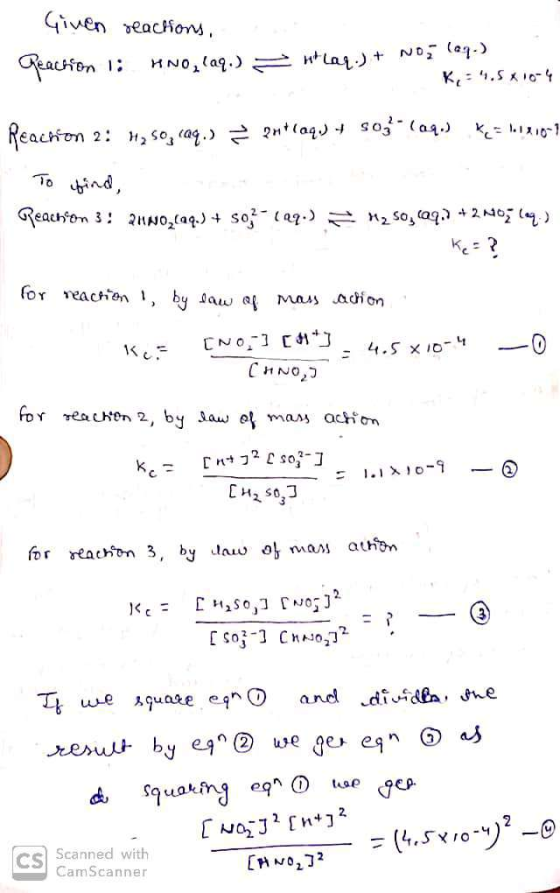
![Dividing eqh 4 by can we get [NozJ? c Mys03] - 14.5x10⁻¹² - © Isobn] [ HNOL] 2 1.1X10⁻⁹ Right hand side of egn @ and ean are](http://img.homeworklib.com/questions/5edb1940-d2f9-11eb-b46d-752e2f6a7847.png?x-oss-process=image/resize,w_560) Hope you will like my
answer:)
Hope you will like my
answer:)
Add Answer to:
Part A - Combining Equilibrium Expressions Given the equilibrium constants for the following two reactions in...
Chapter 15 Combining Equilibrium Constants 14 of 32 Review Constants Periodic Table Part A It is...
 Chapter 15 Combining Equilibrium Constants 14 of 32 Review Constants Periodic Table Part A It is possible to predict the equilibrium constant of a reaction by combining two or more reactions for which the value of Kis known. When combining equilibrium constant is important to note the following • When a reaction is reversed its Kales inverted that is, Ki-1/uwa • When the coefficients of a reaction are multiplied by a factor, the K value is raised to the power...
Given the following acid dissociation constants, Ka (HNO2) = 4.0 x 10⁻⁴ Ka (HCN) = 4.0...
Given the following acid dissociation constants, Ka (HNO2) = 4.0 x 10⁻⁴ Ka (HCN) = 4.0 x10⁻¹⁰ determine the equilibrium constant for the reaction below. HCN(aq) + NO2 - (aq) CN- (aq) + HNO2(aq)
4.8 Write the expressions for the equilibrium constants for the following reactions , making the approximation...
4.8 Write the expressions for the equilibrium constants for the following reactions , making the approximation of replacing activities by molar concentrations or partial pressures : (a) G6P(aq)+H 2 O(l) rightleftharpoons G(aq)+P i (aq), , where G6P is glucose-6 phosphate, G is glucose, and , is inorganic phosphate. P i (b) Gly(aq)+Ala(aq) rightleftharpoons Gly-Ala(aq)+H 2 O(l) ) (C) Mg^ 2+ (aq)+ATP^ + (aq) rightleftharpoons MgATP^ 2- (aq) (d) 2 CH 3 COCOOH(aq)+5 O 2 (g) rightleftharpoons6 CO 2 (g)+4 H...
Equilibrium Consider the following equilibrium: CH 3COOH(aq) + H 20(1) = CH 3COO "(aq) + H...
 Equilibrium Consider the following equilibrium: CH 3COOH(aq) + H 20(1) = CH 3COO "(aq) + H 30 +(aq) What would be the effect of adding sodium acetate (CH 3COONa) a strong electrolyte to the reaction and what would happen to the pH of the solution? a. the equilbrium will shift to the right and the pH will decrease O b. the equilibrium will shift to the left and there will be no change in pH O c. the equilbrium will...
Equilibrium constants for four weak acids are given below. • carolinic acid: 6.2 x 10⁵ •...
 Equilibrium constants for four weak acids are given below. • carolinic acid: 6.2 x 10⁵ • isabellic acid: 4.9 x 10⁷ • jackic acid: 3.1 x 10³ • pennic acid: 7.2 x 10⁻⁹ Weak acids (referred to as HA below) react with water per the reaction below to form their conjugate base (A™) and hydronium ion (H30"); HA (aq) + H20 (liquid) = A (aq) +H30* (aq) Each acid is reacted with water and allowed to reach equilibrium. When the...
7. Given the equilibrium constants for the following reactions, 2 CH4 (g) = C2H6 (g) +...
 7. Given the equilibrium constants for the following reactions, 2 CH4 (g) = C2H6 (g) + H2 (g) CH4 (g) + H2O (g) = CH3OH (g) + H2 (g) Kc = 9.5 x 10⁻¹³ Kc = 2.8 x 10⁻²¹ Calculate the equilibrium constant, Kc, for the reaction, 2 CH3OH (g) + H2 (g) = C2H6 (g) + 2 H20 (g)
the equilibrium constant is given for two of the reactions below. Determine the value of the...
 the equilibrium constant is given for two of the reactions below. Determine the value of the missing 23) - equilibrium constant A(g) +B(g) - AB(g) AB(g) + A(g) - A2B(g) 2 A(g) +B(g) - A2B(g) Ke=0.24 Ke = 3.8 Ke=? A) 0.63 B) 4.0 C) 16 D) 0.91 E) 3.6 24) 24) Determine the value of Kp for the following reaction, at 300K, if the equilibrium concentrations are as follows: (N2leq -1.5M, [H2leq = 1.1 M, (NH3 leq = 0.47...
18. Given the following equilibrium constants, K. (HSO4) = 1.2 x 10² K(CHCO2) = 5.6 x...
 18. Given the following equilibrium constants, K. (HSO4) = 1.2 x 10² K(CHCO2) = 5.6 x 100 Kw = 1.00 x 10⁻¹⁴ determine the equilibrium constant for the reaction below at 25°C. HSO4 (aq) + CH3CO2 (aq) =30/(aq) + CH3COH(aq) a. 6.7 x 10⁻¹² b. 2.1 x 10⁻⁷ c. 1.5 x 10- d. 6.7 x 10 e. 2.1 x 10⁷
sic Equilibrium Calculations 25 of 33 below the reaction. Rank the extent of each rea refers...
 sic Equilibrium Calculations 25 of 33 below the reaction. Rank the extent of each rea refers to how much reactant is converted to product at equilibrium. equilibrium constant for the following two reactions. The equilibrium concentration of each reactant and product is given in the box action at equilibrium by calculating the equilibrium constant. Note that the "extent of each reaction Reaction 2 2N2(g) +O2(g) Reaction 1 CO(g) + O2(g) 2CO2(g) 2NO2(g) [CO] = 1.1 M [02] = 1.1 M...
Calculate the equilibrium concentrations of all chemical species present in a 0.10 M H2CO3(aq) solution. What...
 Calculate the equilibrium concentrations of all chemical species
present in a 0.10 M H2CO3(aq)
solution. What is the percent ionization of the acid and resulting
pH?
[H2CO3] =
[HCO3-] =
[CO32-] =
[H3O+] =
% ionization =
pH =
Acid Acetic Ammonium Formula CH:COOH NH4+ H2BO: Boric Carbonic H2CO3 HC1O2 HCOOH Chlorous Formic Hydrocyanic Perchloric 1.8 x 10⁵ 5.6 x 10⁻¹⁰ 5.4 x 10⁻¹⁰ 4.5 x 10⁻⁷ 4.7 x 10⁻¹¹ 1.1 x 10⁻² 1.8 x 10⁻⁴ 5.2 x 10⁻¹⁰ Very...
Calculate the equilibrium concentrations of all chemical species
present in a 0.10 M H2CO3(aq)
solution. What is the percent ionization of the acid and resulting
pH?
[H2CO3] =
[HCO3-] =
[CO32-] =
[H3O+] =
% ionization =
pH =
Acid Acetic Ammonium Formula CH:COOH NH4+ H2BO: Boric Carbonic H2CO3 HC1O2 HCOOH Chlorous Formic Hydrocyanic Perchloric 1.8 x 10⁵ 5.6 x 10⁻¹⁰ 5.4 x 10⁻¹⁰ 4.5 x 10⁻⁷ 4.7 x 10⁻¹¹ 1.1 x 10⁻² 1.8 x 10⁻⁴ 5.2 x 10⁻¹⁰ Very...
 Chapter 15 Combining Equilibrium Constants 14 of 32 Review Constants Periodic Table Part A It is possible to predict the equilibrium constant of a reaction by combining two or more reactions for which the value of Kis known. When combining equilibrium constant is important to note the following • When a reaction is reversed its Kales inverted that is, Ki-1/uwa • When the coefficients of a reaction are multiplied by a factor, the K value is raised to the power...
 Equilibrium Consider the following equilibrium: CH 3COOH(aq) + H 20(1) = CH 3COO "(aq) + H 30 +(aq) What would be the effect of adding sodium acetate (CH 3COONa) a strong electrolyte to the reaction and what would happen to the pH of the solution? a. the equilbrium will shift to the right and the pH will decrease O b. the equilibrium will shift to the left and there will be no change in pH O c. the equilbrium will...
 Equilibrium constants for four weak acids are given below. • carolinic acid: 6.2 x 10⁵ • isabellic acid: 4.9 x 10⁷ • jackic acid: 3.1 x 10³ • pennic acid: 7.2 x 10⁻⁹ Weak acids (referred to as HA below) react with water per the reaction below to form their conjugate base (A™) and hydronium ion (H30"); HA (aq) + H20 (liquid) = A (aq) +H30* (aq) Each acid is reacted with water and allowed to reach equilibrium. When the...
 7. Given the equilibrium constants for the following reactions, 2 CH4 (g) = C2H6 (g) + H2 (g) CH4 (g) + H2O (g) = CH3OH (g) + H2 (g) Kc = 9.5 x 10⁻¹³ Kc = 2.8 x 10⁻²¹ Calculate the equilibrium constant, Kc, for the reaction, 2 CH3OH (g) + H2 (g) = C2H6 (g) + 2 H20 (g)
 the equilibrium constant is given for two of the reactions below. Determine the value of the missing 23) - equilibrium constant A(g) +B(g) - AB(g) AB(g) + A(g) - A2B(g) 2 A(g) +B(g) - A2B(g) Ke=0.24 Ke = 3.8 Ke=? A) 0.63 B) 4.0 C) 16 D) 0.91 E) 3.6 24) 24) Determine the value of Kp for the following reaction, at 300K, if the equilibrium concentrations are as follows: (N2leq -1.5M, [H2leq = 1.1 M, (NH3 leq = 0.47...
 18. Given the following equilibrium constants, K. (HSO4) = 1.2 x 10² K(CHCO2) = 5.6 x 100 Kw = 1.00 x 10⁻¹⁴ determine the equilibrium constant for the reaction below at 25°C. HSO4 (aq) + CH3CO2 (aq) =30/(aq) + CH3COH(aq) a. 6.7 x 10⁻¹² b. 2.1 x 10⁻⁷ c. 1.5 x 10- d. 6.7 x 10 e. 2.1 x 10⁷
 sic Equilibrium Calculations 25 of 33 below the reaction. Rank the extent of each rea refers to how much reactant is converted to product at equilibrium. equilibrium constant for the following two reactions. The equilibrium concentration of each reactant and product is given in the box action at equilibrium by calculating the equilibrium constant. Note that the "extent of each reaction Reaction 2 2N2(g) +O2(g) Reaction 1 CO(g) + O2(g) 2CO2(g) 2NO2(g) [CO] = 1.1 M [02] = 1.1 M...
 Calculate the equilibrium concentrations of all chemical species
present in a 0.10 M H2CO3(aq)
solution. What is the percent ionization of the acid and resulting
pH?
[H2CO3] =
[HCO3-] =
[CO32-] =
[H3O+] =
% ionization =
pH =
Acid Acetic Ammonium Formula CH:COOH NH4+ H2BO: Boric Carbonic H2CO3 HC1O2 HCOOH Chlorous Formic Hydrocyanic Perchloric 1.8 x 10⁵ 5.6 x 10⁻¹⁰ 5.4 x 10⁻¹⁰ 4.5 x 10⁻⁷ 4.7 x 10⁻¹¹ 1.1 x 10⁻² 1.8 x 10⁻⁴ 5.2 x 10⁻¹⁰ Very...
Calculate the equilibrium concentrations of all chemical species
present in a 0.10 M H2CO3(aq)
solution. What is the percent ionization of the acid and resulting
pH?
[H2CO3] =
[HCO3-] =
[CO32-] =
[H3O+] =
% ionization =
pH =
Acid Acetic Ammonium Formula CH:COOH NH4+ H2BO: Boric Carbonic H2CO3 HC1O2 HCOOH Chlorous Formic Hydrocyanic Perchloric 1.8 x 10⁵ 5.6 x 10⁻¹⁰ 5.4 x 10⁻¹⁰ 4.5 x 10⁻⁷ 4.7 x 10⁻¹¹ 1.1 x 10⁻² 1.8 x 10⁻⁴ 5.2 x 10⁻¹⁰ Very...
Most questions answered within 3 hours.
-
Where is the error in this code sequence?
String s1 = "Hello";
String s2 = "ello";...
asked 10 months ago -
Financial data for Joel de Paris, Inc., for last year
follow:
Joel de Paris, Inc.
Balance...
asked 10 months ago -
Consider this reaction:
Al2(SO4)3 (aq)+ BaCl3
(aq) Al2Cl6 (aq)- +
3BaSO4(s) . What is the...
asked 10 months ago -
Suppose that Savneet is considering increasing her
recent random sample from 20 car rentals to 40...
asked 10 months ago -
Trucks arrive at an unloading terminal at an average rate of 120
per hour.
Trucks arrive...
asked 10 months ago -
Why are methanol and ethanol completely soluble in water while
octanol is not very little soluble....
asked 10 months ago -
A facilities manager at a university reads in a research report
that the mean amount of...
asked 10 months ago -
When the CuSO4 is rehydrated by adding water to the anhydrous
compound, is this an endothermic...
asked 10 months ago -
A ray of sunlight is passing from diamond into crown glass; the
angle of incidence is...
asked 10 months ago -
A block of mass 0.249 kg is placed on top of a light, vertical
spring of...
asked 10 months ago -
how do the kidneys compensate in the presences of acidosis
a) trigger hyperventilate
b) reserve acid...
asked 10 months ago -
Question 501 pts
The rental rate of capital to the firm increases. Which of the
following...
asked 10 months ago