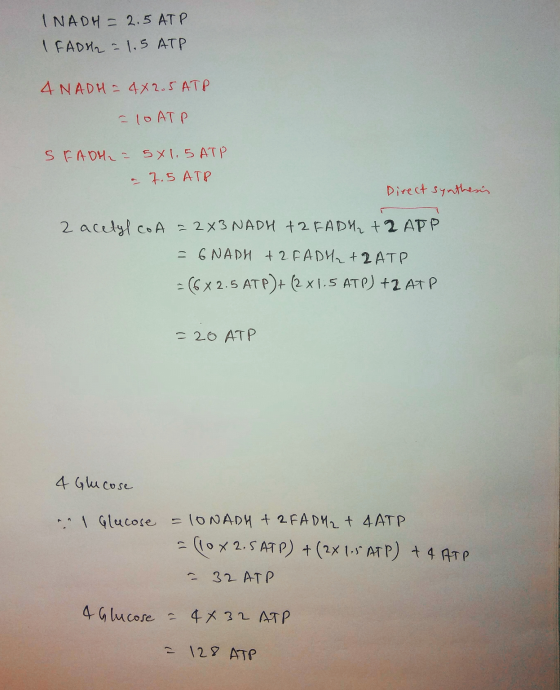
Calculate the number of ATP generated from each of the given molecules. For this problem, use...
Calculate the number of ATP generated from each of the given molecules.
For this problem, use the values:
1 NADH provides the energy for the synthesis of 2.5 ATP.
1 FADH2 provides energy for the synthesis of 1.5 ATP.
4 NADH:___ ATP 2 acetyl-CoA:____ ATP
5 FADH2:____ATP 4 glucose: ___ ATP
Homework Answers
Add Answer to:
Calculate the number of ATP generated from each of the given
molecules.
For this problem, use...
Calculate the net number of moles of ATP generated from the oxidation of 1 mole of...
Calculate the net number of moles of ATP generated from the oxidation of 1 mole of decanoic acid if all of the NADH, FADH2, and acetyl-CoA are metabolized by citrate cycle and oxidative phosphorylation. a) There are 100 net moles of ATP generated b) There are 64 net moles of ATP generated c) There are 106 net moles of ATP generated d) There are 148 net moles of ATP generated The correct answer is B. The question is if you...
A fatty acid composed of 20 carbon atoms undergoes β‑oxidation. How many acetyl CoA, FADH2, and...
A fatty acid composed of 20 carbon atoms undergoes β‑oxidation. How many acetyl CoA, FADH2, and NADH does β‑oxidation of this fatty acid generate? (answer is 10 acetyl CoA, 9 FADH2, 9 NADH) Calculate the net ATP generated by the β‑oxidation of the 20‑carbon fatty acid. Assume that each FADH2 generates 1.5 ATP and each NADH generates 2.5 ATP. number of ATP molecules: ??????
If each NADH generates 3 ATP molecules and each FADH2 generates 2 ATP molecules, calculate the...
If each NADH generates 3 ATP molecules and each FADH2 generates 2 ATP molecules, calculate the number of ATPmolecules generated from one saturated 12 ‑carbon fatty acid. (It is NOT 78ATP)
Which of the following is not a net product of the citric acid cycle for each...
Which of the following is not a net product of the citric acid cycle for each molecule of pyruvate generated in glycolysis? Select one: a. 1 ATP (GTP) b. 1 acetyl coA c. 3 NADH d. 1 FADH2 Question 2 Which of the following is NOT an end product for an acetyl group that enters the citric acid cycle? Select one: a. ATP b. NADH c. FADH2 d. oxaloacetate Question 3 Once they have been processed through the citric acid...
8. ATP synthesis. How many ATP molecules are generated during the complete oxidative degradation of each...
 8. ATP synthesis. How many ATP molecules are generated during the complete oxidative degradation of each of the following metabolites to CO2 and H2O? [Write your answers in the spaces provided.] Number of ATPs synthesized A) B) C) D) E) Metabolite Acetyl COA Pyruvate Glucose Glycerol (Hint: enters glycolysis through DHAP) Aspartic acid (Hint: enters citric acid cycle through oxaloacetate)
8. Fill in the table below with the correct number of high energy compounds generated during...
 8. Fill in the table below with the correct number of high energy compounds generated during each process starting with one molecule of glucose and ending with 6 molecules of CO2 Assuming each NADH generates 2.5 ATPs and FADH2 generates 1.5 ATP. In column 4, please list the total number of net ATPs generated from substrate level phosphorylation, FADH and NADH. (6 marks) Column I Net ATPs generated phosphorylation Column 2 Column 3 Column 4 Number of FADH2Total ATPs from...
Biochemistry II: Calculating ATP from beta-oxidation In calculating the number of ATP molecules generated by the...
Biochemistry II: Calculating ATP from beta-oxidation In calculating the number of ATP molecules generated by the beta-oxidation of a single fatty acid molecule with an even number of carbons, a) Identify how the P/O ratios can be used (what are their significance), and b) help me to construct a formula given the P/O value of 3 for NADH and 2 for FADH2.
2 pts DQuestion 7 For arachadic acid calculate the total number of FADH2 and NADH molecules, resp...
 2 pts DQuestion 7 For arachadic acid calculate the total number of FADH2 and NADH molecules, respectively, that are formed in the B-oxidation and subsequent utilization of CoA in the TCA cycle. Reference figure 23.16 when calculating these values. 19,39 14, 26 O 2,5 12, 12 C-SCoA 7 CoA, 7 [FAD], 7 NAD B-Oxidation 7 [FADH21, 7 NADH +7H 8 Acetyl-CoA 100 ADP 100 Oxidative Electron transport phosphorylation 100 ATP 24 NADH, 8 [FADH TCA cycle >16 CO2 →8AIP FIGURE...
Question 3 1 pts How many of the molecules below are products of glycolysis? ATP ADP...
 Question 3 1 pts How many of the molecules below are products of glycolysis? ATP ADP NADH Pyruvate Acetyl-CoA CO2 FADH2 Water Oxygen Glucose FADH NAD
How many total ATP molecules can be generated for each FADH2, assuming oxidative phosphorylation is 100...
How many total ATP molecules can be generated for each FADH2, assuming oxidative phosphorylation is 100 percent efficient? How many total ATP molecules can be generated for each NADH, assuming oxidative phosphorylation is 100 percent efficient? The answer choices for both questions: a. 3.3 b. 3 c. 2.5 d. 2
 8. ATP synthesis. How many ATP molecules are generated during the complete oxidative degradation of each of the following metabolites to CO2 and H2O? [Write your answers in the spaces provided.] Number of ATPs synthesized A) B) C) D) E) Metabolite Acetyl COA Pyruvate Glucose Glycerol (Hint: enters glycolysis through DHAP) Aspartic acid (Hint: enters citric acid cycle through oxaloacetate)
 8. Fill in the table below with the correct number of high energy compounds generated during each process starting with one molecule of glucose and ending with 6 molecules of CO2 Assuming each NADH generates 2.5 ATPs and FADH2 generates 1.5 ATP. In column 4, please list the total number of net ATPs generated from substrate level phosphorylation, FADH and NADH. (6 marks) Column I Net ATPs generated phosphorylation Column 2 Column 3 Column 4 Number of FADH2Total ATPs from...
 2 pts DQuestion 7 For arachadic acid calculate the total number of FADH2 and NADH molecules, respectively, that are formed in the B-oxidation and subsequent utilization of CoA in the TCA cycle. Reference figure 23.16 when calculating these values. 19,39 14, 26 O 2,5 12, 12 C-SCoA 7 CoA, 7 [FAD], 7 NAD B-Oxidation 7 [FADH21, 7 NADH +7H 8 Acetyl-CoA 100 ADP 100 Oxidative Electron transport phosphorylation 100 ATP 24 NADH, 8 [FADH TCA cycle >16 CO2 →8AIP FIGURE...
 Question 3 1 pts How many of the molecules below are products of glycolysis? ATP ADP NADH Pyruvate Acetyl-CoA CO2 FADH2 Water Oxygen Glucose FADH NAD
Most questions answered within 3 hours.
-
Where is the error in this code sequence?
String s1 = "Hello";
String s2 = "ello";...
asked 10 months ago -
Financial data for Joel de Paris, Inc., for last year
follow:
Joel de Paris, Inc.
Balance...
asked 10 months ago -
Consider this reaction:
Al2(SO4)3 (aq)+ BaCl3
(aq) Al2Cl6 (aq)- +
3BaSO4(s) . What is the...
asked 10 months ago -
Suppose that Savneet is considering increasing her
recent random sample from 20 car rentals to 40...
asked 10 months ago -
Trucks arrive at an unloading terminal at an average rate of 120
per hour.
Trucks arrive...
asked 10 months ago -
Why are methanol and ethanol completely soluble in water while
octanol is not very little soluble....
asked 10 months ago -
A facilities manager at a university reads in a research report
that the mean amount of...
asked 10 months ago -
When the CuSO4 is rehydrated by adding water to the anhydrous
compound, is this an endothermic...
asked 10 months ago -
A ray of sunlight is passing from diamond into crown glass; the
angle of incidence is...
asked 10 months ago -
A block of mass 0.249 kg is placed on top of a light, vertical
spring of...
asked 10 months ago -
how do the kidneys compensate in the presences of acidosis
a) trigger hyperventilate
b) reserve acid...
asked 10 months ago -
Question 501 pts
The rental rate of capital to the firm increases. Which of the
following...
asked 10 months ago