
Homework Answers
Answer is B.
NaOH is a strong base and it deprotonate both Carboxylic acid and alcohol but NaHCO3 is weak base and it deprotonate only Carboxylic acid and not alcohol.
Add Answer to:
Lab 7: Question 2 Homework. Unanswered Why is aqueous NaHCO3 used for the initial extraction of...
Lab 7: Question 4 Homework. Unanswered What is the purpose of adding aqueous base to extract...
 Lab 7: Question 4 Homework. Unanswered What is the purpose of adding aqueous base to extract the acidic components of the unknown mixture? O A Acids and bases afford salts that are water soluble in this experiment O B It moves the compounds of interest to the aqueous layer It enables selective extraction by reacting a weak base and a strong acid followed by reacting a strong base and weak acid, O D all of the above
Lab 7: Question 7 Homework – Unanswered Why would it be relatively challenging to separate I...
 Lab 7: Question 7 Homework – Unanswered Why would it be relatively challenging to separate I and Il via an acid-base extraction? O A Only one of these is soluble in organic solvents O B Both are relatively neutral O C Compound II is more polar
Lab 7: Question 8 Homework – Unanswered Why would an acid-base extraction procedure be inefficient in...
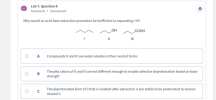 Lab 7: Question 8 Homework – Unanswered Why would an acid-base extraction procedure be inefficient in separating 1-111? LOHCOOH M 1,0 r.com O A Compounds II and III are water soluble in their neutral forms The pka values of ll and Ill are not different enough to enable selective deprotonation based on base strength Ос The deprotonated form of Il that is isolated after extraction is too stable to be protonated to recover neutral Il
Lab 7: Question 8 Homework – Unanswered Why would an acid-base extraction procedure be inefficient in...
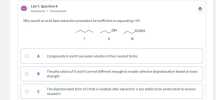 Lab 7: Question 8 Homework – Unanswered Why would an acid-base extraction procedure be inefficient in separating 1-111? LOHCOOH M 1,0 r.com O A Compounds II and III are water soluble in their neutral forms The pka values of ll and Ill are not different enough to enable selective deprotonation based on base strength Ос The deprotonated form of Il that is isolated after extraction is too stable to be protonated to recover neutral Il
Lab 7: Question 6 Homework - Unanswered Why should Il be protonated, rather than deprotonated, in...
 Lab 7: Question 6 Homework - Unanswered Why should Il be protonated, rather than deprotonated, in order to make it water soluble for extraction from an organic solvent? ♡ on olemas O A The anion derived from Il is too strong and reactive a base to remain stable under aqueous extraction conditions Protonation of amines to form ammonium salts affords a less reactive salt compared to the deprotonation product O C Both a and b are correct
Acetylation of ferrocene and column chromatography Lab 4: Question 3 Homework • Unanswered Important ... The...
 Acetylation of ferrocene and column chromatography
Lab 4: Question 3 Homework • Unanswered Important ... The solvent is changed from petroleum ether to diethyl ether after the ferrocene is collected from the column. Why not use diethyl ether the entire time? Because diethyl ether is more polar than petroleum ether Because petroleum ether selectively elutes ferrocene since it contains more ether oxygens than diethyl ether Because diethyl ether would lead to a poorer separation of ferrocene and acetylferrocene Both a...
Acetylation of ferrocene and column chromatography
Lab 4: Question 3 Homework • Unanswered Important ... The solvent is changed from petroleum ether to diethyl ether after the ferrocene is collected from the column. Why not use diethyl ether the entire time? Because diethyl ether is more polar than petroleum ether Because petroleum ether selectively elutes ferrocene since it contains more ether oxygens than diethyl ether Because diethyl ether would lead to a poorer separation of ferrocene and acetylferrocene Both a...
Question 2: Why is the CH2Cl2 layer the bottom layer in a CH2Cl2 / aqueous NaHCO3 extraction? In this experiment, what does the CH2Cl2 layer contain? What does the aqueous NaHCO3 layer contain?
 Question 2 of Prelab questionsWhy is the CH2Cl2 layer the bottom layer in a CH2Cl2 / aqueous NaHCO3 extraction? In this experiment, what does the CH2Cl2 layer contain? What does the aqueous NaHCO3 layer contain?
Explain in a few sentences how extraction can be used to separate an organic compound from sodium chloride.
 06 Lab 3a Separation.pdfQuestion 1 of prelabExplain in a few sentences how extraction can be used to separate an organic compound from sodium chloride.
Prelab
1. Explain in a few sentences how extraction can be used to separate an organic compound from
sodium chloride.
2. Why is the CH2Cl2 layer the bottom layer in a CH2Cl2 / aqueous NaHCO3 extraction? In this
experiment, what does the CH2Cl2 layer contain? What does the aqueous NaHCO3 layer
contain?
3. In general, how...
06 Lab 3a Separation.pdfQuestion 1 of prelabExplain in a few sentences how extraction can be used to separate an organic compound from sodium chloride.
Prelab
1. Explain in a few sentences how extraction can be used to separate an organic compound from
sodium chloride.
2. Why is the CH2Cl2 layer the bottom layer in a CH2Cl2 / aqueous NaHCO3 extraction? In this
experiment, what does the CH2Cl2 layer contain? What does the aqueous NaHCO3 layer
contain?
3. In general, how...
question 1 and 2! CHE 129A Lab 5_Liquid-Liquid Extraction Name : Rika Mochizuki Date : _...
 question 1 and 2!
CHE 129A Lab 5_Liquid-Liquid Extraction Name : Rika Mochizuki Date : _ 10/28/19 Notebook Ref: _Attached! Part 1: Simple Extraction and Determination of the Distribution Coefficient (Partition Coefficient) for Propionic Acid Between Ether and Water Table 1 (a) Preparation of Propionic Acid (PA) Solution weight PA Volume H2O (mL) (b) Titration of Aqueous Propionic Acid Solution Before Ether Extraction Volume PA Volume NaOH Aliquot (mL) (mL) 10.wml 18.00ml (c) Titration of Aqueous Propionic Solution After Ether...
question 1 and 2!
CHE 129A Lab 5_Liquid-Liquid Extraction Name : Rika Mochizuki Date : _ 10/28/19 Notebook Ref: _Attached! Part 1: Simple Extraction and Determination of the Distribution Coefficient (Partition Coefficient) for Propionic Acid Between Ether and Water Table 1 (a) Preparation of Propionic Acid (PA) Solution weight PA Volume H2O (mL) (b) Titration of Aqueous Propionic Acid Solution Before Ether Extraction Volume PA Volume NaOH Aliquot (mL) (mL) 10.wml 18.00ml (c) Titration of Aqueous Propionic Solution After Ether...
Liquid-liquid extraction lab questions 1. Why does the m-nitroaniline dissolve in acid? 2. Why does the...
Liquid-liquid extraction lab questions 1. Why does the m-nitroaniline dissolve in acid? 2. Why does the benzoic acid dissolve in base? 3. Why does the naphthalene remain in the organic layer? Please answer in details, thank u!
 Lab 7: Question 4 Homework. Unanswered What is the purpose of adding aqueous base to extract the acidic components of the unknown mixture? O A Acids and bases afford salts that are water soluble in this experiment O B It moves the compounds of interest to the aqueous layer It enables selective extraction by reacting a weak base and a strong acid followed by reacting a strong base and weak acid, O D all of the above
 Lab 7: Question 7 Homework – Unanswered Why would it be relatively challenging to separate I and Il via an acid-base extraction? O A Only one of these is soluble in organic solvents O B Both are relatively neutral O C Compound II is more polar
 Lab 7: Question 8 Homework – Unanswered Why would an acid-base extraction procedure be inefficient in separating 1-111? LOHCOOH M 1,0 r.com O A Compounds II and III are water soluble in their neutral forms The pka values of ll and Ill are not different enough to enable selective deprotonation based on base strength Ос The deprotonated form of Il that is isolated after extraction is too stable to be protonated to recover neutral Il
 Lab 7: Question 8 Homework – Unanswered Why would an acid-base extraction procedure be inefficient in separating 1-111? LOHCOOH M 1,0 r.com O A Compounds II and III are water soluble in their neutral forms The pka values of ll and Ill are not different enough to enable selective deprotonation based on base strength Ос The deprotonated form of Il that is isolated after extraction is too stable to be protonated to recover neutral Il
 Lab 7: Question 6 Homework - Unanswered Why should Il be protonated, rather than deprotonated, in order to make it water soluble for extraction from an organic solvent? ♡ on olemas O A The anion derived from Il is too strong and reactive a base to remain stable under aqueous extraction conditions Protonation of amines to form ammonium salts affords a less reactive salt compared to the deprotonation product O C Both a and b are correct
 Acetylation of ferrocene and column chromatography
Lab 4: Question 3 Homework • Unanswered Important ... The solvent is changed from petroleum ether to diethyl ether after the ferrocene is collected from the column. Why not use diethyl ether the entire time? Because diethyl ether is more polar than petroleum ether Because petroleum ether selectively elutes ferrocene since it contains more ether oxygens than diethyl ether Because diethyl ether would lead to a poorer separation of ferrocene and acetylferrocene Both a...
Acetylation of ferrocene and column chromatography
Lab 4: Question 3 Homework • Unanswered Important ... The solvent is changed from petroleum ether to diethyl ether after the ferrocene is collected from the column. Why not use diethyl ether the entire time? Because diethyl ether is more polar than petroleum ether Because petroleum ether selectively elutes ferrocene since it contains more ether oxygens than diethyl ether Because diethyl ether would lead to a poorer separation of ferrocene and acetylferrocene Both a...
 question 1 and 2!
CHE 129A Lab 5_Liquid-Liquid Extraction Name : Rika Mochizuki Date : _ 10/28/19 Notebook Ref: _Attached! Part 1: Simple Extraction and Determination of the Distribution Coefficient (Partition Coefficient) for Propionic Acid Between Ether and Water Table 1 (a) Preparation of Propionic Acid (PA) Solution weight PA Volume H2O (mL) (b) Titration of Aqueous Propionic Acid Solution Before Ether Extraction Volume PA Volume NaOH Aliquot (mL) (mL) 10.wml 18.00ml (c) Titration of Aqueous Propionic Solution After Ether...
question 1 and 2!
CHE 129A Lab 5_Liquid-Liquid Extraction Name : Rika Mochizuki Date : _ 10/28/19 Notebook Ref: _Attached! Part 1: Simple Extraction and Determination of the Distribution Coefficient (Partition Coefficient) for Propionic Acid Between Ether and Water Table 1 (a) Preparation of Propionic Acid (PA) Solution weight PA Volume H2O (mL) (b) Titration of Aqueous Propionic Acid Solution Before Ether Extraction Volume PA Volume NaOH Aliquot (mL) (mL) 10.wml 18.00ml (c) Titration of Aqueous Propionic Solution After Ether...
Most questions answered within 3 hours.
-
Where is the error in this code sequence?
String s1 = "Hello";
String s2 = "ello";...
asked 10 months ago -
Financial data for Joel de Paris, Inc., for last year
follow:
Joel de Paris, Inc.
Balance...
asked 10 months ago -
Consider this reaction:
Al2(SO4)3 (aq)+ BaCl3
(aq) Al2Cl6 (aq)- +
3BaSO4(s) . What is the...
asked 10 months ago -
Suppose that Savneet is considering increasing her
recent random sample from 20 car rentals to 40...
asked 10 months ago -
Trucks arrive at an unloading terminal at an average rate of 120
per hour.
Trucks arrive...
asked 10 months ago -
Why are methanol and ethanol completely soluble in water while
octanol is not very little soluble....
asked 10 months ago -
A facilities manager at a university reads in a research report
that the mean amount of...
asked 10 months ago -
When the CuSO4 is rehydrated by adding water to the anhydrous
compound, is this an endothermic...
asked 10 months ago -
A ray of sunlight is passing from diamond into crown glass; the
angle of incidence is...
asked 10 months ago -
A block of mass 0.249 kg is placed on top of a light, vertical
spring of...
asked 10 months ago -
how do the kidneys compensate in the presences of acidosis
a) trigger hyperventilate
b) reserve acid...
asked 10 months ago -
Question 501 pts
The rental rate of capital to the firm increases. Which of the
following...
asked 10 months ago