

Homework Answers
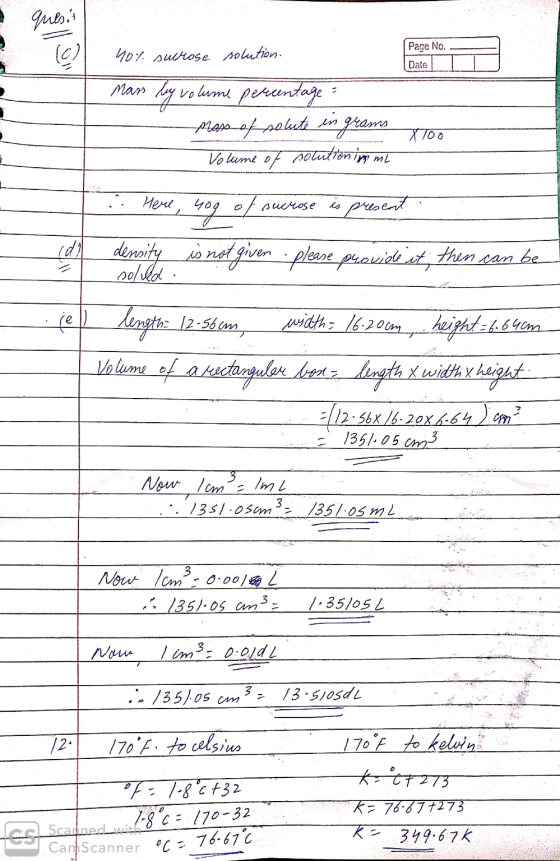
Due to strict guidelines to all the experts,we can only solve 1 question at a time but i have solved 3 for you.Hope you understand this.If you have any further queries,you can ask in the comment box and i will definitely have them solved for you.Hope you like the solutions.Please hit the like button,please.
Add Answer to:
c) If Cylinder C contains a 40.0 % sucrose solution (40.0 g suger per 100 mL...
Q12. Determine the mass (in g) of each sucrose solution that contains 19 g of sucrose....
Q12. Determine the mass (in g) of each sucrose solution that contains 19 g of sucrose. part A 4.5 % sucrose by mass part B 2.7 % sucrose by mass part C 13.3 % sucrose by mass Q.13 The percent concentration of a solution is a ratio of the amounts of dissolved solute and solution, expressed as a percentage. The percent concentration of a solution can be written generally as %concentration=amountofsoluteamountofsolution×100% A mass percent concentration may be calculated for mass/mass...
Aglicose solution contains 45.2 g of sucrose (342.3 g/mol) in 155 g of water (18 g/mol),...
 Aglicose solution contains 45.2 g of sucrose (342.3 g/mol) in 155 g of water (18 g/mol), Determine the boiling point of this solution. Assume the density of the solution is 1 g/ml. Ky 186 Cm Ko =0.512 °C/m 1.58 °C 1.58 °C • 100 44 °C 0.44 °C 100.12 °C
The mass of solute per 100 mL of solution is abbreviated as (m/v). Mass is not...
 The mass of solute per 100 mL of solution is abbreviated as (m/v). Mass is not technically the same thing as weight, but the abbreviation (w/v) is also common. How many grams of sucrose are needed to make 795 mL of a 40.0% (w/v) sucrose solution? sucrose MISS Use the quantities to show how each calculation is made. Answer Bank Lof solution ml of solution grams of wolute moles of solute % (m/v) = Calculate the molarity of the two...
1. 1200 mL aqueous solution of 45 g of ethylene glycol and 80 g of sucrose...
 1. 1200 mL aqueous solution of 45 g of ethylene glycol and 80 g of sucrose were prepared with a density of 1.37 g/mL. Assume that the solution behaves ideally. Notes: The vapor pressures of water and ethylene glycol at 20 °C are 17.54 torr and 0.06 torr, respectively, and Kb and Kf of water are 0.51 K/m and 1.86 K/m, at 25 °C respectively. a. What is the freezing point of this solution? b. What is the vapor pressure,...
3. What volume of 40.0% NaNO3 solution contains 0.15 mole of NaNO3? Density 1.32 g/mL
 3. What volume of 40.0% NaNO3 solution contains 0.15 mole of NaNO3? Density 1.32 g/mL
ACTIVITY ACTIVITY 2 A Determining the Densities of Solutions 1. Weigh an empty 50-ml graduated cylinder....
 ACTIVITY ACTIVITY 2 A Determining the Densities of Solutions 1. Weigh an empty 50-ml graduated cylinder. Record the mass in Data Table 2. 2. Add 5 mL of water (0% sucrose) to the 50-ml graduated cylinder. Use the pipet to add or remove small quantities of liquid so that the water is exactly at the 5-mL mark. 3. Record the Mass of Solution + Graduated Cylinder in Data Table 2. 4. Add more water until the cylinder contains 10 mL...
1) A calorimeter contains 28.0 mL of water at 11.5 ?C . When 2.20 g of...
1) A calorimeter contains 28.0 mL of water at 11.5 ?C . When 2.20 g of X (a substance with a molar mass of 51.0 g/mol ) is added, it dissolves via the reaction X(s)+H2O(l)?X(aq) and the temperature of the solution increases to 30.0 ?C . Calculate the enthalpy change, ?H, for this reaction per mole of X. Assume that the specific heat of the resulting solution is equal to that of water [4.18 J/(g??C)], that density of water is...
Instructions: Use the following image to answer the following questions. A solution contains 40 g of NaCl per 100 g of...
 Instructions: Use the following image to answer the following
questions.
A solution contains 40 g of NaCl per 100 g of water at 100˚C.
Is the solution unsaturated, saturated or supersaturated?
A solution contains 50 g of
KCl per 100 g of water at 25˚C. Is the solution unsaturated,
saturated or supersaturated?
A solution contains 10 g of KNO3 per 100 g of water at 30˚C. Is
the solution unsaturated, saturated or supersaturated?
An 8 oz bottle of Dr. Pepper...
Instructions: Use the following image to answer the following
questions.
A solution contains 40 g of NaCl per 100 g of water at 100˚C.
Is the solution unsaturated, saturated or supersaturated?
A solution contains 50 g of
KCl per 100 g of water at 25˚C. Is the solution unsaturated,
saturated or supersaturated?
A solution contains 10 g of KNO3 per 100 g of water at 30˚C. Is
the solution unsaturated, saturated or supersaturated?
An 8 oz bottle of Dr. Pepper...
TUTOR Determining Molality and Mass Percent An aqueous solution of silver nitrate, AgNO3, has a concentration...
 TUTOR Determining Molality and Mass Percent An aqueous solution of silver nitrate, AgNO3, has a concentration of 1.58 mol/L and has a density of 1.22 g/mL. What are the mass pel AgNO3 in this solution? Mass nercent AYO, 280 10:31 PM Sun Mar 29 < G.C. 2-7 for online lab observations given (Patrick Ande) (1).... 2 HC,H, O SYSTEM #1: SOLUTIONS 0 1M | C 0 H + C,H,O PH O BSERVATION ORANGE Higher pH LIGHT ORANGE D.IM HC.H.O. -...
Part A: A calorimeter contains 26.0 mL of water at 13.0 ∘C . When 2.10 g...
Part A: A calorimeter contains 26.0 mL of water at 13.0 ∘C . When 2.10 g of X (a substance with a molar mass of 49.0 g/mol ) is added, it dissolves via the reaction X(s)+H2O(l)→X(aq) and the temperature of the solution increases to 25.0 ∘C . Calculate the enthalpy change, ΔH, for this reaction per mole of X. Assume that the specific heat of the resulting solution is equal to that of water [4.18 J/(g⋅∘C)], that density of water...
 Aglicose solution contains 45.2 g of sucrose (342.3 g/mol) in 155 g of water (18 g/mol), Determine the boiling point of this solution. Assume the density of the solution is 1 g/ml. Ky 186 Cm Ko =0.512 °C/m 1.58 °C 1.58 °C • 100 44 °C 0.44 °C 100.12 °C
 The mass of solute per 100 mL of solution is abbreviated as (m/v). Mass is not technically the same thing as weight, but the abbreviation (w/v) is also common. How many grams of sucrose are needed to make 795 mL of a 40.0% (w/v) sucrose solution? sucrose MISS Use the quantities to show how each calculation is made. Answer Bank Lof solution ml of solution grams of wolute moles of solute % (m/v) = Calculate the molarity of the two...
 1. 1200 mL aqueous solution of 45 g of ethylene glycol and 80 g of sucrose were prepared with a density of 1.37 g/mL. Assume that the solution behaves ideally. Notes: The vapor pressures of water and ethylene glycol at 20 °C are 17.54 torr and 0.06 torr, respectively, and Kb and Kf of water are 0.51 K/m and 1.86 K/m, at 25 °C respectively. a. What is the freezing point of this solution? b. What is the vapor pressure,...
 3. What volume of 40.0% NaNO3 solution contains 0.15 mole of NaNO3? Density 1.32 g/mL
 ACTIVITY ACTIVITY 2 A Determining the Densities of Solutions 1. Weigh an empty 50-ml graduated cylinder. Record the mass in Data Table 2. 2. Add 5 mL of water (0% sucrose) to the 50-ml graduated cylinder. Use the pipet to add or remove small quantities of liquid so that the water is exactly at the 5-mL mark. 3. Record the Mass of Solution + Graduated Cylinder in Data Table 2. 4. Add more water until the cylinder contains 10 mL...
 Instructions: Use the following image to answer the following
questions.
A solution contains 40 g of NaCl per 100 g of water at 100˚C.
Is the solution unsaturated, saturated or supersaturated?
A solution contains 50 g of
KCl per 100 g of water at 25˚C. Is the solution unsaturated,
saturated or supersaturated?
A solution contains 10 g of KNO3 per 100 g of water at 30˚C. Is
the solution unsaturated, saturated or supersaturated?
An 8 oz bottle of Dr. Pepper...
Instructions: Use the following image to answer the following
questions.
A solution contains 40 g of NaCl per 100 g of water at 100˚C.
Is the solution unsaturated, saturated or supersaturated?
A solution contains 50 g of
KCl per 100 g of water at 25˚C. Is the solution unsaturated,
saturated or supersaturated?
A solution contains 10 g of KNO3 per 100 g of water at 30˚C. Is
the solution unsaturated, saturated or supersaturated?
An 8 oz bottle of Dr. Pepper...
 TUTOR Determining Molality and Mass Percent An aqueous solution of silver nitrate, AgNO3, has a concentration of 1.58 mol/L and has a density of 1.22 g/mL. What are the mass pel AgNO3 in this solution? Mass nercent AYO, 280 10:31 PM Sun Mar 29 < G.C. 2-7 for online lab observations given (Patrick Ande) (1).... 2 HC,H, O SYSTEM #1: SOLUTIONS 0 1M | C 0 H + C,H,O PH O BSERVATION ORANGE Higher pH LIGHT ORANGE D.IM HC.H.O. -...
Most questions answered within 3 hours.
-
Where is the error in this code sequence?
String s1 = "Hello";
String s2 = "ello";...
asked 10 months ago -
Financial data for Joel de Paris, Inc., for last year
follow:
Joel de Paris, Inc.
Balance...
asked 10 months ago -
Consider this reaction:
Al2(SO4)3 (aq)+ BaCl3
(aq) Al2Cl6 (aq)- +
3BaSO4(s) . What is the...
asked 10 months ago -
Suppose that Savneet is considering increasing her
recent random sample from 20 car rentals to 40...
asked 10 months ago -
Trucks arrive at an unloading terminal at an average rate of 120
per hour.
Trucks arrive...
asked 10 months ago -
Why are methanol and ethanol completely soluble in water while
octanol is not very little soluble....
asked 10 months ago -
A facilities manager at a university reads in a research report
that the mean amount of...
asked 10 months ago -
When the CuSO4 is rehydrated by adding water to the anhydrous
compound, is this an endothermic...
asked 10 months ago -
A ray of sunlight is passing from diamond into crown glass; the
angle of incidence is...
asked 10 months ago -
A block of mass 0.249 kg is placed on top of a light, vertical
spring of...
asked 10 months ago -
how do the kidneys compensate in the presences of acidosis
a) trigger hyperventilate
b) reserve acid...
asked 10 months ago -
Question 501 pts
The rental rate of capital to the firm increases. Which of the
following...
asked 10 months ago