The reaction between phenolphthalein and hydroxide ion is first order with respect to the phenolphthalein and...
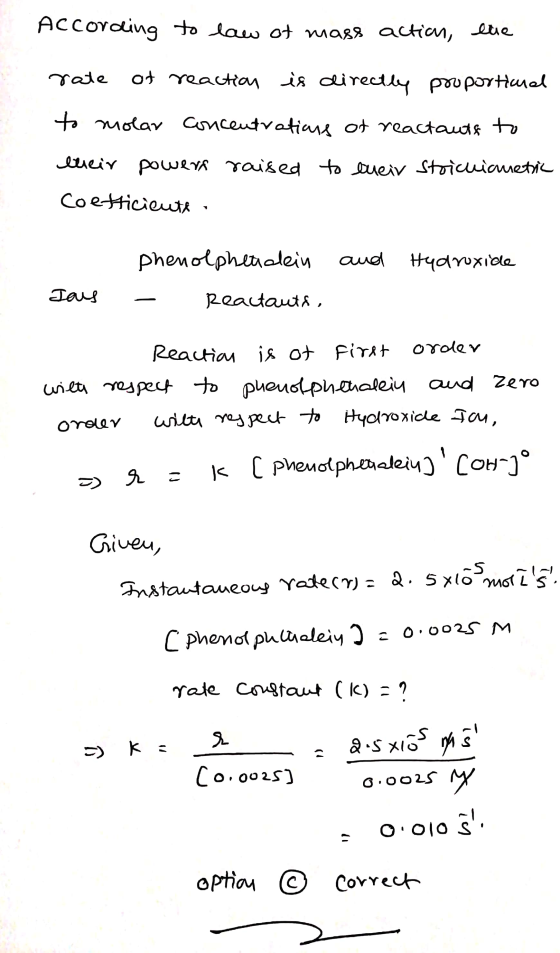
The reaction between phenolphthalein and hydroxide ion is first order with respect to the phenolphthalein and zero order with respect to the hydroxide. Calculate the rate constant for this reaction when the instantaneous rate of reaction is 2.5 x 10⁻⁵moles per liter per second for a concentration of 0.00250 M for the phenolphthalein.
Group of answer choices
a. 0.010 M-1 s-1
b. 2.5 x 10⁻⁵M/s
c. 0.010 s-1
d. 0.010 M-2 s-1
e. cannot be determined from the given information
Homework Answers
Add Answer to:
The reaction between phenolphthalein and hydroxide ion is first
order with respect to the phenolphthalein and...
The following reaction is second order in respect to NO and first order in respect to...
The following reaction is second order in respect to NO and first order in respect to H2. The rate constant was found to be 0.67 M-2· s-1. If the reaction starts with 0.200 M NO and 0.350 M H2, calculate the initial reaction rate. Group of answer choices 0.0094 M/s 0.047 M/s 0.014 M/s 0.0022 M/s
Question 22 2 pts The following reaction is first order in respect to CH3OH and first...
 Question 22 2 pts The following reaction is first order in respect to CH3OH and first order in respect to HCI. With this in mind, what is the rate constant for the reaction? Be sure you choose the answer with the right units. CH2OH(aq) + HCl(aq) CH2Cl (aq) + HO (0) CH3OH HCI Initial Rate Reaction conc. conc. (M/s) 1 0.100 M 0.100 M 1.1 x 10⁻² *conc = concentration 1.1 M-1 • 5:1 1.15-1 11 M-1.5-1 11 5-1 Question...
Consider a reaction which is 1st order with respect to A and 1st order with respect...
Consider a reaction which is 1st order with respect to A and 1st order with respect to B. What happens to the reaction rate if the concentration of A is doubled and the concentration of B is doubled? The reaction rate is quadrupled The reaction rate does not change The reaction rate is doubled cannot be determined without the rate constant
The hydroxide ion concentration of a solution is 0.00001 moles per liter. What is the hydrogen...
The hydroxide ion concentration of a solution is 0.00001 moles per liter. What is the hydrogen ion concentration, and is the solution acidic or basic? Group of answer choices 10–5, basic 10–9, acidic 10–10, acidic 10–9, basic 10–5, acidic
problem 5.31 The rate of the reaction of methyl chloride with hydroxide ion is linearly dependent...
problem 5.31 The rate of the reaction of methyl chloride with hydroxide ion is linearly dependent on both the concentration of methyl chloride and the concentration hydroxide ion. At 30 ∘C, the constant for the reaction is 1.0×10⁻⁵M−1s−1. Part A What is the rate of the reaction when [CH3Cl]=0.65M and [HO−]=0.15M? Express your answer to two significant figures and include the appropriate units.
A reaction is found to be 0th order with respect to thiosulfate ion. If the concentration...
A reaction is found to be 0th order with respect to thiosulfate ion. If the concentration of thiosulfate ion is 0.159M after 20.5 seconds have passed, and the rate law constant is 0.0175 M/sec, what was the initial concentration of thiosulfate ion?
A reaction is found to be 1st order with respect to perbromate ion. If the initial...
A reaction is found to be 1st order with respect to perbromate ion. If the initial concentration of perbromate ion is 0.863M and the rate law constant is 0.0221 M/sec, what will the concentration of perbromate ion be after 20.9 seconds have passed?
A reaction is found to be 2nd order with respect to cyanide ion. If the concentration...
A reaction is found to be 2nd order with respect to cyanide ion. If the concentration of cyanide ion is 0.175M after 16.9 seconds have passed, and the rate law constant is 0.0201 M/sec, what was the initial concentration of cyanide ion?
A reaction is found to be 1st order with respect to carbonate ion. If the initial...
A reaction is found to be 1st order with respect to carbonate ion. If the initial concentration of carbonate ion is 0.873M and the rate law constant is 0.0197 M/sec, how many seconds must pass before the concentration of carbonate ion drops to 0.339M?
A reaction is found to be 1st order with respect to carbonate ion. If the initial...
A reaction is found to be 1st order with respect to carbonate ion. If the initial concentration of carbonate ion is 0.871M and the rate law constant is 0.0203 M/sec, how many seconds must pass before the concentration of carbonate ion drops to 0.343M?
 Question 22 2 pts The following reaction is first order in respect to CH3OH and first order in respect to HCI. With this in mind, what is the rate constant for the reaction? Be sure you choose the answer with the right units. CH2OH(aq) + HCl(aq) CH2Cl (aq) + HO (0) CH3OH HCI Initial Rate Reaction conc. conc. (M/s) 1 0.100 M 0.100 M 1.1 x 10⁻² *conc = concentration 1.1 M-1 • 5:1 1.15-1 11 M-1.5-1 11 5-1 Question...
Most questions answered within 3 hours.
-
Where is the error in this code sequence?
String s1 = "Hello";
String s2 = "ello";...
asked 10 months ago -
Financial data for Joel de Paris, Inc., for last year
follow:
Joel de Paris, Inc.
Balance...
asked 10 months ago -
Consider this reaction:
Al2(SO4)3 (aq)+ BaCl3
(aq) Al2Cl6 (aq)- +
3BaSO4(s) . What is the...
asked 10 months ago -
Suppose that Savneet is considering increasing her
recent random sample from 20 car rentals to 40...
asked 10 months ago -
Trucks arrive at an unloading terminal at an average rate of 120
per hour.
Trucks arrive...
asked 10 months ago -
Why are methanol and ethanol completely soluble in water while
octanol is not very little soluble....
asked 10 months ago -
A facilities manager at a university reads in a research report
that the mean amount of...
asked 10 months ago -
When the CuSO4 is rehydrated by adding water to the anhydrous
compound, is this an endothermic...
asked 10 months ago -
A ray of sunlight is passing from diamond into crown glass; the
angle of incidence is...
asked 10 months ago -
A block of mass 0.249 kg is placed on top of a light, vertical
spring of...
asked 10 months ago -
how do the kidneys compensate in the presences of acidosis
a) trigger hyperventilate
b) reserve acid...
asked 10 months ago -
Question 501 pts
The rental rate of capital to the firm increases. Which of the
following...
asked 10 months ago