problem 5.31 The rate of the reaction of methyl chloride with hydroxide ion is linearly dependent...
problem 5.31
The rate of the reaction of methyl chloride with hydroxide ion is
linearly dependent on both the concentration of methyl chloride and
the concentration hydroxide ion. At 30 ∘C, the constant for the
reaction is 1.0×10⁻⁵M−1s−1.
Part A
What is the rate of the reaction when [CH3Cl]=0.65M and [HO−]=0.15M?
Express your answer to two significant figures and include the appropriate units.
Homework Answers

Add Answer to:
problem 5.31
The rate of the reaction of methyl chloride with hydroxide ion is
linearly dependent...
The reaction of methyl chloride with aqueous sodium hydroxide to produce methanol and chloride ion is...
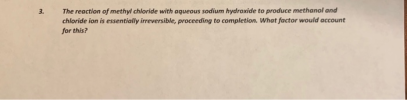 The reaction of methyl chloride with aqueous sodium hydroxide to produce methanol and chloride ion is essentially irreversible, proceeding to completion. What factor would account for this?
The reaction of methyl chloride with aqueous sodium hydroxide to produce methanol and chloride ion is...
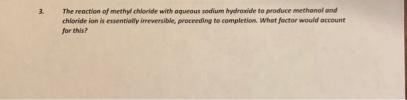 The reaction of methyl chloride with aqueous sodium hydroxide to produce methanol and chloride ion is essentially irreversible, proceeding to completion. What factor would account for this?
A first-order reaction A⟶BA⟶B has the rate constant k=k= 2.8×10⁻³ s−1s−1 . If the initial concentration...
A first-order reaction A⟶BA⟶B has the rate constant k=k= 2.8×10⁻³ s−1s−1 . If the initial concentration of AA is 1.5×10⁻² MM, what is the rate of the reaction at t=t= 690 ss ? Express your answer to two significant figures and include the appropriate units.
12) The first-order rate constant for the reaction of methyl chloride (CH3Cl) with water to produce...
12) The first-order rate constant for the reaction of methyl chloride (CH3Cl) with water to produce methanol (CH3OH) and hydrochloric acid (HCl) is 3.32 × 10^−10 s^−1 at 25°C. Calculate the rate constant at 50.1°C if the activation energy is 116 kJ/mol. _____ × 10^___s^-1 (Enter your answer in scientific notation.)
Consider the following reaction: PCl5(g)⇌PCl3(g)+Cl2(g) a. Initially, 0.62 mol of PCl5 is placed in a 1.0...
Consider the following reaction: PCl5(g)⇌PCl3(g)+Cl2(g) a. Initially, 0.62 mol of PCl5 is placed in a 1.0 L flask. At equilibrium, there is 0.20 mol of PCl3 in the flask. What is the equilibrium concentration of PCl5? Express your answer to two significant figures and include the appropriate units. b. What is the equilibrium concentration of Cl2? Express your answer to two significant figures and include the appropriate units. c. What is the numerical value of the equilibrium constant, Kc, for...
The reaction between phenolphthalein and hydroxide ion is first order with respect to the phenolphthalein and...
The reaction between phenolphthalein and hydroxide ion is first order with respect to the phenolphthalein and zero order with respect to the hydroxide. Calculate the rate constant for this reaction when the instantaneous rate of reaction is 2.5 x 10⁻⁵moles per liter per second for a concentration of 0.00250 M for the phenolphthalein. Group of answer choices a. 0.010 M-1 s-1 b. 2.5 x 10⁻⁵M/s c. 0.010 s-1 d. 0.010 M-2 s-1 e. cannot be determined from the given information
12. The first-order rate constant for the reaction of methyl chloride (CH3Cl) with water to produce...
12. The first-order rate constant for the reaction of methyl chloride (CH3Cl) with water to produce methanol (CH3OH) and hydrochloric acid (HCl) is 3.32 × 10⁻¹⁰ s−1 at 25°C. Calculate the rate constant at 52.1°C if the activation energy is 116 kJ/mol. _____ ×10^____ s−1 (Enter your answer in scientific notation.) 14. The rate constant of a first-order reaction is 2.75 × 10⁻⁴ s−1 at 350.°C. If the activation energy is 101 kJ/mol, calculate the temperature at which its rate constant...
A first-order reaction A⟶B has the rate constant k= 3.2×10⁻³ s^−1 . If the initial concentration...
A first-order reaction A⟶B has the rate constant k= 3.2×10⁻³ s^−1 . If the initial concentration of A is 1.5×10⁻² M, what is the rate of the reaction at t= 620 s ? Express your answer to two significant figures and include the appropriate units.
The following kinetic data are collected for the initial rates of a reaction 2X + Z...
 The following kinetic data are collected for the initial rates of a reaction 2X + Z rightarrow products: What is the value of the rate constant with proper units? Express your answer to two significant figures and include the appropriate units. What is the reaction rate when the initial concentration of X is 0.68 M and that of Z is 1.38 M? Express your answer to two significant figures and include the appropriate units. Calculate the molar concentration of OH^-...
trans-Cycloheptene (C7H12), a strained cyclic hydrocarbon, converts to cis-cycloheptene at low temperatures. This molecular rearrangement is...
trans-Cycloheptene (C7H12), a strained cyclic hydrocarbon, converts to cis-cycloheptene at low temperatures. This molecular rearrangement is a second-order process with a rate constant of 0.030 M−1s−1 at 60 ∘C. If the initial concentration of trans-cycloheptene is 3.9×10⁻² M . Part A Part complete What is the concentration of trans-cycloheptene after a reaction time of 1400 s ? Express your answer to two significant figures and include the appropriate units. 1.5×10⁻² M Previous Answers Answer Requested Part B At what time...
 The reaction of methyl chloride with aqueous sodium hydroxide to produce methanol and chloride ion is essentially irreversible, proceeding to completion. What factor would account for this?
 The reaction of methyl chloride with aqueous sodium hydroxide to produce methanol and chloride ion is essentially irreversible, proceeding to completion. What factor would account for this?
 The following kinetic data are collected for the initial rates of a reaction 2X + Z rightarrow products: What is the value of the rate constant with proper units? Express your answer to two significant figures and include the appropriate units. What is the reaction rate when the initial concentration of X is 0.68 M and that of Z is 1.38 M? Express your answer to two significant figures and include the appropriate units. Calculate the molar concentration of OH^-...
Most questions answered within 3 hours.
-
Where is the error in this code sequence?
String s1 = "Hello";
String s2 = "ello";...
asked 11 months ago -
Financial data for Joel de Paris, Inc., for last year
follow:
Joel de Paris, Inc.
Balance...
asked 11 months ago -
Consider this reaction:
Al2(SO4)3 (aq)+ BaCl3
(aq) Al2Cl6 (aq)- +
3BaSO4(s) . What is the...
asked 11 months ago -
Suppose that Savneet is considering increasing her
recent random sample from 20 car rentals to 40...
asked 11 months ago -
Trucks arrive at an unloading terminal at an average rate of 120
per hour.
Trucks arrive...
asked 11 months ago -
Why are methanol and ethanol completely soluble in water while
octanol is not very little soluble....
asked 11 months ago -
A facilities manager at a university reads in a research report
that the mean amount of...
asked 11 months ago -
When the CuSO4 is rehydrated by adding water to the anhydrous
compound, is this an endothermic...
asked 11 months ago -
A ray of sunlight is passing from diamond into crown glass; the
angle of incidence is...
asked 11 months ago -
A block of mass 0.249 kg is placed on top of a light, vertical
spring of...
asked 11 months ago -
how do the kidneys compensate in the presences of acidosis
a) trigger hyperventilate
b) reserve acid...
asked 11 months ago -
Question 501 pts
The rental rate of capital to the firm increases. Which of the
following...
asked 11 months ago