
Homework Answers
Add Answer to:
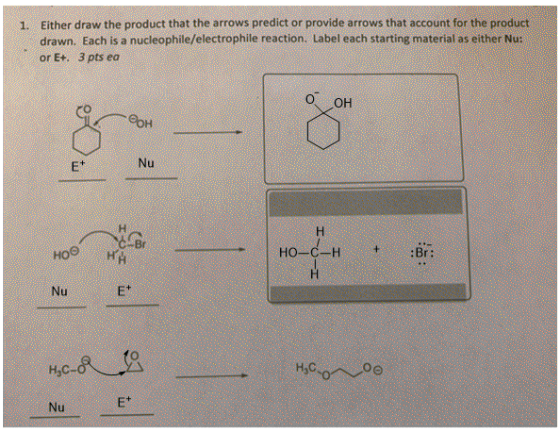
1. Either draw the product that the arrows predict or provide arrows that account for the...
5. a) Draw the major 1,2-addition product and the major 1,4-addition product of each of the...
 5. a) Draw the major 1,2-addition product and the major 1,4-addition product of each of the following reactions. Label each product as either the 1,2-addition product or 1,4-addition product and as either the thermodynamic or kinetic product. (12 pts) H" catalyst H catalyst b) Consider the reaction of a nucleophile with conjugated carbonyl. Provide an example of a nucleophile that would favor the 1,2-addition product and explain why. Provide an example of a nucleophile that would favor the 1,4-addition product...
[Review Topics) [References Draw the structure of the major organic product of the following reaction. Predict...
 [Review Topics) [References Draw the structure of the major organic product of the following reaction. Predict whether the product will be an aldol or an enone. dilute aqueous NaOH CH3 0-5° • You do not have to consider stereochemistry. • You do not have to explicitly draw H atoms. . Do not include lone pairs in your answer. They will not be considered in the grading. • If no reaction occurs, draw the organic starting material. C-@- - 0 Write...
also show the mechanism and curved arrows for each mechanism 2. Predict the products for the...
 also show the mechanism and curved arrows for each
mechanism
2. Predict the products for the reaction between le products for the reaction between Br, as well as Br/H, and the Alkenes listed below. rredict whether each reaction is syn- or anti-, Label the substrate, nucleophile and electrophile in each reaction. Substrate Structure Overall Reaction with Brz (with products) syn- or Overall Reaction with Bry/H20 (with products) anti- 3,3-dimethyl-1-1 butene 1-hexene styrene (phenylethene)
also show the mechanism and curved arrows for each
mechanism
2. Predict the products for the reaction between le products for the reaction between Br, as well as Br/H, and the Alkenes listed below. rredict whether each reaction is syn- or anti-, Label the substrate, nucleophile and electrophile in each reaction. Substrate Structure Overall Reaction with Brz (with products) syn- or Overall Reaction with Bry/H20 (with products) anti- 3,3-dimethyl-1-1 butene 1-hexene styrene (phenylethene)
4. Reaction Fill-ins! Predict the product(s) OR starting material of the following reactions. Remember Hydride shifts a...
 4. Reaction Fill-ins! Predict the product(s) OR starting material of the following reactions. Remember Hydride shifts are possible if when a more stable carbocation can exist (depending on reaction mechanism)! Put your answers in the indicated boxes. H2SO4 (cat.), H20 а. 1.4-product 1.2-product Br Br HBr b. Br Major product Minor produt Minor product HCI C. 1,2-product 1,4-product HI он MAJOR prod Minor prod. e. Draw the FULL electron-pushing mechanism for the reaction in part a above, INCLUDING ALL resonance...
1. By following the curved arrows, draw the product(s) of each of the following reaction steps. Also indicate which...
 1. By following the curved arrows, draw the product(s) of each of the following reaction steps. Also indicate which species is the electrophile and which is the nucleophile. a. CH3CH2 –Br: -NH3 CH3 CH3 HO: CH3 CH3 c. CH2C=CCH;
Draw the mechanisms arrows that would show how the product is formed in each elementary step....
 Draw the mechanisms arrows that would show how the product is
formed in each elementary step. Make sure to draw the products of
the reaction and name the elementary reaction step(proton transfer,
sn2, coordination, heterolysis, e2, nucleophilic addition,
carbocation rearrangement, nucleophile elimination, electrophilic
addition, electrophile elimination).
Draw the mechanisms arrows that would show how the product is
formed in each elementary step. Make sure to draw the products of
the reaction and name the elementary reaction step(proton transfer,
sn2, coordination, heterolysis, e2, nucleophilic addition,
carbocation rearrangement, nucleophile elimination, electrophilic
addition, electrophile elimination).
4. Reduction Mechanism. Draw the major product for the reduction reaction below in the box. Then,...
 4. Reduction Mechanism. Draw the major product for the reduction reaction below in the box. Then, draw the proper FULL electron-pushing mechanism for the reaction, including ALL intermediates (with formal charges) and electron pushing arrows. Label the Electrophile and Nucleophile in each step! 1. NaBH4 2. H30+
5. Grignard Mechanism. Draw the major product for the Grignard reaction below in the box. Then,...
 5. Grignard Mechanism. Draw the major product for the Grignard reaction below in the box. Then, draw the proper FULL electron-pushing mechanism for the reaction, including ALL intermediates (with formal charges) and electron pushing arrows. Label the Electrophile and Nucleophile in each step! 1. BrMg 2. H2O+
Exploring Enolates (Predict the Product, Reactant, or Reagent). (5 pts each, 20 pts TOTAL) Provide the...
 Exploring Enolates (Predict the Product, Reactant, or Reagent). (5 pts each, 20 pts TOTAL) Provide the stable organic product(s) that would result for each reaction below, or provide the reactant necessary to achieve the transformation show, or provide the appropriate reagents and work-up conditions (if necessary) to perform the given reaction. Label the product formed in highest yield as "major" and include stereochemistry whenever appropriate 0 Ph ONa (catalytic) F3C он 78 °C a dicarbonyl starting material NH2 CH3CH2ONa (catalytic)...
Chem 202, Fall 2019 Homework Packet 8 (Resonance and Aromaticity) 4. Reaction Fill-ins! Predict the product(s)...
 Chem 202, Fall 2019 Homework Packet 8 (Resonance and Aromaticity) 4. Reaction Fill-ins! Predict the product(s) OR starting material of the following reactions. Remember, Hydride shifts are possible if/when a more stable carbocation can exist (depending on reaction mechanism)! Put your answers in the indicated boxes H2SO4 (cat.), H20 а. 1,2-product 1,4-product Br HBr Br Minor produt Minor product Major product НC C. 1,2-product 1,4-product HI d. ОН MAJOR prod Minor prod e. Draw the FULL electron-pushing mechanism for the...
 5. a) Draw the major 1,2-addition product and the major 1,4-addition product of each of the following reactions. Label each product as either the 1,2-addition product or 1,4-addition product and as either the thermodynamic or kinetic product. (12 pts) H" catalyst H catalyst b) Consider the reaction of a nucleophile with conjugated carbonyl. Provide an example of a nucleophile that would favor the 1,2-addition product and explain why. Provide an example of a nucleophile that would favor the 1,4-addition product...
 [Review Topics) [References Draw the structure of the major organic product of the following reaction. Predict whether the product will be an aldol or an enone. dilute aqueous NaOH CH3 0-5° • You do not have to consider stereochemistry. • You do not have to explicitly draw H atoms. . Do not include lone pairs in your answer. They will not be considered in the grading. • If no reaction occurs, draw the organic starting material. C-@- - 0 Write...
 also show the mechanism and curved arrows for each
mechanism
2. Predict the products for the reaction between le products for the reaction between Br, as well as Br/H, and the Alkenes listed below. rredict whether each reaction is syn- or anti-, Label the substrate, nucleophile and electrophile in each reaction. Substrate Structure Overall Reaction with Brz (with products) syn- or Overall Reaction with Bry/H20 (with products) anti- 3,3-dimethyl-1-1 butene 1-hexene styrene (phenylethene)
also show the mechanism and curved arrows for each
mechanism
2. Predict the products for the reaction between le products for the reaction between Br, as well as Br/H, and the Alkenes listed below. rredict whether each reaction is syn- or anti-, Label the substrate, nucleophile and electrophile in each reaction. Substrate Structure Overall Reaction with Brz (with products) syn- or Overall Reaction with Bry/H20 (with products) anti- 3,3-dimethyl-1-1 butene 1-hexene styrene (phenylethene)
 4. Reaction Fill-ins! Predict the product(s) OR starting material of the following reactions. Remember Hydride shifts are possible if when a more stable carbocation can exist (depending on reaction mechanism)! Put your answers in the indicated boxes. H2SO4 (cat.), H20 а. 1.4-product 1.2-product Br Br HBr b. Br Major product Minor produt Minor product HCI C. 1,2-product 1,4-product HI он MAJOR prod Minor prod. e. Draw the FULL electron-pushing mechanism for the reaction in part a above, INCLUDING ALL resonance...
 1. By following the curved arrows, draw the product(s) of each of the following reaction steps. Also indicate which species is the electrophile and which is the nucleophile. a. CH3CH2 –Br: -NH3 CH3 CH3 HO: CH3 CH3 c. CH2C=CCH;
 Draw the mechanisms arrows that would show how the product is
formed in each elementary step. Make sure to draw the products of
the reaction and name the elementary reaction step(proton transfer,
sn2, coordination, heterolysis, e2, nucleophilic addition,
carbocation rearrangement, nucleophile elimination, electrophilic
addition, electrophile elimination).
Draw the mechanisms arrows that would show how the product is
formed in each elementary step. Make sure to draw the products of
the reaction and name the elementary reaction step(proton transfer,
sn2, coordination, heterolysis, e2, nucleophilic addition,
carbocation rearrangement, nucleophile elimination, electrophilic
addition, electrophile elimination).
 4. Reduction Mechanism. Draw the major product for the reduction reaction below in the box. Then, draw the proper FULL electron-pushing mechanism for the reaction, including ALL intermediates (with formal charges) and electron pushing arrows. Label the Electrophile and Nucleophile in each step! 1. NaBH4 2. H30+
 5. Grignard Mechanism. Draw the major product for the Grignard reaction below in the box. Then, draw the proper FULL electron-pushing mechanism for the reaction, including ALL intermediates (with formal charges) and electron pushing arrows. Label the Electrophile and Nucleophile in each step! 1. BrMg 2. H2O+
 Exploring Enolates (Predict the Product, Reactant, or Reagent). (5 pts each, 20 pts TOTAL) Provide the stable organic product(s) that would result for each reaction below, or provide the reactant necessary to achieve the transformation show, or provide the appropriate reagents and work-up conditions (if necessary) to perform the given reaction. Label the product formed in highest yield as "major" and include stereochemistry whenever appropriate 0 Ph ONa (catalytic) F3C он 78 °C a dicarbonyl starting material NH2 CH3CH2ONa (catalytic)...
 Chem 202, Fall 2019 Homework Packet 8 (Resonance and Aromaticity) 4. Reaction Fill-ins! Predict the product(s) OR starting material of the following reactions. Remember, Hydride shifts are possible if/when a more stable carbocation can exist (depending on reaction mechanism)! Put your answers in the indicated boxes H2SO4 (cat.), H20 а. 1,2-product 1,4-product Br HBr Br Minor produt Minor product Major product НC C. 1,2-product 1,4-product HI d. ОН MAJOR prod Minor prod e. Draw the FULL electron-pushing mechanism for the...
Most questions answered within 3 hours.
-
Where is the error in this code sequence?
String s1 = "Hello";
String s2 = "ello";...
asked 10 months ago -
Financial data for Joel de Paris, Inc., for last year
follow:
Joel de Paris, Inc.
Balance...
asked 10 months ago -
Consider this reaction:
Al2(SO4)3 (aq)+ BaCl3
(aq) Al2Cl6 (aq)- +
3BaSO4(s) . What is the...
asked 10 months ago -
Suppose that Savneet is considering increasing her
recent random sample from 20 car rentals to 40...
asked 10 months ago -
Trucks arrive at an unloading terminal at an average rate of 120
per hour.
Trucks arrive...
asked 10 months ago -
Why are methanol and ethanol completely soluble in water while
octanol is not very little soluble....
asked 10 months ago -
A facilities manager at a university reads in a research report
that the mean amount of...
asked 10 months ago -
When the CuSO4 is rehydrated by adding water to the anhydrous
compound, is this an endothermic...
asked 10 months ago -
A ray of sunlight is passing from diamond into crown glass; the
angle of incidence is...
asked 10 months ago -
A block of mass 0.249 kg is placed on top of a light, vertical
spring of...
asked 10 months ago -
how do the kidneys compensate in the presences of acidosis
a) trigger hyperventilate
b) reserve acid...
asked 10 months ago -
Question 501 pts
The rental rate of capital to the firm increases. Which of the
following...
asked 10 months ago