
Homework Answers
Add Answer to:
please make it short explaination. i only have so much space
to write.
Aldol Condensation Due...
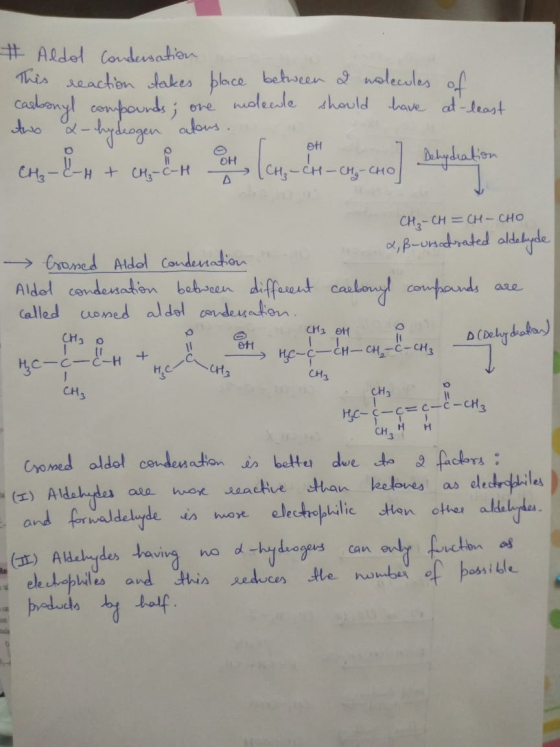
Aldol Condensation Reaction
Why is the major product between p-anisaldehyde and acetophenone the crossed aldol product rather than the Cannizzaro reaction or the self-condensation ofacetophenone?Please actually explain instead of showing a mechanism. I do know the mechanism but am having a hard time understanding why these two other reactions are not favored.
In Organic Chem II from the Aldol Condensation lab (using 3-nitrobenzaldehyde, acetophenone, ethanol, sodium hydroxide, methanol...
In Organic Chem II from the Aldol Condensation lab (using 3-nitrobenzaldehyde, acetophenone, ethanol, sodium hydroxide, methanol and final product 3-nitrochalcone) please help anser the following answer. Please write clear; many times it's hard to read response on Chegg-thank you. 1. There are two possible products of this aldol condensation. Draw the structure of both. 2. Explain why only one aldol product is formed in this reaction. Comment on both the reactivity of the starting materials as well as your experimental...
Please help!!!, i need details explaination so i can write a lab report thanks a lottttttttttttttt....
Please help!!!, i need details explaination so i can write a lab report thanks a lottttttttttttttt. i'm working on a gravimatric sulfate experiment. 1. Does the solubility of BaSO4 increase significantly as the temperature of the solution is increase?. Look up the Ksp at different temperatures and calculate the solubility. 2. What are some errors in the procedure that could afft the final amount of precipitate? 3. From your answer to question 6, would you say that the procedure for...
Experimental Outline In its simplest form, the aldol condensation is a self-addition involving tw...
 Organic Chemistry 2
Experimental Outline In its simplest form, the aldol condensation is a self-addition involving two molecules of the same aldehyde or ketone, in the presence of a base, and results in the formation of a new carbon-carbon bond joining the carbonyl carbon of one molecule to the a-position of the second. In many cases - if the reaction conditions aren't sufficiently mild - the initially formed aldol product reacts further in an elimination reaction to give what is...
Organic Chemistry 2
Experimental Outline In its simplest form, the aldol condensation is a self-addition involving two molecules of the same aldehyde or ketone, in the presence of a base, and results in the formation of a new carbon-carbon bond joining the carbonyl carbon of one molecule to the a-position of the second. In many cases - if the reaction conditions aren't sufficiently mild - the initially formed aldol product reacts further in an elimination reaction to give what is...
Lab 8: Preparation of an a B-Unsaturated Ketone via Michael and Aldol Condensation Reactions of a...
 please write a balanced eqaution for this reaction
We were unable to transcribe this imageLab 8: Preparation of an a B-Unsaturated Ketone via Michael and Aldol Condensation Reactions of an a, B-Unsaturated Ketone via Michael and Aldol Condensation Reactions Finally, the aldol intermediate is dehydrated to form the final product, 6-ethoxycarbonyl-3,5-diphenyl-2-cyclohexenone. The a Bunsaturated ketone that is formed is very stable because of the conjugation of the double bond with both the carbonyl group and a phenyl group. CH2Et-O CH...
please write a balanced eqaution for this reaction
We were unable to transcribe this imageLab 8: Preparation of an a B-Unsaturated Ketone via Michael and Aldol Condensation Reactions of an a, B-Unsaturated Ketone via Michael and Aldol Condensation Reactions Finally, the aldol intermediate is dehydrated to form the final product, 6-ethoxycarbonyl-3,5-diphenyl-2-cyclohexenone. The a Bunsaturated ketone that is formed is very stable because of the conjugation of the double bond with both the carbonyl group and a phenyl group. CH2Et-O CH...
Product was formed successfully based on the exp. below (about 85% yield), please interpret/discuss HNMR/IR in...
 Product was formed successfully based on the exp. below (about
85% yield), please interpret/discuss HNMR/IR in as much detail as
possible and assign peaks on HNMR (which peak represents which
protons of which group, etc). Note: I already know how you
determine the formation of the product so you can skip that part of
part b).
Based on this exp:
Discuss the IR spectrum and what is the peak in IR that you can see for a specific functional group...
Product was formed successfully based on the exp. below (about
85% yield), please interpret/discuss HNMR/IR in as much detail as
possible and assign peaks on HNMR (which peak represents which
protons of which group, etc). Note: I already know how you
determine the formation of the product so you can skip that part of
part b).
Based on this exp:
Discuss the IR spectrum and what is the peak in IR that you can see for a specific functional group...
PLEASE make ur hand writing clear so I can read it 1.2.6 The sample space of...
 PLEASE make ur hand writing clear so I can read it
1.2.6 The sample space of an experiment consists of the measured resistances of two resistors. Give four examples of partitions.
PLEASE make ur hand writing clear so I can read it
1.2.6 The sample space of an experiment consists of the measured resistances of two resistors. Give four examples of partitions.
PLEASE make ur hand writing clear so I can read it 1.2.5 The sample space of...
 PLEASE make ur hand writing clear so I can read it
1.2.5 The sample space of an experiment consists of all undergraduates at a univer- sity. Give four examples of partitions.
PLEASE make ur hand writing clear so I can read it
1.2.5 The sample space of an experiment consists of all undergraduates at a univer- sity. Give four examples of partitions.
Please make it easy to read (no cursive) THANK YOU SO MUCH :) 10. Which solvent...
 Please make it easy to read (no cursive) THANK YOU SO MUCH
:)
10. Which solvent (acetone or t-butyl alcohol) would be better to carry out the following reaction? Why? Draw the complete mechanism of this reaction using generic base B. O 0 11. Name the following compounds F Ph NH ... H NH2 Bn
Please make it easy to read (no cursive) THANK YOU SO MUCH
:)
10. Which solvent (acetone or t-butyl alcohol) would be better to carry out the following reaction? Why? Draw the complete mechanism of this reaction using generic base B. O 0 11. Name the following compounds F Ph NH ... H NH2 Bn
Please make it easy to read (no cursive) THANK YOU SO MUCH :) 7. Is it...
 Please make it easy to read (no cursive) THANK YOU SO MUCH :)
7. Is it possible to tell if the following reaction took place via an E, or an E2 reaction? Explain why? H CH, H H Н. Base ΠΗ X + CH Br H 8. What is the majority product from the following Ez reaction, why? Br 9. Describe all of the reaction conditions necessary to complete the following reaction. Draw the mechanism. Оснэ
Please make it easy to read (no cursive) THANK YOU SO MUCH :)
7. Is it possible to tell if the following reaction took place via an E, or an E2 reaction? Explain why? H CH, H H Н. Base ΠΗ X + CH Br H 8. What is the majority product from the following Ez reaction, why? Br 9. Describe all of the reaction conditions necessary to complete the following reaction. Draw the mechanism. Оснэ
 Organic Chemistry 2
Experimental Outline In its simplest form, the aldol condensation is a self-addition involving two molecules of the same aldehyde or ketone, in the presence of a base, and results in the formation of a new carbon-carbon bond joining the carbonyl carbon of one molecule to the a-position of the second. In many cases - if the reaction conditions aren't sufficiently mild - the initially formed aldol product reacts further in an elimination reaction to give what is...
Organic Chemistry 2
Experimental Outline In its simplest form, the aldol condensation is a self-addition involving two molecules of the same aldehyde or ketone, in the presence of a base, and results in the formation of a new carbon-carbon bond joining the carbonyl carbon of one molecule to the a-position of the second. In many cases - if the reaction conditions aren't sufficiently mild - the initially formed aldol product reacts further in an elimination reaction to give what is...
 please write a balanced eqaution for this reaction
We were unable to transcribe this imageLab 8: Preparation of an a B-Unsaturated Ketone via Michael and Aldol Condensation Reactions of an a, B-Unsaturated Ketone via Michael and Aldol Condensation Reactions Finally, the aldol intermediate is dehydrated to form the final product, 6-ethoxycarbonyl-3,5-diphenyl-2-cyclohexenone. The a Bunsaturated ketone that is formed is very stable because of the conjugation of the double bond with both the carbonyl group and a phenyl group. CH2Et-O CH...
please write a balanced eqaution for this reaction
We were unable to transcribe this imageLab 8: Preparation of an a B-Unsaturated Ketone via Michael and Aldol Condensation Reactions of an a, B-Unsaturated Ketone via Michael and Aldol Condensation Reactions Finally, the aldol intermediate is dehydrated to form the final product, 6-ethoxycarbonyl-3,5-diphenyl-2-cyclohexenone. The a Bunsaturated ketone that is formed is very stable because of the conjugation of the double bond with both the carbonyl group and a phenyl group. CH2Et-O CH...
 Product was formed successfully based on the exp. below (about
85% yield), please interpret/discuss HNMR/IR in as much detail as
possible and assign peaks on HNMR (which peak represents which
protons of which group, etc). Note: I already know how you
determine the formation of the product so you can skip that part of
part b).
Based on this exp:
Discuss the IR spectrum and what is the peak in IR that you can see for a specific functional group...
Product was formed successfully based on the exp. below (about
85% yield), please interpret/discuss HNMR/IR in as much detail as
possible and assign peaks on HNMR (which peak represents which
protons of which group, etc). Note: I already know how you
determine the formation of the product so you can skip that part of
part b).
Based on this exp:
Discuss the IR spectrum and what is the peak in IR that you can see for a specific functional group...
 PLEASE make ur hand writing clear so I can read it
1.2.6 The sample space of an experiment consists of the measured resistances of two resistors. Give four examples of partitions.
PLEASE make ur hand writing clear so I can read it
1.2.6 The sample space of an experiment consists of the measured resistances of two resistors. Give four examples of partitions.
 PLEASE make ur hand writing clear so I can read it
1.2.5 The sample space of an experiment consists of all undergraduates at a univer- sity. Give four examples of partitions.
PLEASE make ur hand writing clear so I can read it
1.2.5 The sample space of an experiment consists of all undergraduates at a univer- sity. Give four examples of partitions.
 Please make it easy to read (no cursive) THANK YOU SO MUCH
:)
10. Which solvent (acetone or t-butyl alcohol) would be better to carry out the following reaction? Why? Draw the complete mechanism of this reaction using generic base B. O 0 11. Name the following compounds F Ph NH ... H NH2 Bn
Please make it easy to read (no cursive) THANK YOU SO MUCH
:)
10. Which solvent (acetone or t-butyl alcohol) would be better to carry out the following reaction? Why? Draw the complete mechanism of this reaction using generic base B. O 0 11. Name the following compounds F Ph NH ... H NH2 Bn
 Please make it easy to read (no cursive) THANK YOU SO MUCH :)
7. Is it possible to tell if the following reaction took place via an E, or an E2 reaction? Explain why? H CH, H H Н. Base ΠΗ X + CH Br H 8. What is the majority product from the following Ez reaction, why? Br 9. Describe all of the reaction conditions necessary to complete the following reaction. Draw the mechanism. Оснэ
Please make it easy to read (no cursive) THANK YOU SO MUCH :)
7. Is it possible to tell if the following reaction took place via an E, or an E2 reaction? Explain why? H CH, H H Н. Base ΠΗ X + CH Br H 8. What is the majority product from the following Ez reaction, why? Br 9. Describe all of the reaction conditions necessary to complete the following reaction. Draw the mechanism. Оснэ
Most questions answered within 3 hours.
-
Where is the error in this code sequence?
String s1 = "Hello";
String s2 = "ello";...
asked 10 months ago -
Financial data for Joel de Paris, Inc., for last year
follow:
Joel de Paris, Inc.
Balance...
asked 10 months ago -
Consider this reaction:
Al2(SO4)3 (aq)+ BaCl3
(aq) Al2Cl6 (aq)- +
3BaSO4(s) . What is the...
asked 10 months ago -
Suppose that Savneet is considering increasing her
recent random sample from 20 car rentals to 40...
asked 10 months ago -
Trucks arrive at an unloading terminal at an average rate of 120
per hour.
Trucks arrive...
asked 10 months ago -
Why are methanol and ethanol completely soluble in water while
octanol is not very little soluble....
asked 10 months ago -
A facilities manager at a university reads in a research report
that the mean amount of...
asked 10 months ago -
When the CuSO4 is rehydrated by adding water to the anhydrous
compound, is this an endothermic...
asked 10 months ago -
A ray of sunlight is passing from diamond into crown glass; the
angle of incidence is...
asked 10 months ago -
A block of mass 0.249 kg is placed on top of a light, vertical
spring of...
asked 10 months ago -
how do the kidneys compensate in the presences of acidosis
a) trigger hyperventilate
b) reserve acid...
asked 10 months ago -
Question 501 pts
The rental rate of capital to the firm increases. Which of the
following...
asked 10 months ago