Please write out the complete mechanism using curved arrow formalism, showing each intermediate expected along the...
Please write out the complete mechanism using curved arrow formalism, showing each intermediate expected along the reaction pathway for synthesis of 2-butoxynaphthalene. Ethanol (20 mL), NaOH (554 mg), 2-naphthol (997 mg) and 1-bromobutane (1 mL) were used in this experiment. Also, could you please show step-by-step calculations of limiting reactant and theoretical yield?
Homework Answers
Synthesis of 2-butoxynaphthalene
Mechanism:
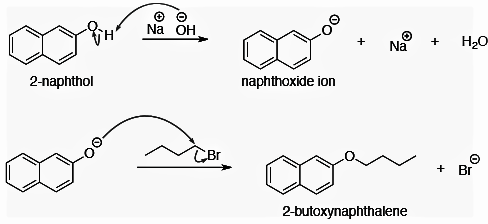
No. of moles of NaOH =mass/molar mass = 554/40 = 13.85 mmol
No. of moles of 2-naphthol = 997/ 144.2 = 6.91 mmol = 0.00691 moles
No. of moles of 1-bromobutane = mass/137
mass = volume x density = 1 x 1.27 = 1.27 g
no.of moles of 1-bromobutane = 1.27/137 = 9.27 mmol
So here the limiting reagent is 2- naphthol (since the stochiometry of the three reagent in the balanced chemical equation is 1:1:1 )
Theoretical yield = no.of moles of limiting reagent x molar mass of 2-butoxynaphthalene
= 0.00691 x 200.28 = 1.3839 g
Add Answer to:
Please write out the complete mechanism using curved arrow
formalism, showing each intermediate expected along the...
Using the correct curved arrow nomeclature and showing only one step per drawn structure, provide a...
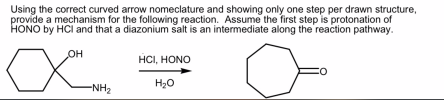 Using the correct curved arrow nomeclature and showing only one step per drawn structure, provide a mechanism for the following reaction. Assume the first step is protonation of HONO by HCl and that a diazonium salt is an intermediate along the reaction pathway. OH HCI, HONO -NH2 H2O
please show work Using the curved arrow formalism, draw the mechanism for the reaction between N-acetyl-ptoluidine...
please show work Using the curved arrow formalism, draw the mechanism for the reaction between N-acetyl-ptoluidine with concentrated nitric acid. Be sure to show all of the intermediates and rationalize the regioselectivity of the reaction.
write a complete step-wise mechanism showing the oxidation of benzoin to benzil. (show curved arrow, lone...
write a complete step-wise mechanism showing the oxidation of benzoin to benzil. (show curved arrow, lone pairs, charges)
s. Write out the complete mechanism, using curved arrows and all intermediate(s), of a first-order elimination...
 s. Write out the complete mechanism, using curved arrows and all intermediate(s), of a first-order elimination of 3-chloro-3-methylpentane with sodium ethoxide in ethanol (8 points). Be sure to write out major and minor products, and indicate why each is major/minor (5 points). Indicate the name of each step, and identify which reagent is concentration-dependent, kinetically (2 points). 4. For the second-order substitution reactions below, draw the expected product(s), if any (6 points). CI NaBr OCH3 NaN3 2
8) (11 pts) a) Write out thc 3-step arrow pushing mechanism showing how cthyl propanoate is...
 8) (11 pts) a) Write out thc 3-step arrow pushing mechanism showing how cthyl propanoate is hydrolyzed in the presence of I mole equivalent NaOH to form sodium propanoate and ethanol. b) H/HO also serve to hydrolyze an ester; brielly explain why NaOH HO is generally preferable. 10) (8 pts) Fill in the missing reagents in cach of the following reductions. More than one step may be required. For + racinho HO + NaOH e come to Na + HO...
Please see online the molecular wheights if needed please answer all questions throughly density of acetic...
 Please see online the molecular wheights if needed
please answer all questions throughly
density of acetic anhydride is 1.08
Report the melting point range of aspirin and compare it to the literature value in a t format 2. able 3a. Calculate the moles of aspirin that salicylic acid would form if it were the limiting reactant. Use proper significant figures, units and show all work. 3b. Calculate the moles of aspirin that acetic anhydride would form if it were the...
Please see online the molecular wheights if needed
please answer all questions throughly
density of acetic anhydride is 1.08
Report the melting point range of aspirin and compare it to the literature value in a t format 2. able 3a. Calculate the moles of aspirin that salicylic acid would form if it were the limiting reactant. Use proper significant figures, units and show all work. 3b. Calculate the moles of aspirin that acetic anhydride would form if it were the...
Mechanism for step 1 (week 2) - This should be detailed showing all the curved arrows...
 Mechanism for step 1 (week 2) - This should be detailed showing
all the curved arrows and correct molecular structures for
reactants, intermediates and product(s) for the TA to correct.
(Aldol project: as you have unknowns, show the mechanism
using use generic structures i.e. –R groups.).
mechanism (incl ude all arrows), results, discussion and conclusions. Check to ensure the , Uomplete accuracy of all information presented and list references as appropriate. Detailed project information 1. Preparation of exo-exo-5,6-bis(methoxycarbonyl)-7- oxabicyclo[2.2.1)hept-2-ene M.B.;...
Mechanism for step 1 (week 2) - This should be detailed showing
all the curved arrows and correct molecular structures for
reactants, intermediates and product(s) for the TA to correct.
(Aldol project: as you have unknowns, show the mechanism
using use generic structures i.e. –R groups.).
mechanism (incl ude all arrows), results, discussion and conclusions. Check to ensure the , Uomplete accuracy of all information presented and list references as appropriate. Detailed project information 1. Preparation of exo-exo-5,6-bis(methoxycarbonyl)-7- oxabicyclo[2.2.1)hept-2-ene M.B.;...
Please answer the questions clearly, showing all working. 1(i). Balance the following equations, and then write...
Please answer the questions clearly, showing all working. 1(i). Balance the following equations, and then write the net ionic equation (a) (NH4)2CO3(aq) + Cu(NO3)2(aq) → CuCO3(s) + NH4NO3(aq) (b) Mg(OH)2(s) + HCl(aq) → MgCl2(aq) + H2O(l) (c) BaCO3(s) + HBr(aq) → BaBr2(aq) + H2O(l) + CO2(g) 1(ii). For each reaction equation, identify the driving force of the reaction 2. What is an electrolyte? How can you experimentally differentiate between a weak electrolyte and a strong electrolyte? Name and give the...
I did an experiment where I synthesized 2-phenyl-2-propanol using the grignard reaction. please help me answer these lab questions Reagents Moles of Reagent 0.00142 moles (0.224 g)bromoben...
 I did an experiment where I synthesized
2-phenyl-2-propanol using the grignard reaction. please help me
answer these lab questions
Reagents Moles of Reagent 0.00142 moles (0.224 g)bromobenzene 0.00712 mol (0.173 g) 2 mL of THF (n/a moles) tetrahydrofuran 0.00142 mol (0.083g, 0.11mL) acetone, HPLC grade, anh Reagent Name FW 157.75 24.31 n/a 58 Comments Mg powder grind before using must be anhydrous must be anhydrous Pre-Lab Assignment: 1. Determine the volume (mL) of bromobenzene needed for the experiment. Obtain the...
I did an experiment where I synthesized
2-phenyl-2-propanol using the grignard reaction. please help me
answer these lab questions
Reagents Moles of Reagent 0.00142 moles (0.224 g)bromobenzene 0.00712 mol (0.173 g) 2 mL of THF (n/a moles) tetrahydrofuran 0.00142 mol (0.083g, 0.11mL) acetone, HPLC grade, anh Reagent Name FW 157.75 24.31 n/a 58 Comments Mg powder grind before using must be anhydrous must be anhydrous Pre-Lab Assignment: 1. Determine the volume (mL) of bromobenzene needed for the experiment. Obtain the...
Need help, numbers 3-6 please show work. and fill out table of chemicals for all chemical...
 Need help, numbers 3-6 please show work. and fill out table of
chemicals for all chemical used.
calculate mmol in the table as well show work please
and each of these must be listed in its own row. There are 10 column headings: IUPAC name OR common name, structure, CAS number (Chemical Abstract Service number) molecular mass, melting point (if applicable), boiling point (if applicable), solubility (in water, if applicable), density, amounts to be used in the experiment, and the...
Need help, numbers 3-6 please show work. and fill out table of
chemicals for all chemical used.
calculate mmol in the table as well show work please
and each of these must be listed in its own row. There are 10 column headings: IUPAC name OR common name, structure, CAS number (Chemical Abstract Service number) molecular mass, melting point (if applicable), boiling point (if applicable), solubility (in water, if applicable), density, amounts to be used in the experiment, and the...
 Using the correct curved arrow nomeclature and showing only one step per drawn structure, provide a mechanism for the following reaction. Assume the first step is protonation of HONO by HCl and that a diazonium salt is an intermediate along the reaction pathway. OH HCI, HONO -NH2 H2O
 s. Write out the complete mechanism, using curved arrows and all intermediate(s), of a first-order elimination of 3-chloro-3-methylpentane with sodium ethoxide in ethanol (8 points). Be sure to write out major and minor products, and indicate why each is major/minor (5 points). Indicate the name of each step, and identify which reagent is concentration-dependent, kinetically (2 points). 4. For the second-order substitution reactions below, draw the expected product(s), if any (6 points). CI NaBr OCH3 NaN3 2
 8) (11 pts) a) Write out thc 3-step arrow pushing mechanism showing how cthyl propanoate is hydrolyzed in the presence of I mole equivalent NaOH to form sodium propanoate and ethanol. b) H/HO also serve to hydrolyze an ester; brielly explain why NaOH HO is generally preferable. 10) (8 pts) Fill in the missing reagents in cach of the following reductions. More than one step may be required. For + racinho HO + NaOH e come to Na + HO...
 Please see online the molecular wheights if needed
please answer all questions throughly
density of acetic anhydride is 1.08
Report the melting point range of aspirin and compare it to the literature value in a t format 2. able 3a. Calculate the moles of aspirin that salicylic acid would form if it were the limiting reactant. Use proper significant figures, units and show all work. 3b. Calculate the moles of aspirin that acetic anhydride would form if it were the...
Please see online the molecular wheights if needed
please answer all questions throughly
density of acetic anhydride is 1.08
Report the melting point range of aspirin and compare it to the literature value in a t format 2. able 3a. Calculate the moles of aspirin that salicylic acid would form if it were the limiting reactant. Use proper significant figures, units and show all work. 3b. Calculate the moles of aspirin that acetic anhydride would form if it were the...
 Mechanism for step 1 (week 2) - This should be detailed showing
all the curved arrows and correct molecular structures for
reactants, intermediates and product(s) for the TA to correct.
(Aldol project: as you have unknowns, show the mechanism
using use generic structures i.e. –R groups.).
mechanism (incl ude all arrows), results, discussion and conclusions. Check to ensure the , Uomplete accuracy of all information presented and list references as appropriate. Detailed project information 1. Preparation of exo-exo-5,6-bis(methoxycarbonyl)-7- oxabicyclo[2.2.1)hept-2-ene M.B.;...
Mechanism for step 1 (week 2) - This should be detailed showing
all the curved arrows and correct molecular structures for
reactants, intermediates and product(s) for the TA to correct.
(Aldol project: as you have unknowns, show the mechanism
using use generic structures i.e. –R groups.).
mechanism (incl ude all arrows), results, discussion and conclusions. Check to ensure the , Uomplete accuracy of all information presented and list references as appropriate. Detailed project information 1. Preparation of exo-exo-5,6-bis(methoxycarbonyl)-7- oxabicyclo[2.2.1)hept-2-ene M.B.;...
 I did an experiment where I synthesized
2-phenyl-2-propanol using the grignard reaction. please help me
answer these lab questions
Reagents Moles of Reagent 0.00142 moles (0.224 g)bromobenzene 0.00712 mol (0.173 g) 2 mL of THF (n/a moles) tetrahydrofuran 0.00142 mol (0.083g, 0.11mL) acetone, HPLC grade, anh Reagent Name FW 157.75 24.31 n/a 58 Comments Mg powder grind before using must be anhydrous must be anhydrous Pre-Lab Assignment: 1. Determine the volume (mL) of bromobenzene needed for the experiment. Obtain the...
I did an experiment where I synthesized
2-phenyl-2-propanol using the grignard reaction. please help me
answer these lab questions
Reagents Moles of Reagent 0.00142 moles (0.224 g)bromobenzene 0.00712 mol (0.173 g) 2 mL of THF (n/a moles) tetrahydrofuran 0.00142 mol (0.083g, 0.11mL) acetone, HPLC grade, anh Reagent Name FW 157.75 24.31 n/a 58 Comments Mg powder grind before using must be anhydrous must be anhydrous Pre-Lab Assignment: 1. Determine the volume (mL) of bromobenzene needed for the experiment. Obtain the...
 Need help, numbers 3-6 please show work. and fill out table of
chemicals for all chemical used.
calculate mmol in the table as well show work please
and each of these must be listed in its own row. There are 10 column headings: IUPAC name OR common name, structure, CAS number (Chemical Abstract Service number) molecular mass, melting point (if applicable), boiling point (if applicable), solubility (in water, if applicable), density, amounts to be used in the experiment, and the...
Need help, numbers 3-6 please show work. and fill out table of
chemicals for all chemical used.
calculate mmol in the table as well show work please
and each of these must be listed in its own row. There are 10 column headings: IUPAC name OR common name, structure, CAS number (Chemical Abstract Service number) molecular mass, melting point (if applicable), boiling point (if applicable), solubility (in water, if applicable), density, amounts to be used in the experiment, and the...
Most questions answered within 3 hours.
-
Where is the error in this code sequence?
String s1 = "Hello";
String s2 = "ello";...
asked 10 months ago -
Financial data for Joel de Paris, Inc., for last year
follow:
Joel de Paris, Inc.
Balance...
asked 10 months ago -
Consider this reaction:
Al2(SO4)3 (aq)+ BaCl3
(aq) Al2Cl6 (aq)- +
3BaSO4(s) . What is the...
asked 10 months ago -
Suppose that Savneet is considering increasing her
recent random sample from 20 car rentals to 40...
asked 10 months ago -
Trucks arrive at an unloading terminal at an average rate of 120
per hour.
Trucks arrive...
asked 10 months ago -
Why are methanol and ethanol completely soluble in water while
octanol is not very little soluble....
asked 10 months ago -
A facilities manager at a university reads in a research report
that the mean amount of...
asked 10 months ago -
When the CuSO4 is rehydrated by adding water to the anhydrous
compound, is this an endothermic...
asked 10 months ago -
A ray of sunlight is passing from diamond into crown glass; the
angle of incidence is...
asked 10 months ago -
A block of mass 0.249 kg is placed on top of a light, vertical
spring of...
asked 10 months ago -
how do the kidneys compensate in the presences of acidosis
a) trigger hyperventilate
b) reserve acid...
asked 10 months ago -
Question 501 pts
The rental rate of capital to the firm increases. Which of the
following...
asked 10 months ago