
Homework Answers
Add Answer to:
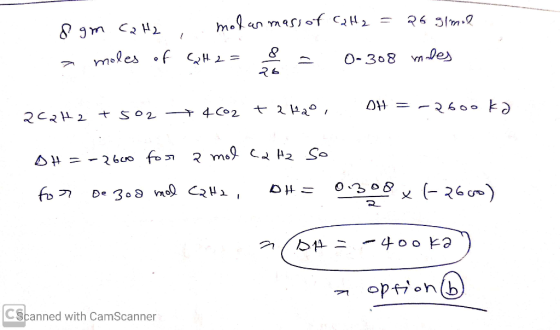
stion 4 Given the equation below, what is A4 for burning 8.0 g of C2H2 (g)...
5. How much heat is produced by the combustion of 5.25 g of acetylene (C2H2, 26.036...
 5. How much heat is produced by the combustion of 5.25 g of acetylene (C2H2, 26.036 g/mol)? 2C2H2+502( 4CO2(@+ 2H20( AH -2602 kJ a) 131 kJ b) 262 kJ c) 496 kJ d) 6830 k e) 13660 kJ 10 6. How many grams of Nal (149.89 g/mol) are required to produce 92.2 g of Pbl2 (461.00 g/mol)? Pb(NO 3)2(aq) + 2NaI (a) Pbl2)+ 2NANO3(ag) a) 567 g b) 284 g c) 60.0 g d) 30.0 g e) 92.9 g
1. Acetylene (C2H2) undergoes combustion in excess oxygen to generate gaseous carbon dioxide and water. Given...
 1. Acetylene (C2H2) undergoes combustion in excess oxygen to generate gaseous carbon dioxide and water. Given AHC02(8)] = -393.5 kl/mol, AH® [H20(8)] = -241.8 kJ/mol, and AH(CH2(g)] = 226.6 kJ/mol, how much energy is released (kl) when 32.5L of CO2 gas are produced at 3.5atm and 255°C? 2C₂H2 (g) + 302 (5) 4CO2(g) + 2 H₂Org)
7. What will the coefficient be for NaOH in the chemical equation listed below when the...
 7. What will the coefficient be for NaOH in the chemical equation listed below when the equation is balanced? H3PO4 (aq) + NaOH (aq) → NasPO4 (aq) + H20 (1) c) 2 d) 4 How many grams of metallic Na will be needed to produce 25.43 grams of Hz upon reaction with H2O? 2 Na (s) + H20 (1) + NaOH (aq) + H2 (g) a) 578.8 g b) 868.3 g c) 289.4 g d) 45.98 g 9. How many...
C2H2(9) + S/2 02(g) → 2 CO2(g) + H20(9) Ann."-1255.8 kJ Given that ΔΗ0f of CO2(g)--393.5...
 C2H2(9) + S/2 02(g) → 2 CO2(g) + H20(9) Ann."-1255.8 kJ Given that ΔΗ0f of CO2(g)--393.5 krmol and Aro, of H2O(g)-. 241.8 krnol, what is Aror of C2H2(g)? kJ/mol of formation to find dH+, of butane [C4H10cm. C4H10(n-13/202(g) → 4 CO2(9) + 5 H2O(g) k)
What will the coefficient be for NaOH in the chemical equation listed below when the equation...
 What will the coefficient be for NaOH in the chemical equation listed below when the equation is balanced? H3PO4 (aq) + NaOH(aq) → Na3PO4 (aq) + H20 (1) d) 4 a) 1 b) 3 c) 2 8. How many grams of metallic Na will be needed to produce 25.43 grams of H2 upon reaction with H2O? 2 Na (s) +2H20 (1) + NaOH (aq) + H2 (8) a) 578.8 g b) 868.3 g c) 289.4 g d) 45.98 g 9....
Acetylene burns in oxygen to give CO2 and H20 according to the equation below. 2 CH2(g)...
 Acetylene burns in oxygen to give CO2 and H20 according to the equation below. 2 CH2(g) +502(g) — 4CO2(g) + 2 H20(g) What volume of oxygen will react completely with 33 L CH?! 170L 13L 83 L 66L 33 L Submit Answer Try Another Version 2 item attempts remaining 1 PE pl
Given that: C2H2 (g) + 2 H2O (g) → C2H6O2 (l) ∆H° = - 198 kJ...
Given that: C2H2 (g) + 2 H2O (g) → C2H6O2 (l) ∆H° = - 198 kJ calculate ∆H°, in kJ, for the reaction C2H2 (g) + 2 H2O (l) → C2H6O2 (l) (∆H°f values: H2O (l) = -286, H2O (g) = - 242) A. 154 B. -110 C. - 286 D. - 242 E. - 154
Based on the equation below, which is correct? 2 C2H2(g) + 5 O2(g) → 4 CO2(g)...
Based on the equation below, which is correct? 2 C2H2(g) + 5 O2(g) → 4 CO2(g) + 2 H2O(g) Group of answer choices C2H2(g) is reduced C2H2(g) is oxidized The oxidation state of O in O2(g) increases from 0 to -2. O2(g) is the reducing agent.
Based on the equation below, which is correct? 2 C2H2(g) + 5 O2(g) - 4 CO2(g)...
 Based on the equation below, which is correct? 2 C2H2(g) + 5 O2(g) - 4 CO2(g) + 2 H2O(g) o C2H2(g) is reduced o O2(g) is the reducing agent. o C2H2(g) is oxidized o The oxidation state of O in O2(g) increases from 0 to -2.
Use the table below to answer question 1. Thermodynamic Quantities for Selected Substances at 298.15 K...
 Use the table below to answer question 1. Thermodynamic Quantities for Selected Substances at 298.15 K (25 °C) Substance AHºf (kJ/mol) AG°f (kJ/mol) S (J/K-mol) 2.84 2.43 Sige Carbon C(s, diamond) 1.88 C(s, graphite) 0 C2H2 (g) 226.7 C2H4 (g) 52.30 C2H6 (g) -84.68 CO(g) -110.5 CO2 (g) -393.5 209.2 68.11 -32.89 -137.2 -394.4 5.69 200.8 219.4 229.5 197.9 213.6 Hydrogen H2(g) 0 0 130.58 Oxygen O2 (g) H20 (1) 205.0 69.91 -285.83 -237.13 1) The combustion of acetylene in...
 5. How much heat is produced by the combustion of 5.25 g of acetylene (C2H2, 26.036 g/mol)? 2C2H2+502( 4CO2(@+ 2H20( AH -2602 kJ a) 131 kJ b) 262 kJ c) 496 kJ d) 6830 k e) 13660 kJ 10 6. How many grams of Nal (149.89 g/mol) are required to produce 92.2 g of Pbl2 (461.00 g/mol)? Pb(NO 3)2(aq) + 2NaI (a) Pbl2)+ 2NANO3(ag) a) 567 g b) 284 g c) 60.0 g d) 30.0 g e) 92.9 g
 1. Acetylene (C2H2) undergoes combustion in excess oxygen to generate gaseous carbon dioxide and water. Given AHC02(8)] = -393.5 kl/mol, AH® [H20(8)] = -241.8 kJ/mol, and AH(CH2(g)] = 226.6 kJ/mol, how much energy is released (kl) when 32.5L of CO2 gas are produced at 3.5atm and 255°C? 2C₂H2 (g) + 302 (5) 4CO2(g) + 2 H₂Org)
 7. What will the coefficient be for NaOH in the chemical equation listed below when the equation is balanced? H3PO4 (aq) + NaOH (aq) → NasPO4 (aq) + H20 (1) c) 2 d) 4 How many grams of metallic Na will be needed to produce 25.43 grams of Hz upon reaction with H2O? 2 Na (s) + H20 (1) + NaOH (aq) + H2 (g) a) 578.8 g b) 868.3 g c) 289.4 g d) 45.98 g 9. How many...
 C2H2(9) + S/2 02(g) → 2 CO2(g) + H20(9) Ann."-1255.8 kJ Given that ΔΗ0f of CO2(g)--393.5 krmol and Aro, of H2O(g)-. 241.8 krnol, what is Aror of C2H2(g)? kJ/mol of formation to find dH+, of butane [C4H10cm. C4H10(n-13/202(g) → 4 CO2(9) + 5 H2O(g) k)
 What will the coefficient be for NaOH in the chemical equation listed below when the equation is balanced? H3PO4 (aq) + NaOH(aq) → Na3PO4 (aq) + H20 (1) d) 4 a) 1 b) 3 c) 2 8. How many grams of metallic Na will be needed to produce 25.43 grams of H2 upon reaction with H2O? 2 Na (s) +2H20 (1) + NaOH (aq) + H2 (8) a) 578.8 g b) 868.3 g c) 289.4 g d) 45.98 g 9....
 Acetylene burns in oxygen to give CO2 and H20 according to the equation below. 2 CH2(g) +502(g) — 4CO2(g) + 2 H20(g) What volume of oxygen will react completely with 33 L CH?! 170L 13L 83 L 66L 33 L Submit Answer Try Another Version 2 item attempts remaining 1 PE pl
 Based on the equation below, which is correct? 2 C2H2(g) + 5 O2(g) - 4 CO2(g) + 2 H2O(g) o C2H2(g) is reduced o O2(g) is the reducing agent. o C2H2(g) is oxidized o The oxidation state of O in O2(g) increases from 0 to -2.
 Use the table below to answer question 1. Thermodynamic Quantities for Selected Substances at 298.15 K (25 °C) Substance AHºf (kJ/mol) AG°f (kJ/mol) S (J/K-mol) 2.84 2.43 Sige Carbon C(s, diamond) 1.88 C(s, graphite) 0 C2H2 (g) 226.7 C2H4 (g) 52.30 C2H6 (g) -84.68 CO(g) -110.5 CO2 (g) -393.5 209.2 68.11 -32.89 -137.2 -394.4 5.69 200.8 219.4 229.5 197.9 213.6 Hydrogen H2(g) 0 0 130.58 Oxygen O2 (g) H20 (1) 205.0 69.91 -285.83 -237.13 1) The combustion of acetylene in...
Most questions answered within 3 hours.
-
Where is the error in this code sequence?
String s1 = "Hello";
String s2 = "ello";...
asked 10 months ago -
Financial data for Joel de Paris, Inc., for last year
follow:
Joel de Paris, Inc.
Balance...
asked 10 months ago -
Consider this reaction:
Al2(SO4)3 (aq)+ BaCl3
(aq) Al2Cl6 (aq)- +
3BaSO4(s) . What is the...
asked 10 months ago -
Suppose that Savneet is considering increasing her
recent random sample from 20 car rentals to 40...
asked 10 months ago -
Trucks arrive at an unloading terminal at an average rate of 120
per hour.
Trucks arrive...
asked 10 months ago -
Why are methanol and ethanol completely soluble in water while
octanol is not very little soluble....
asked 10 months ago -
A facilities manager at a university reads in a research report
that the mean amount of...
asked 10 months ago -
When the CuSO4 is rehydrated by adding water to the anhydrous
compound, is this an endothermic...
asked 10 months ago -
A ray of sunlight is passing from diamond into crown glass; the
angle of incidence is...
asked 10 months ago -
A block of mass 0.249 kg is placed on top of a light, vertical
spring of...
asked 10 months ago -
how do the kidneys compensate in the presences of acidosis
a) trigger hyperventilate
b) reserve acid...
asked 10 months ago -
Question 501 pts
The rental rate of capital to the firm increases. Which of the
following...
asked 10 months ago