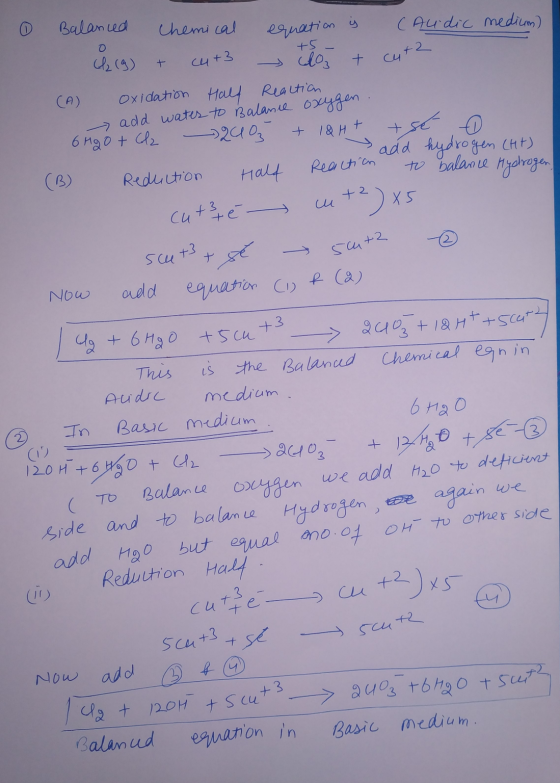
Write a balanced chemical equation describing the oxidation of chlorine gas by the copper (III) ion to form the chlorate ion and copper (II) in an acidic aqueous solution. Use the smallest whole number coefficients possible.
I have tried the following answers and I have no idea what to do to make it correct:




Thank you so much for your help!
Here is the hint I was given:
One way to determine the balanced equation for a redox reaction is to write a preliminary expression relating the reactants and products, do an oxidation number analysis, and balance atoms and charge. In an acidic aqueous solution, hydrogen ions and water may be used to balance atoms.
Homework Answers
Add Answer to:
Write a balanced chemical equation describing the oxidation of
chlorine gas by the copper (III) ion...
1. Write a balanced chemical equation for the oxidation of zinc metal (Zn) by copper(II) ions...
 1. Write a balanced chemical equation for the oxidation of zinc metal (Zn) by copper(II) ions (Cu?") in a copper sulfate solution. Note that copper(II) sulfate completely dissociates in aqueous solution and forms Cu2+ (aq) and SO,- (aq) in water. Zinc metal is a solid and should be represented as Zn (3) Write a chemical equation for the decomposition of limestone (CaCO,) by heating to high temperature to drive off carbon dioxide. The other product of this decomposition reaction is...
Write a balanced chemical equation for the oxidation reaction between Caro’s acid (H2SO5) and CN– ion...
Write a balanced chemical equation for the oxidation reaction between Caro’s acid (H2SO5) and CN– ion in aqueous solution.
Write balanced reaction for: a) Iron(III) ion with excess of ammonia in aqueous solution b) Copper(II)...
Write balanced reaction for: a) Iron(III) ion with excess of ammonia in aqueous solution b) Copper(II) ion with excess of ammonia in aqueous solution c) The reaction between copper(II) nitrate and potassium iodide d) The oxidation of chromium(III) to chromate(VI) with hydrogen peroxide in sodium hydroxide solution
Write the balanced redox reaction in acidic solution for the aqueous reaction of the VO2+ ion...
Write the balanced redox reaction in acidic solution for the aqueous reaction of the VO2+ ion with iodide ions to create V3+ and IO3-. What is the oxidation number of V in the reactant species?
Write the complete balanced equation for the reaction below under acidic conditions: I- (aq) + IO3-...
Write the complete balanced equation for the reaction below under acidic conditions: I- (aq) + IO3- (aq) ----- I2(aq) Question 3 options: 5I-(aq) + 6IO3-(aq) + 12H+ ----- 6I2(aq) + 6H2O 10I-(aq) + 2IO3-(aq) + 12H+ ----- 6I2(aq) + 6H2O 10I-(aq) + 2IO3-(aq) + 6H+ ----- 6I2(aq) + 6H2O 10I- (aq) + 2IO3- (aq) + 12H+ ----- 5I2(aq) +6H2O
Write the balanced reaction equation for the oxidation of ascorbic acid (C6H8O6) by triiodide ion (I3−)...
Write the balanced reaction equation for the oxidation of ascorbic acid (C6H8O6) by triiodide ion (I3−) in acidic medium to produce dehydroascorbic acid (C6H6O6) and I−.
4. Consider the following unbalanced net redox equation: HCI + KMnO, (aq) + H,02 (aq) -. MnC12 (a...
 PLEASE ANSWER EACH QUESTION OR DO NOT ANSWER AT ALL. THANK
YOU!
4. Consider the following unbalanced net redox equation: HCI + KMnO, (aq) + H,02 (aq) -. MnC12 (aq) + O2 (g) + KCI in an acid solution a. Determine the oxidation state of each atom or ion in the above reaction: b. Which atom is being oxidized? Which atom is being reduced? C. Which species is the reducing agent? Which is the oxidizing agent? d. Write the net...
PLEASE ANSWER EACH QUESTION OR DO NOT ANSWER AT ALL. THANK
YOU!
4. Consider the following unbalanced net redox equation: HCI + KMnO, (aq) + H,02 (aq) -. MnC12 (aq) + O2 (g) + KCI in an acid solution a. Determine the oxidation state of each atom or ion in the above reaction: b. Which atom is being oxidized? Which atom is being reduced? C. Which species is the reducing agent? Which is the oxidizing agent? d. Write the net...
Write the balanced net ionic equation for: Tin metal reduces the vanadyl ion (VO2+) to vanadium(III)...
Write the balanced net ionic equation for: Tin metal reduces the vanadyl ion (VO2+) to vanadium(III) ions in acidic solution. Tin(II) ions are also formed. Please use aq, l, s, and g.
Write a balanced chemical equation for the reaction of aqueous iron(III) ion with aqueous thiocyanate ion....
 Write a balanced chemical equation for the reaction of aqueous iron(III) ion with aqueous thiocyanate ion. Be sure to include phase symbols. balanced chemical equation:
1)Sodium thiosulfate is used to remove excess Cl2 from chlorine-bleached fabrics. The thiosulfate ion forms SO42−...
1)Sodium thiosulfate is used to remove excess Cl2 from chlorine-bleached fabrics. The thiosulfate ion forms SO42− and elemental sulfur, while Cl2 is reduced to Cl−. Express your answer as a chemical equation including phases. 2) An aqueous solution of SO2 reduces aqueous KMnO4 to MnSO4(aq). Write balanced equation for this reaction. 3)An aqueous solution of SO2 reduces acidic aqueous Cr2O72− to aqueous Cr3+. Write balanced equation for this reaction.
 1. Write a balanced chemical equation for the oxidation of zinc metal (Zn) by copper(II) ions (Cu?") in a copper sulfate solution. Note that copper(II) sulfate completely dissociates in aqueous solution and forms Cu2+ (aq) and SO,- (aq) in water. Zinc metal is a solid and should be represented as Zn (3) Write a chemical equation for the decomposition of limestone (CaCO,) by heating to high temperature to drive off carbon dioxide. The other product of this decomposition reaction is...
 PLEASE ANSWER EACH QUESTION OR DO NOT ANSWER AT ALL. THANK
YOU!
4. Consider the following unbalanced net redox equation: HCI + KMnO, (aq) + H,02 (aq) -. MnC12 (aq) + O2 (g) + KCI in an acid solution a. Determine the oxidation state of each atom or ion in the above reaction: b. Which atom is being oxidized? Which atom is being reduced? C. Which species is the reducing agent? Which is the oxidizing agent? d. Write the net...
PLEASE ANSWER EACH QUESTION OR DO NOT ANSWER AT ALL. THANK
YOU!
4. Consider the following unbalanced net redox equation: HCI + KMnO, (aq) + H,02 (aq) -. MnC12 (aq) + O2 (g) + KCI in an acid solution a. Determine the oxidation state of each atom or ion in the above reaction: b. Which atom is being oxidized? Which atom is being reduced? C. Which species is the reducing agent? Which is the oxidizing agent? d. Write the net...
 Write a balanced chemical equation for the reaction of aqueous iron(III) ion with aqueous thiocyanate ion. Be sure to include phase symbols. balanced chemical equation:
Most questions answered within 3 hours.
-
Where is the error in this code sequence?
String s1 = "Hello";
String s2 = "ello";...
asked 10 months ago -
Financial data for Joel de Paris, Inc., for last year
follow:
Joel de Paris, Inc.
Balance...
asked 10 months ago -
Consider this reaction:
Al2(SO4)3 (aq)+ BaCl3
(aq) Al2Cl6 (aq)- +
3BaSO4(s) . What is the...
asked 10 months ago -
Suppose that Savneet is considering increasing her
recent random sample from 20 car rentals to 40...
asked 10 months ago -
Trucks arrive at an unloading terminal at an average rate of 120
per hour.
Trucks arrive...
asked 10 months ago -
Why are methanol and ethanol completely soluble in water while
octanol is not very little soluble....
asked 10 months ago -
A facilities manager at a university reads in a research report
that the mean amount of...
asked 10 months ago -
When the CuSO4 is rehydrated by adding water to the anhydrous
compound, is this an endothermic...
asked 10 months ago -
A ray of sunlight is passing from diamond into crown glass; the
angle of incidence is...
asked 10 months ago -
A block of mass 0.249 kg is placed on top of a light, vertical
spring of...
asked 10 months ago -
how do the kidneys compensate in the presences of acidosis
a) trigger hyperventilate
b) reserve acid...
asked 10 months ago -
Question 501 pts
The rental rate of capital to the firm increases. Which of the
following...
asked 10 months ago