
Homework Answers
The given reaction is

Now, we are given that the initial concentration of the conjugate base NO2- is 0.69 M, which results in the given ICE table
Now, we can write the expression of equilibrium constant K for the above reaction as follows:
![K_(HNO3)(OH) [NO]](http://img.homeworklib.com/questions/0ce1b760-d7b8-11eb-b18a-9b9d7136ef8f.png?x-oss-process=image/resize,w_560)
Where the concentrations are the equilibrium values.
Note that H2O does not appear in the expression as it is the pure solvent with a constant concentration.
Since we have a base (NO2-) being hydrolysed in water, the equilibrium constant is called Kb.
Now, using the ICE table we can write the following expression for Kb.
](http://img.homeworklib.com/questions/0d434ed0-d7b8-11eb-9c97-f50373254df1.png?x-oss-process=image/resize,w_560)
Now, it is also given that the Ka of HNO2
is as  .
.
The reaction of HNO2 in water for which we get the equilibrium constant Ka can be written as

Hence, we can write the expression of Ka as follows:
![K [NO] [H30+1 [H NO2]](http://img.homeworklib.com/questions/0e3db920-d7b8-11eb-b312-afde0f214b81.png?x-oss-process=image/resize,w_560)
Again water does not appear in the expression.
Now if we multiply expressions of Ka and Kb we get the following,
![Kax Ko = [107][H30+1, [HNO2][OH-] T = [H30+][OH [HNO2 NO,](http://img.homeworklib.com/questions/0e97e440-d7b8-11eb-bd34-a1a4a475c3c9.png?x-oss-process=image/resize,w_560)
The product  is called the ionic product of water, Kw and has a
constant value for an aqueous solution at a particular
temperature.
is called the ionic product of water, Kw and has a
constant value for an aqueous solution at a particular
temperature.
At standard temperature of 25 C,
![Kw = [H3O+1OH] = 1.0 x 10-14](http://img.homeworklib.com/questions/0f496e80-d7b8-11eb-8932-5fccd9b1f6d1.png?x-oss-process=image/resize,w_560)
Hence, we can write
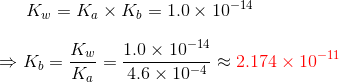
Hence, the Kb of the reaction given in the
question is approximately  (rounded to two significant digits.)
Now, using the Kb value calculated above, we can calculate the equilibrium concentrations of the species using the ICE table as follows:
![K6 = [H NO2][OH-] 4 1.2 x 12 [NO] (0.69 – 1.0) -= 2.174 x 10⁻¹¹ → 32 = 2.174 x 10⁻¹¹ (0.69 – ) 3,87 x 10⁻⁶ M](http://img.homeworklib.com/questions/10591940-d7b8-11eb-9083-b5c267021c73.png?x-oss-process=image/resize,w_560)
Hence, the equilibrium concentrations in the ICE table will be
![HNO2) = [OH-] = 1.1 = 3.87 x 10⁻⁶ M](http://img.homeworklib.com/questions/10b412b0-d7b8-11eb-bdc3-8b70de8308bc.png?x-oss-process=image/resize,w_560)
![N07] = 0.69 M - I = 0.69 M - 3.87 x 10⁻⁶ M -0.69 M](http://img.homeworklib.com/questions/110f8560-d7b8-11eb-bf0e-9f46a2f88da4.png?x-oss-process=image/resize,w_560)
Add Answer to:
please dive details on how you got this answer
also...thanks!
+ H2O() $ NO- (aq) 0.69M...
Please show how you got each answer. Thanks in advance! 13. The net ionic equation for...
 Please show how you got each answer. Thanks in advance!
13. The net ionic equation for the reaction between aqueous solutions of HF and KOH is b. HF(aq) + OH-(aq)→ H2O() + F-(aq) H+(aq) + K+(aq) + Он'(aq) F(aq) + H2O() + K+(aq) + F(ag) e. 14. Based on the solubility rules, which of the following will occur if solutions of Cus0.(aq) and BaC2(aq) are mixed? a. CuCl2 will precipitate; Ba2 and SO- are spectator ions. b. CuSO4 will precipitate;...
Please show how you got each answer. Thanks in advance!
13. The net ionic equation for the reaction between aqueous solutions of HF and KOH is b. HF(aq) + OH-(aq)→ H2O() + F-(aq) H+(aq) + K+(aq) + Он'(aq) F(aq) + H2O() + K+(aq) + F(ag) e. 14. Based on the solubility rules, which of the following will occur if solutions of Cus0.(aq) and BaC2(aq) are mixed? a. CuCl2 will precipitate; Ba2 and SO- are spectator ions. b. CuSO4 will precipitate;...
(Set 2) Practice Problems in Equilibrium All weak acids use this generic equation: HA(aq)+ H2O() A (aq) + H30*(aq) And...
 (Set 2) Practice Problems in Equilibrium All weak acids use this generic equation: HA(aq)+ H2O() A (aq) + H30*(aq) And all weak bases use this one: B(aq)+ H2O(I) = BH*(aq)+ OH'(aq) Part A: Finding K, or Kb 3.012? What is the value of Ka for a weak acid if a 1.44 M solution has a pH 1. 2. A weak acid is 0.00987 M, but is found to be 25.5 % ionized. What is the pH? 3. The pH for...
Balance the equation: ____H2SO4(aq)+ ____Ba(OH)2(aq) >>> ____ H2O(l)+ ____BaSO4(s) Please Show how to solve. Thanks!
Balance the equation: ____H2SO4(aq)+ ____Ba(OH)2(aq) >>> ____ H2O(l)+ ____BaSO4(s) Please Show how to solve. Thanks!
please explain how you got your answer 18. Given the Ka values (in parentheses) for the...
 please explain how you got your answer
18. Given the Ka values (in parentheses) for the following acids: HCI (Ka is very large) HNO2 (Ka = 4.0 x 10-): HF (Ka = 7.2 x 10⁴) CH3COOH (Ks = 1.8 x 10⁻⁵) HCN (K. = 6.2 x 10⁻¹⁰) C6H3COOH (Ka = 6.3 x 10⁻⁵). Rank (or list) these acids in order of decreasing strength (strongest first). A. HCI > HF > HNO2 > C6H5COOH > CH3COOH > HCN B. HCI >...
please explain how you got your answer
18. Given the Ka values (in parentheses) for the following acids: HCI (Ka is very large) HNO2 (Ka = 4.0 x 10-): HF (Ka = 7.2 x 10⁴) CH3COOH (Ks = 1.8 x 10⁻⁵) HCN (K. = 6.2 x 10⁻¹⁰) C6H3COOH (Ka = 6.3 x 10⁻⁵). Rank (or list) these acids in order of decreasing strength (strongest first). A. HCI > HF > HNO2 > C6H5COOH > CH3COOH > HCN B. HCI >...
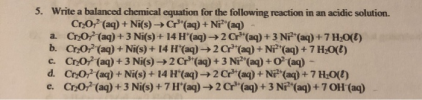
Can you please show and explain how you got your answer please 5. Write a balanced...
 Can you please show and explain how you got your answer
please
5. Write a balanced chemical equation for the following reaction in an acidic solution. Cr207 (aq) + Ni(s) → Cr(aq) + N1"(aq) - a. Cr 07 (aq) + 3 Ni(s) + 14 H(aq) → Cr(aq) + 3 NP(aq) + 7 H2O(1) b. Cr2O72 (aq) + Ni(s) + 14 H(aq) + 2Cr (aq) + Ni?'(aq) + 7 H2O(l) c. Cr2072 (aq) + 3 Ni(s) 2 Cr(aq) + 3 Ni?'...
Can you please show and explain how you got your answer
please
5. Write a balanced chemical equation for the following reaction in an acidic solution. Cr207 (aq) + Ni(s) → Cr(aq) + N1"(aq) - a. Cr 07 (aq) + 3 Ni(s) + 14 H(aq) → Cr(aq) + 3 NP(aq) + 7 H2O(1) b. Cr2O72 (aq) + Ni(s) + 14 H(aq) + 2Cr (aq) + Ni?'(aq) + 7 H2O(l) c. Cr2072 (aq) + 3 Ni(s) 2 Cr(aq) + 3 Ni?'...
please do #9 and #10. please show details on how you got the answer and why...
 please do #9 and #10. please show details on how you got the answer
and why you got it. just detail stuff please!
9. Heavy water, is water in which the usual hydrogen atom, 'H, has been replaced with the heavy isotope of hydrogen, "H. At 25°C, the pH of pure heavy water is 7.476. Determine the autoprotolysis constant for heavy water. 10. When 1.23x10 moles of substance X was used to prepare 250.0 mL of an aqueous solution, the...
please do #9 and #10. please show details on how you got the answer
and why you got it. just detail stuff please!
9. Heavy water, is water in which the usual hydrogen atom, 'H, has been replaced with the heavy isotope of hydrogen, "H. At 25°C, the pH of pure heavy water is 7.476. Determine the autoprotolysis constant for heavy water. 10. When 1.23x10 moles of substance X was used to prepare 250.0 mL of an aqueous solution, the...
Classify the following transformation as a reduction, oxidation, or neither. Also, please explain how you got...
 Classify the following
transformation as a reduction, oxidation, or neither.
Also, please explain how you got the answer. Thanks.
Classify the following transformation as a reduction, oxidation, or neither.reduction oxidation redox neutralAlso, please explain how you got the answer. Thanks.
Classify the following
transformation as a reduction, oxidation, or neither.
Also, please explain how you got the answer. Thanks.
Classify the following transformation as a reduction, oxidation, or neither.reduction oxidation redox neutralAlso, please explain how you got the answer. Thanks.
please explain how you got all your answers 20. Calculate the MOLAR SOLUBILITY of silver bromide...
 please explain how you got all your answers
20. Calculate the MOLAR SOLUBILITY of silver bromide (Kp - 5.40 x 10¹³) in 1.0 M NH. Complex ion [Ag(NHs)2] can be formed (K, 1.70 x 10). Ag(NH,) (aq)+ Br' (aq) Overall Reaction: AgBr(s)+2 NH,(aq) 21. The pH of a 0.0412 M solution of a monoprotic acid is 1.39. Is this a STRONG ACID? a. Yes b. No c. Not enough information d. Unknown
please explain how you got all your answers
20. Calculate the MOLAR SOLUBILITY of silver bromide (Kp - 5.40 x 10¹³) in 1.0 M NH. Complex ion [Ag(NHs)2] can be formed (K, 1.70 x 10). Ag(NH,) (aq)+ Br' (aq) Overall Reaction: AgBr(s)+2 NH,(aq) 21. The pH of a 0.0412 M solution of a monoprotic acid is 1.39. Is this a STRONG ACID? a. Yes b. No c. Not enough information d. Unknown
Can you please answer the part i underlined? Thanks!! Point A,b,c is not given details about...
 Can
you please answer the part i underlined? Thanks!!
Point A,b,c is not given details about the points are given so
you have to guess and find it thats the part I was having a hard
time with
Computer-Simulated Titration Curve 12.00 + 0.00 10.00 0.00 12.00 2.00 8.00 4.00 6.00 Drops of Added 0.01 M NaOH Figure 14.10 1 drop of 0.04 M H,PO, with 0.01 M NaOH. H3PO4(aq) + NaOH(aq) + NaH PO,(aq) + H2O(1) Referring to Figure...
Can
you please answer the part i underlined? Thanks!!
Point A,b,c is not given details about the points are given so
you have to guess and find it thats the part I was having a hard
time with
Computer-Simulated Titration Curve 12.00 + 0.00 10.00 0.00 12.00 2.00 8.00 4.00 6.00 Drops of Added 0.01 M NaOH Figure 14.10 1 drop of 0.04 M H,PO, with 0.01 M NaOH. H3PO4(aq) + NaOH(aq) + NaH PO,(aq) + H2O(1) Referring to Figure...
please explain how you got all your answers 15. H.00,(aq) + H,0(I) <-> HCO3(aq) + H,0*...
 please explain how you got all your answers
15. H.00,(aq) + H,0(I) <-> HCO3(aq) + H,0* (aq) HCO, (aq) + H, O) <->CO (aq) + HBO (aq) According to the equations above, what is the CONJUGATE ACID of HCO,? a. H2CO3(aq) b. H2O(1) 6. H2O*(aq) d. cosº (aq) 16. A flask contains the following chemical system at EQUILIBRIUM. CUCO,(s) - Cu(aq) + 200 (aq) Addition of which of the following substances will increase the solubility of Cucos(s) in water? 1....
please explain how you got all your answers
15. H.00,(aq) + H,0(I) <-> HCO3(aq) + H,0* (aq) HCO, (aq) + H, O) <->CO (aq) + HBO (aq) According to the equations above, what is the CONJUGATE ACID of HCO,? a. H2CO3(aq) b. H2O(1) 6. H2O*(aq) d. cosº (aq) 16. A flask contains the following chemical system at EQUILIBRIUM. CUCO,(s) - Cu(aq) + 200 (aq) Addition of which of the following substances will increase the solubility of Cucos(s) in water? 1....
 Please show how you got each answer. Thanks in advance!
13. The net ionic equation for the reaction between aqueous solutions of HF and KOH is b. HF(aq) + OH-(aq)→ H2O() + F-(aq) H+(aq) + K+(aq) + Он'(aq) F(aq) + H2O() + K+(aq) + F(ag) e. 14. Based on the solubility rules, which of the following will occur if solutions of Cus0.(aq) and BaC2(aq) are mixed? a. CuCl2 will precipitate; Ba2 and SO- are spectator ions. b. CuSO4 will precipitate;...
Please show how you got each answer. Thanks in advance!
13. The net ionic equation for the reaction between aqueous solutions of HF and KOH is b. HF(aq) + OH-(aq)→ H2O() + F-(aq) H+(aq) + K+(aq) + Он'(aq) F(aq) + H2O() + K+(aq) + F(ag) e. 14. Based on the solubility rules, which of the following will occur if solutions of Cus0.(aq) and BaC2(aq) are mixed? a. CuCl2 will precipitate; Ba2 and SO- are spectator ions. b. CuSO4 will precipitate;...
 (Set 2) Practice Problems in Equilibrium All weak acids use this generic equation: HA(aq)+ H2O() A (aq) + H30*(aq) And all weak bases use this one: B(aq)+ H2O(I) = BH*(aq)+ OH'(aq) Part A: Finding K, or Kb 3.012? What is the value of Ka for a weak acid if a 1.44 M solution has a pH 1. 2. A weak acid is 0.00987 M, but is found to be 25.5 % ionized. What is the pH? 3. The pH for...
 please explain how you got your answer
18. Given the Ka values (in parentheses) for the following acids: HCI (Ka is very large) HNO2 (Ka = 4.0 x 10-): HF (Ka = 7.2 x 10⁴) CH3COOH (Ks = 1.8 x 10⁻⁵) HCN (K. = 6.2 x 10⁻¹⁰) C6H3COOH (Ka = 6.3 x 10⁻⁵). Rank (or list) these acids in order of decreasing strength (strongest first). A. HCI > HF > HNO2 > C6H5COOH > CH3COOH > HCN B. HCI >...
please explain how you got your answer
18. Given the Ka values (in parentheses) for the following acids: HCI (Ka is very large) HNO2 (Ka = 4.0 x 10-): HF (Ka = 7.2 x 10⁴) CH3COOH (Ks = 1.8 x 10⁻⁵) HCN (K. = 6.2 x 10⁻¹⁰) C6H3COOH (Ka = 6.3 x 10⁻⁵). Rank (or list) these acids in order of decreasing strength (strongest first). A. HCI > HF > HNO2 > C6H5COOH > CH3COOH > HCN B. HCI >...
 Can you please show and explain how you got your answer
please
5. Write a balanced chemical equation for the following reaction in an acidic solution. Cr207 (aq) + Ni(s) → Cr(aq) + N1"(aq) - a. Cr 07 (aq) + 3 Ni(s) + 14 H(aq) → Cr(aq) + 3 NP(aq) + 7 H2O(1) b. Cr2O72 (aq) + Ni(s) + 14 H(aq) + 2Cr (aq) + Ni?'(aq) + 7 H2O(l) c. Cr2072 (aq) + 3 Ni(s) 2 Cr(aq) + 3 Ni?'...
Can you please show and explain how you got your answer
please
5. Write a balanced chemical equation for the following reaction in an acidic solution. Cr207 (aq) + Ni(s) → Cr(aq) + N1"(aq) - a. Cr 07 (aq) + 3 Ni(s) + 14 H(aq) → Cr(aq) + 3 NP(aq) + 7 H2O(1) b. Cr2O72 (aq) + Ni(s) + 14 H(aq) + 2Cr (aq) + Ni?'(aq) + 7 H2O(l) c. Cr2072 (aq) + 3 Ni(s) 2 Cr(aq) + 3 Ni?'...
 please do #9 and #10. please show details on how you got the answer
and why you got it. just detail stuff please!
9. Heavy water, is water in which the usual hydrogen atom, 'H, has been replaced with the heavy isotope of hydrogen, "H. At 25°C, the pH of pure heavy water is 7.476. Determine the autoprotolysis constant for heavy water. 10. When 1.23x10 moles of substance X was used to prepare 250.0 mL of an aqueous solution, the...
please do #9 and #10. please show details on how you got the answer
and why you got it. just detail stuff please!
9. Heavy water, is water in which the usual hydrogen atom, 'H, has been replaced with the heavy isotope of hydrogen, "H. At 25°C, the pH of pure heavy water is 7.476. Determine the autoprotolysis constant for heavy water. 10. When 1.23x10 moles of substance X was used to prepare 250.0 mL of an aqueous solution, the...
 Classify the following
transformation as a reduction, oxidation, or neither.
Also, please explain how you got the answer. Thanks.
Classify the following transformation as a reduction, oxidation, or neither.reduction oxidation redox neutralAlso, please explain how you got the answer. Thanks.
Classify the following
transformation as a reduction, oxidation, or neither.
Also, please explain how you got the answer. Thanks.
Classify the following transformation as a reduction, oxidation, or neither.reduction oxidation redox neutralAlso, please explain how you got the answer. Thanks.
 please explain how you got all your answers
20. Calculate the MOLAR SOLUBILITY of silver bromide (Kp - 5.40 x 10¹³) in 1.0 M NH. Complex ion [Ag(NHs)2] can be formed (K, 1.70 x 10). Ag(NH,) (aq)+ Br' (aq) Overall Reaction: AgBr(s)+2 NH,(aq) 21. The pH of a 0.0412 M solution of a monoprotic acid is 1.39. Is this a STRONG ACID? a. Yes b. No c. Not enough information d. Unknown
please explain how you got all your answers
20. Calculate the MOLAR SOLUBILITY of silver bromide (Kp - 5.40 x 10¹³) in 1.0 M NH. Complex ion [Ag(NHs)2] can be formed (K, 1.70 x 10). Ag(NH,) (aq)+ Br' (aq) Overall Reaction: AgBr(s)+2 NH,(aq) 21. The pH of a 0.0412 M solution of a monoprotic acid is 1.39. Is this a STRONG ACID? a. Yes b. No c. Not enough information d. Unknown
 Can
you please answer the part i underlined? Thanks!!
Point A,b,c is not given details about the points are given so
you have to guess and find it thats the part I was having a hard
time with
Computer-Simulated Titration Curve 12.00 + 0.00 10.00 0.00 12.00 2.00 8.00 4.00 6.00 Drops of Added 0.01 M NaOH Figure 14.10 1 drop of 0.04 M H,PO, with 0.01 M NaOH. H3PO4(aq) + NaOH(aq) + NaH PO,(aq) + H2O(1) Referring to Figure...
Can
you please answer the part i underlined? Thanks!!
Point A,b,c is not given details about the points are given so
you have to guess and find it thats the part I was having a hard
time with
Computer-Simulated Titration Curve 12.00 + 0.00 10.00 0.00 12.00 2.00 8.00 4.00 6.00 Drops of Added 0.01 M NaOH Figure 14.10 1 drop of 0.04 M H,PO, with 0.01 M NaOH. H3PO4(aq) + NaOH(aq) + NaH PO,(aq) + H2O(1) Referring to Figure...
 please explain how you got all your answers
15. H.00,(aq) + H,0(I) <-> HCO3(aq) + H,0* (aq) HCO, (aq) + H, O) <->CO (aq) + HBO (aq) According to the equations above, what is the CONJUGATE ACID of HCO,? a. H2CO3(aq) b. H2O(1) 6. H2O*(aq) d. cosº (aq) 16. A flask contains the following chemical system at EQUILIBRIUM. CUCO,(s) - Cu(aq) + 200 (aq) Addition of which of the following substances will increase the solubility of Cucos(s) in water? 1....
please explain how you got all your answers
15. H.00,(aq) + H,0(I) <-> HCO3(aq) + H,0* (aq) HCO, (aq) + H, O) <->CO (aq) + HBO (aq) According to the equations above, what is the CONJUGATE ACID of HCO,? a. H2CO3(aq) b. H2O(1) 6. H2O*(aq) d. cosº (aq) 16. A flask contains the following chemical system at EQUILIBRIUM. CUCO,(s) - Cu(aq) + 200 (aq) Addition of which of the following substances will increase the solubility of Cucos(s) in water? 1....
Most questions answered within 3 hours.
-
Where is the error in this code sequence?
String s1 = "Hello";
String s2 = "ello";...
asked 10 months ago -
Financial data for Joel de Paris, Inc., for last year
follow:
Joel de Paris, Inc.
Balance...
asked 10 months ago -
Consider this reaction:
Al2(SO4)3 (aq)+ BaCl3
(aq) Al2Cl6 (aq)- +
3BaSO4(s) . What is the...
asked 10 months ago -
Suppose that Savneet is considering increasing her
recent random sample from 20 car rentals to 40...
asked 10 months ago -
Trucks arrive at an unloading terminal at an average rate of 120
per hour.
Trucks arrive...
asked 10 months ago -
Why are methanol and ethanol completely soluble in water while
octanol is not very little soluble....
asked 10 months ago -
A facilities manager at a university reads in a research report
that the mean amount of...
asked 10 months ago -
When the CuSO4 is rehydrated by adding water to the anhydrous
compound, is this an endothermic...
asked 10 months ago -
A ray of sunlight is passing from diamond into crown glass; the
angle of incidence is...
asked 10 months ago -
A block of mass 0.249 kg is placed on top of a light, vertical
spring of...
asked 10 months ago -
how do the kidneys compensate in the presences of acidosis
a) trigger hyperventilate
b) reserve acid...
asked 10 months ago -
Question 501 pts
The rental rate of capital to the firm increases. Which of the
following...
asked 10 months ago